Church of Cyprus: An Autocephalous Greek Orthodox Church
Site at a Glance
- Rating
- 4.8
- Popularity
- Very Low
- Country
- Cyprus
- Primary era
- Medieval
- Eras represented
- Medieval
- Civilizations
- Byzantine
- Site type
- Religious
- Remains
- Church
On this page19 sections
History
The Church of Cyprus is an autocephalous Greek Orthodox church based in Cyprus and traditionally founded by Barnabas the Apostle around AD 45–50. Its historical seat is in Nicosia, where the Archbishop’s Palace forms part of the Holy Archbishopric complex. Cyprus traditionally regards Barnabas, an early Christian missionary and close associate of Paul, as its founding apostle and first bishop. The church is among the oldest self-governing churches of Eastern Christianity and continues to follow the Byzantine rite, the Eastern Orthodox tradition of services, prayers, music, vestments, and sacramental practices.
Early Christianity and autocephaly
According to Christian tradition, Barnabas established the church at Salamis during his second visit to Cyprus and was later buried there. Paul, Barnabas, and Mark are associated with the early spread of Christianity on the island. At Paphos, Paul is traditionally said to have converted the Roman proconsul Sergius Paulus, an event regarded in Christian tradition as the first recorded conversion of a Roman provincial governor to Christianity.
Several early bishops are associated with Cyprus, including Lazarus of Kition, Herakleidios of Tamassos, Auxibius of Soloi, and Theodotus of Kyrenia. By the end of the fourth century, Christianity had spread across the island. A late antique list names fifteen dioceses, including Salamis or Constantia, Kition, Amathus, Neapolis, Kourion, Paphos, Arsinoe, Soloi, Lapithos, Kyrenia, Tamassos, Ledra, Chytroi, Trimithous, and Karpasia.
The Council of Ephesus in AD 431 recognized the independence of the Cypriot church from the Patriarchate of Antioch. The broader claim that Cyprus had always been independent remains uncertain, but the council confirmed the right of its bishops to elect their own bishops. In AD 478, Archbishop Anthemius claimed to have found the tomb and relics of Barnabas after a vision. A copy of the Gospel of Matthew was said to have rested on the apostle’s chest. Emperor Zeno then reaffirmed the church’s self-government and granted its archbishop three traditional privileges: signing documents in vermilion ink, wearing Tyrian purple beneath his vestments, and carrying an imperial sceptre instead of an episcopal crozier.
Displacement and the Nova Justiniana title
During the reign of Emperor Justinian II, Arab attacks led to the sack of Constantia, Kourion, and Paphos. The archbishop and surviving Christians fled to the Dardanelles, where they established Nova Justiniana near Cyzicus. The Quinisext Council, also called the Council in Trullo, was held in Constantinople in AD 692 and confirmed the archbishop’s privileges. After the archbishop returned to Cyprus in AD 698, he retained the title “Archbishop of Nova Justiniana and All Cyprus.” That title remains part of the church’s identity and preserves the memory of the seventh-century displacement.
Latin and Venetian rule
Latin rule began with the establishment of the Kingdom of Cyprus in 1191. Catholic rulers reduced the Orthodox hierarchy from fourteen bishops to four, removed bishops from their traditional cities, and placed them under Latin bishops. The Orthodox archbishop was transferred from Nicosia to Soloi near Morphou, while the bishop of Larnaca was transferred to Lefkara.
Catholic authorities confiscated property belonging to Orthodox monasteries and sometimes attempted to impose Latin doctrine and liturgical practices. In 1231, thirteen monks of Kantara Monastery were persecuted and executed after resisting Latin liturgical reforms. Orthodox worship and identity nevertheless survived among the Greek Cypriot population. The two communities later reached a relatively stable coexistence. When Venetian rule replaced Lusignan rule in 1489, the institutional position of the Orthodox Church did not substantially change.
Ottoman administration
The Ottoman conquest of Cyprus in 1570–1571 ended Latin dominance. The Orthodox Church became the only legally recognized Christian church, and its bishops served as both spiritual and civil leaders of the Greek Christian population under the millet system. This Ottoman arrangement allowed recognized religious communities to manage many internal affairs while their leaders acted as intermediaries with the state. The hierarchy was initially limited to the archbishopric of Cyprus and the metropolitanates of Paphos, Kition, and Kyrenia.
Ottoman rule allowed the Orthodox community to elect its own archbishop and generally permitted it to retain its churches, religious practices, property, and internal leadership. Christians were subject to special taxation, and some converted to Islam. In the early nineteenth century, the archbishop exercised extensive influence over Cyprus’s civil affairs and finances.
The outbreak of the Greek War of Independence in 1821 brought severe repression. Archbishop Kyprianos, his archdeacon, the bishops of Paphos, Kition, and Kyrenia, and other clergy and lay leaders were arrested. Kyprianos and his archdeacon were hanged, while the three bishops were beheaded. Other prominent figures were killed or deported. In 1827, the Patriarchate of Antioch sent a new hierarchy to Cyprus.
British rule and the rise of Makarios III
British administration began in 1878, followed by annexation to the British Empire in 1914. Religious practice became less restricted, including the renewed use of church bells, although the colonial administration continued to intervene in church governance. The October 1931 revolt led to the exile of Bishop Nikodemos of Kition and Bishop Makarios of Kyrenia, as well as restrictions on the election of the archbishop.
Makarios III was elected archbishop in 1950. He had founded the Apostle Barnabas Seminary in 1949 and organized a referendum on enosis, the political movement advocating union between Cyprus and Greece, in 1950. From 1955 to 1959 he became the political leader of the EOKA struggle against British rule and was exiled by the British to the Seychelles.
Independence, division, and reorganization
After Cyprus became independent in 1960, Makarios III was elected the first president of the Republic of Cyprus. Disputes between him and the other three bishops produced a church crisis in 1972–1973. The bishops of Paphos, Kition, and Kyrenia were deposed, and the metropolitanates of Limassol and Morphou were created from parts of Kition and Kyrenia respectively.
A coup on 15 July 1974 forced Makarios III to leave Cyprus, although he returned in December of that year. The Turkish invasion that began on 20 July placed approximately 35 percent of the island under occupation and displaced hundreds of thousands of Orthodox Christians. The northern dioceses of Kyrenia, Morphou, and Constantia–Ammochostos consequently operated from temporary or exiled seats. Many Orthodox churches and monasteries in northern Cyprus were destroyed, looted, converted, or abandoned. By May 2001, only 421 Greek Orthodox Cypriots and 155 Maronites were recorded as remaining in the north.
Makarios III died on 3 August 1977 and was succeeded by Archbishop Chrysostomos I. In 1979 the church adopted a new Statutory Charter, replacing the charter of 1914. Chrysostomos II was elected archbishop on 5 November 2006. After his death, George III was elected on 24 December 2022 as the church’s seventy-sixth primate.
Contemporary governance and communion
The Holy Synod is the church’s highest ecclesiastical authority. It includes the archbishop, ruling metropolitans, diocesan bishops, and auxiliary bishops. Its responsibilities include ecclesiastical administration, doctrine, worship, relations with other churches and religions, church courts, and central financial administration.
The church is headed by the Archbishop of Nova Justiniana and All Cyprus, whose seat is in Nicosia. Its territorial organization includes an archdiocese and the metropolitanates of Paphos, Kition, Kyrenia, Limassol, Morphou, Constantia–Ammochostos, Kykkos–Tillyria, Tamassos–Oreini, and Trimithous. It also includes the dioceses or chorepiscopates of Karpasia, Arsinoe, and Amathus. The organization was expanded and partly restored in 2007, when several metropolitanates and smaller jurisdictions were created or re-established, including Karpasia, Amathus, Neapolis, Mesaoria, Ledra, and Chytroi.
The Church of Cyprus uses Koine and modern Greek in its liturgy, follows the Revised Julian calendar, and belongs to the Eastern Orthodox communion. In October 2020, it recognized the autocephaly of the Orthodox Church of Ukraine when Archbishop Chrysostomos II liturgically commemorated Metropolitan Epiphanius. Four Cypriot hierarchs opposed the decision, but the Holy Synod decided in November 2020 not to reject it.
Remains
Archbishopric and cathedral in Nicosia
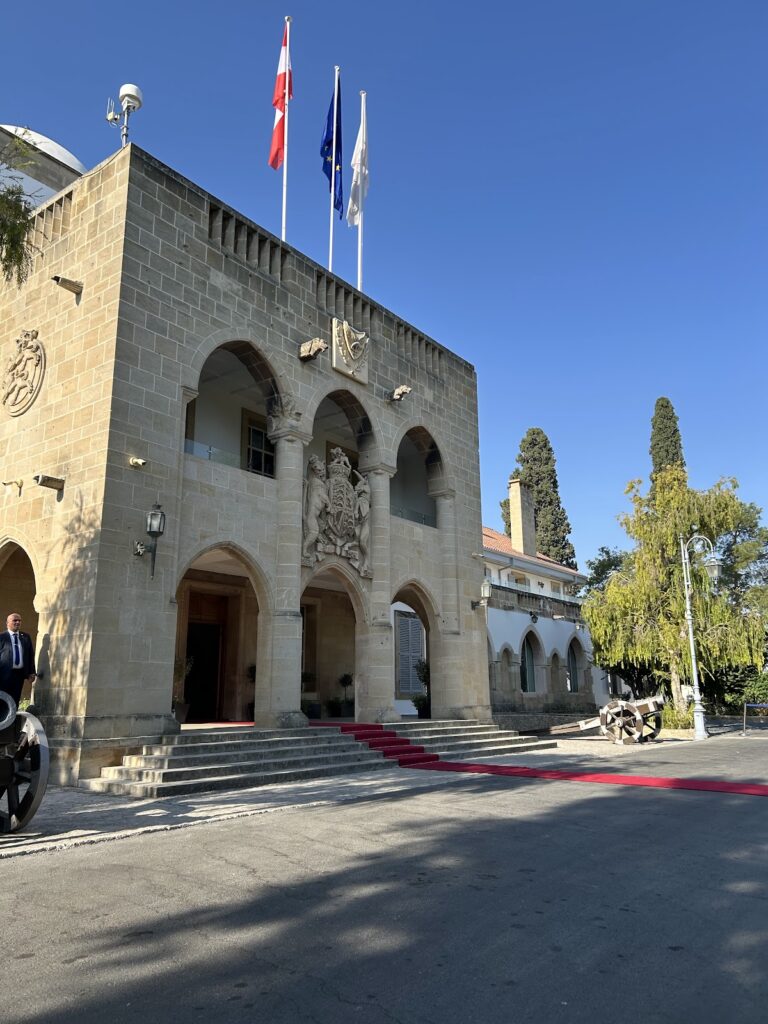
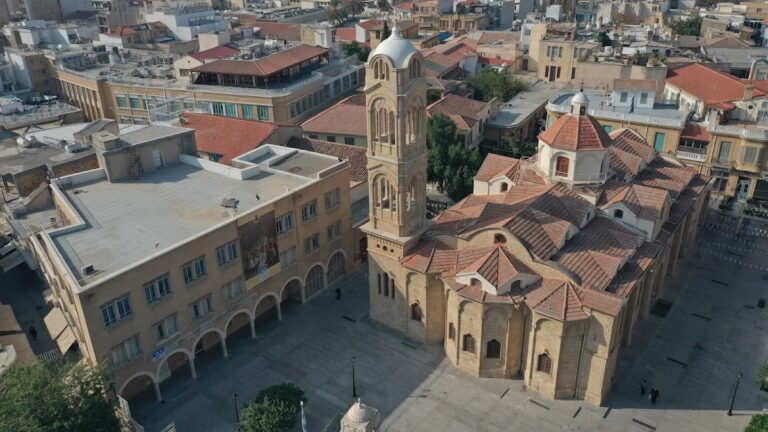
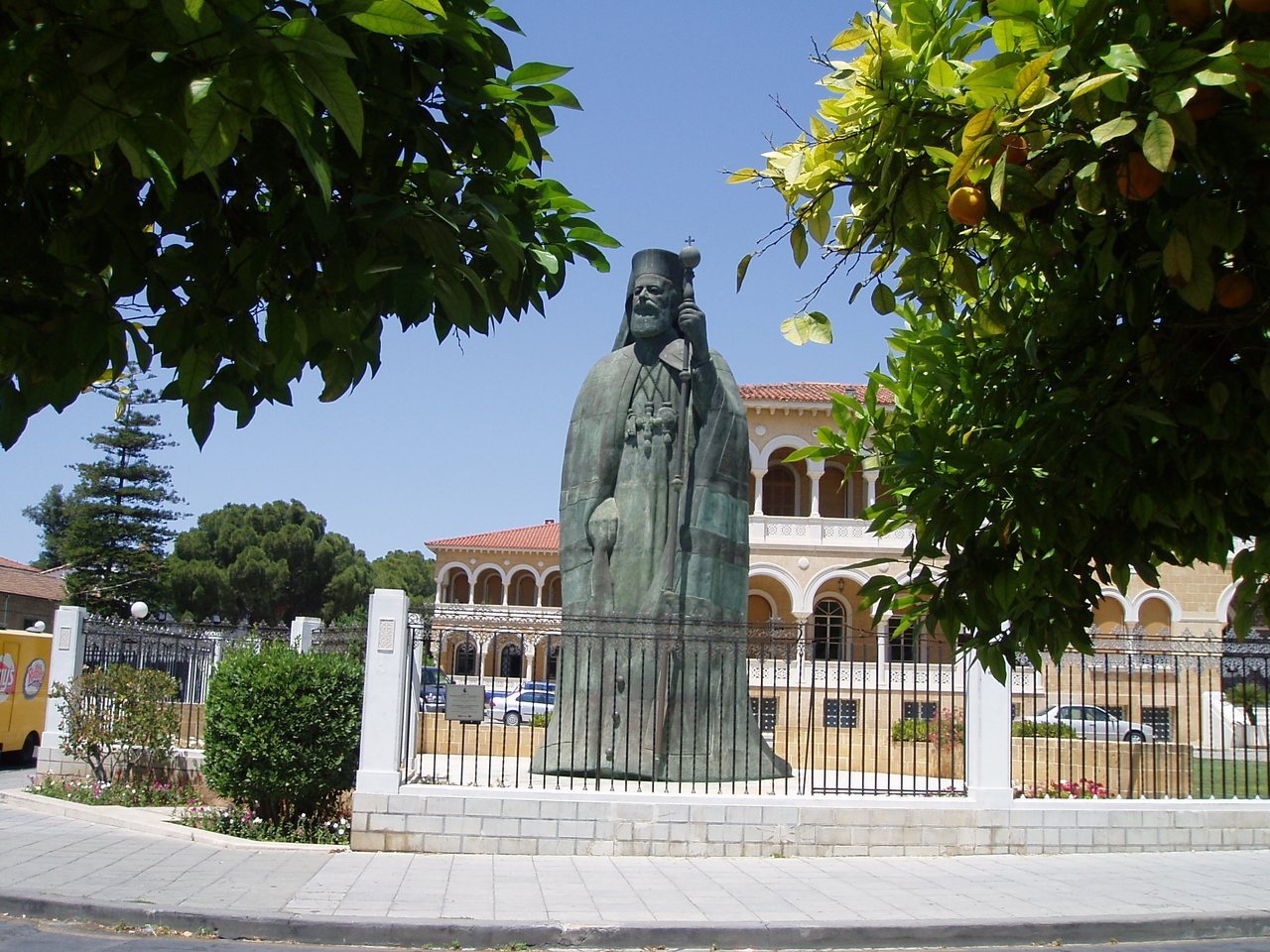
The church’s headquarters occupy the Archbishop’s Palace within the Holy Archbishopric complex in the Old City of Nicosia. The Cathedral of Saint John the Theologian is identified as the cathedral of the Church of Cyprus. These institutions form the church’s principal central complex and remain associated with the archbishop’s seat and the administration of the Cypriot Orthodox hierarchy.
Churches and Byzantine heritage
Nicosia contains several churches associated with the Church of Cyprus, including Chrysaliniotissa, Panagia Chrysospiliotissa, and the Church of the Archangel Michael Trypiotis. The church is also associated with nine Byzantine churches in the Troodos Mountains that are included on the UNESCO World Heritage List. Its wider material heritage includes Byzantine icons, frescoes, mosaics, manuscripts, reliquaries, chalices, wooden carvings, crosses, Bibles, and other liturgical objects.
Saint George of the Greeks
The Orthodox cathedral of Saint George of the Greeks in Famagusta now stands in ruins. It was described as nearly as tall and monumental as the neighboring Catholic cathedral of Saint Nicholas and reflects an interaction between Gothic and Byzantine architectural traditions.
Stauropegic monasteries
Five monasteries are stauropegic, meaning that they stand directly under the authority of the church’s primate or synod rather than a local diocesan bishop. They are the Monastery of the Panagia of Kykkos in the Troodos Mountains, the Monastery of the Panagia of Machairas near Lazanias, the Monastery of Saint Neophytos near Paphos, the Monastery of the Apostle Barnabas near Enkomi, and the Monastery of Panagia Katharon in the Kyrenia area.
Monasteries of Kykkos, Machairas, and Saint Neophytos
The monasteries of Kykkos, Machairas, and Saint Neophytos remain major stauropegic institutions. Their abbots hold episcopal rank within the church’s organization. The metropolitanate of Kykkos–Tillyria has its seat at the Monastery of the Panagia of Kykkos, linking the monastery directly with the territorial structure of the church.
Monasteries of the Apostle Barnabas and Panagia Katharon
The Monastery of the Apostle Barnabas has been closed since 1976 and converted into an archaeological museum. The Monastery of Panagia Katharon was closed after 1974. Their present condition reflects the wider effects of political division on Orthodox institutions in Cyprus.
Other monastic institutions and diocesan seats
Other monasteries associated with the church include Stavrovouni, the Monastery of Saint Andrew, Trooditissa, Chrysorroyiatissa, Saint Thekla, Saint George of Alamanos, Saint Herakleidios, and the Monastery of the Forerunner at Mesa Potamos. These institutions form part of the church’s wider network of religious foundations.
The metropolitanate of Kyrenia operates from Latsia in Nicosia, the metropolitanate of Morphou from Evrychou, and the metropolitanate of Constantia–Ammochostos from Paralimni. Their historical seats lie in territories affected by the 1974 occupation. Tamassos–Oreini has its seat at Episkopio, while Trimithous has a historical seat at Tremetousia and a temporary seat at Dali. The metropolitanate of Paphos has the chorepiscopate of Arsinoe as an associated jurisdiction, and Limassol has the chorepiscopate of Amathus.
Displaced and damaged church heritage
Many churches in northern Cyprus contain Byzantine icons, frescoes, and mosaics that were looted after 1974. Of the 514 churches, chapels, and monasteries in the north, many were converted into mosques or museums, or abandoned. The destruction and dispersal of this heritage affected both the buildings and the liturgical objects connected with them.
Panagia Kanakaria mosaics
The sixth-century mosaics of Panagia Kanakaria were removed from a church in northern Cyprus and sold on the antiquities market. Federal court rulings in Indianapolis and Chicago eventually led to their return to the Church of Cyprus.
Repatriated icons
Icons from the former Kyrenia diocese and from Panagia Asinou were repatriated from the United States in 2007. Icons stolen earlier from Kalopanayiotis were also returned to the custody of the Church of Cyprus. These returns form part of the church’s continuing recovery of displaced religious heritage.
Looting after 1974 is estimated to have destroyed or removed approximately 15,000–20,000 icons, several dozen major sixth- to fifteenth-century frescoes and mosaics, and thousands of chalices, wooden carvings, crosses, and Bibles. Most of these objects remained lost. The surviving buildings and recovered objects preserve material evidence of the long history of Orthodox Christianity in Cyprus, from Byzantine foundations to the modern church.