Sant’Andrea delle Fratte: A Roman Catholic Church in Rome
Site at a Glance
- Popularity
- Very High
- Country
- Italy
- Primary era
- Early Modern
- Eras represented
- Early Modern, Modern
- Civilizations
- Italian, Papal States
- Site type
- Religious
- Remains
- Basilica
On this page28 sections
History
Sant’Andrea delle Fratte is a Roman Catholic church in Rome, Italy. A church stood on the site by 1192, while construction of the present building began in 1604 and continued through several campaigns. Francesco Borromini shaped its Baroque dome and bell tower. The church has served religious communities in Rome for centuries and is associated with the 1842 apparition known as the Miracle of the Madonna.
Medieval church and the Minims
The medieval church stood in a rural area at the northern edge of Rome and was associated with Augustinian nuns, members of religious communities following the Rule of Saint Augustine. It later became the national church of the Scottish community in Rome, a role it retained until Scotland became Protestant. The name Sant’Andrea delle Fratte means Saint Andrew of the Thickets. The word Fratte was applied to the site from the fifteenth century and probably referred to its overgrown surroundings.
In 1585, Pope Sixtus V assigned the church to the Minim friars, members of a Catholic order founded by Francis of Paola. The friars began developing a monastic complex, and a new church was started in 1604 to a design by Gaspare Guerra. The earlier church was demolished in 1605. Building work on the replacement stopped after eight years because of financial difficulties, despite material help from the Del Bufalo family.
Borromini’s campaign and the façade
Francesco Borromini took up the unfinished project in 1653 and designed the apse, the raised structure supporting the dome, and the bell tower. Work on the dome and tower continued into 1667. After Borromini’s death, Mattia de Rossi carried on the construction, but shortages of money again brought work to a halt.
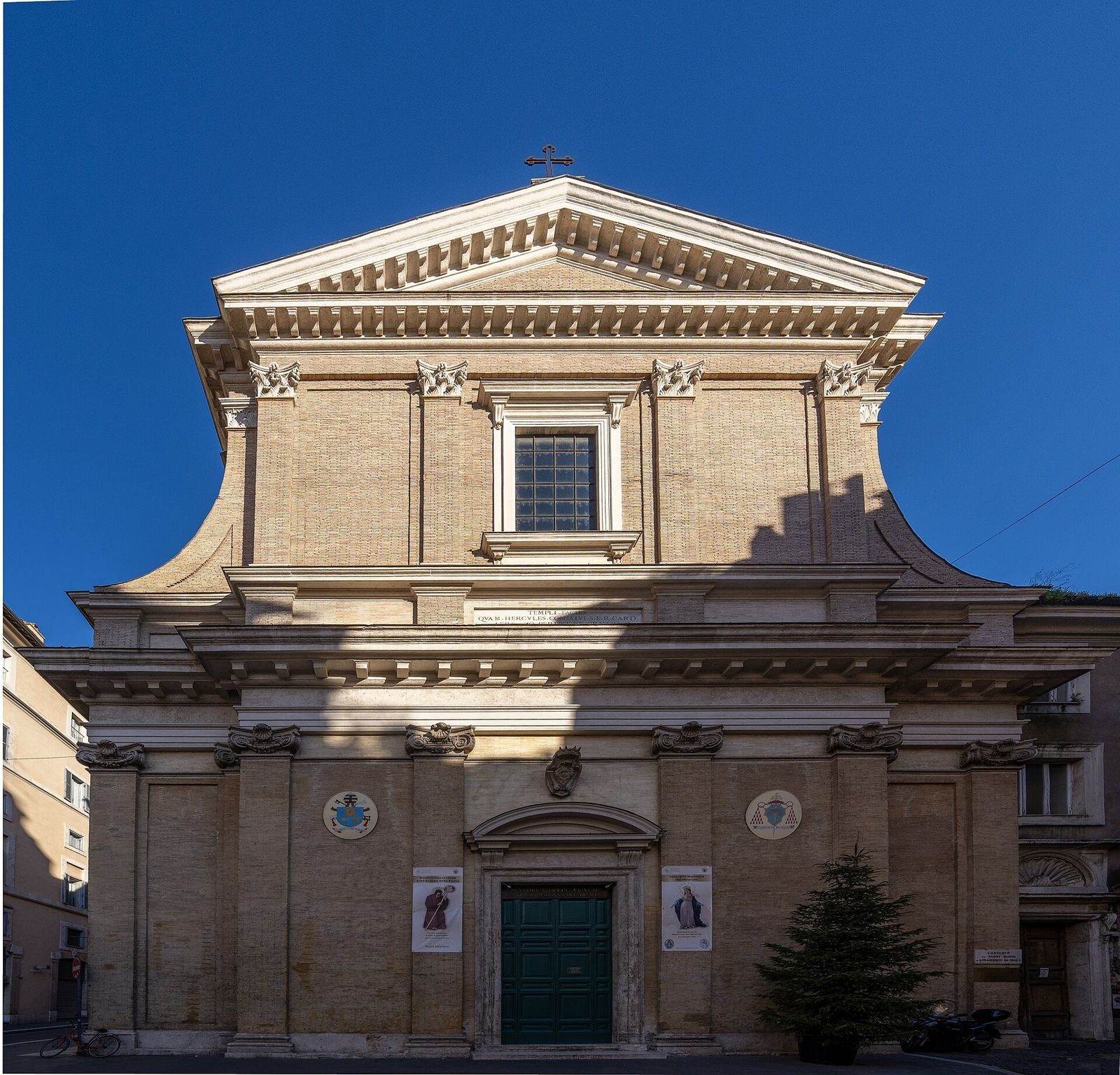
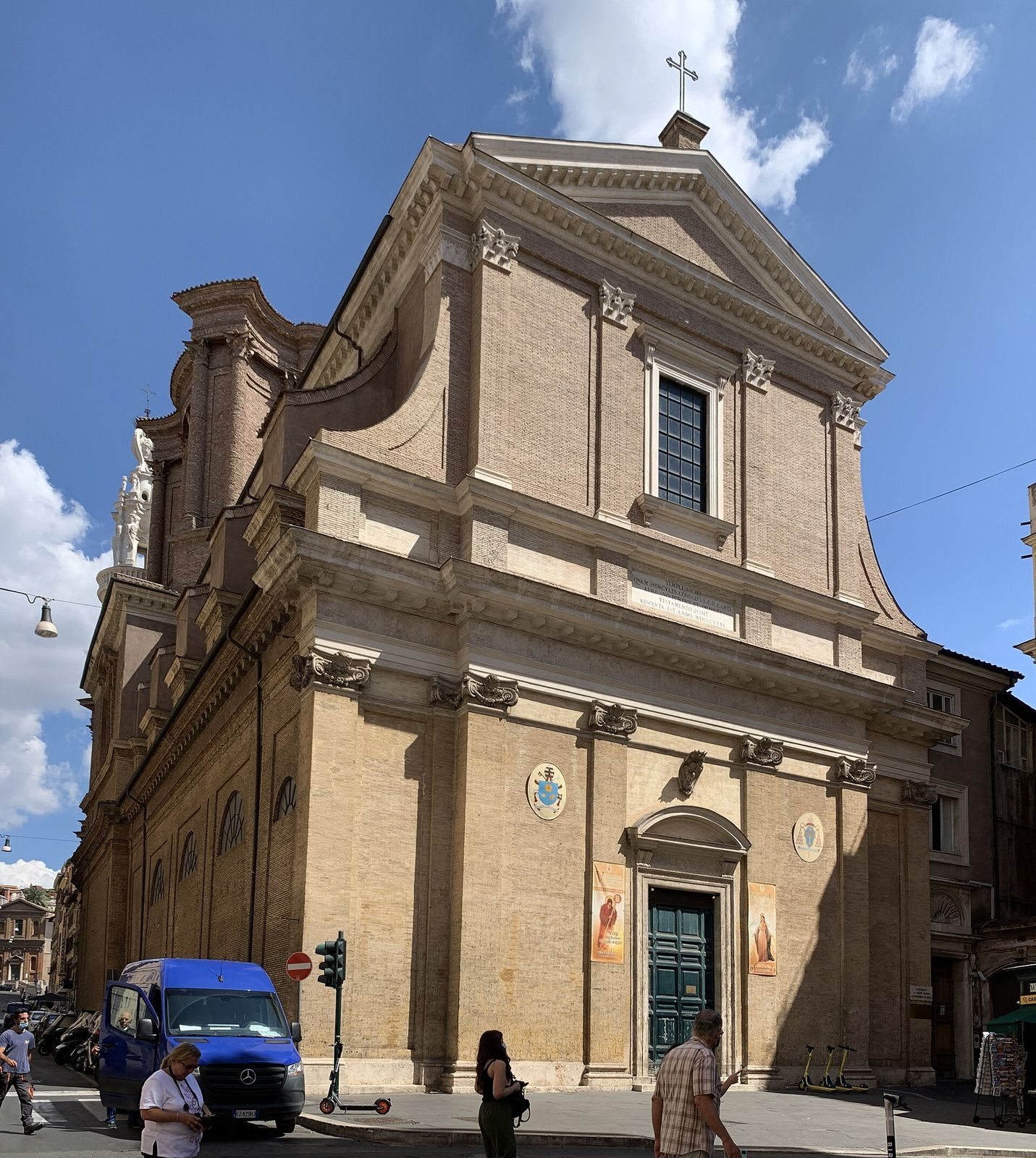
The façade was completed in 1826 with money provided through the will of Cardinal Ercole Consalvi, a cardinal and papal diplomat. Pasquale Belli designed it, probably following suggestions from Giuseppe Valadier.
The Miracle and later religious roles
On 20 January 1842, Alphonse Marie Ratisbonne, a young Frenchman of Jewish background, reportedly experienced an apparition of the Virgin Mary in the church. The Catholic Church recognized the event, which prompted his conversion to Catholicism. He later founded the Congregation of Notre-Dame de Sion. The church is also known as the Shrine of the Madonna of the Miracle.
In 1918, the Polish Franciscan priest Maximilian Kolbe celebrated his first Mass in the chapel of the Madonna of the Miracle. Pope Pius XII raised the church to the rank of minor basilica on 25 April 1942. On 12 March 1960, Pope John XXIII established its cardinal-priest title, an ecclesiastical assignment of a church to a cardinal. Sant’Andrea delle Fratte remains a Roman Catholic parish entrusted to the Order of Minims.
Remains
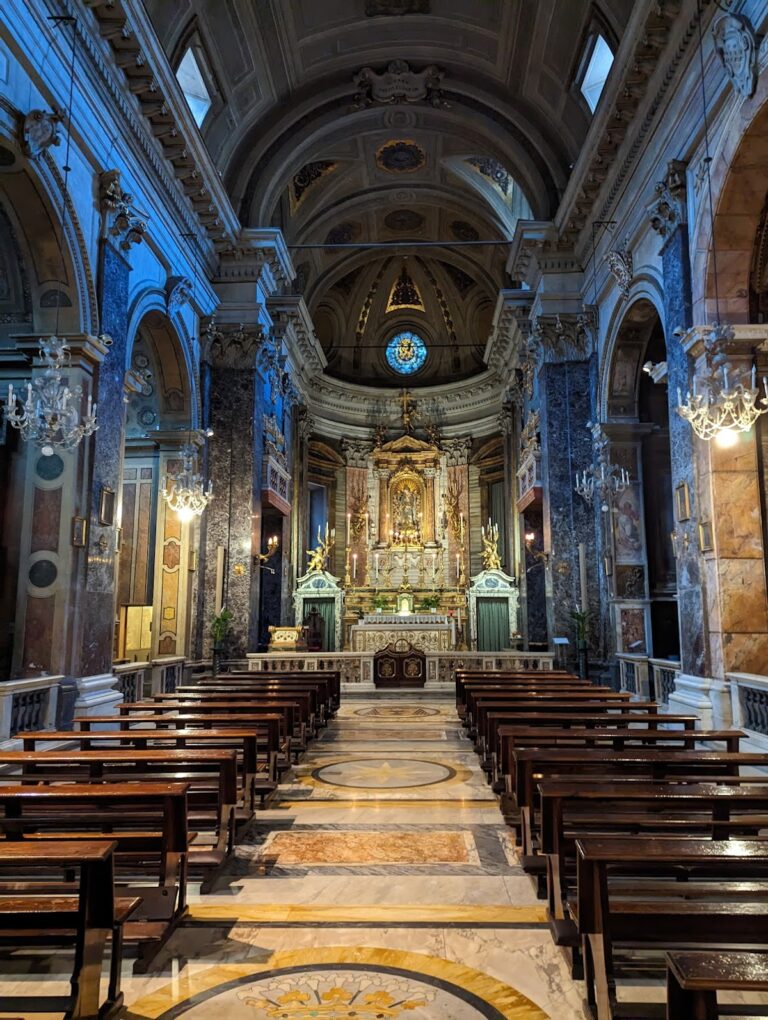
The church has a plan shaped like a cross, with a single main hall and a short crosswise arm. The area around the main altar ends in a semicircular recess. Three chapels open off each side of the main hall, with two smaller chapels near the entrance and further chapels in the crosswise arm. That arm remains within the outer line of the side chapels rather than projecting beyond them.
Exterior and structure
Façade
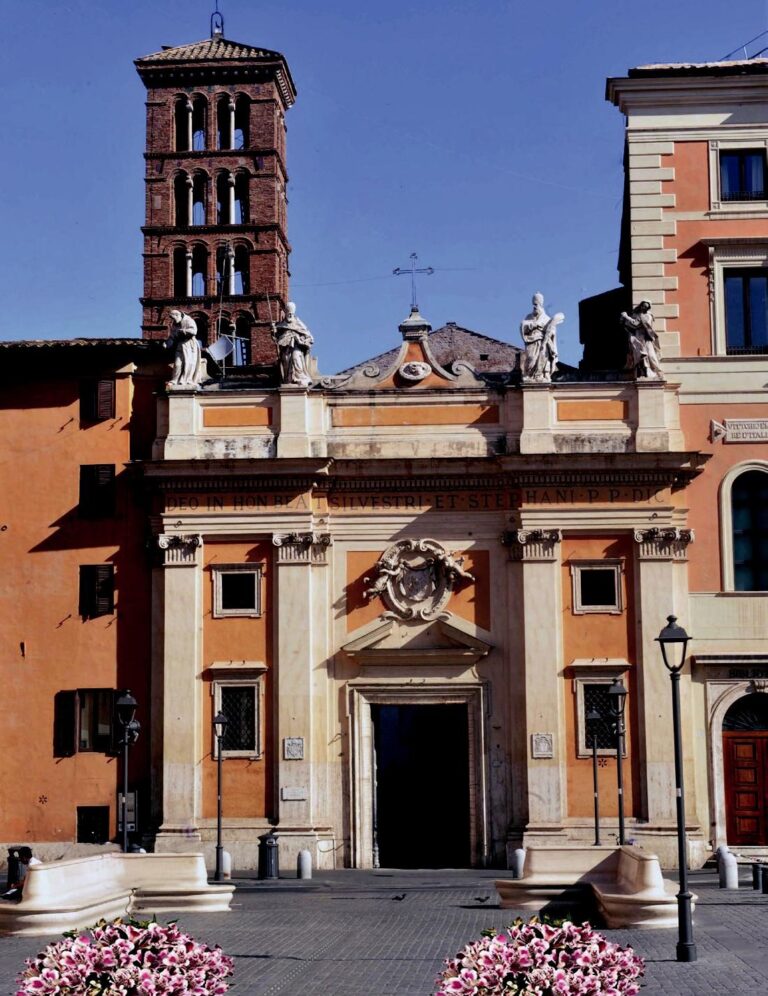
The two-storey façade combines brick with stone or stucco details. Yellowish brick forms the lower level, where six shallow wall supports have Ionic capitals, with the four central supports projecting slightly. They frame a plain horizontal band and a projecting ledge. Brackets carry the raised triangular top above the entrance, with the Del Bufalo family arms set above it. The upper level, built in pink brick, rises from a base of five recessed rectangular panels. A marble plaque in the central panel marks the façade’s completion. Four brick supports with Corinthian capitals frame this level and carry a horizontal band beneath a triangular top. The restrained decoration follows the two-tiered format of sixteenth-century Roman church façades, with neoclassical details. The church’s left side faces the Palace of Propaganda Fide, a building associated with Borromini and Bernini.
Dome and bell tower
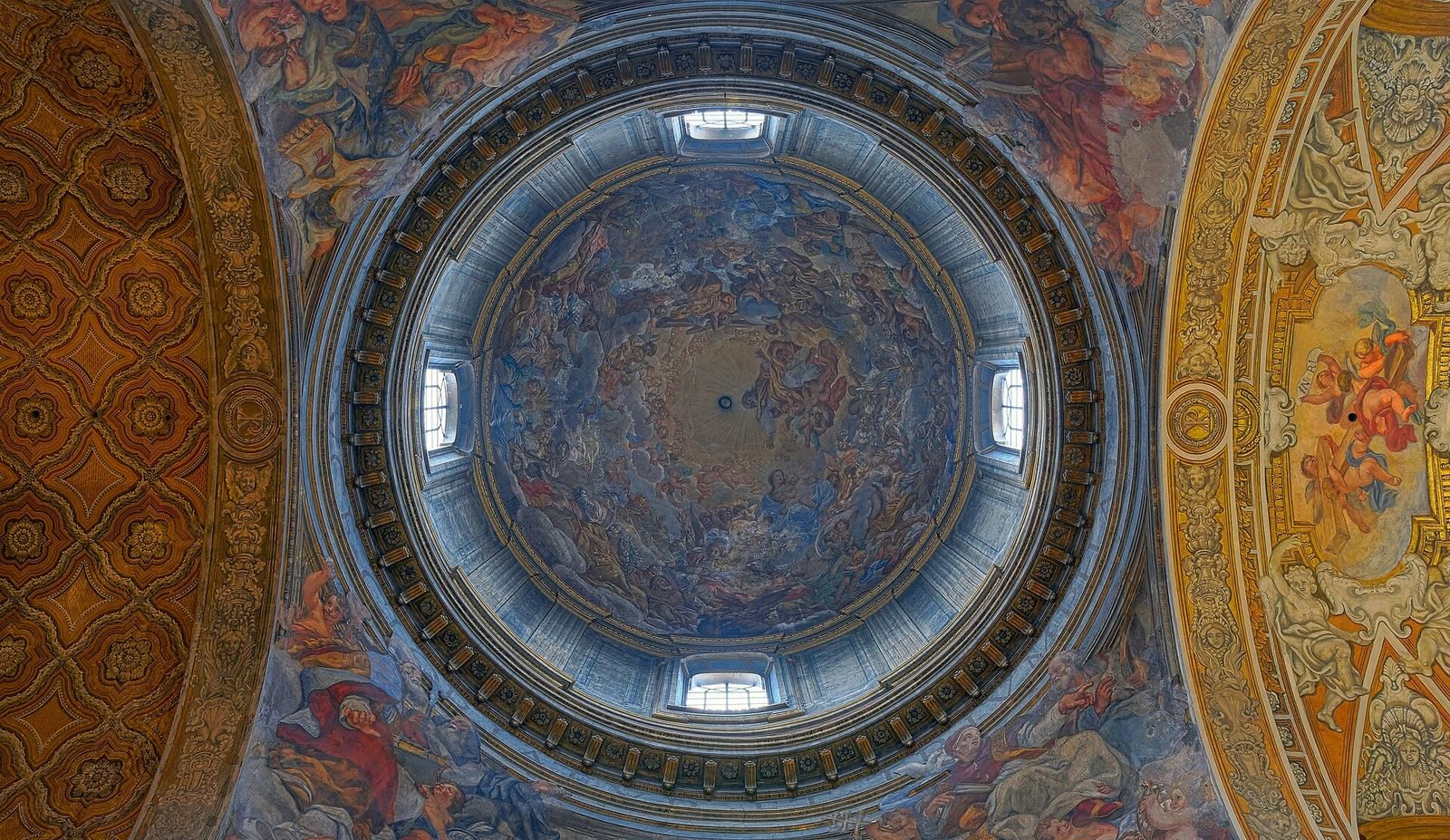
Borromini’s dome rises above a tall base divided into four projecting arms, with high windows between them and a shallow dome above. Diagonal supports give the exterior an outline compared to Saint Andrew’s cross. The rough, exposed brick of the dome’s supporting structure contrasts with the bell tower’s white upper levels.
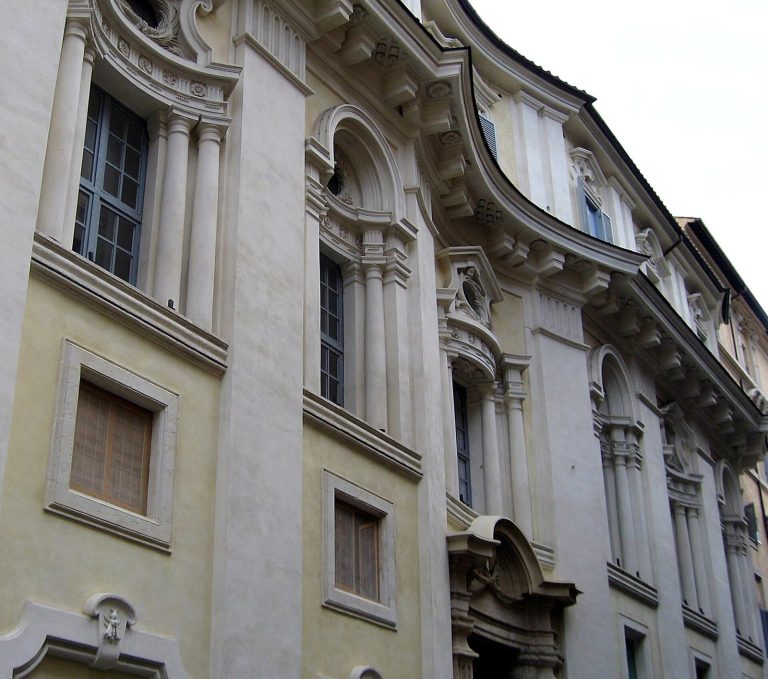
The tower adjoins the main hall at the end of the crosswise arm. Its lowest level is brick and matches the church. On the second brick level, Corinthian columns carry a projecting ledge, while the projecting corners echo the shape of the dome’s base. Each face has a large rectangular panel framed by paired Doric columns, a horizontal architectural band, and a triangular top. The higher levels are white. The third, circular level has four pairs of Corinthian columns, a ring-shaped band, and a balustrade. Four angels with folded wings support the ledge of the fourth level. Eight flaming torch ends rise from the fifth level’s base. At the top, four raised scrolls face inward and support a metal crown topped by a cross.
Interior paintings and sculpture
Dome and apse
Pasquale Marini decorated the dome’s interior and its curved triangular supports with seventeenth-century frescoes. The central image shows the Assumption of Mary. In the apse, the curved surface above the altar bears Marini’s painting of the Feeding of the Five Thousand. Below it are large works depicting the Crucifixion of Saint Andrew by Giovanni Battista Lenardi, Saint Andrew on the Cross by Lazzaro Baldi, and the Entombment of Saint Andrew by Francesco Trevisani. Giovanni Antonio Grecolini painted smaller scenes above the side doors, showing Saint Andrew being led to his martyrdom and being scourged.
Bernini’s angels
Two marble angels by Gian Lorenzo Bernini stand beside the apse. One holds the Crown of Thorns; the other carries the Titulus Crucis, the inscription placed above Jesus on the cross. Pope Clement IX originally commissioned the sculptures for the Stations of the Cross on Ponte Sant’Angelo. They were considered too valuable to remain exposed to the weather and were given to Bernini. His heirs donated them to the church in 1729, and copies were installed on the bridge in their place.
Chapels
Chapel of Saint John the Baptist
At the right-hand corner of the entrance, the chapel of Saint John the Baptist serves as the baptistery. Its wall displays Ludovico Gimignani’s Baptism of Christ, flanked by paintings by Marcantonio Belladonna on the right and Domenico Jacovacci on the left. The wooden cover of the baptismal font, shaped like a small temple, was painted by Jacques Courtois in 1674.
Chapel of Saint Michael the Archangel
This chapel contains an altarpiece by Ludovico Gimignani and a small image of Saint Rita of Cascia.
Chapel of Saint Francis de Sales
Marco Antonio Remoli’s altarpiece depicts Saint Francis de Sales with Saint Jane de Chantal. A small image of Pope Pius X is also present.
Accoramboni family chapel
The chapel associated with the Accoramboni family may be Borromini’s work. Its marble decoration resembles a temporary funerary structure.
Chapel of Gaspar de Bono and Nicholas of Longobardi
This chapel is dedicated to two early members of the Minim order who were beatified. Giuseppe Cades’s altarpiece shows them with the Virgin Mary. The flanking paintings depict Saint Rosalia with Jesus and with the Virgin, and a small image of Saint Maria Goretti is also kept here.
Chapel of Saint Francis of Paola
Designed by Filippo Barigioni, this chapel occupies the right arm of the cross-shaped plan. Its altarpiece, painted by Paris Nogari before the present church was built, depicts Saint Francis of Paola. Gilded angels supporting the work are by Giovanni Battista Maini.
Chapel of the Virgin Mary
Near the left side of the entrance, this chapel has an altarpiece by Avanzino Nucci showing the Virgin and Child with saints. Nucci also painted the Annunciation and Nativity scenes beside it.
Chapel of the Crucifixion
An anonymous crucifix dating to about 1680 is kept in this chapel.
Chapel of the Madonna of the Miracle
The central altarpiece depicts the Virgin as she appeared to Ratisbonne. A bust of Ratisbonne stands to the left of the altar, and a statue of Maximilian Kolbe to the right. The chapel, completely renovated by architect Marcello Piacentini in 1950 and enriched with marble, was formerly dedicated to Saint Michael. Its altar was moved to the chapel on the opposite side of the church. The pews are oriented toward the Madonna of the Miracle altar.
Chapel of Saint Joseph
This chapel contains an altarpiece by Francesco Cozza and a small image of Saint Thérèse of Lisieux.
Chapel of Saint Anne
The chapel in the left arm of the cross-shaped plan was designed by Luigi Vanvitelli and later altered by Giuseppe Valadier. Giuseppe Bottani’s altarpiece shows Mary as a child with Saint Anne and Saint Joachim. Beneath the altar, Giovanni Battista Maini’s marble sculpture depicts the dying Saint Anne. It was modeled on Bernini’s sculpture of Blessed Ludovica Albertoni in San Francesco a Ripa.
Cloister, crypt, organ, and burials
Cloister
The adjoining cloister has seventeenth-century frescoes depicting episodes from the life of Saint Francis of Paola. Pasquale Marini, Francesco Cozza, and Filippo Gherardi painted its arched wall sections.
Crypt
A crypt lies beneath the main altar and the area around it. It contains a putridarium, a temporary funerary room where bodies decomposed before bones were transferred to a bone repository. It is described as the only example in Rome.
Organ
The pipe organ was built in 1933 by Balbiani Vegezzi-Bossi and later enlarged by Continiello. It occupies two deep choir lofts opening onto the side walls of the area around the main altar. The instrument has electric action, 32 stops, three keyboards, and a pedalboard.
Burials
People buried in the church include Petar Parchevich, archbishop of Marcianopolis, who died in 1674; Cardinals Carolo Leopoldo Calcagnini (1679–1746), Pierluigi Carafa (1677–1755), and Ludovico Valenti (1695–1763); and the artist Felice Giani. The painter Angelika Kauffmann was buried here in 1807, and the artist Oreste Kiprensky died in 1836.