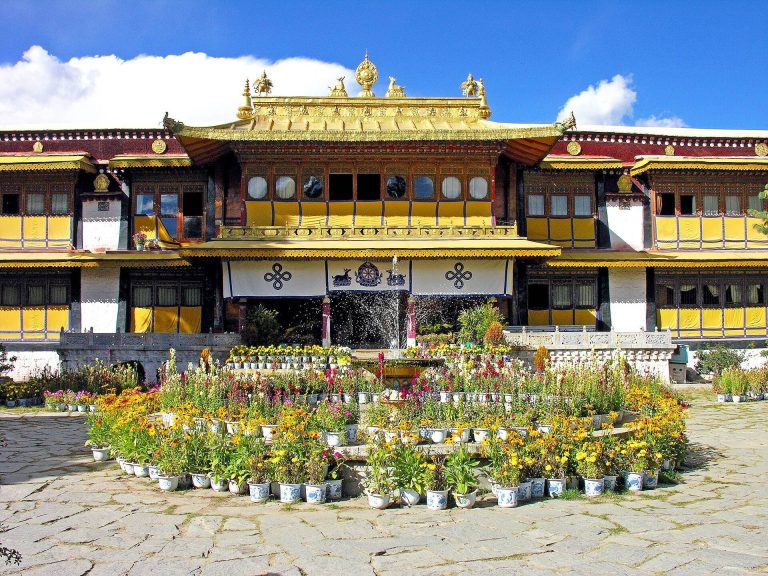
Potala Palace: Seat of Tibet’s Religious and Temporal Government
Site at a Glance
- Rating
- 4.8
- Popularity
- Medium
- Country
- China
- Primary era
- Early Modern
- External website
- Open
- Eras represented
- Classical, Early Modern, Modern
- Civilizations
- Tibetan
- Site type
- Religious
- Remains
- Palace
On this page17 sections
History
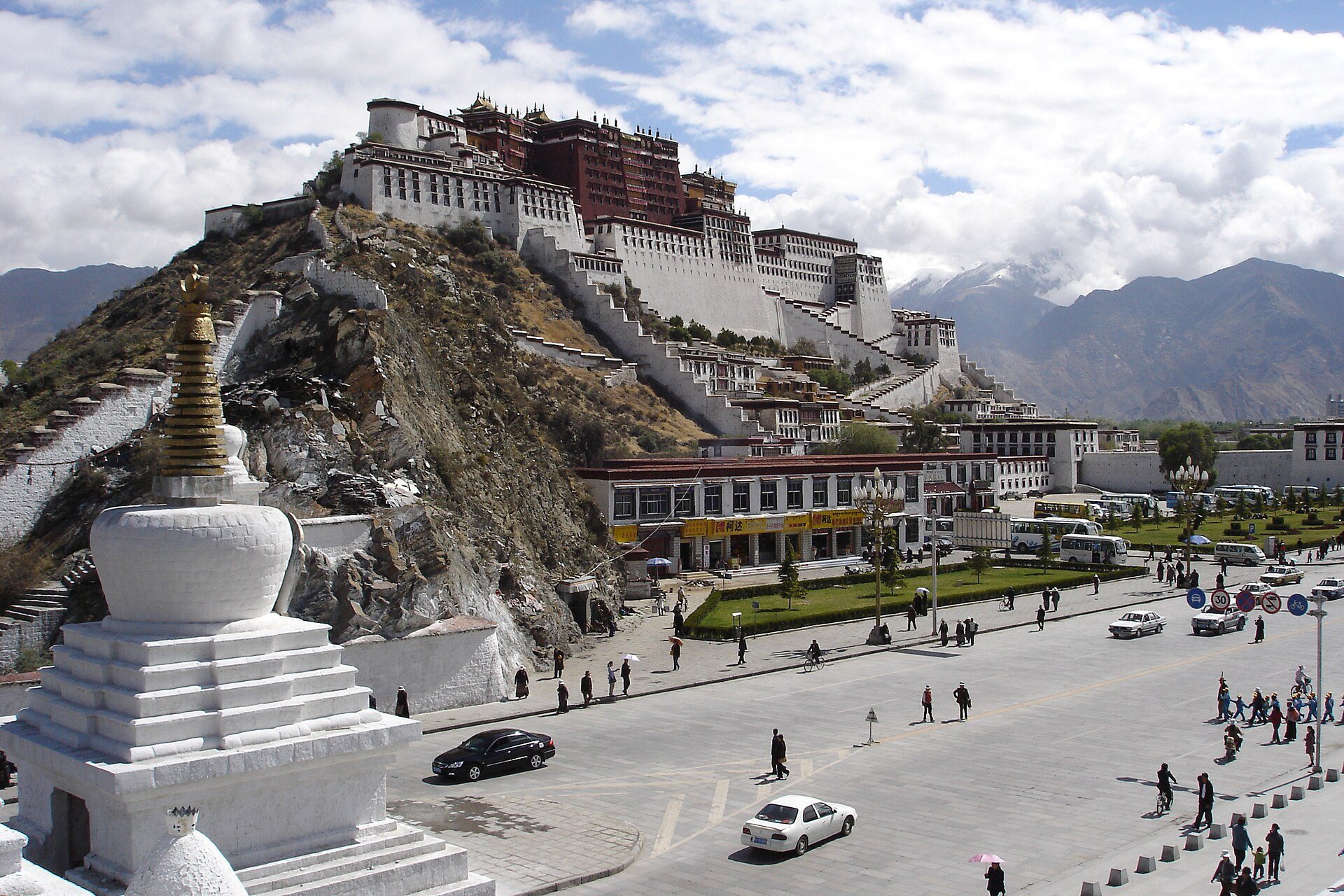
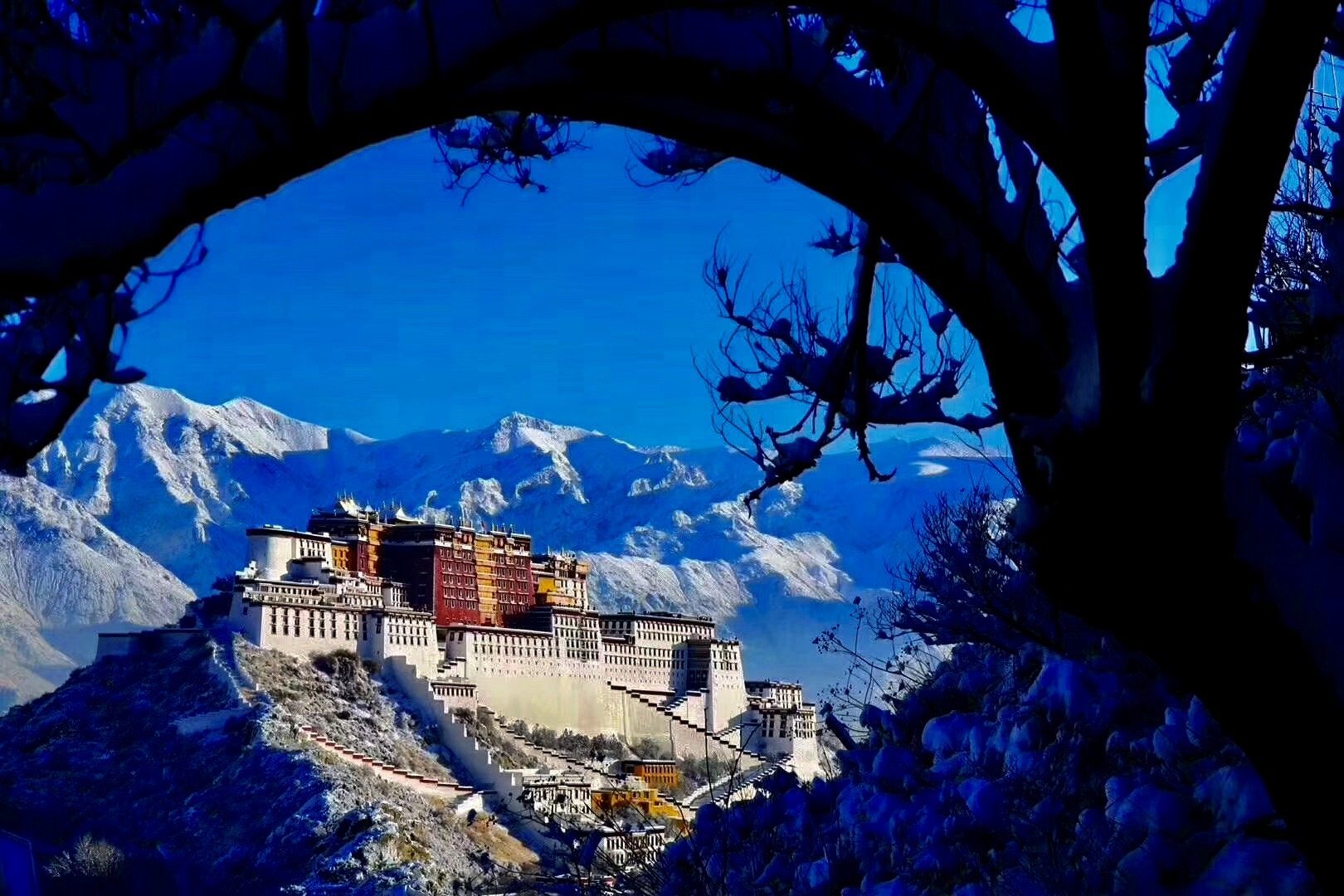
The Potala Palace in China stands on Marpo Ri, the Red Hill, in the center of the Lhasa Valley. The present complex was begun in 1645 on the orders of the Fifth Dalai Lama, Lobsang Gyatso, in the Tibetan Buddhist and political tradition of the seventeenth century. It became the residence of successive Dalai Lamas and the center of Tibet’s religious and temporal administration.
The Earlier Sacred Site
Tradition links Marpo Ri with Songtsen Gampo, the seventh-century ruler credited with consolidating the Tibetan Empire and helping establish Buddhism in Tibet. An earlier palace is said to have been built on the hill in 637. Lightning partly destroyed the complex in the late eighth century, and it was completely ruined during the collapse of the Tibetan Empire in the ninth century. Two sacred spaces associated with the earlier palace survive in the present complex, the Phakpa Lhakhang and the Chogyel Drupuk meditation cave.
The name Potala derives from Mount Potalaka, regarded in Buddhist tradition as the abode of Avalokiteshvara, the bodhisattva of compassion. Tibetan Buddhism traditionally identifies the Dalai Lama as a manifestation of Avalokiteshvara, giving the palace a religious association that accompanied its political role.
Construction under the Fifth Dalai Lama
The Fifth Dalai Lama ordered the present palace in 1645 after his adviser Konchog Chophel identified Marpo Ri as a suitable seat of government between Drepung and Sera monasteries and the old city of Lhasa. The outer construction took about three years, while the interior work and furnishings continued until 1694. The White Palace was completed first, and the Fifth Dalai Lama and his government moved there in 1649.
The move transferred government departments and the Namgyal monastic college to the new complex. The college had originally been founded at Drepung in 1574 by the Third Dalai Lama for monastic training. At the Potala, the institution formed part of a combined religious and administrative center. The palace became the seat of the Ganden Phodrang, the governmental system headed by the Dalai Lama, as well as the principal residence of successive Dalai Lamas.
Late in his life, the Fifth Dalai Lama withdrew from public affairs and entrusted power to the regent Sangye Gyatso. The Dalai Lama died in 1682 before the palace was complete, and Sangye Gyatso concealed the death for more than twelve years so that construction could continue. He began the Red Palace in 1690, and the work continued until 1694. About 7,000 craftsmen took part, with assistance from Chinese and Manchu craftsmen sent by the Qing emperor Kangxi and from Nepal.
Governmental and Religious Center
After Norbulingka was constructed under the Seventh Dalai Lama, Kelzang Gyatso, the Potala became the Dalai Lamas’ winter palace. Kelzang Gyatso also established the Kashag, the council of ministers that administered the Tibetan government, with offices at the Potala. He founded the Tse school at the summit to train Tibetan government officials. The palace therefore combined residence, government offices, monastic education, worship, and ceremonial functions within one fortified complex.
The Potala also remained associated with public ritual. Sangye Gyatso instituted the Tsomchö Sertreng ceremony in 1694 to commemorate the death of the Fifth Dalai Lama. Processions, dances, music, and the display of enormous thangkas, Tibetan Buddhist religious images painted or embroidered on textile, formed part of the observance. The ceremony ceased after 1959, although the thangkas were displayed again in 1994 without the ritual being regularly resumed.
Later Additions and Political Change
A convention between the British and Tibetan government was signed at the Potala on 7 September 1904. Further expansion under the Thirteenth Dalai Lama, Thubten Gyatso, in the early twentieth century brought the White Palace to its present extent. Restoration or enlargement in 1922 is also associated with the palace’s current dimensions.
The Potala remained the seat of the Tibetan government until the Fourteenth Dalai Lama, Tenzin Gyatso, fled to India during the Tibetan uprising of 1959. The palace subsequently became a museum, while retaining religious functions and housing a monastery. It was shelled during the uprising. Damage was reported to the south façade, the porch of the Red Palace, and the Tse Lobtra school.
The palace avoided damage during the Cultural Revolution of 1966 to 1976 through the intervention of Zhou Enlai. Claims that more than 100,000 volumes, historical documents, artworks, and other valuables were removed, damaged, or destroyed remain contested. The surviving collections nevertheless include large bodies of religious art, manuscripts, ritual objects, and furnishings from Tibet and neighboring regions.
Protection and Conservation
The Potala was protected as a major nationally protected historical and cultural site in China from 1961. It was inscribed on the UNESCO World Heritage List in 1994 as part of the Historic Ensemble of the Potala Palace, Lhasa. The Jokhang Temple and Norbulingka were added as extensions in 2000 and 2001. A protected area and buffer zone covering the palace and the Shol settlement were defined in 1997.
Restoration and maintenance campaigns from 1989 to 1994 and again from 2002 contributed to the palace’s preservation. The later work used traditional materials and craftsmanship. Restrictions on buildings higher than 21 metres were introduced around the palace, while the demolition and redevelopment of parts of the historic Shol settlement altered its surrounding setting. A large square esplanade now occupies part of the area in front of the palace, following the removal of modern residences and shops in 1998.
Remains
Hilltop Complex and Construction
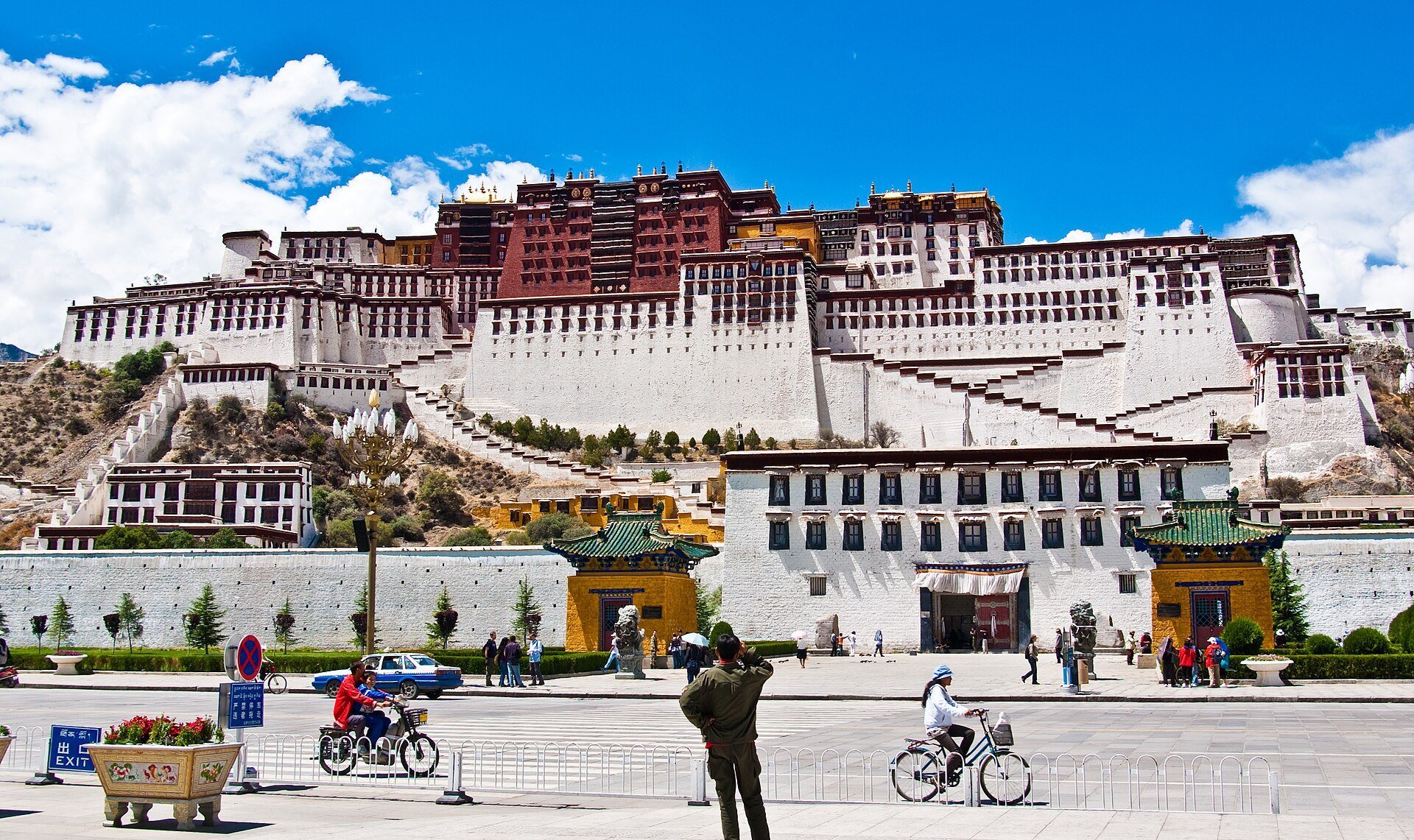
The Potala is a fortified architectural complex combining defensive, administrative, and religious functions. It follows the east-west ridge of Marpo Ri rather than the north-south axis typical of imperial Chinese palace layouts. The hill rises approximately 130 metres above its base, at an elevation of about 3,700 metres. The palace extends roughly 400 metres from east to west and 350 metres from north to south, occupying about 130,000 square metres within its principal enclosure. Its upper buildings rise approximately 117 metres above the hill and more than 300 metres above the valley floor.
The inward-sloping walls are chiefly made of rammed earth faced with brick or stone. They average about 3 metres in thickness and reach roughly 5 metres at the base. Copper was poured into the foundations as protection against earthquakes. Straight rows of upper-level windows, flat roofs at several levels, imposing walls, and large gates give the complex the character of a fortress as well as a monastery. It functioned as one of Tibet’s major military fortresses until the mid-eighteenth century.
The complex contains more than 1,000 rooms, approximately 10,000 shrines, and about 200,000 statues. Its exterior has the equivalent of about thirteen storeys, although the interior is arranged across nine storeys. An eastern tower with a sun-shaped plan and a western tower with a moon-shaped plan emphasize the east-west orientation of the ridge.
Approach and Lower Setting
Stairways and Entrances
A principal staircase rises from the east and divides halfway up. Its right-hand branch leads toward the White Palace, while the left-hand branch leads toward the Red Palace. A wider sequence of relatively moderate stairways and inclined passages continues toward the summit. The White Palace is reached by three wooden stairways, of which the central stairway was originally reserved for the Dalai Lama.
Shol and the Palace Grounds
The southern base of the hill contains a large walled and gated area associated with Shol. It formerly held government offices and offices of the Tibetan army. The historic settlement included buildings dating in part from the seventeenth century, many of which were demolished during twentieth-century redevelopment. Behind the hill lies the Dragon King Pool, a garden containing a lake with several small islands. A park, pond, and chapel are also associated with the rear of the palace.
The White Palace
The White Palace, or Potrang Karpo, occupies the eastern part of the complex. It served as the Dalai Lama’s residential and secular administrative quarter, with living quarters, offices, a seminary, and a printing house. The building measures about 320 metres from east to west and 200 metres from north to south and has seven storeys.
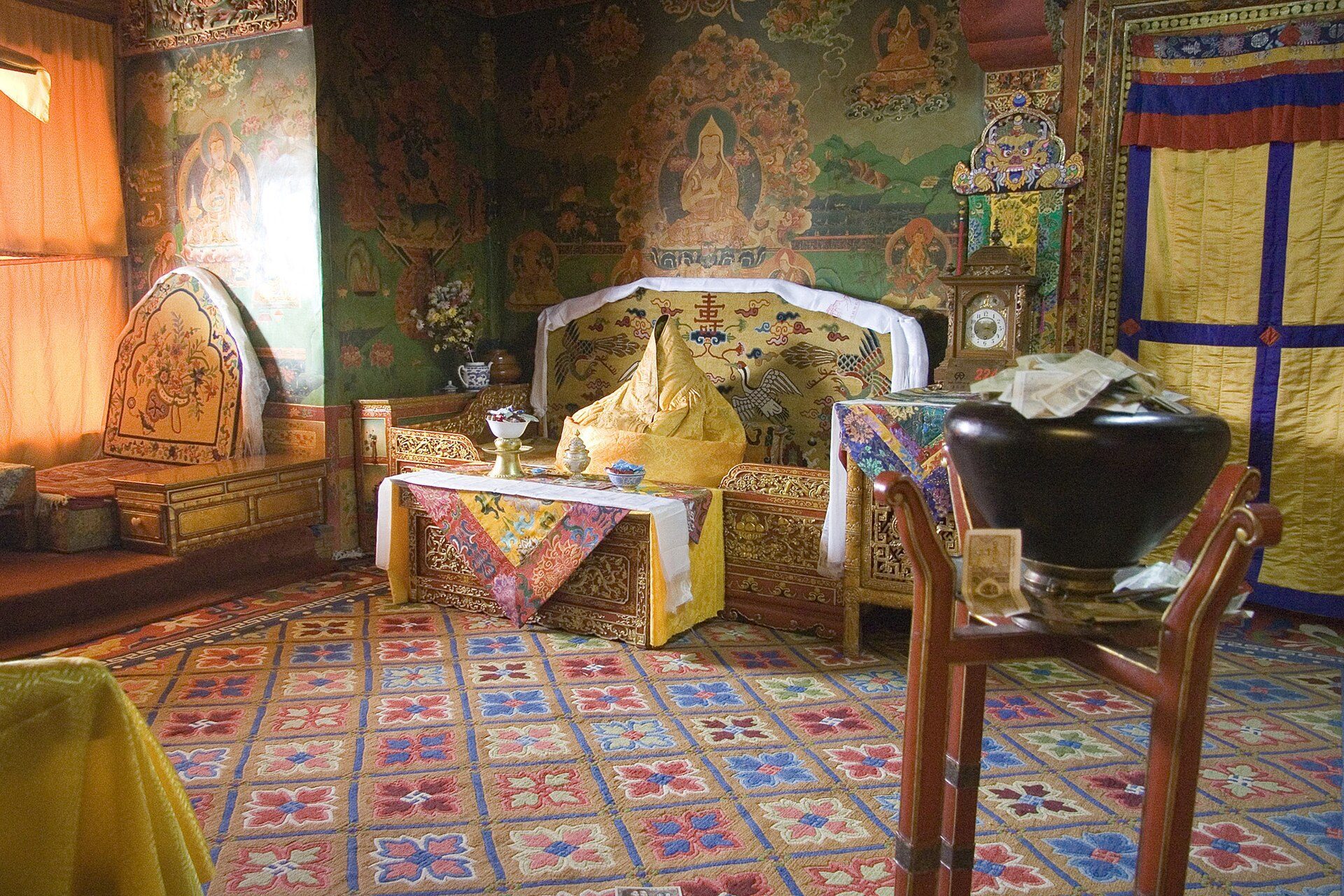
Its central yellow courtyard, the Deyang Shar, separated the residential areas from the Red Palace. The courtyard was used for ceremonies, religious dances, and performances of Tibetan opera. On the fourth floor, the central eastern hall measures about 25.8 by 27.8 metres. It hosted major ceremonies, including Dalai Lama enthronements. The Dalai Lama’s throne stands on the northern side, while murals depict historical and religious subjects, legends, and folktales.
The upper residential level contains the Western and Eastern Sunlight Halls. The Western Sunlight Hall was built under the Fifth Dalai Lama, and the Eastern Sunlight Hall was commissioned by the Thirteenth Dalai Lama. Large southern windows provided the light that gave both halls their names.
The Red Palace
The Red Palace, or Potrang Marpo, forms the central red-painted section of the complex. It is devoted to Buddhist study, prayer, chapels, shrines, and monastic functions. Its complicated plan contains halls and chapels on several levels, connected by small galleries and winding corridors. The palace’s burial stupas, Buddhist reliquary monuments that contain sacred remains or the bodies of revered figures, commemorate eight Dalai Lamas: the Fifth, Seventh, Eighth, Ninth, Tenth, Eleventh, Twelfth, and Thirteenth.
Burial Stupas and Libraries
The stupa of the Fifth Dalai Lama was built in 1691. It is approximately 14.85 metres high, made of sandalwood, covered with gold, and set with thousands of precious stones. The stupa of the Thirteenth Dalai Lama is about 14 metres high and is also covered with gold and precious stones. It contains his embalmed body, while murals portray episodes from his life in the early twentieth century. Associated offerings include elephant tusks, porcelain lions and vessels, and a pagoda made from approximately 200,000 pearls.
The Red Palace libraries include Buddhist manuscripts identified with the Kangyur, a 108-volume collection of translated scriptures, and the Tengyur, a 225-volume collection of commentaries and related works. These books form part of the palace’s larger holdings of Buddhist manuscripts and religious literature.
Great West Hall and Chapels
The Great West Hall contains four major chapels and murals depicting events in the life of the Fifth Dalai Lama, including his visit to the Qing emperor Shunzhi in Beijing. The chapel of the saint, or Phakpa Lhakhang, opens from the hall’s northern wall. A golden inscription above its entrance is attributed to the Qing emperor Tongzhi.
The Phakpa Lhakhang contains an ancient jeweled image of Avalokiteshvara with two attendants. A low passage leads from the chapel to the Dharma Cave, identified as the meditation cave of Songtsen Gampo. Images of Songtsen Gampo, his wives, his chief minister, and Sambhota are kept in the cave. Sambhota is traditionally credited with developing the Tibetan script.
Other chapels contain images of the Buddha, the Fifth Dalai Lama, Padmasambhava, Tsongkhapa, Avalokiteshvara, and other Buddhist figures. Padmasambhava was an eighth-century Indian Buddhist teacher associated with the introduction of tantric Buddhism to Tibet. Tsongkhapa founded the Gelug, or Yellow Hat, school of Tibetan Buddhism. A chapel dedicated to him contains five gilded stupas, including the central stupa of the Fifth Dalai Lama and stupas associated with the Tenth and Twelfth Dalai Lamas.
Monastic Areas and Ceremonial Displays
The Namgyal Dratsang monastic college stands west of the Red Palace. A private monastery associated with the Dalai Lama is also situated west of the Red Palace. The lower white façade was used for the display of two enormous embroidered or painted thangkas representing Tara and Sakyamuni during the Tsomchö Sertreng ceremony. A yellow building beside the White Palace stored large embroidered religious banners that were hung on the southern side of the palace during New Year celebrations.
Murals, Thangkas, and Collections
The palace contains tens of thousands of murals. One gallery alone is described as containing at least 698. Their subjects include historical events, religious legends, architectural motifs, Buddhist narratives, and scenes of daily life. The murals in the halls and chapels connect the palace’s political history with its religious and ceremonial functions.
Nearly 10,000 thangkas are preserved in the palace. They include painted and embroidered works on silk, cloth, or paper, depicting Buddhist deities, portraits of Dalai Lamas, Buddhist legends, folktales, and historical episodes. The collections also include sculptures made of stone, wood, and metal, many gilded, ranging in size from a few millimetres to about 10 metres.
Other objects associated with the palace include Buddhist books and manuscripts, paintings, ritual banners, carpets, Tibetan woollen sitting or sleeping rugs, curtains, and objects made of porcelain, jade, gold, and silver. The collections include material from Tibet, China, India, Nepal, and Kashmir. The extent to which books and valuables were removed or preserved remains disputed.