Knock Castle: A Scottish Tower House in Royal Deeside


Site at a Glance
- Rating
- 4.5
- Popularity
- Very Low
- Country
- United Kingdom
- Primary era
- Early Modern
- Eras represented
- Medieval, Early Modern
- Civilizations
- Kingdom of Scotland
- Site type
- Military
- Remains
- Castle
On this page6 sections
History
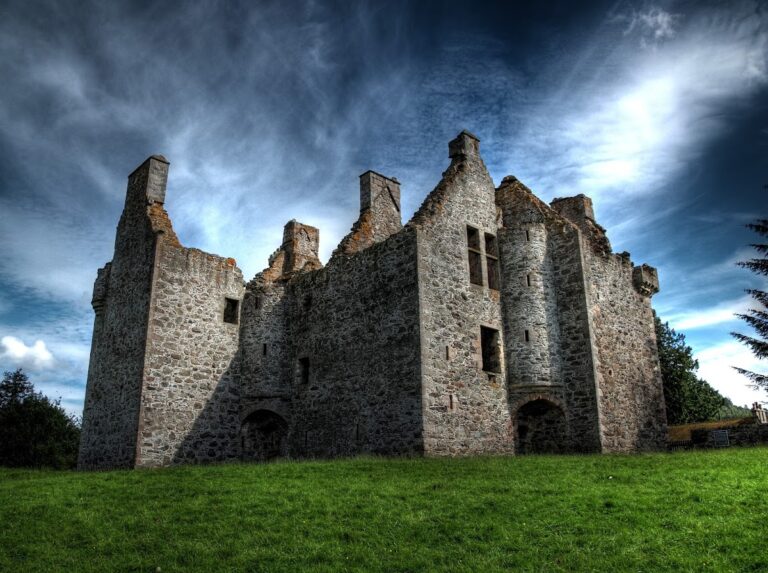
Knock Castle is a ruined tower house in Scotland, United Kingdom, built as the residence and defensible dwelling of a Scottish laird, or landed proprietor, with its surviving tower dating from about 1600, at the beginning of the seventeenth century. It stands near Ballater at the entrance to Glen Muick in Royal Deeside and is associated with the Gordons of Abergeldie.
The Gordon settlement
The castle was granted to the Gordons of Abergeldie by George Gordon, 4th Earl of Huntly, after the Battle of Corrichie on 28 October 1562. This conflict was fought between Huntly and forces commanded by James Stewart, 1st Earl of Moray, acting for Mary, Queen of Scots. The grant established Knock as a Gordon residence and placed the tower within the unsettled political and clan landscape of sixteenth-century north-east Scotland.
An earlier stronghold called Old Castle Knock belonged to the Earls of Mar. Clan Chattan, a confederation of Highland clans led in this historical identification by the Macintosh family, destroyed it in 1590. The surviving mound west of the later tower may preserve part of this earlier fortified site.
Violence and rebuilding
In 1592, Henry Gordon, the second Laird of Knock, was murdered during a cattle raid by men of Clan Forbes and Clan Chattan. His brother Alexander Gordon succeeded him and may have rebuilt or remodelled the castle while living there. The present tower belongs to the period around 1600, when the site was reshaped after these episodes of conflict.
Local tradition tells of a further clash between the Gordons and Forbes. According to the story, seven of Alexander Gordon’s sons were killed after accidentally cutting peat on Forbes territory. Their heads were said to have been displayed on peat spades. When a servant brought the news to Alexander, he collapsed at the top of the castle staircase and fell to his death. The Forbes laird was later captured and executed, while his lands were confiscated in favour of Abergeldie.
Knock Castle is a Category B listed building, a Scottish designation for a structure of regional or more than local importance. It is cared for by Historic Environment Scotland, Scotland’s national body for protecting and managing many historic monuments and archaeological sites.
Remains
Knock Castle occupies a knoll in a field on the south side of Craig of the Knock, a low hill at the entrance to Glen Muick. The rectangular tower measures about 27 by 22 feet, or 8.2 by 6.7 metres, and its walls are approximately 4 feet, or 1.2 metres, thick. The external walls remain largely intact, while the roof and interior have been lost.
The tower house
The tower rises through four storeys and contains a vaulted basement that served as a kitchen. A spiral turnpike staircase, built within the tower, leads upward to a small gabled cap house enclosing the stair access. The arrangement has been compared with Birse Castle and with the fortified border residences known as pele towers. Beneath the numerous windows, three pistol shot holes form an unusual defensive pattern: the central opening faces forward, while the two outer openings angle slightly to either side, directing fire toward the ground.
Courtyard and earlier stronghold
Foundations of an enclosing courtyard wall remain visible around the tower. The entrance opened on the north side of the courtyard and was probably protected by a strong wooden door combined with an iron yett, a heavy defensive gate. Buildings around the perimeter may have included a brewery, stables, and bakehouse.
A short distance west lies a motte, or raised defensive mound, with possible foundations of the twelfth-century timber stronghold called Old Castle Knock. The surviving remains also appear to include evidence of a corn-drying kiln, linking the earlier fortified site with activities associated with the surrounding settlement.