Saints Martin and Sebastian of the Swiss: A Renaissance Chapel for the Pontifical Swiss Guard
Site at a Glance
- Popularity
- Medium
- Country
- Vatican City
- Primary era
- Early Modern
- Eras represented
- Early Modern, Modern
- Civilizations
- Papal States
- Site type
- Religious
- Remains
- Chapel
On this page6 sections
History
Foundation and Guard use
The Oratory of Saints Martin and Sebastian of the Swiss is a sixteenth-century Renaissance chapel in Vatican City. It is also regarded as one of Switzerland’s national churches in Rome, a term for churches associated with national communities in the city.
Pope Pius V ordered the chapel’s construction in 1568 as a place of worship reserved for the Pontifical Swiss Guard, the military corps that serves the pope. The Swiss Guard had served in Rome since 1506, and architect Nanni di Baccio Bigio directed the work. The guards’ barracks stood beside Porta San Pellegrino, near the Apostolic Palace. The chapel lay on their daily route between the barracks and the Portone di Bronzo and was accessible to them at any hour.
Dedication and worship
The chapel is dedicated to Saints Martin of Tours and Sebastian, both associated with military service. Martin had been an officer in the Roman army before converting to Christianity and adopting a disciplined monastic life. Sebastian served as a captain in the imperial guard under Diocletian and Maximian and was martyred for his Christian faith.
Until the Peace of Westphalia in 1648, the treaties that ended the Thirty Years’ War, German-speaking Swiss Guards gathered at Santa Maria della Pietà in Campo Santo Teutonico, where a side altar was reserved for them. They also attended religious services at San Pellegrino in Vaticano from 1657 to 1977. With permission from the priest of the parish of Sant’Anna in Vaticano, Swiss Guard members may hold weddings in the chapel, and their family members may be baptized there.
Remains
Exterior and plan
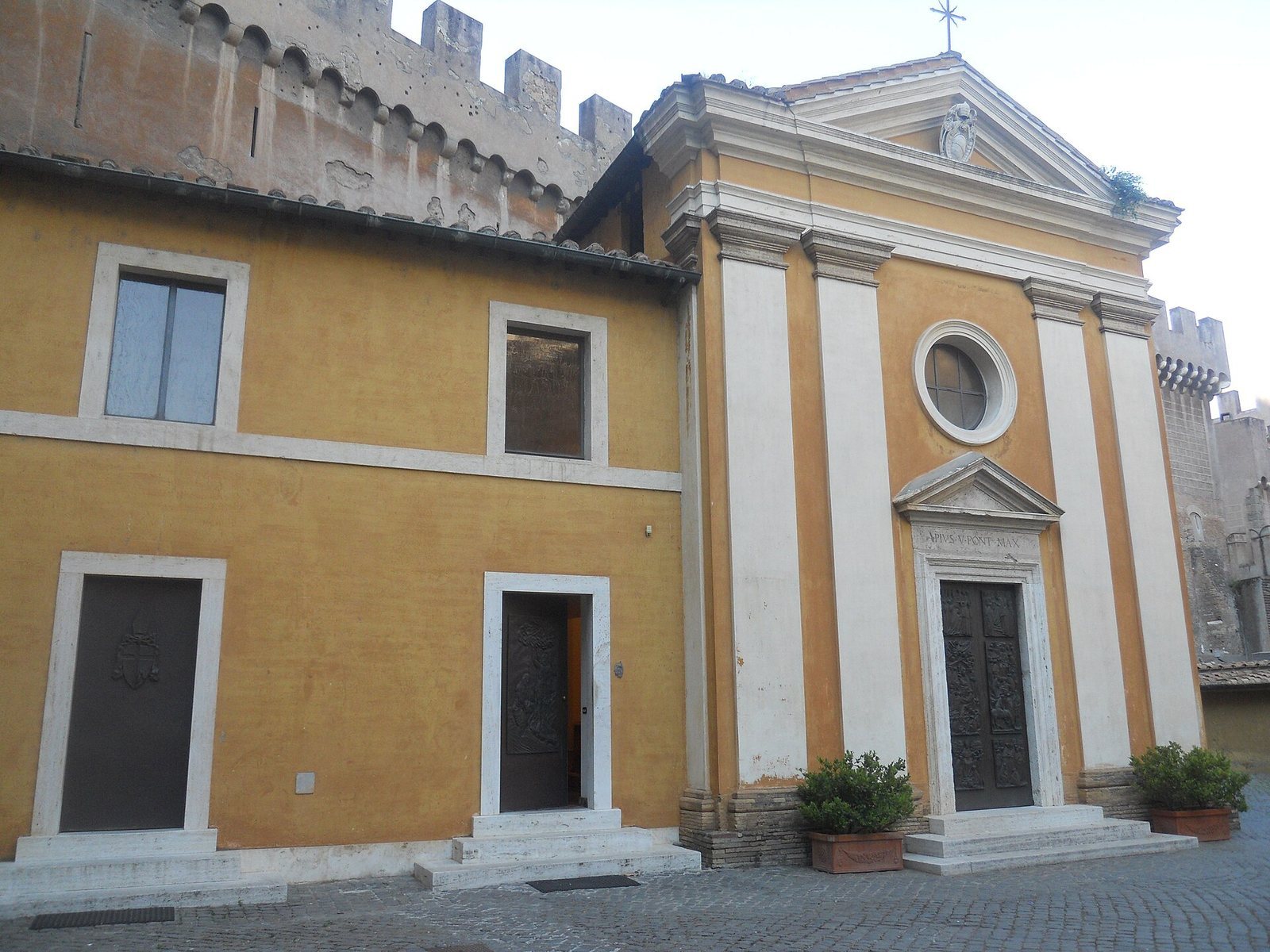
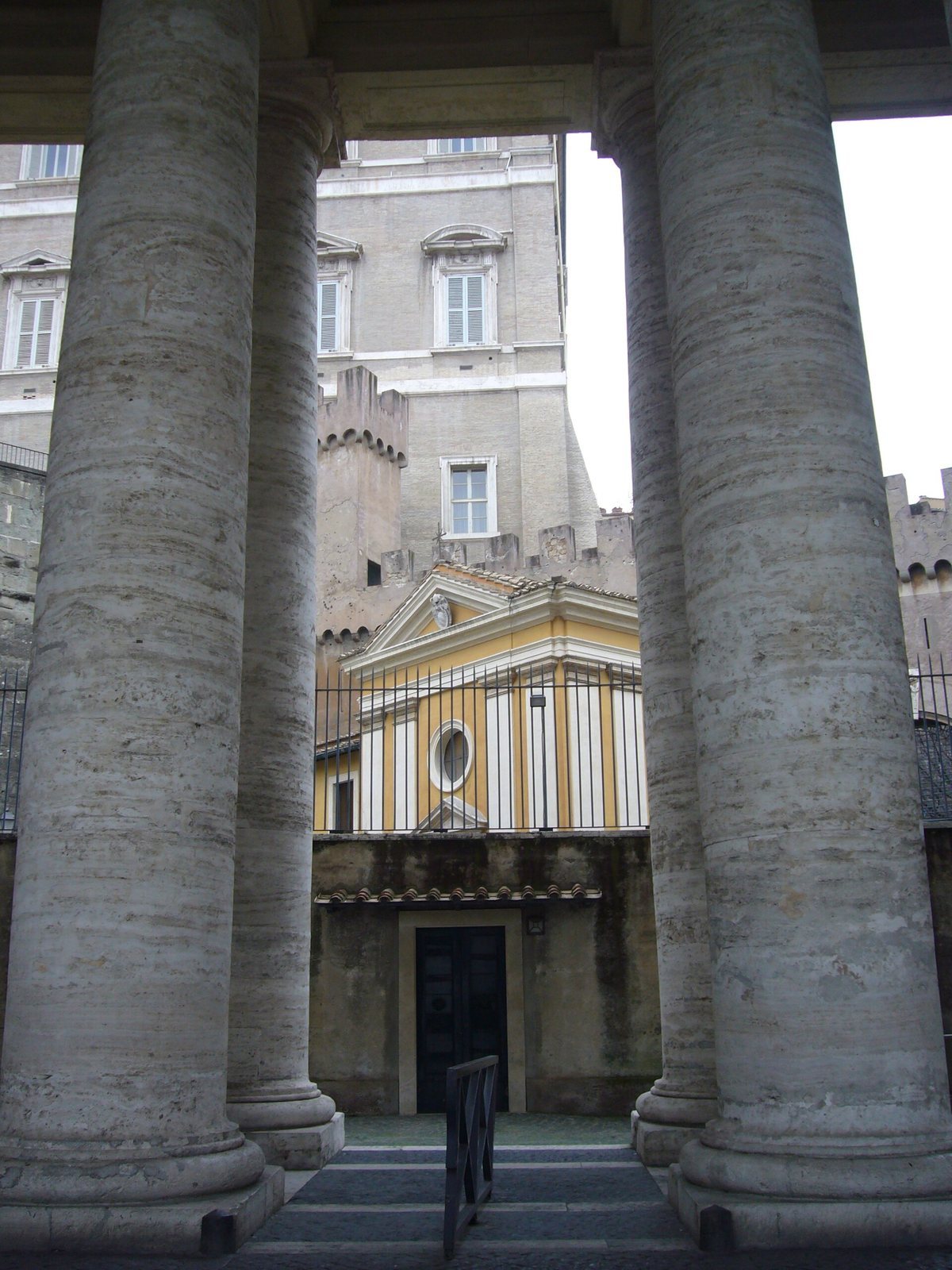
The Renaissance chapel measures 12 by 9 metres, with an area of 108 square metres, and was enlarged in 1999. Its classical façade has four large Doric columns, a type of classical column, supporting a horizontal entablature, the band above them. A pediment, the triangular feature above a building front, bears the coat of arms of Pius V and stops short of spanning the full roofline. A smaller triangular pediment sits above the doorway, topped by a large round window.
Interior decoration
Giulio Mazzoni’s frescoes, or wall paintings, decorated the chapel in collaboration with stucco artist Ferrante Moreschi. Moreschi had also completed part of the stucco decoration in the Sala Regia, a ceremonial hall in the Apostolic Palace, in 1565. The painting above the altar depicts God the Father, while those on its left and right show Saint Martin and Saint Sebastian. The altarpiece depicts the Annunciation of the Virgin Mary. Near the altar, the right wall shows Christ on the cross with Saints Peter and John the Evangelist; the left wall depicts the Virgin Mary with Saint Anne and the Christ Child. Carlo Roncelli restored Mazzoni’s frescoes in 1727–1728. In 1967 they were taken down for conservation and transferred to the Vatican Museums.