Vatican Library: Research Library of the Holy See
Site at a Glance
- Popularity
- Very High
- Country
- Vatican City
- Primary era
- Early Modern
- Eras represented
- Medieval, Early Modern, Modern
- Civilizations
- Papal States
- Site type
- Civic
- Remains
- Library
On this page27 sections
History
The Vatican Library, formally the Vatican Apostolic Library, is the Holy See’s research library in the Vatican Palace in Vatican City. Its institutional roots reach back to the early Church, while its modern public foundation dates to 1475. The library preserves and acquires cultural materials and supports research in history, law, philosophy, science, and theology.
Early Church and dispersed collections
The library’s history is traditionally divided into five periods: Pre-Lateran, Lateran, Avignon, Pre-Vatican, and Vatican. The first reaches back to the early Church. At the Lateran Palace, a church archive and collection of liturgical scrolls took shape in the fourth century. An archive there is associated with Pope Damasus I in 384. From the sixth century, the Vatican secretary oversaw manuscripts, and an office of Vatican librarian appeared in the eighth century. The Lateran period continued until the end of the thirteenth century.
Pope Boniface VIII’s library included illuminated manuscripts, among them 32 Greek books that had belonged to the medieval emperor Frederick II. In 1303, Philip IV of France’s forces burned and plundered the Lateran Palace, taking part of the collection. Pope Clement V ordered 643 valuable manuscripts moved to Assisi in 1310. Many were lost after the Ghibellines, a medieval Italian political faction, attacked the city in 1319.
A new Vatican library began to form in 1318. During the Avignon period, the papal library occupied a tower in the papal palace, and Pope John XXII maintained books for the Curia, the papal administration. The collection grew alongside record-keeping. Pope Gregory XI transferred some books from Avignon to the Vatican. From about 1370 to 1447, the Pre-Vatican collection was scattered among Rome, Avignon, and other places. Much of what remained in Avignon later passed to the National Library of France and the Borghese family.
The public library and Renaissance expansion
Pope Nicholas V, elected in March 1447, is regarded as the founder of the modern collection. Under his predecessor, Pope Eugenius IV, 350 works in Latin, Greek, and Hebrew had been identified. Nicholas brought those together with his own books, establishing a foundation of 800 Latin and 353 Greek manuscripts. He also sought works from Europe and the East, sending the grammarian Alberto Enoch d’Ascolli to find surviving books from the imperial library of Constantinople. Nicholas imagined a public institution that would help make Rome a center of humanist scholarship, but he died before carrying out the plan. The Vatican period began around 1448, when the collection was brought to the Vatican.
Pope Sixtus IV formally established the public library through the bull Ad decorem militantis Ecclesiae on 15 June 1475. It then held 2,527 works, rising to 3,500 manuscripts by 1481. Sixtus appointed the humanist Bartolomeo Platina as its first librarian, organized staff and regular salaries, and opened the holdings to readers under strict supervision. The rooms were arranged as Greek, Latin, secret, and papal libraries. During the pontificate of Pope Leo X, agents travelled across Europe to seek manuscripts, especially copies of classical authors, as part of an effort to renew Latin learning.
Disruption and new quarters
The library held about 4,000 manuscripts when Rome was sacked in 1527. The collection was plundered, and many manuscripts were damaged. Later, as the Catholic Church responded to the Protestant Reformation during the Counter-Reformation, access was restricted, including for Protestant scholars. In the late 1580s, Pope Sixtus V commissioned a new library building from architect Domenico Fontana to provide more space and specially made wooden manuscript cabinets. Under Pope Paul V, archival documents moved to a separate building, beginning the history of the Vatican Secret Archive.
Private and royal collections substantially enlarged the library from the seventeenth century. In 1623, Maximilian I, Elector of Bavaria, gave Pope Gregory XV most of the Heidelberg Palatine Library, which Maximilian had seized during the Thirty Years’ War. The gift acknowledged Gregory’s support in Maximilian’s political contests. In 1815, 38 Latin and Greek manuscripts and works on Heidelberg’s history were returned to the city; Pope Pius VII sent a further 852 manuscripts there in 1816. Pope Alexander VII transferred the Urbino Library to the Vatican in 1657. Founded by Duke Federico da Montefeltro, it contained 1,767 Latin works, 165 Greek works, and 128 works in Hebrew and Arabic.
After Queen Christina of Sweden died in 1689, her collection entered a complex chain of ownership. Her father had gathered some of its books during campaigns in Germany and Poland, and Christina assembled much of the rest while living at Fontainebleau. She left the collection to Cardinal Decio Azzolini. In 1690, his nephew Pompeo sold books to Pope Alexander VIII, who gave some to his nephew, Cardinal Pietro Ottoboni. The later Ottoboniano group included 3,394 Latin and 473 Greek manuscripts, and the library also acquired 288 manuscripts collected by the Florentine marquis Alessandro Capponi.
New collections and scholarly management
In 1715, Pope Clement XI sent Joseph Assemani on an expedition to Syria and Egypt. Over two years, Assemani collected about 150 manuscripts from monasteries in the Nitrian Desert and from Cairo, Damascus, and Lebanon. Pope Clement XIII later added the Assemani brothers’ collection, including 202 Syriac-Chaldean, 180 Arabic, and six Turkish manuscripts. French authorities seized 500 manuscripts during the Napoleonic Wars in 1797. Most were returned in 1815, but 36 were not recovered.
The library acquired Count Cicognara’s books and 1,445 manuscripts belonging to Cardinal Angelo Mai in 1855. Mai had served as chief keeper from 1819 to 1854. Pope Leo XIII modernized the institution, opening a reading room for printed books, introducing rules for manuscript cataloguing, and placing day-to-day work in the hands of professional specialists. He formally reopened the library to scholars in 1883 after earlier restrictions. In 1891, he acquired the Borghese counts’ collections, which included about 300 scrolls from the old Avignon library. The Vatican purchased Cardinal Francesco Barberini’s archives in 1902. Uniform cataloguing rules for printed books followed the First World War.
Further accessions included the Rossiana collection in 1922, the Chigi Library in 1923, and the Ferraioli collection in 1926. The library acquired the archive of St Peter’s Chapter and historian Federico Patetta’s manuscripts, charters, and autographs in 1940, followed by the Rospigliosi family archive in 1953. Collections obtained under Pope John XXIII included Italian manuscripts from Tammaro de Marini, Persian dramatic works, and Ethiopian manuscripts collected by Enrico Cerulli. Borghese materials from the earlier collection returned to the Vatican in 1902.
Between the world wars, Pope Pius XI initiated a major reorganization. With assistance from the American Library Association and the Carnegie Endowment for International Peace, the library introduced modern cataloguing and staff training. Vatican librarians visited American institutions, including the Library of Congress. The collaboration helped establish the International Federation of Library Associations in 1929. On 22 December 1931, a library roof collapsed, killing five people and destroying about 800 books and manuscripts.
Conservation and contemporary research
Measures to protect the collections from insects, damp, and dust developed over several centuries. Pope Paul IV created the post of restorer in 1555, and a restoration laboratory was established under Leo XIII in 1890. Facsimiles of manuscripts, including works by Virgil, Dante, and Petrarch, began to be made in the nineteenth century. As some manuscripts deteriorated through ink corrosion, an international conference on restoration methods met in 1898 at the initiative of Franz Ehrle.
During Pope John Paul II’s pontificate, conservation measures expanded to include radio-frequency identification, electronic tags used to track books. A technology developed with a Japanese company used ultraviolet light to reveal earlier writing on palimpsests, surfaces reused after earlier writing had been erased or obscured. Renovation work from 2007 to 2010 strengthened floors and added lifts and climate control. Manuscript digitization began as a trial in 2010, and the first digitized manuscripts became available online in 2013.
The Lateran Agreements, which established the framework for relations between the Holy See and Italy, guarantee research access to the library subject to Vatican regulations. Its work continues to combine the preservation and acquisition of cultural property with scholarly research and publication.
Remains
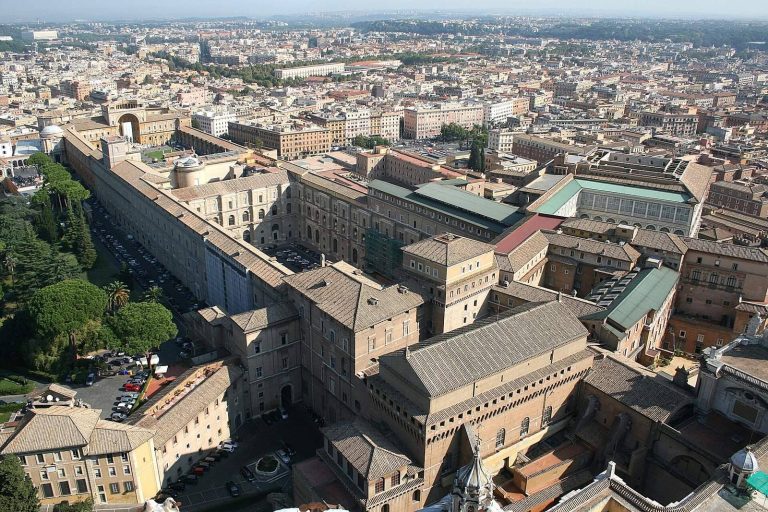
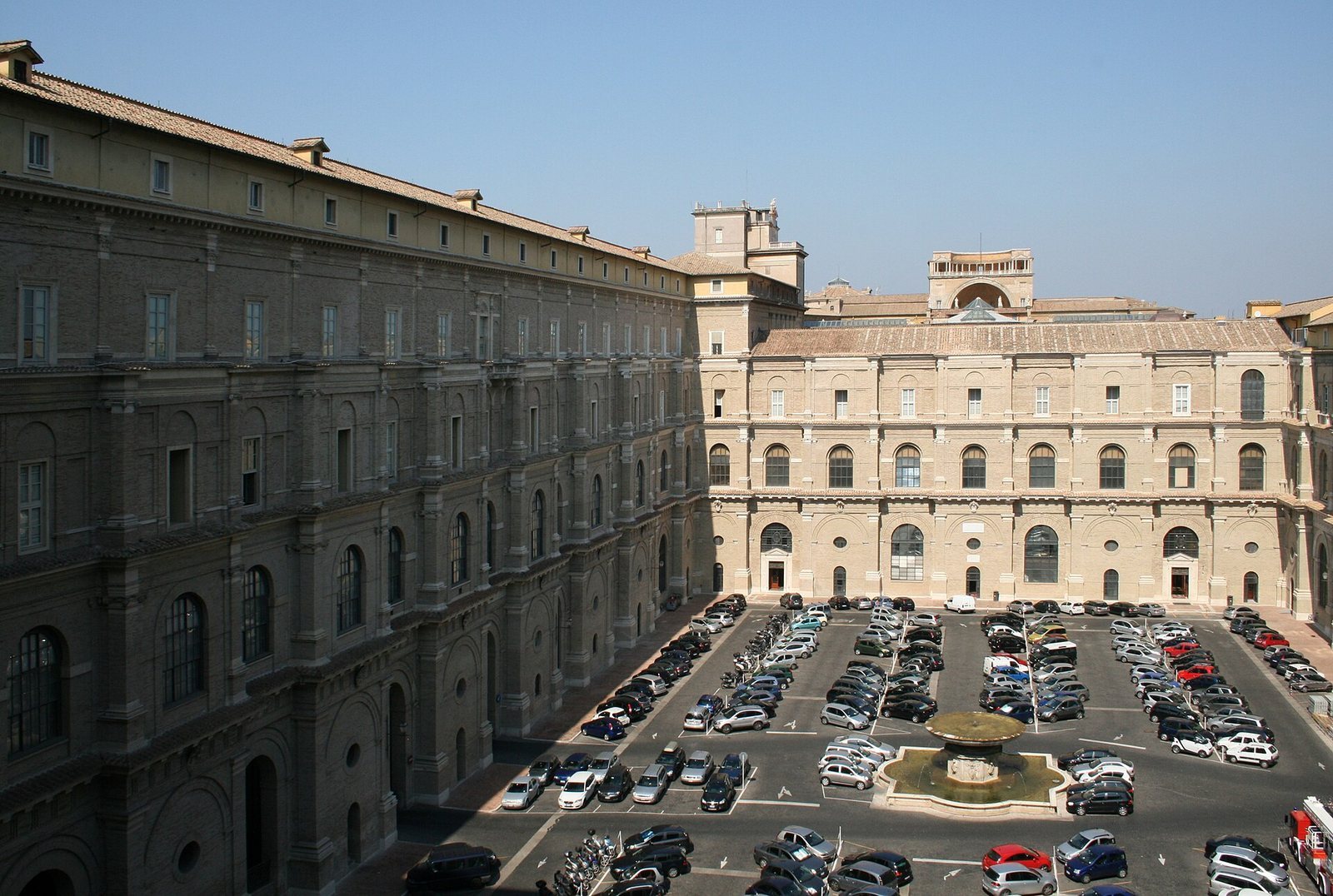
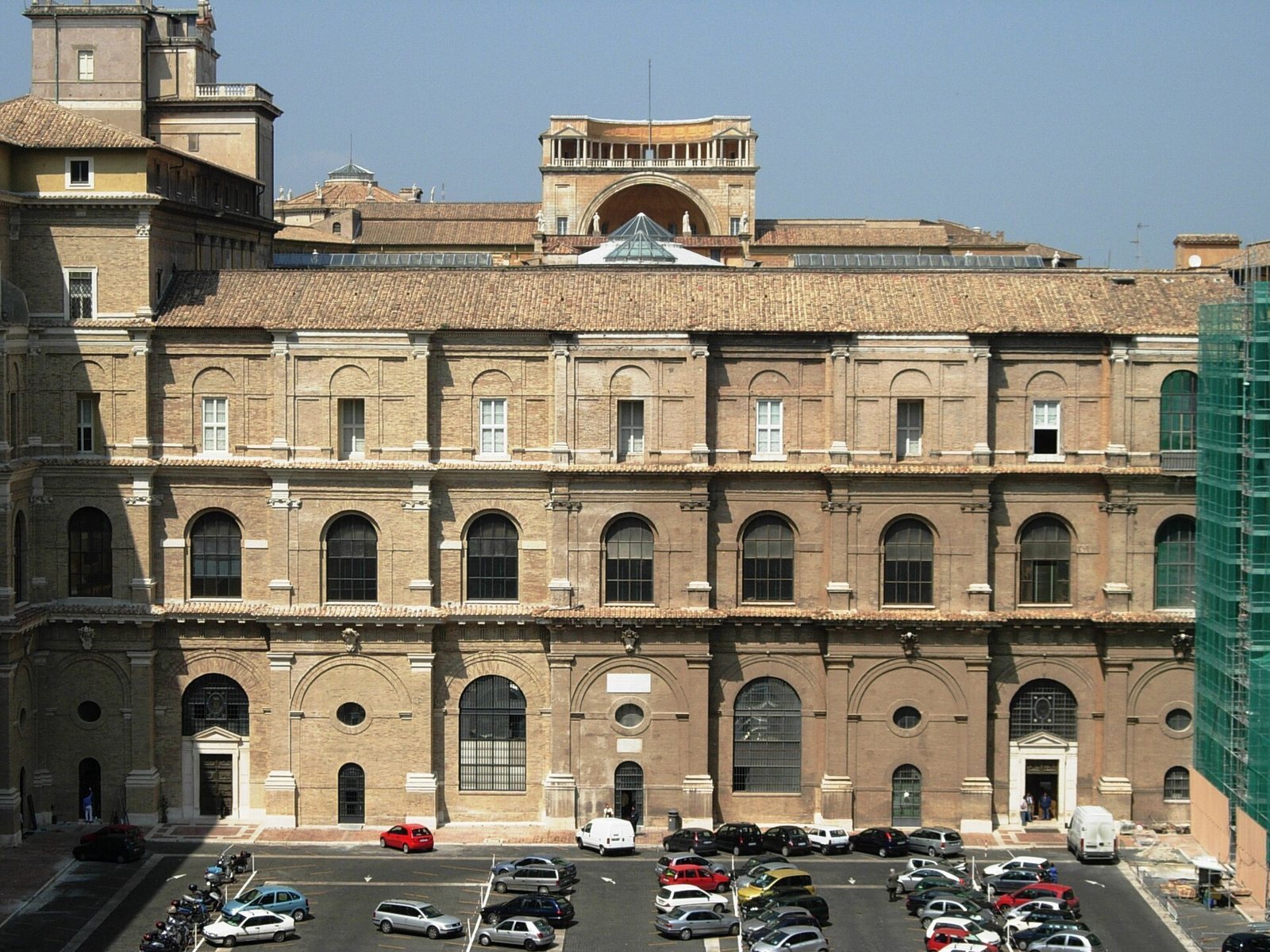
The library occupies a large wing of the Vatican Palace, entered from the Belvedere Courtyard. The wing crosses Bramante’s Belvedere Courtyard, dividing it and altering the courtyard’s late-Renaissance composition. Wooden cabinets were fitted for manuscript storage. The library has about 42 kilometres of shelving. A semi-basement contains a papyrus room and manuscript storage, the first floor houses the restoration laboratory, and the second floor contains the photographic archives.
Rooms and architectural decoration
Nicholas V’s rooms
The original rooms associated with Pope Nicholas V preserve fresco decoration by Domenico Ghirlandaio, Melozzo da Forlì, and Antoniazzo Romano. They form an earlier decorated group within the larger library complex.
The Sistine Salon
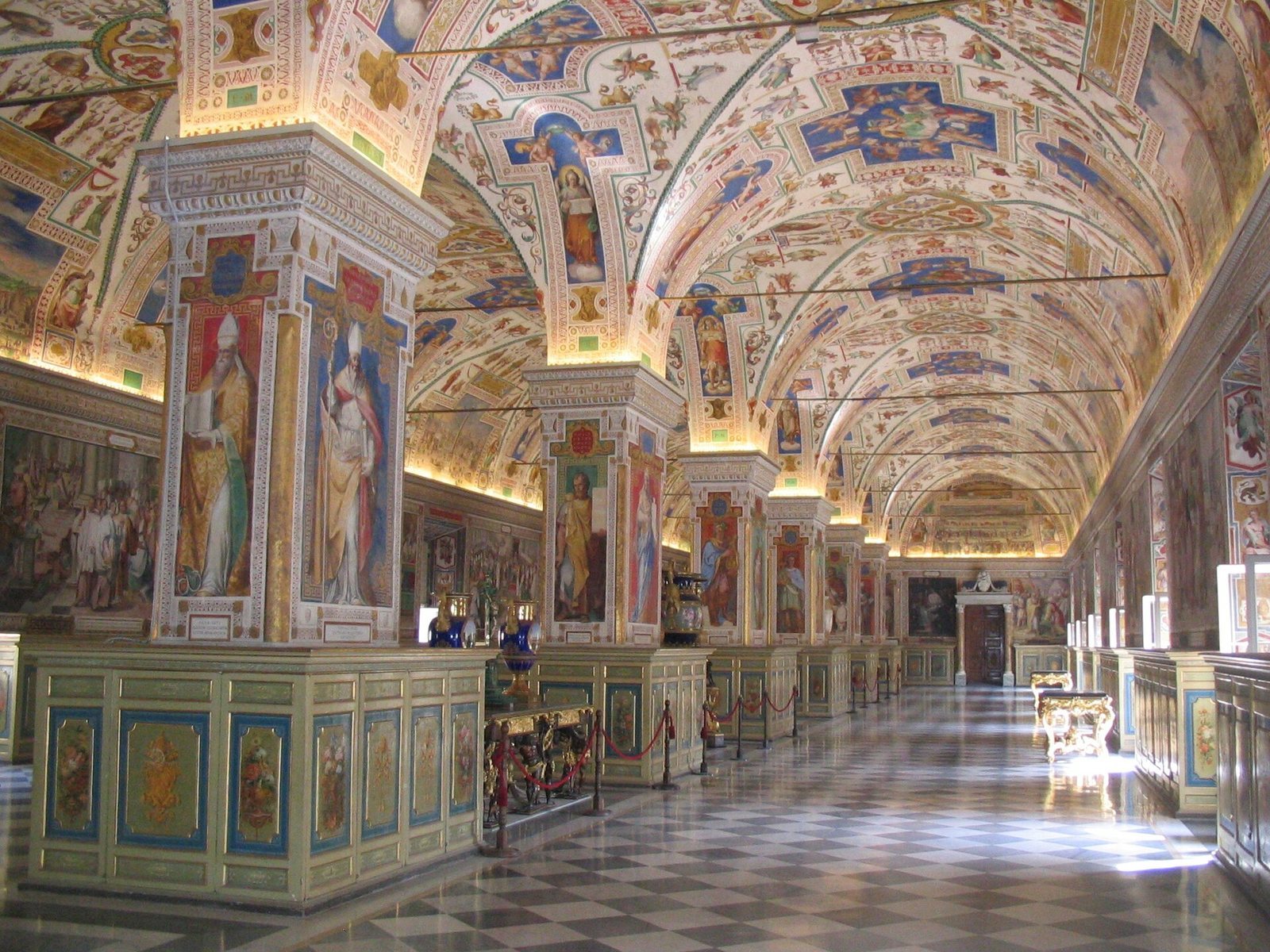
The 70-metre-long, 15-metre-wide Sistine Salon is a Mannerist hall, a late Renaissance style marked by deliberate artifice and complex forms, designed to hold books and manuscripts. Its frescoes depict ancient libraries in Alexandria, Athens, and Rome and their founders, as well as the apostle Peter founding the Vatican Library. Other scenes show the development of alphabets, church councils through 1587, and Roman monuments, including the old and new Lateran Palaces. Captions accompany figures and scenes, and the vaults carry ornamental grotesques. The painters are not securely identified. Prospero Orsi may have painted the grotesques; Lilio, Ricci, Guerra, Nebbia, and others worked on the frescoes. The salon now serves as an exhibition space.
The Aldobrandini Wedding Room
Dating to 1611, this room was restored in 1817 to store copper engravings. The antique fresco known as the Aldobrandini Wedding was moved there in 1818. Found on the Esquiline Hill in 1604, the Augustan-period fresco takes its name from its first owner, Cardinal Pietro Aldobrandini, and its wedding scene. It may represent the marriage of Alexander the Great and Roxana. The room also contains frescoes of scenes from the Odyssey, dating to about the fourth century BC, and a ceiling painting by Guido Reni depicting the deeds of Samson.
The Papyrus Room
Established in 1774 under Pope Clement XIV, the Papyrus Room held papyri from Ravenna dating from the sixth to ninth centuries. Its ceiling paintings by Raphael Mengs depict the founding of the Clementine Museum. Two display cases contain gold cups decorated with secular, Jewish, and Christian scenes.
The Alexander Room
Built in 1690, the Alexander Room was painted by Domenico de Angelis in 1818. Its frescoes portray episodes from Pope Pius VI’s captivity under Napoleon, his exile, and his death in exile in 1799.
The Pauline Rooms and Clementine Gallery
Giovanni Battista Ricci painted the two Pauline Rooms with scenes from the pontificate of Pope Paul V. The Clementine Gallery was built under Pope Clement XII and divided into five rooms under Pope Pius VI. Its frescoes by D. de Angelis depict scenes from the pontificate of Pope Pius VII. Other rooms in the complex are known as the Sistine Halls.
The Urban VIII Gallery
The Urban VIII Gallery houses the Palatine Library. Astronomical instruments are displayed beside its windows.
Museums, chapels, and display rooms
The Pius V Chapel
Jacopo Zucchi painted the chapel between 1566 and 1572 from designs by Giorgio Vasari. A display case holds vessels for relics from the Sancta Sanctorum chapel in the medieval Lateran Palace. Decorated with gilding and precious stones, the vessels were moved to the Vatican in 1905. The relics remain at their original site, in replacement vessels beneath the altar of the Chapel of Saint Lawrence. Other displayed objects include a gold cross of Paschal I, decorated with enamel scenes from Christ’s childhood, and an eleventh-century Byzantine silver container for the head of Saint Praxedes, ornamented with apostles and reliefs.
The Sacred Art Museum
Founded in 1756 to house early Christian objects, the Sacred Art Museum contains cups, bronze and clay lamps, glass and metal objects, and a wax-mosaic icon of Saint Theodore dating to the twelfth or thirteenth century. Its glass collection includes objects acquired by Pope Benedict XIV in 1744 from Cardinal Gaspare Carpegna, who gathered antiquities from Roman catacombs. A collection of precious stones assembled by Vettori later joined it. The museum also holds ancient medallions made with a thin layer of gold between sheets of glass. They show couples, saints, biblical subjects, hunting, and other secular scenes; many came from Roman catacombs.
The Secular Art Museum
The library’s Secular Art Museum provides exhibition space for Roman and Etruscan artifacts.
The address rooms
The room known as the Pius IX Address Hall formerly held addresses of praise to the pope. It now displays textiles, chiefly medieval fragments from the Sancta Sanctorum chapel. Its oldest exhibit is a linen tunic dating to the third century. A separate Address Hall displays Roman and early Christian cups, ivory, enamel, and metalwork. Among its objects are an ivory diptych from Rambona, dating to about 900 and showing the Virgin enthroned and the Crucifixion, and thirteenth-century gilt-copper figures of Christ enthroned and five apostles, decorated with enamel and pearls. The figures once adorned the altar of the old St Peter’s Church.
Statues in the library
The main reference room contains a statue of Saint Thomas Aquinas sculpted by Cesare Aureli around 1910. A large statue of Hippolytus stands at the foot of the grand staircase in the La Galea entrance hall.
Books and manuscripts
Organization and scale of the collections
The holdings include about 1.6 million printed books, 150,000 manuscripts, 8,300 incunabula, meaning books printed before 1501, more than 100,000 engravings and geographical maps, and about 300,000 coins and medals. The Latin collection is called the Bibliotheca Latina, and the Greek manuscript collection the Bibliotheca Graeca. The Bibliotheca Secreta is a restricted collection of valuable documents, while the Bibliotheca Nova Pontifica contains archival material. Manuscripts are arranged by language in open and restricted divisions. The open group is called the Codices Vaticani; restricted manuscripts are organized by provenance.
Greek and Latin manuscripts
The Codex Vaticanus, also called Codex Vaticanus Graecus 1209, is a Greek Bible manuscript from the mid-fourth century and one of the oldest substantially complete Greek Bibles in the collection. Ornament was added in the tenth century, and the manuscript was partly reconstructed in the fifteenth. The four-book Libri Carolini, compiled at Charlemagne’s direction, challenges the decisions and teachings of the Seventh Ecumenical Council, which addressed the veneration of religious images.
Three manuscripts of Virgil preserve different aspects of the library’s classical holdings. The early-fifth-century Vergilius Romanus has 309 square leaves, each 33 centimetres on a side, and 19 coloured illustrations. Its text uses capital letters without spaces between words. The Vergilius Vaticanus, from the late fourth or early fifth century, survives in 75 leaves with 50 illustrations. Its fragments contain nine of the twelve books of the Aeneid and two of the four books of the Georgics. It was at the Abbey of Saint-Martin at Tours in the medieval period, reached Italy by the 1510s, and entered the Vatican Library around 1600. Four leaves of the Vergilius Augusteus are held here, with three others in the Berlin State Library.
The library also holds a two-column parchment manuscript of De arte venandi cum avibus, a work on falconry associated with Frederick II, written in the 1240s and comprising 111 folios. Other notable manuscripts include the Joshua Roll, an illustrated scroll of episodes from the biblical Book of Joshua; the Menologion of Basil II, an illustrated Byzantine calendar of saints’ feast days; the Gelasian Sacramentary, a Christian liturgical book; the Barberini Gospels; and the Vatican Croatian Prayer Book. The Bodmer papyrus contains the oldest texts of Luke and John represented among the library’s holdings. Two copies of the Gutenberg Bible, printed in the mid-fifteenth century, are also held there.
Classical manuscripts include works by Cicero, Terence, Homer, Aristotle, and Euclid. Among the Euclid texts are parts of the Elements, including Book I, Proposition 47, one of the oldest Greek texts on the Pythagorean theorem. The library also holds letters by Thomas Aquinas, Petrarch, Michelangelo, Raphael, Martin Luther, and Henry VIII. The Lorsch Gospels, written and illustrated between 778 and 820, are dispersed among several museums; the Vatican holds their carved ivory rear cover and the Gospels of Luke and John. Other holdings include fragments of the Old Saxon Genesis and Heliand in Palatinus Latinus 1447, a fourteenth-century manuscript of Catullus in Codex Vaticanus Ottobonianus Latinus 1829, and a ninth-century copy of Terence’s comedies in Codex Vaticanus Latinus 3868.
Manuscripts in other languages
The collection includes about 10,000 Latin, Greek, and Eastern manuscripts and early printed books in the Barberini group, and the Borgia collection contains manuscripts in Persian, Turkish, Armenian, Arabic, Georgian, and other languages. Among the library’s manuscripts is the Codex Borgia, a substantial Mesoamerican work made on animal skins, with hieroglyphic writing and images of mythology and foundational rituals. The sole manuscript of the Arabic love story Hadith Bayad wa Riyad is Codex Vat. Arabo 368. Borgiani Siriaci 175 is a scroll of the Mandaean text Diwan Abatur, belonging to a Middle Eastern monotheistic religion whose adherents revere John the Baptist.
More than 100 Quran manuscripts are held across several collections. Examples include Vaticani arabi 73, Borgiani arabi 25, Barberiniani orientali 11, and Rossiani 2. The largest, Vat. Ar. 1484, measures 540 by 420 millimetres. The smallest, Vat. Ar. 924, is a circle 45 millimetres in diameter, preserved in an octagonal case. The library also holds the accordion-folded Codex Vaticanus 3738, or Codex Ríos, which contains an Italian translation of a Spanish colonial-era manuscript with copies of Aztec paintings from the Codex Telleriano-Remensis. It is believed to have been written by the Dominican friar Ríos in 1566.
Printed books, drawings, and maps
Printed books are arranged by fields including palaeography, history, art history, and classical, medieval, and Renaissance philology. The earliest entered the Prima Raccolta in the 1620s and 1630s; later holdings include books from the Barberini, Palatine, and Zelada collections. The Cabinet of Prints and Drawings contains drawings and reproductions. One group comprises 161 volumes assembled through 1793, with about 32,000 sheets arranged by school. A further 10,000 sheets are organized by genre.
Coins, medals, and archival material
The Cabinet of Coins and Medals opened in 1555. Its holdings include a major collection of Greek and Roman coins assembled by Cardinal Alessandro Albani, as well as the Rancè collection, added in 1901. Papal acts form another substantial part of the archival holdings, including about 4,000 volumes from the Chigi collection. The library’s varied contents bring together manuscripts, printed works, visual materials, and objects preserved in its specialist collections.