Saint Nicholas Church on Lipno Island: A Medieval Orthodox Church in Russia


Site at a Glance
- Rating
- 5
- Popularity
- Very Low
- Country
- Russia
- Primary era
- Medieval
- Eras represented
- Medieval
- Civilizations
- Novgorod Republic
- Site type
- Religious
- Remains
- Church
On this page8 sections
History
Saint Nicholas Church on Lipno Island is an Orthodox church in Russia, about 9 km south of Veliky Novgorod, built by Novgorodian builders in 1292–1294 as a late-thirteenth-century example of Novgorodian stone architecture. Its main altar is dedicated to Saint Nicholas the Wonderworker, a principal saint of Eastern Orthodoxy associated with generosity, protection, and miraculous aid, while its chapel is dedicated to Saint Clement. The church stands in the Msta River delta and belongs to the Novgorod Eparchy, the administrative diocese of the Russian Orthodox Church serving the Novgorod region.
Origins and the Stone Church
Local tradition connects the site with an icon of Saint Nicholas painted on a round wooden panel. The icon was said to have been found on Lipno in 1113 and to have healed Mstislav Vladimirovich, a prince of Novgorod who later became grand prince of Kiev. A monastery and wooden church were probably established soon afterward, although their precise dates are unknown. Chronicles record that a church stood within the monastery.
The present stone building was begun in 1292 on the order of Novgorod Archbishop Clement and was probably completed in 1294. It is regarded as one of the first, and possibly the first, documented stone churches built in the Novgorod Republic after the Mongol invasion of Rus. The Novgorod Republic was a medieval polity centered on Novgorod, with autonomous political institutions and extensive regional influence. A church on Shchirkova Street was being built at the same time.
The designers drew on the nearby Nativity Church at Peryn Hermitage, a pre-Mongol Novgorodian building that adapted principles of Smolensk architecture. Saint Nicholas Church therefore belongs to a period when Novgorodian builders were developing a distinctive stone tradition while maintaining connections with earlier architectural models.
Monastic Decline and Wartime Damage
The church was frescoed in 1293–1294. In 1764 the monastery was dissolved. Its refectory and Church of the Holy Trinity were later dismantled, and their materials were used for repairs at Skovorodsky Monastery. During the nineteenth century, Saint Nicholas Church fell into disuse, and services were held only rarely.
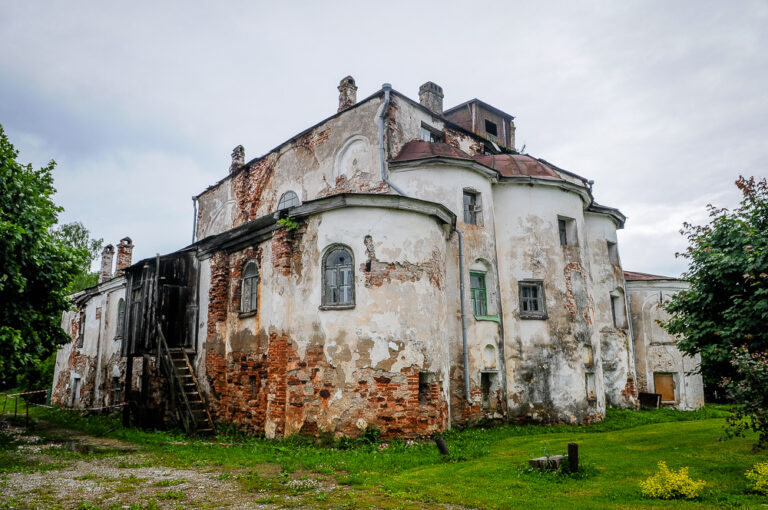
Following the 1917 Revolution, the church was closed and deteriorated severely. Its two-tier belfry was demolished. During the Second World War, a Soviet observation post was established on Lipno Island. Intermittent German shelling from positions about 6 km away caused extensive damage. About 65 percent of the medieval masonry remained, while approximately 35 percent later had to be replaced.
Restoration and Continuing Use
Work on the frescoes began in 1945. A major restoration from 1954 to 1956, directed by Lyubov Shulyak with the participation and advice of P. N. Maksimov, returned the church to its earlier appearance. Further restoration began after a project prepared in 2016 was approved in 2017, and the work was completed in 2019.
Saint Nicholas Church is a federal-level protected cultural-heritage monument of the Russian Federation and forms part of the Historic Monuments of Novgorod and Surroundings, inscribed on the UNESCO World Heritage List in 1992. It remains both an active church and a museum, with services held once or twice a year. On 6 January 2021, Russian President Vladimir Putin attended a Christmas Eve service there and presented the church with an icon of Christ Pantocrator.
Remains
Island Setting and Exterior
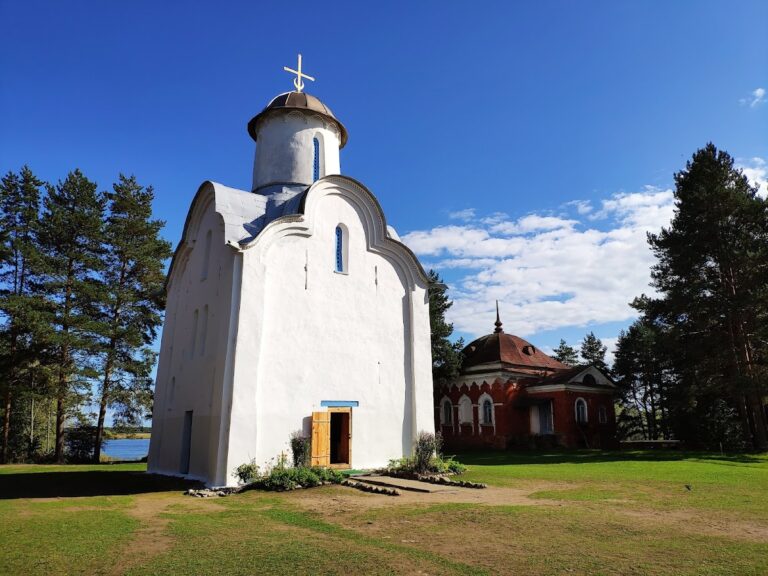
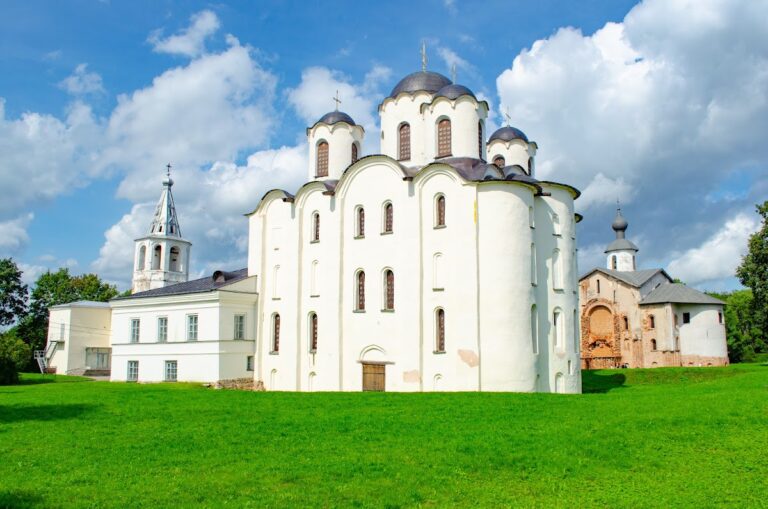
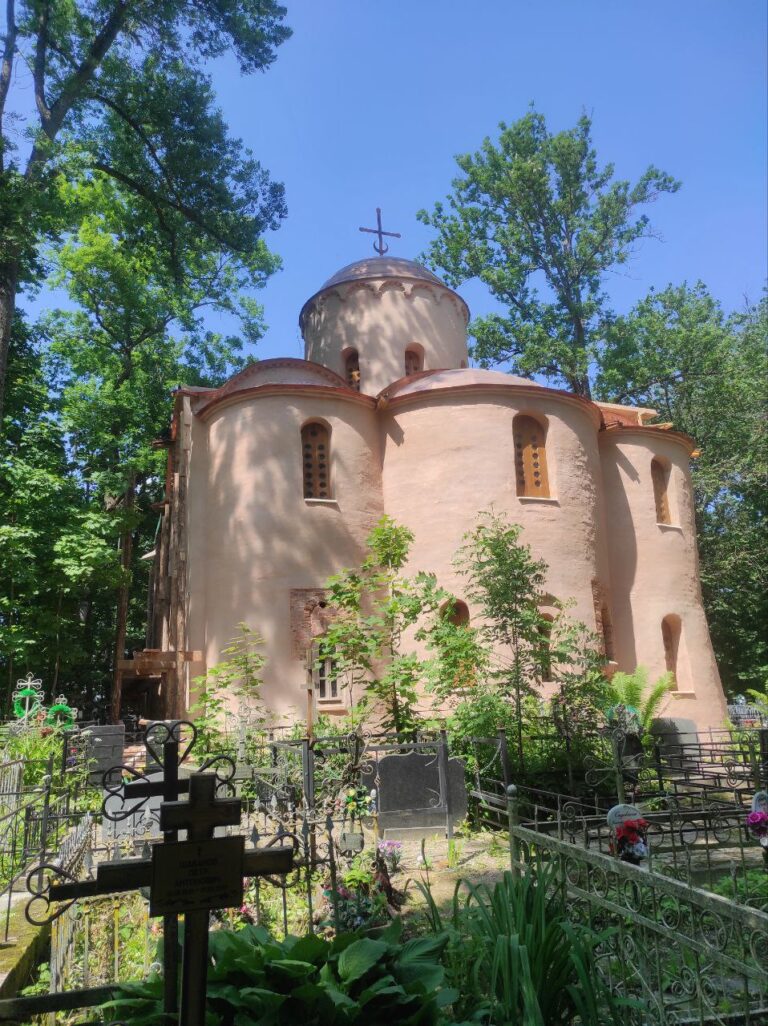
Saint Nicholas Church stands on Lipno Island in the Msta delta, near the confluence of the Msta and Lake Ilmen and on the bank of the Plotnitsa River. The island is itself a protected natural territory. The building is a square, cross-domed church measuring approximately 10 by 10 metres. Its central dome is supported by four piers, and a single apse, a usually semicircular or polygonal projection associated with the altar, extends from the east. A trilobed roof and facade profile gives the church a form characteristic of Novgorodian architecture.
The four facades are not identical. Pilasters appear only at the corners instead of dividing each facade into three vertical sections, producing a comparatively solid, monolithic appearance. The original exterior was unplastered, with masonry made from stone slabs and shell limestone of varied sizes and shades. The limestone came from the Volkhov region. Dark-colored brick formed the window arches, creating a contrast that was an innovation over the earlier combination of limestone and thin brick.
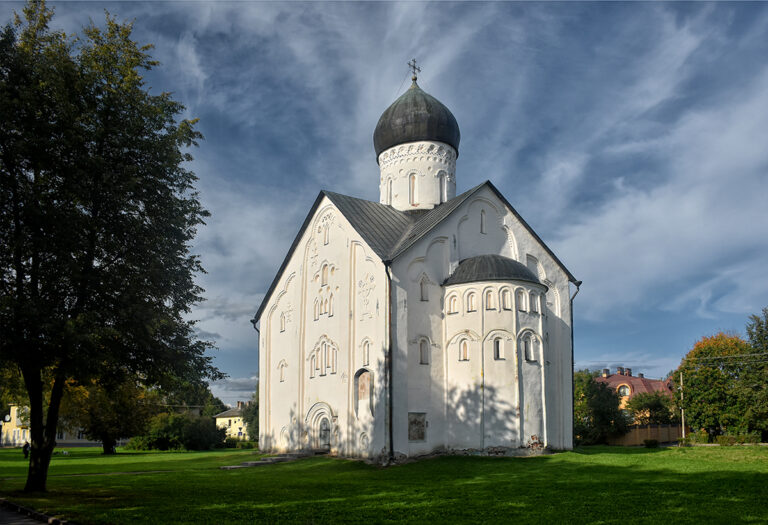
Arcaded friezes run across the upper part of the drum, above the window arches, and below the trilobed facade outlines. These details have been associated with Romanesque or transitional Romanesque-Gothic architecture in Livonia. Baltic craftsmen from Riga or Revel may have worked alongside Novgorodian builders. Small niches containing carved stone crosses also decorate the facades. A niche above the western entrance once held a fresco, which has disappeared.
Interior Structure and Frescoes
The lower sections of the two western supporting piers are hexagonal, while their upper sections are cross-shaped. The eastern piers are rectangular below and cross-shaped above, a form suited to the attachment of an iconostasis. This screen of icons separates the sanctuary from the main worship space in an Eastern Orthodox church. An open staircase from the southwestern corner leads to the choir loft. Earlier, worshippers reached the choir by a staircase built within the wall.
Several sections of the medieval fresco cycle survive. An Annunciation composition appears on the eastern piers, showing the angel Gabriel announcing to Mary that she would bear Jesus. At the entrance to the deacon’s chamber, a subsidiary sanctuary space used for liturgical preparation and storage, is a scene of the Three Youths in the Fiery Furnace from the Book of Daniel. The surviving paintings are lit by windows placed on the central axes of the facades.
Many of the original paintings were destroyed during the Second World War. Several well-preserved sections were uncovered in 1930, when later layers of oil paint were removed. Their survival provides a direct connection with the church’s medieval decoration and with the campaign carried out in 1293–1294.
Saint Nicholas Icon
A large icon of Saint Nicholas, measuring 184 cm in height, was painted for the church in 1294 by the medieval painter Aleksa Petrov. The Third Novgorod Chronicle records its creation. The icon is now exhibited in the Novgorod Kremlin Museum, while the church itself continues to preserve the architectural and painted remains of the medieval foundation.