Annunciation Church at Gorodishche: A Medieval Orthodox Church in Russia
Site at a Glance
- Country
- Russia
- Primary era
- Medieval
- Eras represented
- Medieval
- Civilizations
- Novgorod Republic
- Site type
- Religious
- Remains
- Church
On this page11 sections
History
Foundation and medieval rebuilding
The Annunciation Church at Gorodishche is a ruined Orthodox church in Spas-Nereditsy, Novgorod Oblast, Russia. Mstislav Vladimirovich, a prince of medieval Rus and son of Vladimir Monomakh, ruler of Kievan Rus, founded it in 1103. It was Novgorod’s second stone building, after St Sophia Cathedral, the city’s principal medieval cathedral.
Mstislav established the church to commemorate the birth of his first son, Vsevolod, whose baptismal name was Gabriel. The archangel Gabriel is associated with the Annunciation, linking the dedication to the prince’s name. Two inscriptions concerning Vsevolod-Gabriel’s death may point to this connection between his birth and the church’s foundation and dedication.
A master named Peter has been proposed as the builder. A Novgorod chronicle places Peter in charge of work on St George’s Cathedral at Yuriev Monastery, an Orthodox monastery near Novgorod. He has also been tentatively linked to St Nicholas Cathedral at Yaroslav’s Court, a medieval civic and trading center in the city.
In 1342–1343, the twelfth-century church was dismantled and replaced on the same site. Archbishop Vasily of Novgorod, a senior bishop in the church hierarchy, commissioned the new building.
Damage, rebuilding, and destruction
The church suffered major damage during the Swedish occupation of Novgorod from 1611 to 1617. In 1797, as the building deteriorated, extensive rebuilding removed most of its vaults, arches, and the structure supporting its dome.
The church remained in use until 1930, when it closed and fell out of use. German artillery destroyed it in 1941 during the Second World War.
Investigation and conservation
Study of the church began in the 1930s under Mikhail Karger, a researcher from Leningrad who continued his work in the 1960s. A new phase, led by Vladimir Sedov, began in the early 2000s and ended in 2017. Extensive restoration and conservation followed, including the first use in the Novgorod region of a method intended to preserve the ruins for display.
The church was associated with the Orthodox Diocese of Novgorod and Staraya Russa, a church district overseen by a bishop. Its ruins are a federal-level cultural heritage site and form part of the UNESCO World Heritage property Historic Monuments of Novgorod and Surroundings, inscribed in 1992.
Remains
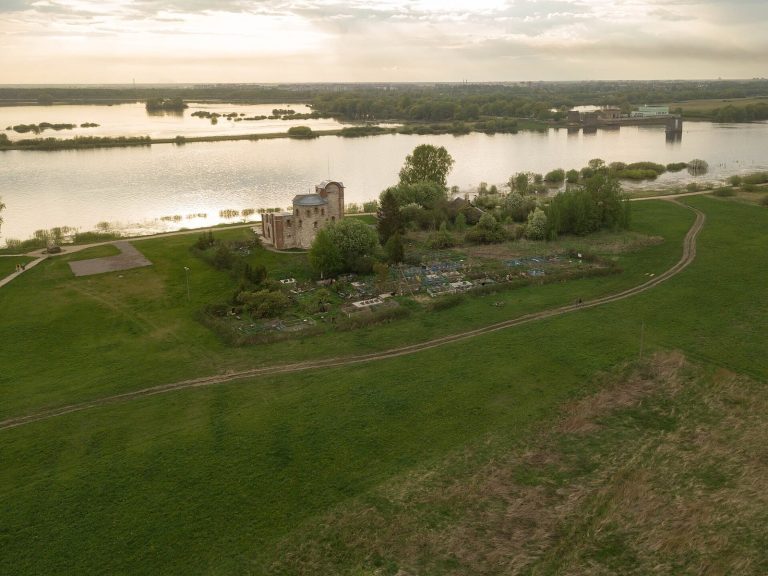
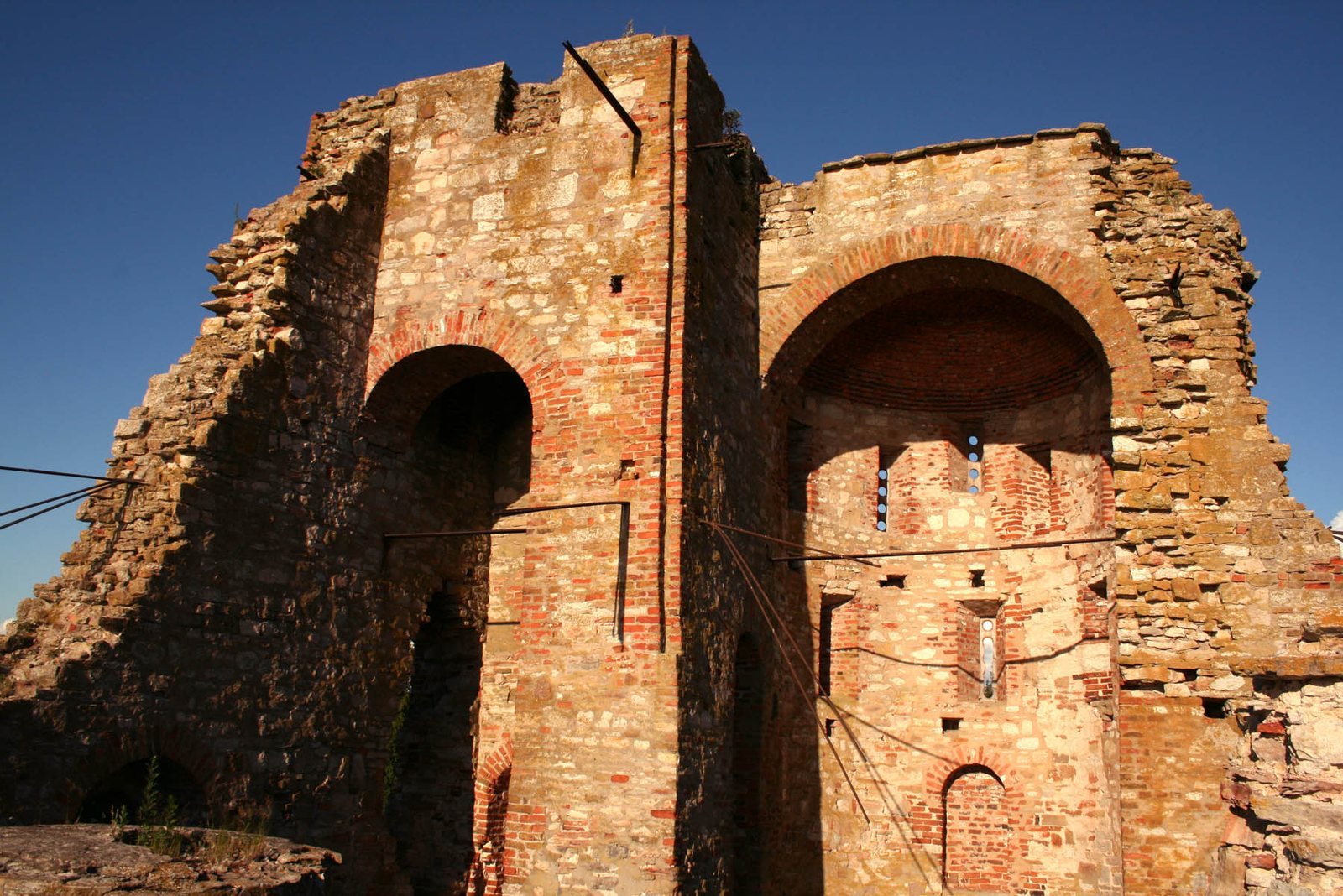
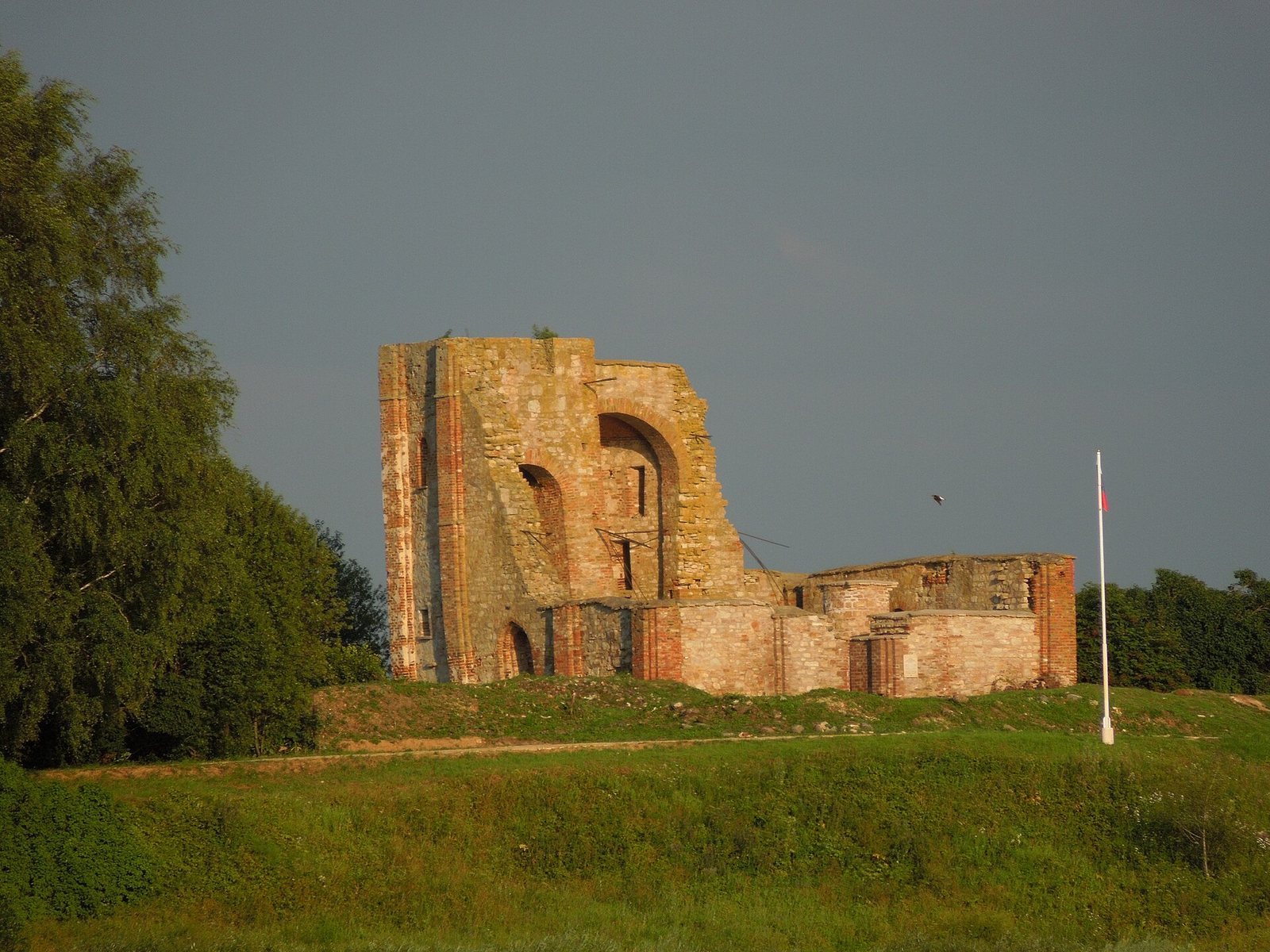
The ruins lie on Rurik’s Hillfort, north of Lake Ilmen on the right bank of the Volkhov River. The replacement church was a large building with six pillars, three apses (projecting spaces commonly found at the end of a church), and an attached stair tower. Shallow vertical pilaster strips articulated its interior and exterior walls, while its façades apparently had three-lobed upper profiles.
Church structure and additions
Main church
The church’s vault and dome collapsed in antiquity and were replaced with wooden ceilings. By the 1860s, the building had one entrance, on its western side, and a floor made of wooden boards.
West porch and bell tower
A porch added against the west wall in 1806 contained a chapel dedicated to the Meeting of the Lord, also called the Presentation of Christ in the Temple. A small stone bell tower was part of the addition. The porch and tower were substantially rebuilt in 1882.
Painting and written evidence
Altar fresco
Frescoes covered a small section of wall within a niche in the altar. The central image was a Pietà, a depiction of the dead Christ with mourners, described as “Christ in the Tomb.” It was flanked by John the Theologian, a traditional name for the apostle John, and Bishop Rodion, apparently the patron saint of the person who commissioned the painting. Its date is uncertain: it may have been painted when the church was built, which would make it among the earliest Novgorod paintings of the fourteenth century, or it may date to the late fourteenth century.
Inscriptions and lettering
Researchers found 49 graffiti inscriptions on fragments of plaster from the church walls. Some use Glagolitic, an early Slavic alphabet distinct from Cyrillic that was already uncommon by the early twelfth century. One is identified as the largest known Glagolitic inscription in Russia. A Cyrillic character found in twelfth-century Novgorod material also informed the Russian linguist A. I. Sobolevsky’s hypothesis that its form belonged to early Cyrillic rather than deriving from a later Serbian form.