Rurikovo Gorodishche: An Early Medieval Fortified Settlement and Princely Residence
Site at a Glance
- Popularity
- Very High
- Country
- Russia
- Primary era
- Medieval
- Eras represented
- Medieval, Early Modern, Modern
- Civilizations
- Kievan Rus, Russian
- Site type
- City
On this page15 sections
History
Rurikovo Gorodishche is an early medieval fortified settlement on the right bank of the Volkhov in Veliky Novgorod, Russia. Its major earth-and-timber defenses date to 858–862, and the settlement developed into a center of trade, crafts, military administration, and princely rule in the Lake Ilmen region.
Early occupation and ninth-century emergence
Occupation began long before the medieval center took shape. The site preserves evidence of a Neolithic campsite from the second or third millennium BCE, a settlement of the first millennium BCE, and activity in the first centuries CE. A later hilltop community preceded the growth of the ninth-century settlement.
In the first half of the ninth century, settlements around Lake Ilmen were linked to Gorodishche through regional trade and provisioning. Their development points to an organized political community centered here before the formation of a state. Rurik, a semi-legendary Varangian ruler associated with the beginnings of the Rus’, is traditionally connected with the site. A Varangian was a Scandinavian involved in travel, trade, or military service in eastern Europe. The tradition places Rurik’s arrival in 862, but chronicles locate him either at Novgorod or at Ladoga, so his residence at Gorodishche remains uncertain.
The settlement’s earlier name was simply Gorodishche. “Rurikovo” entered local-history writing in the early nineteenth century, inspired by traditions that identified the site as Rurik’s capital; it was not the ancient name. The medieval Scandinavian name Hólmgarðr is also linked to the site, although it usually refers to Veliky Novgorod and may have been used for Gorodishche as well.
Princely residence and the rise of Novgorod
Gorodishche flourished in the tenth century as a center for commerce, skilled work, and military administration, as well as a residence for Novgorod’s princes and their followers. Local crafts included bronze casting and bone working, while long-distance trade brought goods from different regions. Scandinavian-type objects make up about 0.5–1.5 percent of the finds. This places Gorodishche among the richest Eastern European sites for such material, alongside Gnezdovo, although the Scandinavian centers of Birka and Hedeby had richer collections.
By the end of the tenth century, a newer center had developed around a Christian complex and the bishop’s court at the site of Novgorod Detinets, the city’s fortified citadel. It took over Gorodishche’s regional social and economic role, but the older settlement remained a princely residence. Its earliest archaeological deposits have no direct cultural connection with the early material remains of Novgorod. Timber building at Gorodishche dates to the 820s, and the latest timber structures date to 947.
In the early eleventh century, Yaroslav the Wise moved his residence downstream to Novgorod’s trading area, reducing activity at Gorodishche. The palace, hall for the prince’s retainers, administrative buildings, and workshops continued in use. During the last third of the eleventh century, the prince again lived at Gorodishche as the authority of the Novgorod posadnik, the city’s senior civic official, grew. The prince retained the right to a residence in the town.
The Novgorod First Chronicle records that Mstislav Vladimirovich commissioned the Church of the Annunciation in 1103, using princely funds. It was described as the second major princely church after Saint Sophia in Novgorod and the second stone church in northern Rus’. The chronicled building work names Peter, the earliest Russian architect identified in chronicles. Fires affected both Gorodishche and Novgorod in 1194.
The Novgorod revolt of 1136 ended the joint rule of prince and boyars. Thereafter, the princes at Gorodishche exercised authority subject to the posadnik; Prince Vsevolod moved to the site after the revolt. Alexander Nevsky spent part of his childhood there. Later visitors included Dmitry Donskoy, Vasily II, Ivan III, Vasily III, and Ivan IV. During Ivan III’s siege of Novgorod in 1477–1478, Gorodishche served as his headquarters. He ordered a bridge over the Volkhov to Yuriev Monastery, which the Italian architect and engineer Aristotle Fioravanti built using boats.
Later history and archaeological study
Peter I granted the village of Gorodishche to Alexander Menshikov. After Menshikov fell from favor, it returned to the crown. In the early nineteenth century, construction of the Siversov Canal cut through the archaeological area. During the Second World War, the Red Army’s front line crossed the site for two and a half years. The Church of the Annunciation, closed in 1930, suffered severe damage during the war and was partly restored in 2019.
Excavations began in 1901 under Novgorod archaeologist N. I. Polyansky. Smaller investigations followed, including work by N. E. Makarenko, N. K. Roerich, A. V. Artsikhovsky, M. K. Karger, S. N. Orlov, M. D. Poluboyarinova, and N. P. Pakhomov. Excavations in 1928, 1935, and 1965 identified three occupation layers. Systematic annual study began in 1975 under E. N. Nosov, who led the work until 2019; N. V. Khvoshchinskaya then took over. In 2021, investigations of the defenses resumed on the cape after high water in the Volkhov had halted work there in 2003. Gorodishche is a federally protected cultural heritage site and part of the UNESCO World Heritage property Historic Monuments of Novgorod and Surroundings, inscribed in 1992.
Remains
Setting and layout
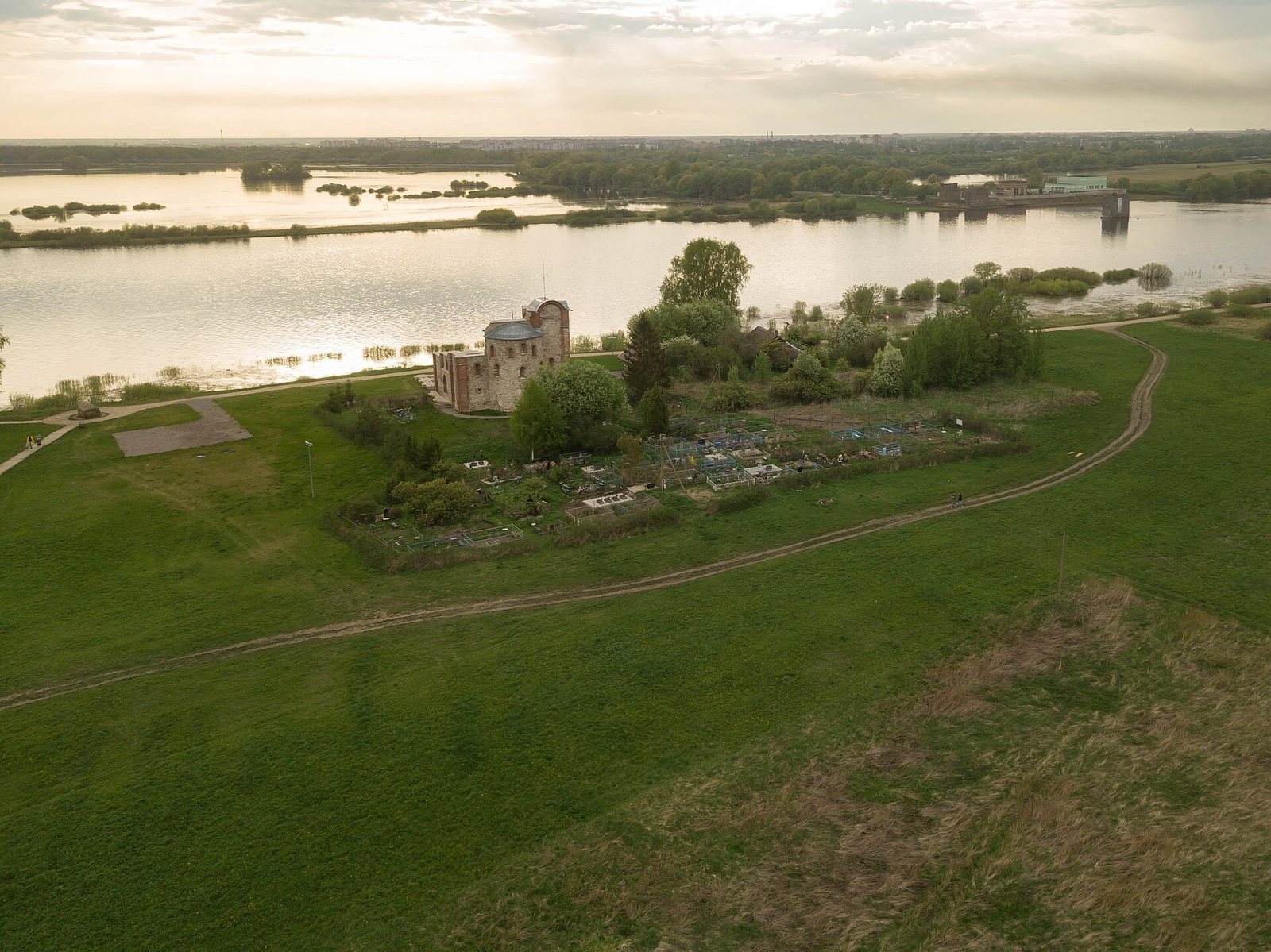
The archaeological area lies about two kilometres south of central Veliky Novgorod, where the Volkhov flows out of Lake Ilmen, opposite Yuriev Monastery. Its position offered control over river and lake traffic. The wider area covers about 10 hectares; the settlement itself is estimated at 6–7 hectares, while its twelfth-century extent is estimated at 4–7 hectares. It occupied a peninsula between the Volkhov, the Little Volkhov, and the Chernaya rivers, on sand above clay. The hill rises about 7–8 metres above low, flood-prone ground, and the slope facing the Volkhov was steepened. During floods, the elevated site could become island-like.
The Siversov Canal crosses the southern part of the archaeological area and divides it into a cape and a hill. Erosion has widened the canal to about 100 metres. Completed in the early nineteenth century and named in 1804, it forms part of the Vyshny Volochyok waterway, built in the eighteenth century along the old Volga trade route. The earliest ninth- to tenth-century settlement occupied a headland on a low island in the floodplain, south of present-day Novgorod’s Slavensky End. Its initial area reached up to 1–1.2 hectares.
Hilltop settlement and defenses
A hilltop settlement was fortified with successive steepened slopes during the seventh and eighth centuries, with a calibrated date of 666–771. A later phase, broadly assigned to the eighth and ninth centuries, had less military importance, and its central area was ploughed. Deposits from the seventh through ninth centuries contain handmade, smooth-walled pottery. Beneath the oldest rampart, a small settlement layer dating to the eighth or first half of the ninth century contains handmade Slavic pottery and traces of fire.
The early settlement’s central area was enclosed by a horseshoe-shaped ditch and rampart containing wooden structures. At the Annunciation excavation, the rampart was about eight metres wide and may have reached five metres in height. The defenses had two wooden lines. The inner line consisted of three-sided oak-log enclosures open toward the hill; parts of the outer line included cross-walls spaced one to two metres apart. The structures stood in tiers to at least four metres and were packed with reddish sandy loam. A level strip of ground, or berm, lay between the defenses and the ditch.
An outer section of the defenses was found in place in 2021, 6.5 metres from the inner wooden structures and two metres from the ditch’s edge. Excavators also exposed the undisturbed base of a wall resting on natural ground and the foundation of a ninth-century timber fortification built from oak logs up to 12 metres long. The logs lacked lengthwise grooves to lock them together. The upper parts of the defenses slumped into the ditch, while the lower sections subsided beneath later occupation deposits. The ditch had largely filled with silt by the turn of the tenth century.
The open, horseshoe-shaped plan has been compared with D-shaped western Slavic forts beside rivers and semicircular Viking fortifications. It has also been interpreted as a fortified landing place for ships. Outdoor bread ovens were later built in the former ditch, around the turn of the tenth century. A separate oven in the settlement’s lower part is dated by its timber to the final decade of the ninth century, with tree-ring dates of 889, 896, and 897.
Churches
Church of the Annunciation
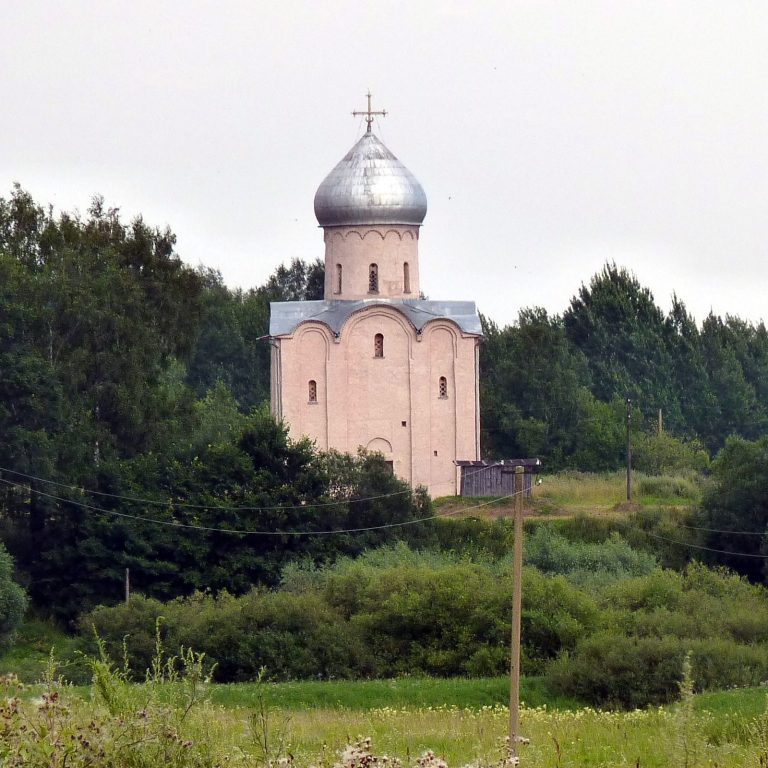
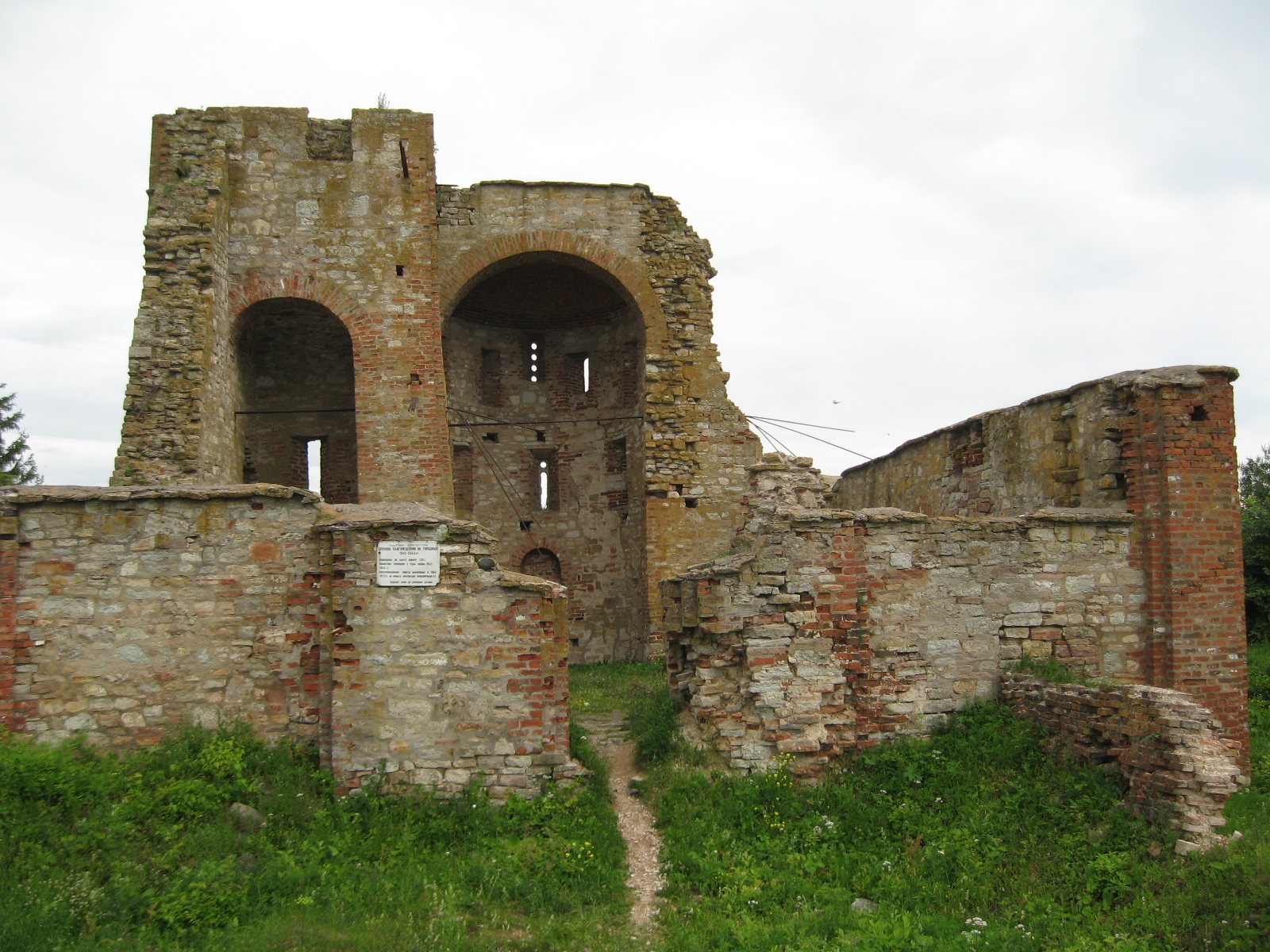
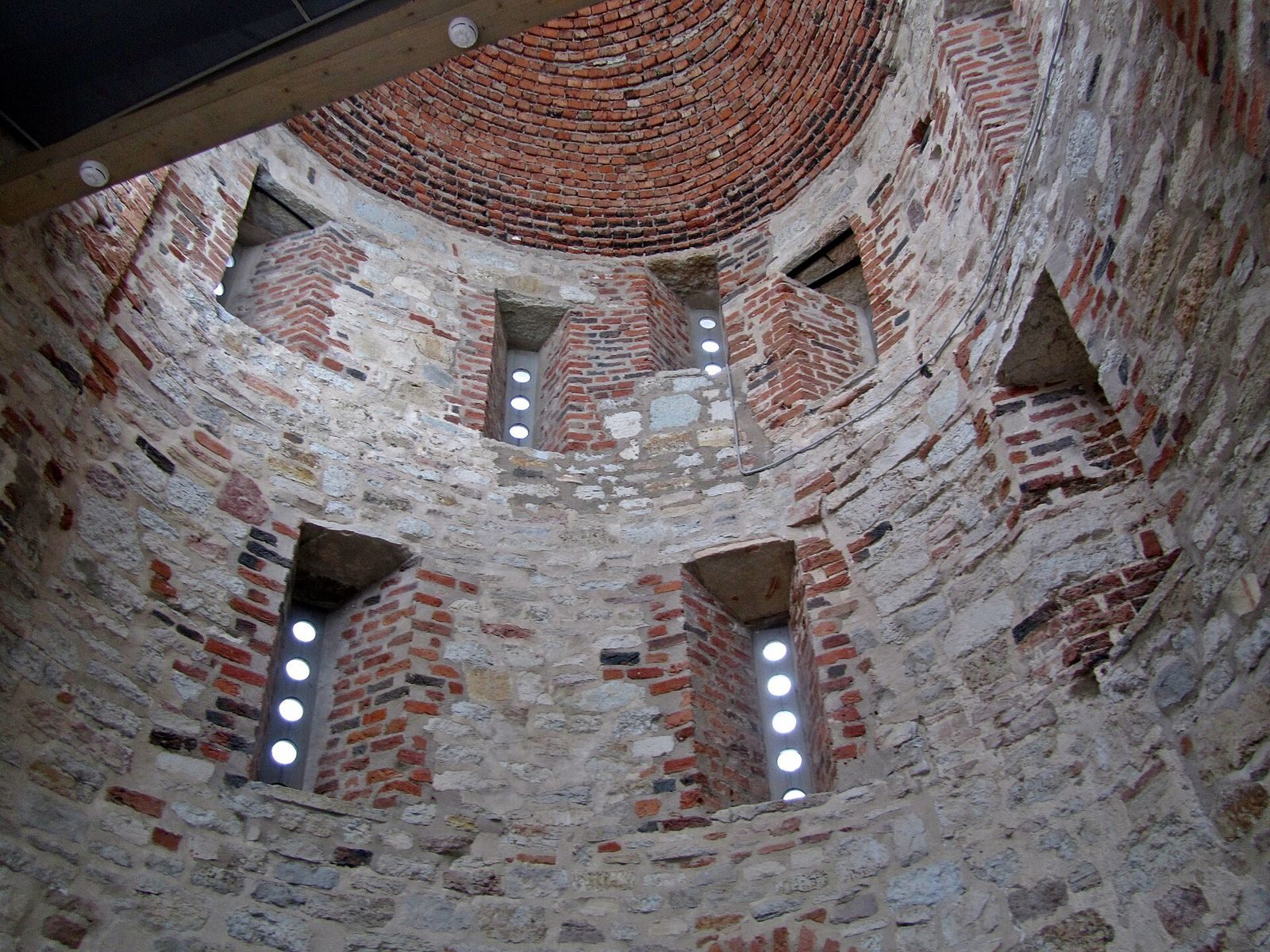
The walls of the Church of the Annunciation remain visible, and its ruins have been partly restored. In 2017, 49 graffiti inscriptions were found on fragments of the church’s plaster. They include writing in Glagolitic, an early Slavic alphabet that was rarely used by the early twelfth century. One prayer inscription may be the largest known Glagolitic inscription in Russia.
Other churches
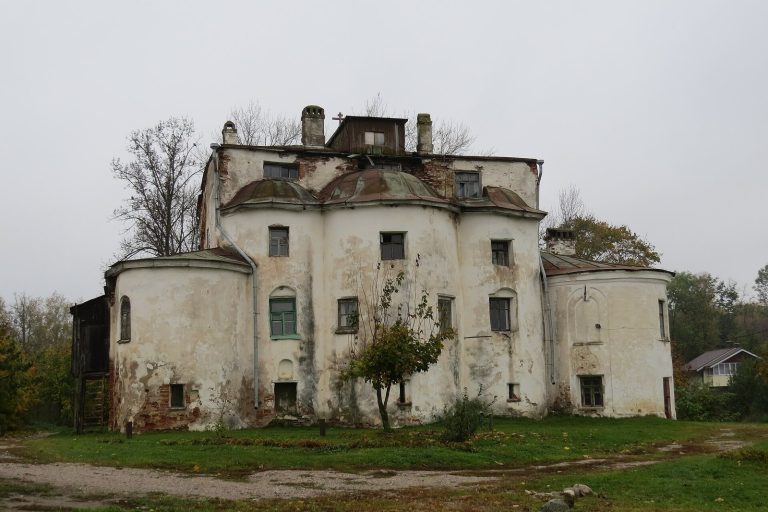
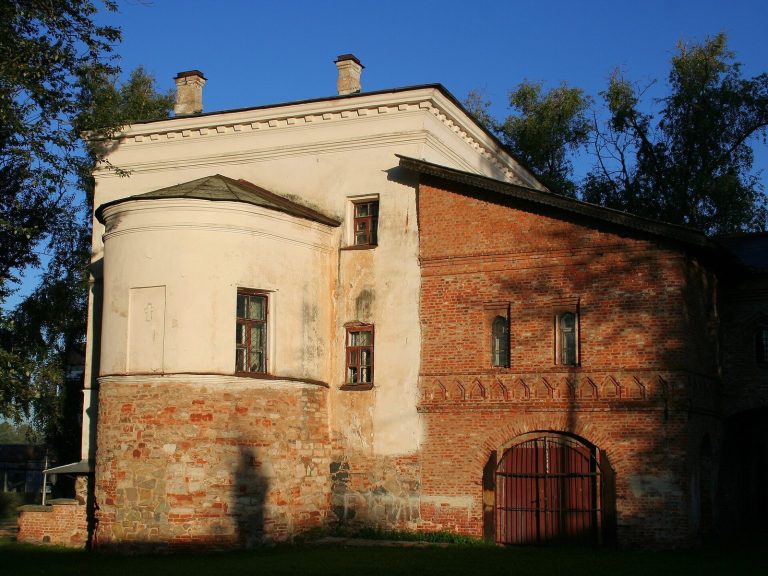
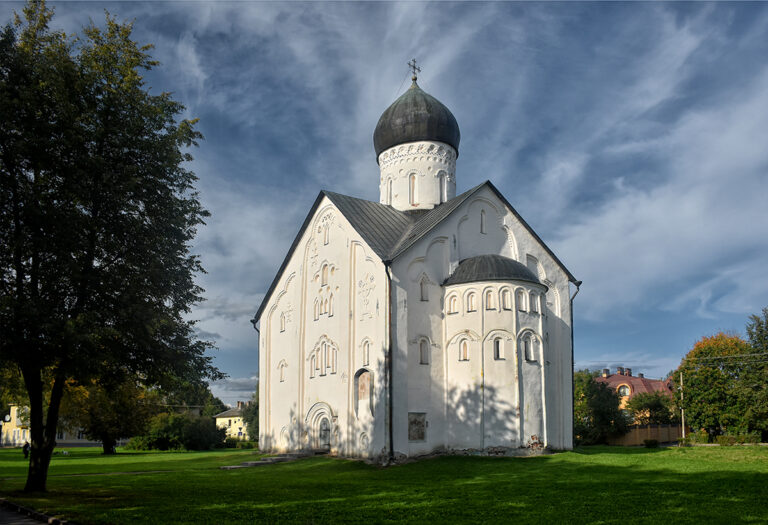
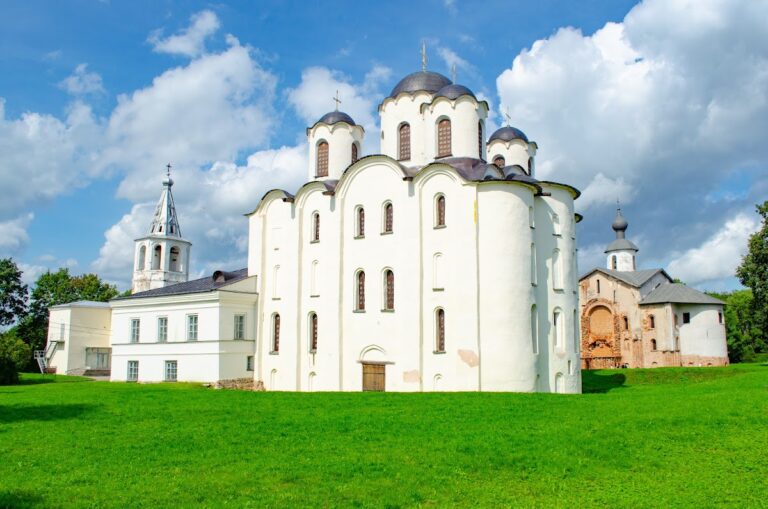
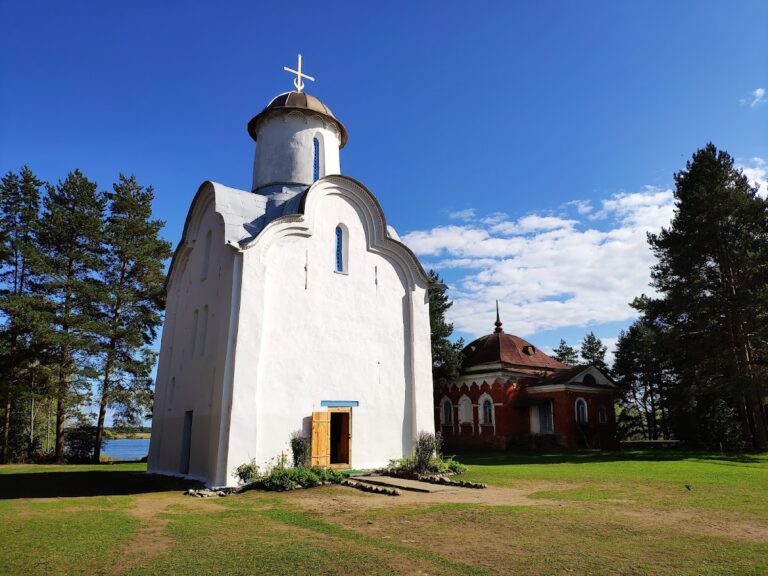
Six wooden and stone churches were built or rebuilt at Gorodishche over time: those of St Nicholas, Cosmas and Damian, Michael the Archangel, and George, as well as the Church of the Annunciation and probably the Church of the Presentation of the Virgin.
Archaeological finds
Trade and crafts
Finds from ninth- to eleventh-century deposits include weapons and clothing associated with Scandinavians, alongside Arabic, Byzantine, and western European coins. Hoards of dirhams, coins used across the medieval Islamic world, date to the late 850s, the late 860s, and the tenth century. A Byzantine bronze coin belongs to the reign of Emperor Theophilos (829–842). Finds from 2006 included transport jars known as amphorae, dated to the first or second millennium BCE, fragments of painted Byzantine cups, and Arabic and Byzantine coins from the mid-ninth century.
Glass, carnelian, and rock-crystal beads, walnut shells, and almond pits also came to light. Craft and household objects include scales and weights, bone combs, wooden toy swords, clay weights used in spinning, glass bracelets, crucibles, casting ladles, animal-shaped finials, and fragments of amphorae. Excavations along the canal between 1997 and 2000 recovered 758 objects from the tenth and eleventh centuries, among them a stone mold for casting belt buckles.
Personal, military, and religious objects
Scandinavian and Baltic-type brooches, iron neck rings with pendants shaped like Thor’s hammer, and two bronze pendants bearing inscriptions, one copied from the other, reflect a range of personal objects. Thor was a Norse god associated with thunder. Other finds include a silver Valkyrie figure, a being from Norse mythology, and silver pendants with floral designs linked to Finno-Ugric peoples, a traditional grouping of peoples and languages. Amulets found in 2007–2012 include Scandinavian pieces with rune-like marks, pendants decorated in Borre style, a Viking-Age Scandinavian art style featuring interlaced animals, and a shield fitting shaped like an animal.
Two-barbed arrowheads with hollow bases fitted to shafts, characteristic of West Slavic forms, are unusually numerous compared with those at other sites in eastern Europe’s forest zone. Other objects from the canal excavations include a snake pendant, a stone cross, and bone combs.
Inscriptions, seals, and symbolic finds
A walrus tusk found in place on the canal’s north bank in 1999 bears a three-part rotational symbol on one side and a non-figurative sign on the other. Its position among the deposits points to a date in the first half of the tenth century. A tally token from the ditch, found in 2020, dates to the end of the ninth century and is the oldest known find of its type in Russia.
A birch-bark letter fragment found in an early twelfth-century deposit in 2003 probably came from several brothers writing to their parents and mentions a prince. It is numbered 950 in Novgorod’s sequence of such finds and is also known as Gorodishche 1. Excavations in 2003 uncovered about 15 lead seals; work from 2005 to 2010 recovered 39 more seals and six blanks. More than 2,000 princely seals from the twelfth through fourteenth centuries have been found at the site overall. The canal excavations also yielded lead seals belonging to a Novgorod posadnik and princes.
Animal remains
A skull recovered in 2003 belonged to an adult female Barbary macaque, a monkey native to North Africa and Gibraltar. Radiocarbon dating places it between 1160 and 1220, making it the earliest known European find of macaque remains from this period. The site has also yielded remains of six cats from ninth- and tenth-century deposits and five more from the eleventh and twelfth centuries.