Saint Nicholas Church: A Historic Church and Skanderbeg Memorial in Lezhë
Site at a Glance
- Rating
- 4.8
- Popularity
- Very Low
- Country
- Albania
- Primary era
- Medieval
- External website
- Open
- Eras represented
- Iron Age, Classical, Medieval
- Civilizations
- Illyrian, Roman, Venetian
- Site type
- Burial
- Remains
- Tomb
On this page7 sections
History
Saint Nicholas Church is a 1459 Gothic church in Lezhë, Albania, whose site became the principal cathedral of the city in the 15th century. It is associated with an earlier structure in an Illyrian settlement later reconstructed by the Romans in the 1st century BC, although the precise relationship between these phases and the surviving church remains uncertain.
From ancient site to medieval cathedral
The site first functioned as a temple and later as a church. The church dated to 1459 replaced a 14th-century building and was dedicated to Saint Nicholas. In 1444, the grounds hosted the formation of the League of Lezhë, a 15th-century alliance of Albanian nobles created to coordinate resistance against the Ottoman Empire.
Skanderbeg, also known as George Kastrioti, was a 15th-century Albanian military leader who led resistance to Ottoman expansion. He was buried in the church in 1468. After Sultan Mehmed II conquered Lezhë in 1478, Ottoman soldiers violated the grave and used the bones as talismans because they believed the remains conveyed bravery.
Ottoman conversion and later memory
Following the conquest, the church was plundered and converted into a mosque. During the reign of Sultan Selim I, who ruled from 1512 to 1520, it was named the Selimije Mosque. The church may have been rebuilt elsewhere as a gesture of tolerance toward Christians. Albanians continued to make pilgrimages to the ruined building during the 17th century to commemorate Skanderbeg. The mosque was restored in the late 18th century during the reign of Sultan Selim III, who ruled from 1789 to 1807.
Excavation, destruction, and memorialization
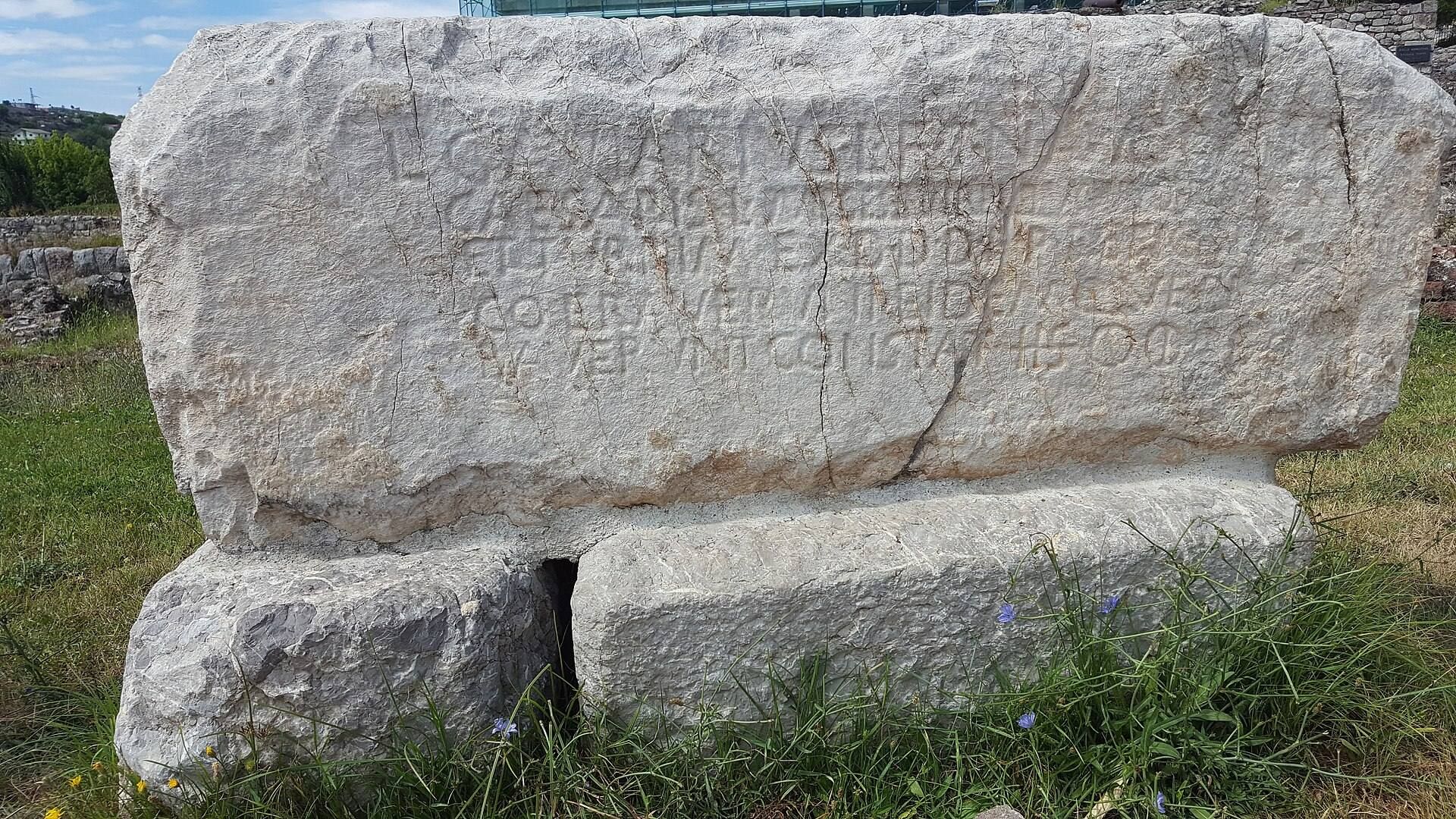
Archaeological investigations in 1966 established that the mosque had previously been a church. Excavations conducted by Frano Prendi and Koço Zheku between 1975 and 1980 uncovered the Gaviarius Stone near the entrance and added evidence about the building’s history. The mosque remained in use until 1968, when it was closed after Enver Hoxha’s government declared Albania the world’s first atheist state in 1967. It was deliberately ruined in 1968, and its minaret no longer survives.
Skanderbeg’s grave was identified at the site in 1978. A strong earthquake in 1979 severely damaged the mosque. Restoration afterward removed the Ottoman additions in an attempt to recover the appearance associated with the church during Skanderbeg’s lifetime. The ruins were then converted into a memorial to Skanderbeg, and the remains of Saint Nicholas Church were recognized as a national cultural monument. The Skanderbeg National Memorial opened in 1981. It remains an active mausoleum-monument, while the former church-mosque is inactive and partly ruined. The site is protected as a Cultural Monument of Albania under the official designation Skanderbeg Memorial, Lezhë. Restoration of the mausoleum began in 2018 after serious water damage.
Remains
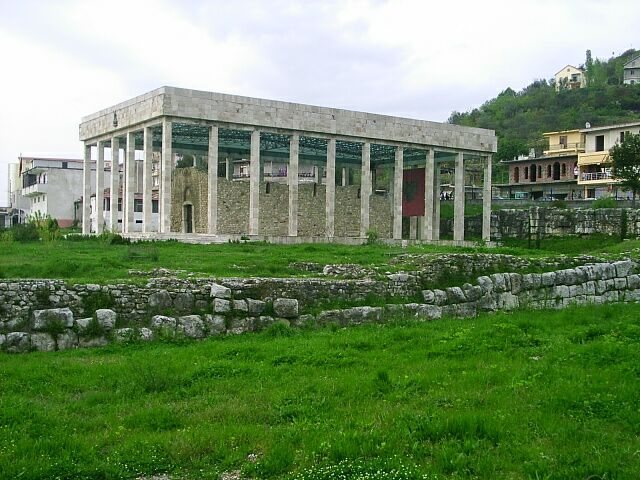
The surviving complex is a stone building near the Drin River and at the foot of the castle hill. Ruins from antiquity occur around the former mosque, while the former church-mosque stands beneath a roof built for the Skanderbeg memorial. The roof protects the surviving walls and encloses the remains within the memorial complex.
Church and mosque remains
The church measured approximately 18 by 8 metres and had a single nave in the Gothic style. Its apse, the rounded eastern end of the church, contained a heavily damaged fresco of Saint Nicholas. Three small windows opened in each of the north and south walls, while the western façade had a doorway and one circular window. The Gaviarius Stone, also written as Gaviarivs Stone, was found in front of the entrance during excavation.
The conversion into a mosque added a raised platform called a dikka, a prayer niche called a mihrab that indicates the direction of Mecca, and a large minaret. The high minaret stood on the southwest side and was constructed in the 18th century. It no longer survives. The present ruins preserve the former church-mosque within the roofed memorial structure, with the Ottoman additions removed during post-earthquake restoration.
Skanderbeg memorial complex
Skanderbeg’s grave lies within the former church-mosque and memorial complex. Inside the memorial are a bust of Skanderbeg by Odise Pascali and a plaque accompanied by replicas of his sword and helmet. The original weapons are preserved in Vienna. Wall panels recall Skanderbeg’s battles and display coats of arms associated with the principalities that formed the League of Lezhë.