Church of Saint Michael the Archangel in Šemetkovce: A Greek Catholic Wooden Church
Site at a Glance
- Popularity
- Very Low
- Country
- Slovakia
- Primary era
- Early Modern
- Eras represented
- Early Modern, Modern
- Civilizations
- Unclassified
- Site type
- Religious
- Remains
- Church
On this page12 sections
History
Origins and religious setting
The Church of Saint Michael the Archangel in Šemetkovce is an active Greek Catholic wooden church in Slovakia, dedicated to a Christian archangel associated with protection and the defeat of evil. Its construction date is uncertain, though tradition places it in 1752–53. It belongs to the Greek Catholic Church, an Eastern Catholic tradition in communion with Rome that follows Byzantine liturgical practices. The church is part of the Prešov Archieparchy, an Eastern Catholic jurisdiction comparable to an archdiocese, and the Svidník deanery, a grouping of parishes; its parish is Ladomirová.
Wartime damage and later repairs
Military operations during the Carpathian-Dukla campaign damaged the church in October and November 1944. The fighting included a tank battle in the Valley of Death. Villagers helped repair the building in 1945, and after the Second World War it was moved from a lower site to its present location.
Further repairs took place in 1967–70 and 2000. Work in 1969–70 restored the iconostasis and altar, while later interventions included renewed exterior cladding in 2001 and another restoration of the iconostasis in 2005. The church has been a Slovak national cultural monument since the 1960s.
Remains
Plan and exterior
Three-part layout
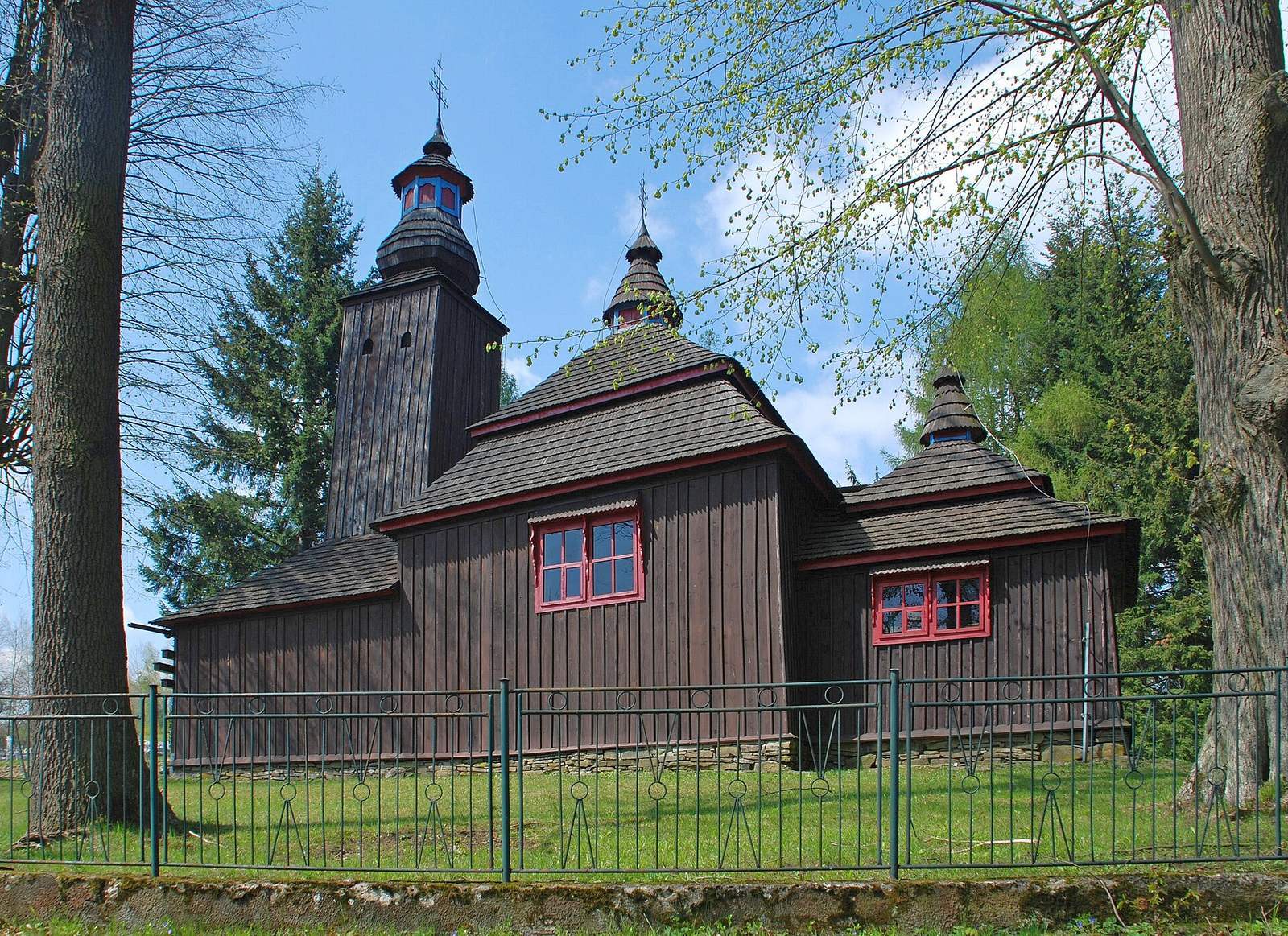
The timber log church has three spaces organized around an elongated rectangular nave and a narrower rectangular sanctuary. A separate entrance section, the babiniec, forms part of the nave and has the same width. The building’s plan therefore distinguishes the entrance area and main body from the narrower sanctuary.
Walls, porch, and roofs
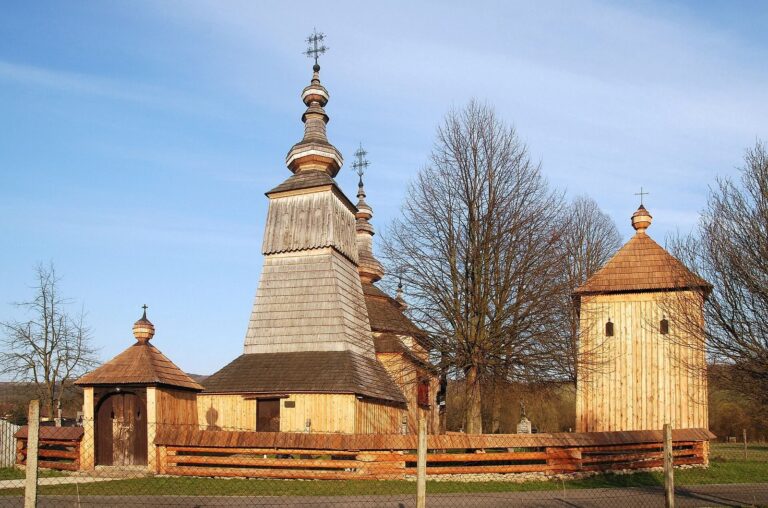
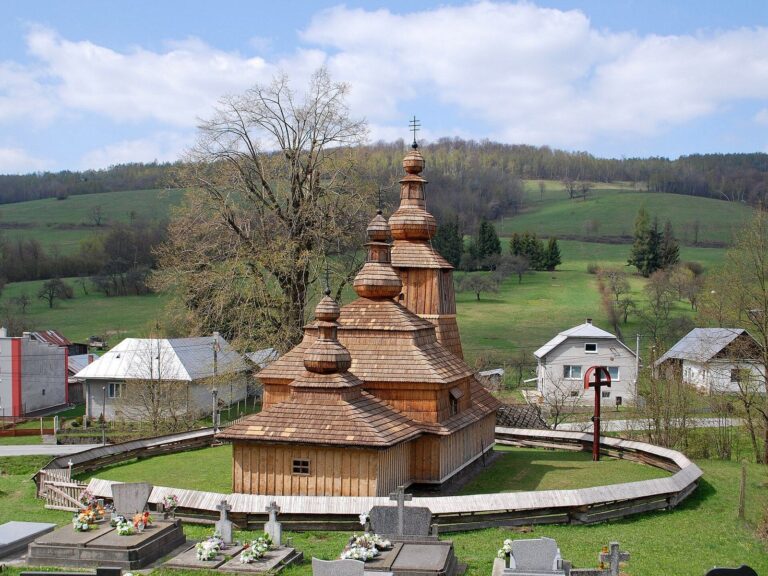
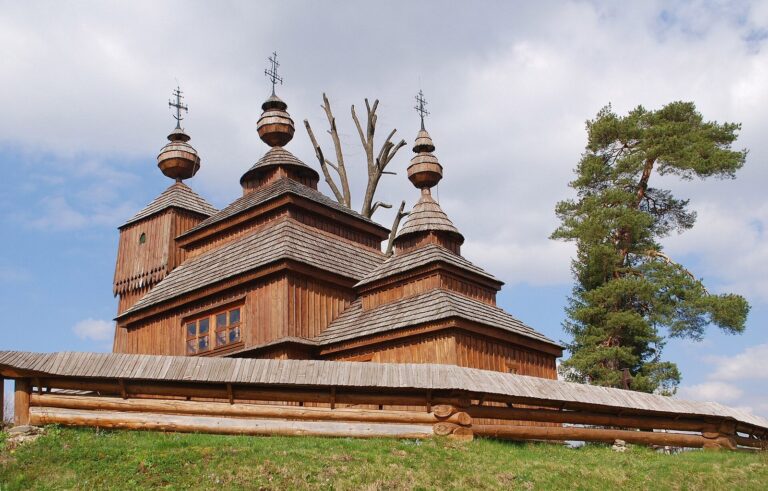
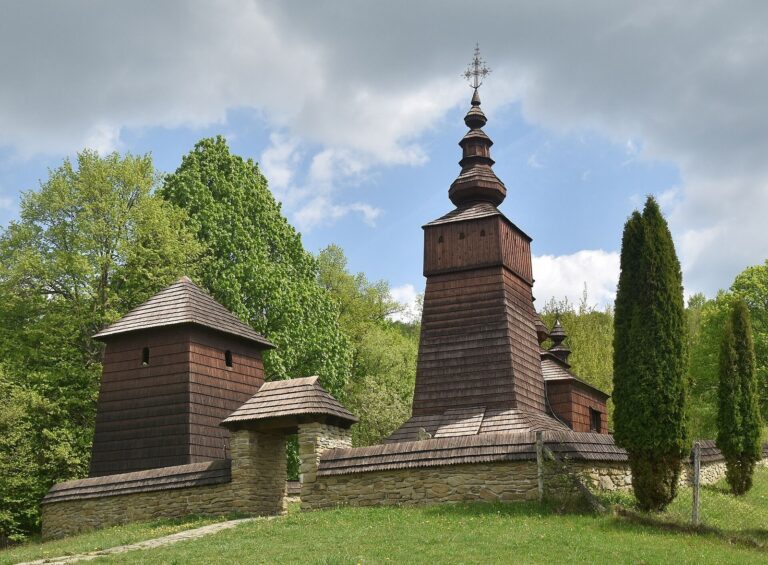
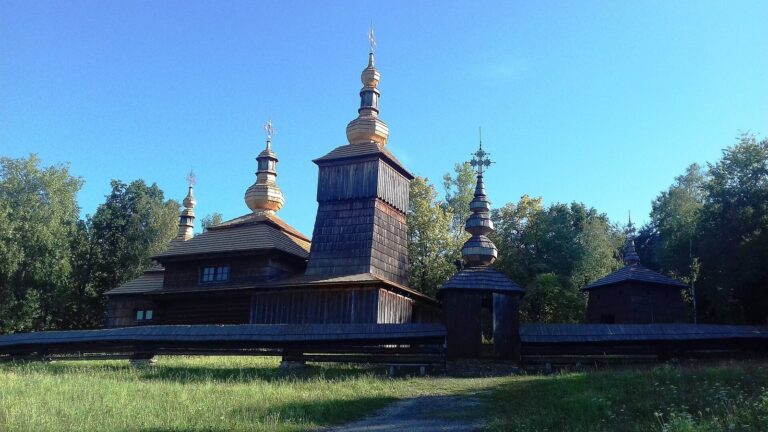
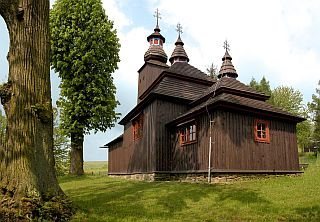
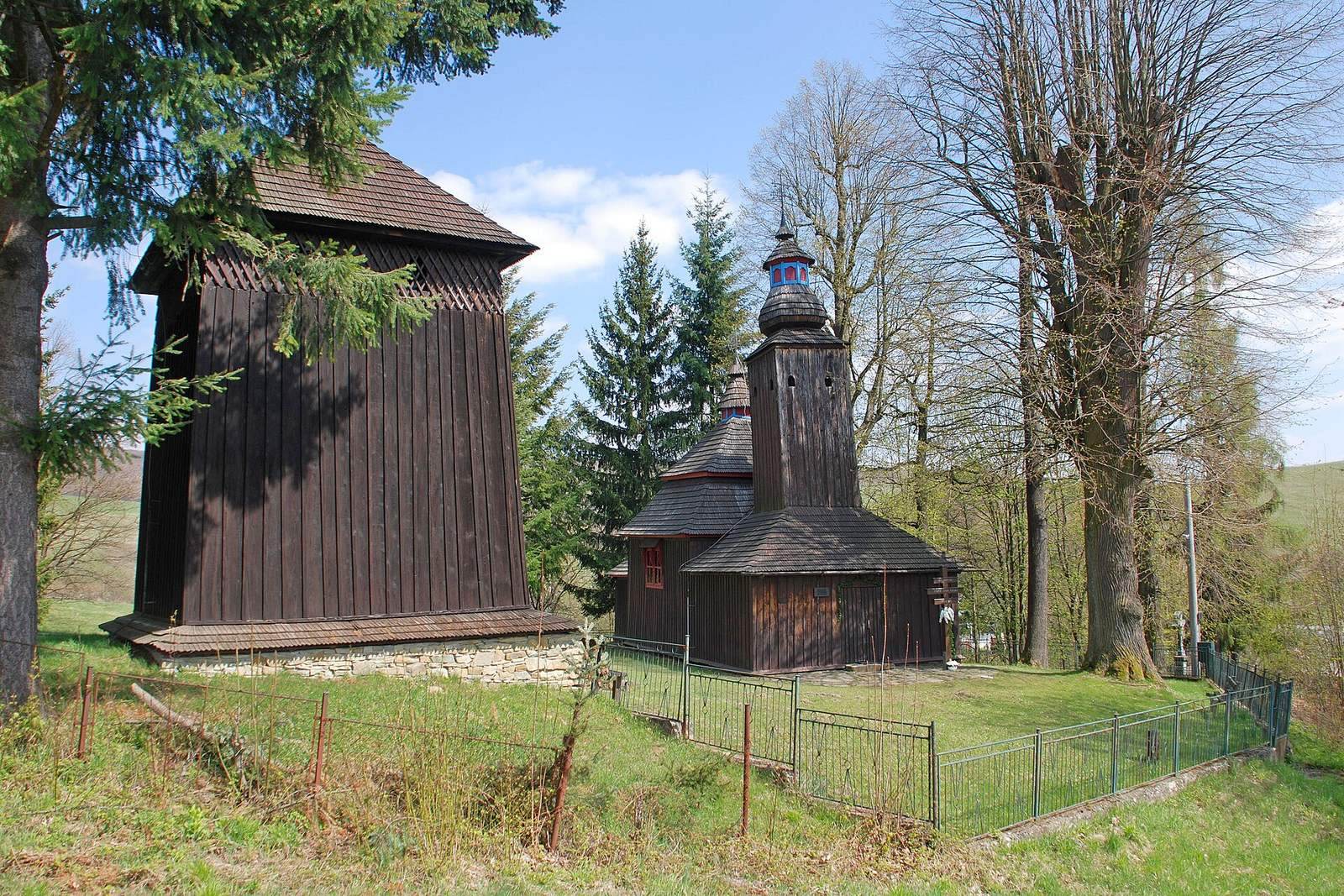
Vertical boards with battens cover the exterior walls. A small porch with a shingle roof stands in front of the entrance. Two-tiered, tent-shaped shingle roofs cover the nave and sanctuary, each topped by a small conical turret and a wrought-iron cross.
Tower and bells
A timber-framed tower rises above the entrance section. Its straight-sided structure has a bulbous roof and a decorative false lantern, topped by an onion-shaped dome on a raised circular base and a wrought-iron cross. The nineteenth-century tower occupies the site of an eighteenth-century predecessor. It contains three bells made in the second half of the twentieth century. The church has one tower and three cupolas, or small domes.
Interior and furnishings
Ceilings and wall paintings
The nave and sanctuary have tent-vaulted ceilings that rise in sloping planes, while the entrance section has a flat ceiling. Remnants of Baroque ornamental and figural paintings survive on the walls. Baroque was a European artistic and architectural style that flourished mainly in the seventeenth and eighteenth centuries; the surviving paintings are now almost entirely illegible.
Iconostasis and altar
The wooden iconostasis, a screen of icons separating the sanctuary from the main body of the church, has four tiers and royal doors, the screen’s principal doors. This Baroque work dates to the mid-to-late eighteenth century. Antoni Krzyżanowski repainted it in 1838, and it includes two seventeenth-century icons, of Saint Nicholas and the Archangel Michael. Saint Nicholas was a fourth-century bishop revered as a saint.
The sanctuary altars include eighteenth-century icons of the Protection of the Mother of God and a Pietà, which depicts Mary mourning the dead Christ. The altar has miniature antique-style columns and a small tabernacle, a receptacle for the Eucharist, with an icon of the Virgin Mary.
Other icons
Most of the church’s furnishings date from around the time of its construction. The collection also includes icons from an older church and several neighboring churches, and is considered one of the most valuable collections in Slovakia’s wooden churches. The sixteenth-century Crucifixion is the oldest icon in the building. On the south wall of the nave are an image of Christ Teaching decorated with cabochons, polished rounded stones or glass, and a seventeenth-century Resurrection.
The west wall bears a late-seventeenth-century icon of the Archangel Michael, eighteenth-century images of the Protection of the Mother of God (Pokrov) and the Dormition, the Eastern Christian commemoration of Mary’s death, and a two-part Raising of Lazarus dated 1715. That image depicts its donor, Kacper Humberg. A nineteenth-century Pentecost, commemorating the descent of the Holy Spirit on the apostles, is also on the wall. Two eighteenth-century Hodegetria icons, a type showing Mary presenting Christ, are on the north wall.