Saint Martin Church in Kazimierz Biskupi: A Romanesque and Gothic Parish Church


Site at a Glance
- Rating
- 4.5
- Popularity
- Low
- Country
- Poland
- Primary era
- Medieval
- External website
- Open
- Eras represented
- Medieval, Early Modern, Modern
- Civilizations
- Kingdom of Poland, Polish–Lithuanian Commonwealth, Russian
- Site type
- Religious
- Remains
- Church
On this page10 sections
History
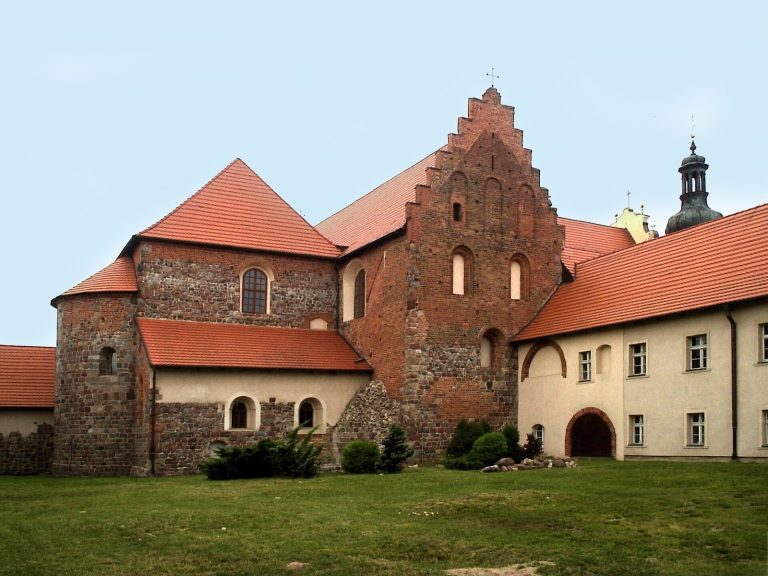
Saint Martin Church in Kazimierz Biskupi, Poland, is a Roman Catholic parish church dedicated to Saint Martin, originally built in the second half of the twelfth century in the Romanesque style. Tradition places the hermitage of Matthew, one of the Five Martyred Brothers, at the site. The church’s foundation has been attributed to Piotr Włostowic, a prominent twelfth-century Silesian magnate and political figure, although another hypothesis names Piotr Wszeborowic as founder.
Medieval foundation
The church’s first recorded mention appears in Jan Długosz’s Annals, in connection with Duke Henry the Bearded’s transfer of Kazimierz to the Bishopric of Lubusz in 1237. A bishopric was an ecclesiastical territory administered by a bishop, and the Bishopric of Lubusz was a medieval diocese whose seat was at Lubusz. This reference places the church within the religious and administrative landscape of medieval Poland.
Rebuilding and later changes
The building was repeatedly altered. Around 1512, Bishop Lubrański, a Polish Catholic prelate of the late fifteenth and early sixteenth centuries, paid for its reconstruction in the Late Gothic style. Swedish forces burned the church at the beginning of the eighteenth century, after which it was rebuilt. The structure was enlarged in 1859 and consecrated in 1869.
During the Second World War, German authorities closed the church and converted it into a grain store. A fifteenth-century gold chalice and the church bells were stolen, while the parish library, which contained 1,090 volumes, was confiscated. The church entered the heritage register as number 51 on February 1, 1965.
Remains
Saint Martin Church combines surviving Romanesque fabric with Gothic elements. The single-nave building is constructed from granite, sandstone, and brick, and contains three altars. Its earliest masonry remains are concentrated in the apse, the chancel walls, and the lower parts of the nave walls, while a Romanesque portal remains visible on the south side despite having been walled up.
Romanesque structure
The walls preserve Romanesque mason’s marks, including a cross on a base and a cross within a circle. These marks have been interpreted respectively as symbols of Earth and Venus. Together with the apse, chancel masonry, lower nave walls, and south portal, they preserve visible evidence of the church’s twelfth-century construction.
Altars and devotional furnishings
High altar and side altars
The interior furnishings are mainly Rococo and date from the first half of the eighteenth century. The Baroque high altar contains a seventeenth-century painting of the Virgin and Child. Its decorative dress dates from 1766, while the two side altars are Rococo.
Altar of the Five Martyred Brothers
The altar on the left is dedicated to the Five Martyred Brothers, early medieval Christian missionaries and martyrs venerated in Poland. It contains a silver casket with their relics, set within an ornate reliquary, a container made to preserve or display relics. The Kazimierz Shoemakers’ Brotherhood funded the reliquary in 1927.
Paintings, sculpture, and baptismal font
A polychrome ceiling painting from around the middle of the nineteenth century presents the hagiography of the Five Martyred Brothers. Hagiography is an artistic or written representation of a saint’s life, martyrdom, or cult. In the painting, the brothers’ killers wear pickelhaubes, the spiked military helmets associated especially with nineteenth- and early twentieth-century German armies. The church also contains a Late Gothic sculpture of the Virgin Mary and a stone baptismal font from the sixteenth century.
Parish cemetery
The nearby parish cemetery contains the grave of unidentified Polish soldiers who died in 1939, as well as the grave of Stanisław and Wanda Mańkowski. A memorial boulder bears a plaque dedicated to those who died fighting for Polish independence in 1918. The cemetery also contains the grave of Józef Ślugaj, a legionnaire and First World War veteran. Communists fired on his grave after the Second World War.