Saint John the Baptist Church in Księginice Wielkie: A Parish Church in Poland
Site at a Glance
- Popularity
- Very Low
- Country
- Poland
- Primary era
- Early Modern
- Eras represented
- Medieval, Early Modern
- Civilizations
- Habsburg, Holy Roman Empire, Kingdom of Bohemia, Kingdom of Prussia
- Site type
- Religious
- Remains
- Church
On this page12 sections
History
Saint John the Baptist Church in Księginice Wielkie is a parish church in Poland, dedicated to John the Baptist, the Christian prophet traditionally understood to have baptized Jesus. Its present building is dated to the late fifteenth or early sixteenth century, while the village’s first church is placed around 1295.
Medieval origins
The early history of the church and parish is uncertain. A former pastor reported knowing no account of the church’s foundation or construction, and no earlier name for it. A medieval reference from 1295 mentions a priest at Knegnitz in connection with the founding of St Mary’s church at Nimptsch, but it does not securely identify this village. A 1335 list gives the village as Knegnicz, and it is clearly identified as Magna Knegcicz in 1349. References from 1204 may concern other places, including Klein Kniegnitz and Kniegnitz near Trebnitz.
The village, formerly called Groß Kniegnitz in German, had Slavic origins and was later settled under German law. The church belonged to the Silesian dukes in the early sixteenth century.
Lutheran and Catholic worship
In 1534, Frederick II, Duke of Liegnitz, Brieg and Wohlau, authorized Lutheran worship at the church. Lutheranism is a branch of Protestant Christianity. On 8 July 1697, lightning struck the building during a thunderstorm and destroyed it. Rebuilding began soon afterward and was completed on 13 August 1698.
A Catholic priest was appointed in 1702, and the church returned to Catholic worship in 1707. A new building followed in 1743, and its tower was repaired in 1768.
Parish life and later changes
Church registers began in 1679, when a pastor took office. The church’s assets included 2,000 thalers, a silver currency used in central Europe. The pastor’s stipend came from the income of an endowment and gardens, while a further 200 thalers in foundation capital was assigned to the Hoffmann family crypt.
During the nineteenth and twentieth centuries, the congregation belonged to the Nimptsch church district within the Church Province of Silesia, a regional division of the Evangelical State Church in Prussia. In 1848, Groß Kniegnitz had 1,023 inhabitants, including 950 Evangelical residents, and the church was under royal patronage.
The church was restored in the nineteenth century and has undergone extensive renovation in more recent times. After the German population was expelled, it was used for Catholic worship. The local parish has existed since 1972. The church was registered as a protected cultural monument on 3 June 1961.
Remains
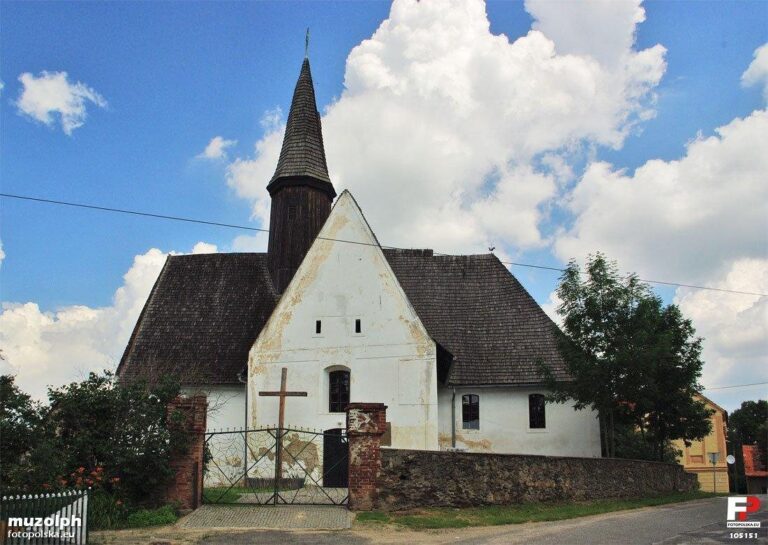
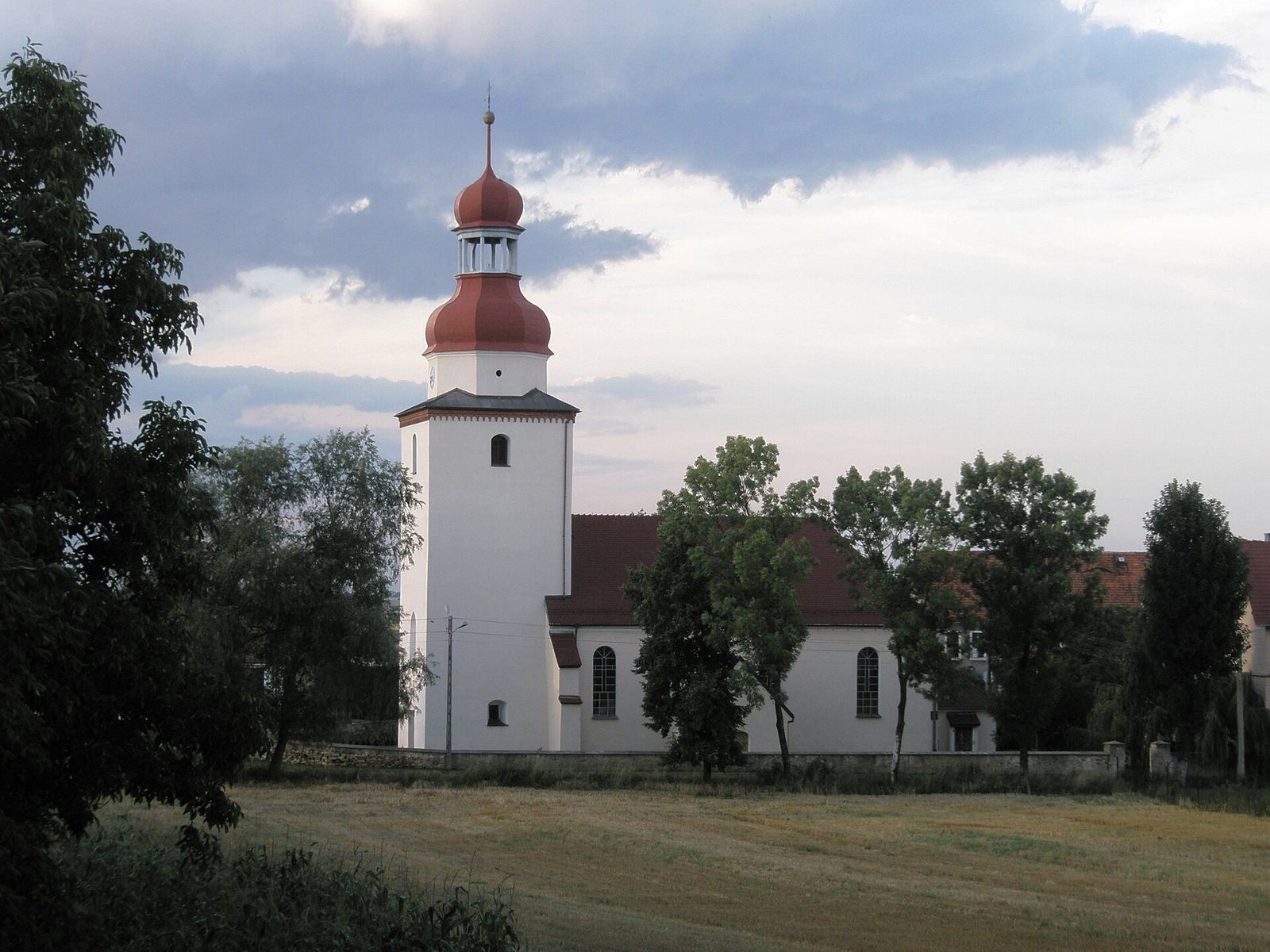
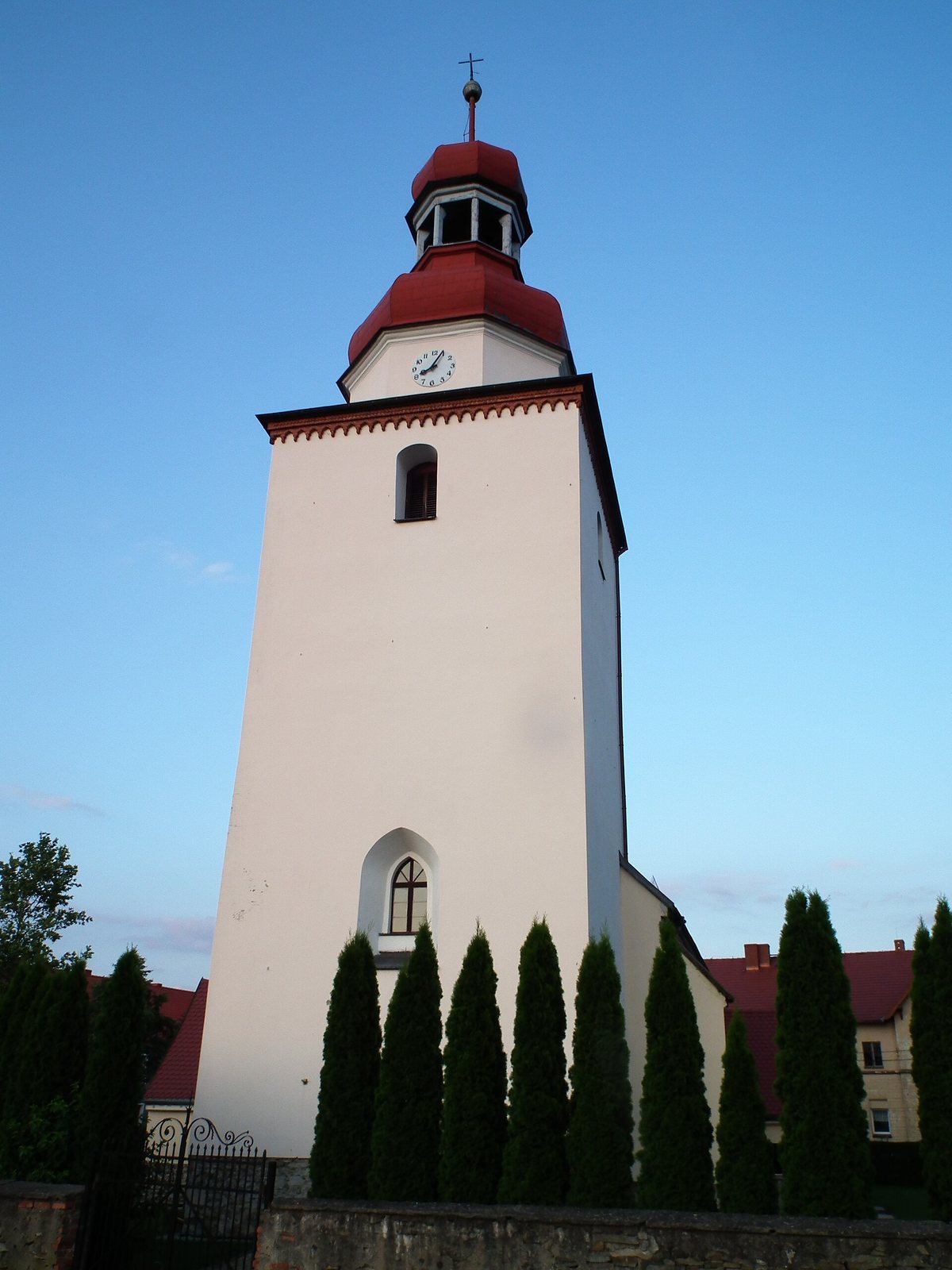
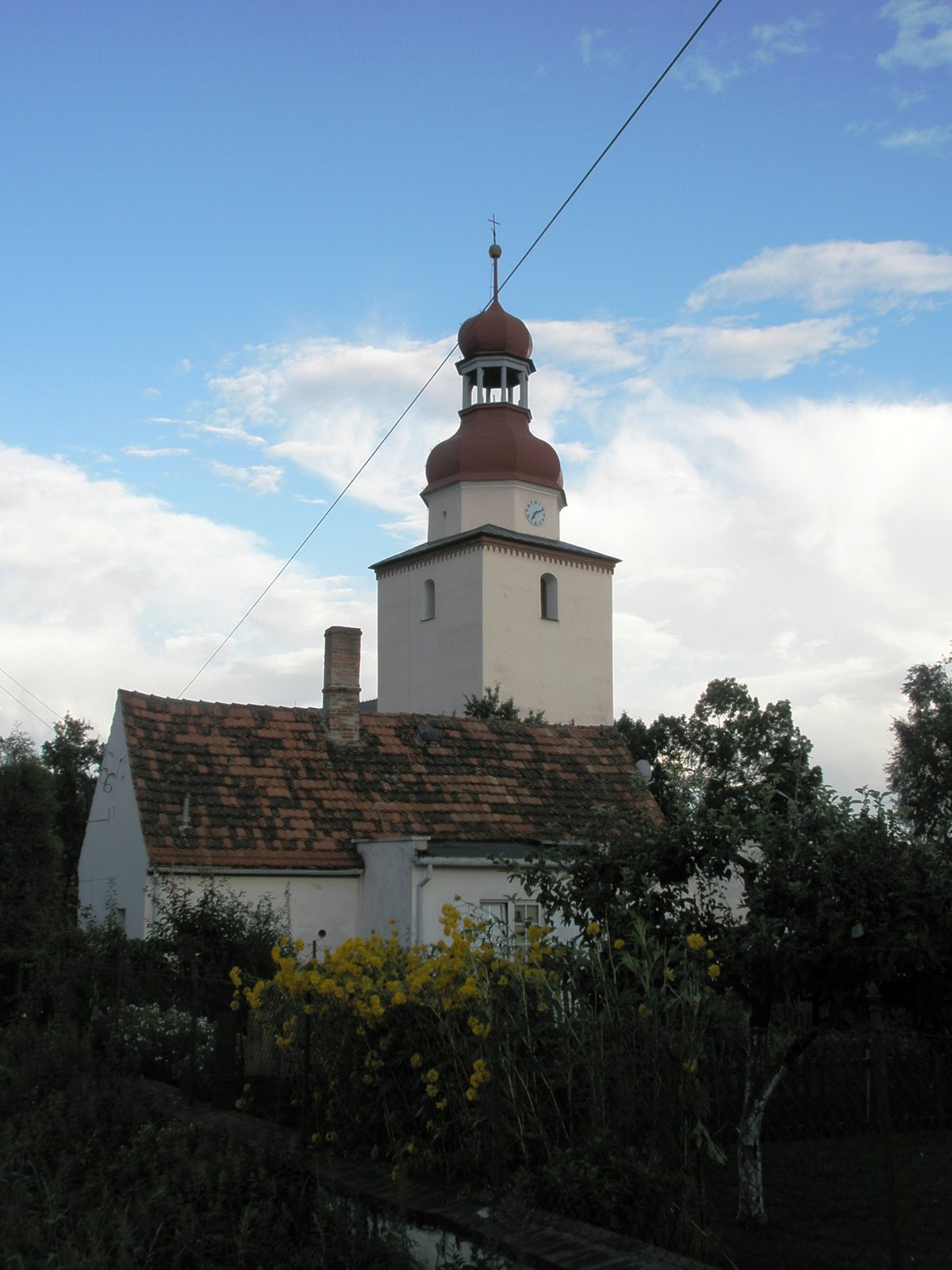
The church is a rectangular, brick-built structure with a single main hall, oriented eastward. A four-sided tower rises at its western end and is crowned by an onion-shaped dome. It is the building’s only tower. In 1848, the structure was described as masonry-built and without vaulted ceilings. Its roof had a timber frame; sheet metal covered the tower, which held two bells.
Interior furnishings
High altar
The Baroque high altar, an example of an ornate European style that developed from the late sixteenth century onward, dates to 1720. Its altarpiece includes a 1672 painting of John the Baptist.
Pulpit and pews
The eighteenth-century pulpit has figures of the Four Evangelists at its corners. In 1797, carpenter Gottlob Wilhelm Gregor recorded the making of new altars for the main and burial churches, together with a pulpit and pews.
Baptismal font
The church’s wooden baptismal font dates to 1819.
Village boundary and burial ground
Fieldstone wall
A fieldstone boundary wall in the village may point to an earlier period of particular importance, possibly when the settlement served as an administrative center.
Former Evangelical cemetery
The village’s sole burial ground was in its upper part. Scattered German gravestones remain in the former Evangelical cemetery.