Saint-Germain Castle: A Medieval Fortress in Montjovet, Italy


Site at a Glance
- Rating
- 4.8
- Popularity
- Very Low
- Country
- Italy
- Primary era
- Medieval
- Eras represented
- Medieval, Early Modern
- Civilizations
- Duchy of Savoy, Holy Roman Empire
- Site type
- Military
- Remains
- Castle
On this page13 sections
History
Saint-Germain Castle is a medieval fortress in Montjovet, Italy, built between the eleventh and twelfth centuries by the De Mongioveto to control the route below and collect tolls. It stands on a promontory that had already served strategic purposes in antiquity, and its history reflects repeated transfers between local nobles and the House of Savoy before its abandonment and deliberate dismantling.
Ancient Strategic Ground
The summit of the Montjovet promontory preserves Neolithic remains. In later antiquity, the Salassi, an Alpine people who occupied the Aosta Valley before Roman control, held the area, followed by the Romans. Both groups used visual and light signals, together with carrier pigeons, to communicate between fortified positions across the valley. The Romans called the promontory Mons Jovis, or “Mountain of Jupiter.”
Foundation and Noble Ownership
The De Mongioveto established Saint-Germain Castle between the eleventh and twelfth centuries. The central keep and the first circuit of walls belong to this early phase, which may have incorporated an older structure. The fortress controlled the settlement below and the road through the valley, while its position enabled its owners to demand payments from travelers.
The later history of the De Mongioveto is obscure, although the family was probably connected with the Chenal family, which owned nearby Chenal Castle. A document from 1250 identifies Bermond of Montjovet as the owner of both castles. He later left them to his nephews.
In 1261, Philippe Bermond, also known as Feidino of Mongioveto, jointly held Saint-Germain Castle with Ebalo I of Challant. Both men rendered feudal homage, a formal declaration of allegiance and obligation, to Amedeo V of Savoy. Feidino’s particularly forceful collection of tolls gave the Savoyard count a pretext to seize the fortress. The castle passed to the House of Savoy around 1270, although 1294 is also given as the date. In exchange, Feidino received the lordship and estate of Coazze in the Sangone Valley, in the Canavese.
Challant and Savoyard Control
In 1295, the fief of Montjovet and its castle became the property of the Challant family. Ebalo I of Challant, who served as Amedeo V’s lieutenant, received Montjovet in exchange for surrendering the viscounty of Aosta.
The castle also played a role in regional political pressure. In 1377, Ibleto of Challant imprisoned Giovanni Fieschi, bishop of Vercelli, at Saint-Germain for approximately one year. The imprisonment was intended to force the bishop to transfer the lordship of Biella to the Count of Savoy.
In 1438, François de Challant, a counselor to Amedeo VIII of Savoy, ceded the lordship, castle, lands, and settlement of Montjovet back to Savoyard control. Amedeo VIII and his successors then modernized the fortress in response to changing military techniques. A castellan, the official responsible for administering and defending a castle, and ten soldiers were stationed there.
Abandonment and Ruin
In 1661, Charles Emmanuel II of Savoy ordered Saint-Germain Castle to be abandoned and deliberately dismantled. The measure was intended to prevent foreign troops from occupying the fortress. Its garrison moved to Bard Fortress, and Saint-Germain fell definitively into ruin at the beginning of the eighteenth century.
The Autonomous Region of Aosta Valley now owns the site. Saint-Germain remains a medieval ruin, and the danger of structural collapse has led to restricted access.
Remains
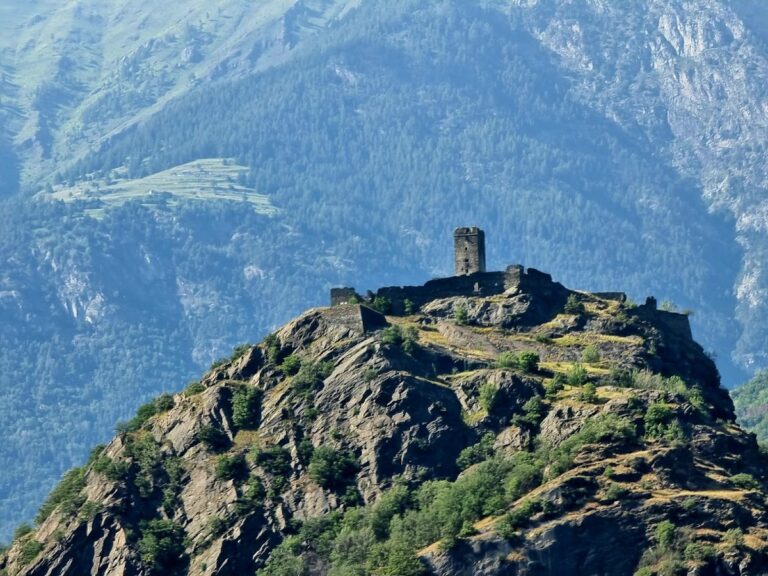
Saint-Germain Castle occupies a hilltop at 656 metres above sea level, on an amphibolite rock spur above the gorge carved by the Dora Baltea. Amphibolite is a hard metamorphic rock formed from older volcanic or related rocks. The promontory lies midway between Verrès and Saint-Vincent and has visual contact with Chenal Tower. Its position provided control over the settlement below and the central Aosta Valley. The Mongiovetta, a section of State Road 26, now cuts through the rock beside the spur.
Early Fortress
Keep and Enclosing Walls
The original fortress follows the characteristic plan of an early Aosta Valley castle. A central keep, the principal fortified tower of a medieval castle, rises 19 metres and measures 6 metres on each side. A substantial circuit wall surrounds it, creating the core of the early defensive complex. The castle could be reached from the northern side of the Montjovet promontory by a path that defenders above could protect easily.
Medieval Structures
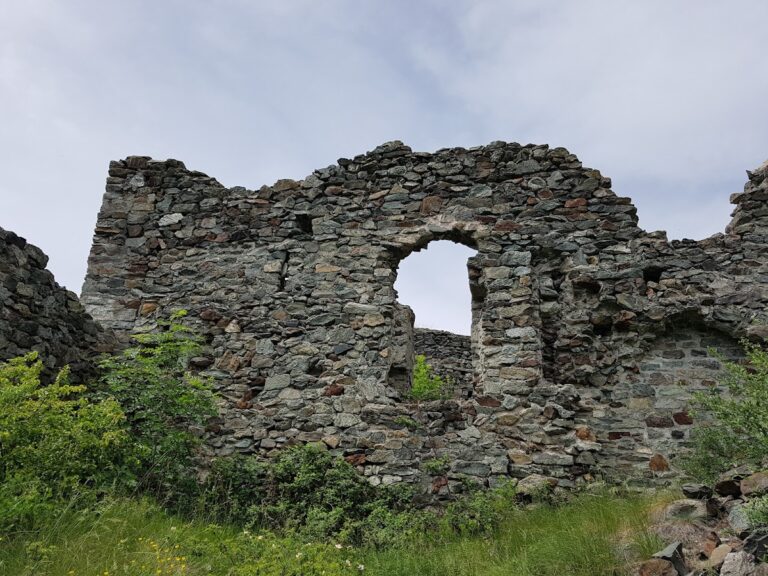
The enclosing walls extend around a perimeter of 200 metres. Medieval stone arches and large medieval windows survive within them. The complex contained residential rooms, quarters for the garrison, and areas for storing weapons. Internal structures and arcades were built in green amphibolite, linking the surviving architecture to the stone of the rocky spur.
Renaissance and Firearm Defenses
Northern Bastion
A Renaissance-style bastion projects from the northern side of the walls. A bastion is a projecting fortification designed to allow defensive fire along the walls, especially against firearms. The feature belongs to the later transformation of the medieval complex as military construction adapted to gunpowder weapons.
Later Military Works
Further improvements included a new circuit wall, battery positions, small turrets, cannon positions, and other defensive systems designed for firearms. Stone moldings and decorative elements on the enclosing walls belong to sixteenth-century alterations, while the southwest corner pavilion and southern tower formed additional parts of the fortified complex.
Surviving Condition
Saint-Germain Castle survives in a ruinous condition, with the early keep, enclosing walls, later defensive works, and internal structures forming the visible remains of its successive phases. A gate prevents entry because of the risk of structural collapse.
Nearby sites