Prevostura di Saint-Gilles: A Medieval Priory and Collegiate Church in Verrès


Site at a Glance
- Rating
- 4.2
- Popularity
- Very Low
- Country
- Italy
- Primary era
- Early Modern
- External website
- Open
- Eras represented
- Medieval, Early Modern
- Civilizations
- Duchy of Savoy, Holy Roman Empire
- Site type
- Religious
- Remains
- Monastery
On this page14 sections
History
Prevostura di Saint-Gilles is a Catholic Roman-rite religious complex dedicated to Saint Giles at Verrès in Italy. Its foundation is dated to around 985, within the medieval development of the lower Aosta Valley, and the complex includes buildings constructed between the eleventh and eighteenth centuries. From the Middle Ages until the beginning of the nineteenth century, its convent of regular canons was governed by a provost, the office that gave the institution its name.
Foundation and ecclesiastical expansion
Older historical tradition attributes the foundation to Adalbert I of Ivrea, a medieval marquis, and his first wife Gisèle at the beginning of the tenth century. Later historical interpretation places the foundation around 985 and connects it with the Marquises of Monferrat, a powerful ruling dynasty of northwestern Italy. In this account, Benedictine monks from Fruttuaria Abbey formed the first religious community. Regular canons of Saint Augustine, clergy who lived communally while undertaking pastoral and liturgical duties, succeeded the Benedictines during the twelfth century.
Saint-Gilles became an important medieval center of religious authority and helped coordinate Catholic affairs across Piedmont, the Aosta Valley, and Savoy. Its responsibilities expanded over numerous Aosta Valley parishes, including Verrès, Fénis, Challand-Saint-Victor, Arnad, Saint-Marcel, Antey-Saint-André, Chambave, Diémoz, Saint-Denis, and Issime. Its jurisdiction also extended to Gressoney-Saint-Jean, Gressoney-La-Trinité, Montjovet, Torgon, Valtournenche, Ayas, Charvensod, Saint-Martin-de-Corléans, Arvier, and Aymavilles.
In 1113, Boson I, bishop of Aosta, assigned the parish of La Thuile and the hospice of the Little Saint Bernard to Saint-Gilles. The institution retained the hospice until 1466. It also controlled the Piedmontese churches of Saint Ambrose, Saint Peter, and Saint Fidelis at Ivrea, together with Saint Emiliano at Cigliano.
Challant patronage and changing communities
During the second half of the fifteenth century, Saint-Gilles came under commendatory administration. This system placed the revenues and governance of a religious institution in the hands of a holder who did not necessarily live within its regular community. The first commendatory administrators were George of Challant and then Charles of Challant, who served as provost from 1484 until his death in 1518 or 1520.
The Challant family, a major noble dynasty of the Aosta Valley, strengthened its authority over the priory by installing three elderly provisional provosts. René of Challant secured the family’s right of patronage through a papal bull dated 14 February 1533. In 1544, he imposed his illegitimate son Francis as provost. After Francis died in 1584, other provosts descended from Francis’s legitimate daughter Isabella of Challant and John Frederick Madruzzo succeeded him.
The complex also changed physically during this period. At Charles of Challant’s order, the bell tower and the large adjoining building were rebuilt in 1512. He also commissioned La Murasse and the New Grange at the edge of the settlement toward Arnad, at the crossroads for Issogne. The Challant Chapel was commissioned by Iblet of Challant, whose burial there followed the wishes expressed in his testament of 15 February 1405.
In 1648, John Baptist Vercellin, bishop of Aosta, introduced the regular canons of the Congregation of Our Savior, a reform congregation associated with Pierre Fourier. Charles Emmanuel Madruzzo, commendatory provost of Saint-Gilles, prince-bishop of Trent, and eighth count of Challant, was forced to leave the convent. The new provosts faced opposition from Challant heirs, who believed that their family had been wronged, but the congregation remained at the convent for 71 years.
After the death of the second provost, Jean-Nicolas Deffays, in 1712, the election of Antoine-Joseph Busquet led to renewed opposition from George Francis of Challant, fifth Baron of Châtillon and thirteenth count of Challant. Busquet resigned on 22 June 1717. Regular canons of Saint Augustine then returned, and Paul Francis of Challant was appointed provost by Pope Clement XI on 18 January 1718, on the condition that he observe a regular and cloistered life.
Rebuilding, suppression, and later use
The Challant family’s rights over the priory were definitively removed in 1772. During the 1770s, the parish church was rebuilt over the remains of its earlier church, while Count Charles Francis Octavius of Challant-Châtillon had the Chapel of Saint George and Saint Maurice attached to the earlier structures. In 1786, the office of provost was united with that of parish priest of Verrès.
The French imperial government suppressed the convent on 1 September 1802, and Ange Gandolpho, prefect of the Department of the Dora, expelled the canons. The institution was re-established on 10 January 1816 after the Aosta Valley returned to the Kingdom of Sardinia. The collegiate church later became associated with the burial of the venerable Egidio Giovanni Battista Laurent, known as Brother Gilles, who was born at Montjovet on 12 September 1884 and died at Verrès on 30 December 1941.
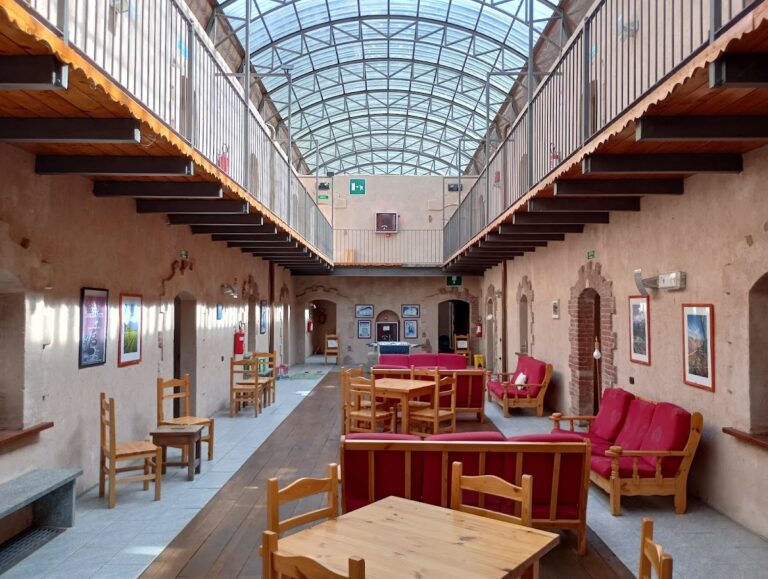
On 8 December 2015, the complex acquired a further religious function with the inauguration of the Pilgrim’s House, a hostel for travellers following the Via Francigena, the historic pilgrimage route leading through western Europe toward Rome.
Remains
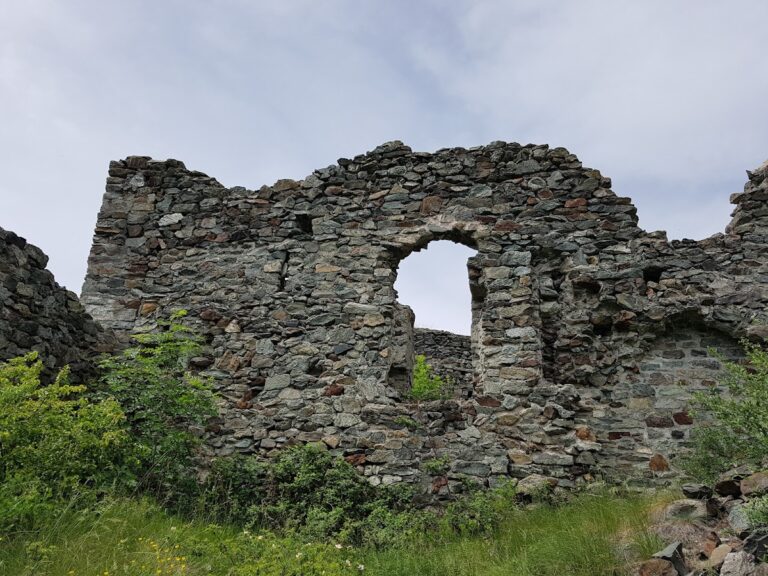
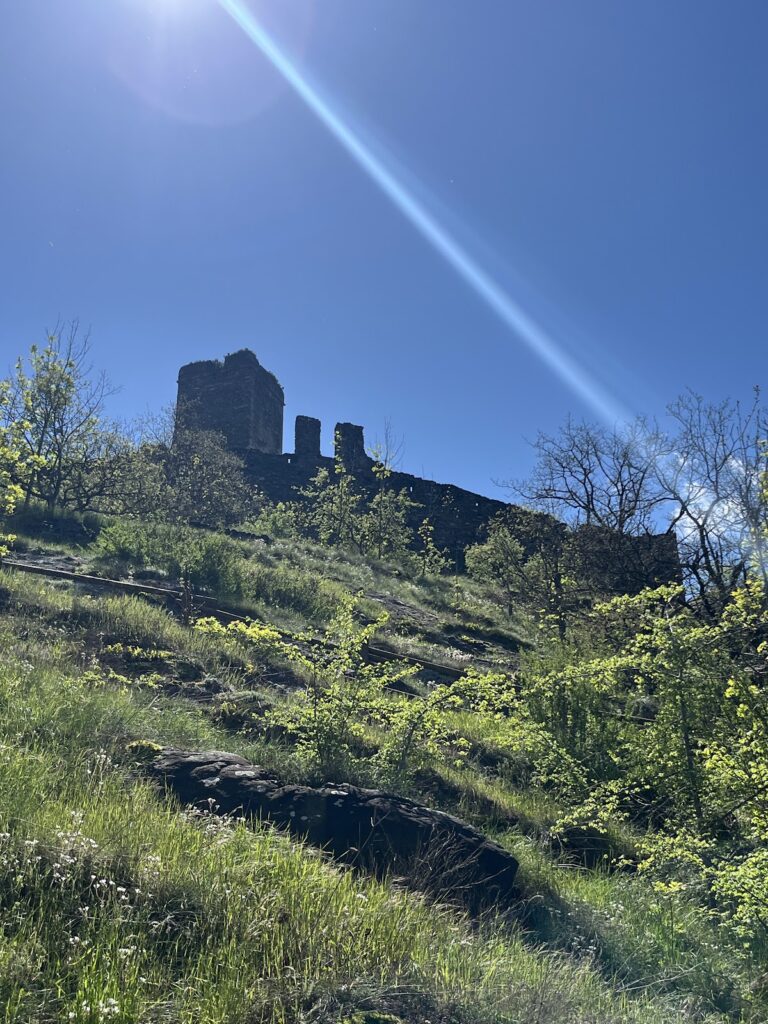
The complex stands uphill from Verrès and is approached along the former Challand road, whose surface is paved with carefully laid cobbles. A ramp leads toward the buildings, followed by a staircase that reaches the lateral entrance and the priory portal. The surviving group combines fabric from the eleventh through eighteenth centuries with later alterations and rebuilding.
Approach and principal entrance
Staircase and terrace
The staircase provides the approach to the lateral entrance and the main priory portal. At its foot, a terrace includes a nineteenth-century stone column made from non-local stone. This terrace forms part of the lower approach to the upper buildings of the complex.
Portal and Gothic window
The monumental portal is assembled from carefully arranged blocks of rough, pale-green stone. Elegant carved columns frame the entrance, while restrained twisted motifs interlace across the stonework. Above the approach, a large three-light window is regarded as a masterpiece of Aosta Valley Gothic. An external three-light Gothic window also remains visible in the parish church.
Bell tower and associated structures
Bell tower
The bell tower belongs to the group rebuilt in 1512 at the order of Charles of Challant. Its upper section has carved corbels, and a crown of corbels runs around the middle of the tower. The tower forms part of the rebuilt architectural group with the large adjoining building.
La Murasse and the New Grange
La Murasse and the New Grange are associated buildings commissioned by Charles of Challant. The New Grange was built at the edge of the settlement toward Arnad, at the crossroads for Issogne. Together with the large building adjoining the bell tower, they preserve the complex’s relationship with the surrounding settlement and its historic routes.
Church and chapels
Challant Chapel
The Challant Chapel is integrated into the complex and contains the burial of its builder, Iblet of Challant. His remains were placed there in accordance with the wishes expressed in his testament. The chapel therefore preserves both a distinct architectural space and a direct funerary connection with the family that shaped the priory’s later history.
Parish church and attached chapel
The parish church incorporates structures from the earlier church, which was rebuilt during the 1770s. The Chapel of Saint George and Saint Maurice was attached to these earlier structures under the patronage of Count Charles Francis Octavius of Challant-Châtillon. The church retains an external three-light Gothic window within this layered fabric.