Saint Francis of Assisi Church in Szendrő: A Baroque Franciscan Church in Hungary


Site at a Glance
- Rating
- 4.8
- Popularity
- Very Low
- Country
- Hungary
- Primary era
- Early Modern
- External website
- Open
- Eras represented
- Early Modern
- Civilizations
- Habsburg, Hungarian
- Site type
- Religious
- Remains
- Church
On this page21 sections
History
Saint Francis of Assisi Church in Szendrő is a Roman Catholic church in Hungary, built in the Baroque style for a Franciscan convent and developed into its present form through rebuilding and enlargement that continued into the 1760s. Its foundations were laid in 1635 and 1636, and the church became an important regional center of Catholic renewal and religious education during the Counter-Reformation, the Catholic effort to strengthen the faith after the spread of Protestant reform movements.
Medieval parish and frontier stronghold
Szendrő had become an independent parish by 1332. Its medieval church was dedicated to Saint Stephen, and its first known parish priest, Márk, served there around 1333 and 1334. Tithe records from 1332 to 1337 indicate that the settlement was already relatively prosperous and had the character of a market town.
During the sixteenth and seventeenth centuries, Szendrő served several important roles. It was the seat of Borsod County, an aristocratic estate center, a royal frontier fortress, and a stronghold within the Upper Hungarian frontier command. Its position drew it into conflicts involving the Habsburg monarchy, the Ottoman Empire, and Transylvania, making religious life part of a wider political and military struggle.
Franciscan foundation and Catholic renewal
From the middle of the sixteenth century, the Protestant Bebek family, which controlled Szendrő, restricted Catholic religious activity in the town. Catholic practice continued chiefly among the fortress garrison and the military population. On 12 November 1625, Ferdinand II, the Habsburg emperor and king of Hungary and Bohemia, sent a priest and a cantor-teacher to the town’s small chapel dedicated to the Holy Trinity.
A Franciscan friar was active in Szendrő from 1632, and a Franciscan priest began serving there in 1635. The Franciscans, formally the Order of Friars Minor, are a Catholic mendicant order founded by Francis of Assisi. Their preaching and missionary work made them prominent agents of Catholic renewal during and after the Reformation.
Imre Lósy, Bishop of Eger and later Archbishop of Esztergom and Primate of Hungary, enabled the construction of a Franciscan convent in Szendrő. The friars were formally installed in 1636 under János Gyöngyösi and undertook intensive missionary work in the surrounding area. The convent and its church were completed in 1638. From 1671 the institution held convent status, supported a larger Franciscan community, and provided substantial theological training.
The church was repeatedly affected by clashes among Transylvanian, Kuruc, and imperial forces during the seventeenth century. Repairs carried out in 1674 added the exterior buttresses. The Franciscan foundation thus gave Szendrő a new religious role alongside its earlier importance as a county center and frontier fortress.
Eighteenth-century rebuilding
Count István Csáky commissioned the rebuilding and enlargement of the church from 1741. The sanctuary was extended westward, a new high altar was completed in 1752, the church was consecrated in 1759, and the transformation of the tower was completed in 1765. Around the middle of the century, approximately 25 to 30 friars lived in the convent.
Szendrő again became an independent parish in 1788. On 18 November 1789, the Order of Friars Minor was dissolved in the Habsburg Monarchy under a decree issued by Joseph II, the Habsburg ruler whose policies included the suppression of some religious orders. The former convent continued to serve as a parish until 1808, when the present large vicarage was completed.
Parish life and later care
A canonical visitation in 1829, a formal inspection of a parish by a bishop or delegated canon, provides the first detailed nineteenth-century description of the church. It recorded four side altars in addition to the high altar. Gábor Máriássy served as parish priest from 1835 to 1844 and later became titular Bishop of Paleopolis and participated in the First Vatican Council. The later Eger canons Ferenc Schákovits and József Baratius also served at the parish.
Canon B. Kiss János served as Szendrő’s parish priest and dean for approximately forty years from 1953 until his death. From 1996, the National Office for the Protection of Monuments arranged the restoration of part of the church furnishings. Ágnes Máger painted the present wall paintings in 1996 and 1997, while József Király carried out the decorative painting. An 1802 map by the master mason Johannes Michael Seidler records the Franciscan convent and church complex.
The church is regarded as an important monument of Szendrő and Hungary because its Baroque furnishings survive as a substantially complete ensemble. The former Franciscan convent no longer survives as an intact complex, but the church continues to preserve the material record of the Franciscan foundation and its role in Catholic renewal.
Remains
Building and former convent
The church is a large, single-nave Baroque building. Its nave is divided into four bays and covered by a barrel vault, with crescent-shaped lunettes formed between the vault and the transverse arches. The two-bay sanctuary ends in a straight apse, the terminating end of the church, and was added during the rebuilding begun in 1741.
The sanctuary contains crypts prepared for members of the Csáky family and the Franciscan friars. The aristocratic burials lie beneath the sanctuary, while the friars’ crypt is beneath the choir. The crypts beneath the sanctuary are flooded. Count Ferenc Xavér Forgách of Ghymes and Gács, an imperial-royal lieutenant field marshal who died in 1764, is buried there.
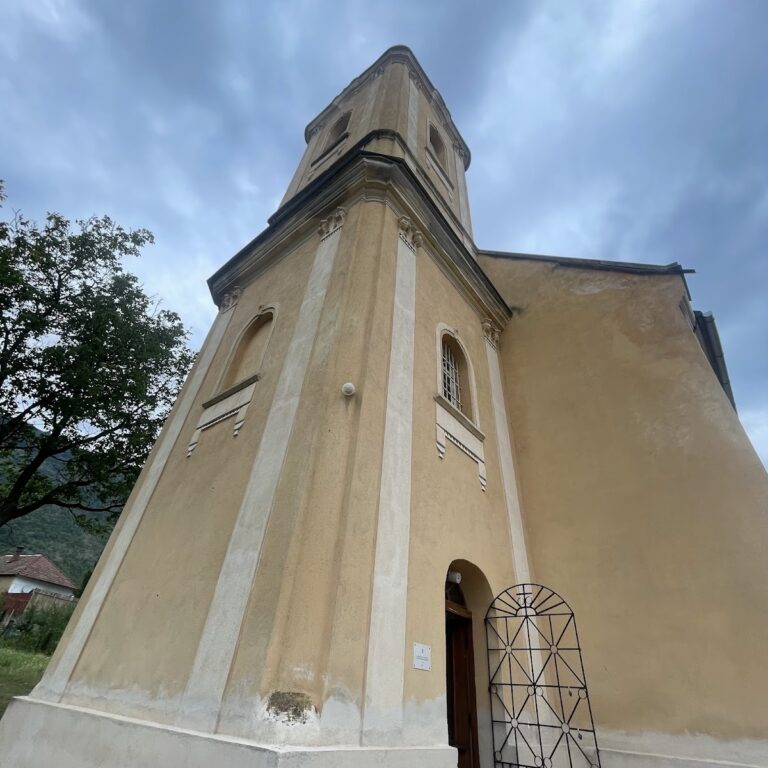
The tower stands before the main facade and is marked by prominent cornices. It has a lantern, a bulbous Baroque roof with an ornamental clock cornice and cushioned spire, and an apostolic double cross at the summit. Four clock faces and three bells are housed in the tower. The second storey has three semicircular-headed windows, while each lower level has one.
Niches in the facade contain statues of King Saint Stephen and Saint Elizabeth of Hungary, also known as Saint Elizabeth of Thuringia. The south elevation alternates semicircular-headed windows with buttresses. Along the north side, a two-storey corridor preserves remains of the former convent cloister.
The internal entrance to the former convent has a late Renaissance stone door frame bearing a linden-leaf Lorántffy coat of arms and the motto “DOMAT OMNIA VIRTUS,” meaning “Virtue subdues all things.” A memorial plaque in the entrance commemorates the known Catholic priests who served in Szendrő from the fourteenth century onward and gives their periods of service.
Baroque altars
High altar
The high altar and several side altars were made in the workshop of the Košice master József Hartmann and commissioned in a unified style by Count Antal Csáky. The high altar has drapery falling from a baldachin and a curved altarpiece. Its central scene shows the stigmatized Saint Francis receiving the indulgence document from Christ and the Virgin Mary amid heavenly hosts.
Statues of the Hungarian holy kings Stephen and Ladislaus flank the altarpiece, while twelve larger and smaller angels and putti complete the decoration. A passage for Franciscan liturgical ceremonies runs between the rear of the altar and its front section, which contains the tabernacle. Confessionals open on both sides. Inscriptions on the altar date its commission and decoration to 1760, while visitation records place its installation around 1752. A pair of bronze candlesticks dated 1636 may belong to the church’s original furnishings.
Saint Anthony of Padua altar
The Saint Anthony of Padua altar was made for the male members of the Csáky family. Its painting shows Saint Anthony kneeling before the Christ Child, with an angel presenting him to the child. Saint Sebastian and Saint Roch stand on the consoles, and Saint John of Nepomuk appears in the pediment.
The altar table bears the Csáky coat of arms, showing a severed Cuman head beneath a count’s crown. Saint Anthony was a Franciscan theologian and preacher, while Saint John of Nepomuk was a Bohemian saint widely venerated as a protector against dangers and floods.
Saint Anne altar
The Saint Anne altar was intended for the female members of the Csáky family. Its painting depicts Saint Anne with her daughter, the child Mary, and is a later replacement. Saint Clare and Saint Helena occupy the consoles, while Saint Barbara appears in the pediment. The altar table bears the Jesuit monogram “IHS.”
The original attributes of Saint Clare and Saint Helena were a flower and probably a cross. Saint Clare founded the Poor Clares, the women’s branch associated with the Franciscan movement.
Loreto altar
The Loreto altar also came from the Hartmann workshop. It was commissioned by Pál Tiszta, deputy lord-lieutenant of Abaúj from 1738 and the county’s parliamentary representative from 1751. Its altar table bears paired coats of arms belonging to the Tiszta family and another unidentified noble family.
The painting follows the image of the Black Madonna of Loreto, associated with the Catholic cult of the Holy House of Loreto. Above it is a Marian monogram within a shield framed by putti, and the Holy Crown appears in the pediment. Saint Barbara and Saint Catherine of Alexandria stand on the consoles, while a statue of Saint John of Nepomuk lying on his bier occupies the predella.
Bethlehem altar
The Bethlehem side altar probably belongs to the church’s original seventeenth-century furnishings. This provincial ecclesiastical Baroque work presents the Holy Family, an angel, and shepherds, together with the coat of arms of an unidentified patron.
Mary and Joseph stand in a cabinet with the infant Jesus in a manger. Two shepherds dressed in German-style clothing flank the cabinet, and a winged angel crowns the composition.
Dolorous Mother altar
The Dolorous Mother side altar probably dates from 1773. It stands beneath the choir before a stylized niche representing the Lourdes grotto. Made of wood, it survives in very good condition.
Front side altars
Two small side altars at the front were consecrated in recent times. The Calvary altar has a painting by Ágnes Máger, which temporarily replaced the high-altarpiece during the lengthy restoration. The Divine Mercy altar contains a donated image of Jesus from the Divine Mercy chapel in Kraków.
Paintings, devotional objects, and liturgical furnishings
Wall paintings and Stations of the Cross
The present fresco cycle was painted by Ágnes Máger in 1996 and 1997, with decorative painting by József Király. The sanctuary contains the Trinity and the four Evangelists, while Christ in the Eucharist appears between two kneeling angels on the triumphal arch. Scenes in the nave depict the Annunciation, Saint Francis preaching to the birds with the wolf of Gubbio at his feet, and the Resurrection.
Smaller scenes show the Visitation, the Nativity and Adoration of the Magi, the Flight into Egypt, Christ on the Mount of Olives, the Crucifixion, the Descent from the Cross, and the Entombment. Fourteen Stations of the Cross paintings from the 1810s present episodes from the Passion of Christ, including Jesus speaking to the weeping women at the eighth station and being nailed to the cross at the eleventh.
Choir stalls and pulpit
The eighteenth-century choir stalls used by the friars for the daily office are now placed on both sides of the high altar. Formerly located in the choir, they carry oil paintings of Franciscan saints, including Anthony of Padua, Louis the Bishop, John of Capistrano, Paschal Baylon, Didacus, Peter of Alcantara, Bonaventure, and Francis. One of the convent’s friars probably painted them.
The richly carved Baroque pulpit has an entrance door decorated with an oil painting of Saint Anthony of Padua preaching to the fish. The sacristy vestibule contains a 1773 statue of Saint John of Nepomuk, formerly placed in the church garden.
Reliquaries and vestments
The church contains a monstrance-shaped reliquary for Saint John of Nepomuk. A monstrance is a vessel used to display the consecrated host, while a reliquary preserves and displays a relic. This example is made of gilded and silver-plated copper, has engraved decoration on its knop, and contains a glazed capsule with a relic enclosed in gilded paper ornament and bullion-thread work.
Three eighteenth-century reliquaries made by nuns contain the remains of martyrs from the Roman catacombs. One stands on the high altar and two on the Saint Anne altar. András Szabó, Bishop of Košice, donated them in 1811. Their names include Saint Fauster, Saint Liberarius, Saint Victrix, Saint Lympherius, and Saint Theodorus. The smallest reliquary incorporates an engraving by Johann Melchior Gutwein depicting the Marian shrine of Landshut.
The sacristy preserves valuable vestments donated chiefly by women of the Csáky family. Among them is a white Baroque moire vestment weighing four kilograms and richly decorated with gold embroidery, probably made by Csáky women. An original Baroque multi-drawer parament cabinet is also preserved there.
Baptismal fonts, library, and other objects
Three baptismal fonts are preserved in the church. A fragmentary red-marble font originally came from the chapel of Szendrő Castle. Imre Lósy donated a second stone font, while Ferenc Fuchs, the first Archbishop of Eger, donated a third, carved in wood in the Zopf style, a late eighteenth-century style between late Baroque and Neoclassicism.
The wooden font has an episcopal coat of arms on its cover and a sculptural group of John the Baptist baptizing Jesus. The church library consists mainly of eighteenth-century Latin theological works. Its most valuable item is a Basel edition of 1588 containing homilies, Gospel commentaries, and sermons by John Chrysostom. The work was translated and compiled from Greek by Franciscus Accoltus, Erasmus of Rotterdam, Germain de Brie, and Theodorus Gaza, and requires restoration.
A Gothic monstrance from the early 1430s, regarded as a masterpiece of contemporary Hungarian goldsmithing, is now part of the permanent exhibition of the Hungarian National Museum. The church’s present large bell weighs 420 kilograms and was cast in Diósgyőr in 1920 in honor of Saint Elizabeth. János Markovics and his family donated it. The middle bell is dedicated to Saint Stephen and weighs 310 kilograms, while the 140-kilogram soul bell was also cast in Diósgyőr in 1920.
The organ was made by the Országh firm in 1881. It formerly served as the small organ of Eger Basilica before being donated to the Szendrő church. The present altar facing the congregation and lectern date from the 1970s. An oval painting of Saint Elizabeth of the Árpád dynasty distributing bread to the poor is considered to be from the eighteenth century.
Calvary Hill chapel
A Baroque Catholic chapel stands near the church on Calvary Hill, forming an additional religious structure associated with the Szendrő church complex.
Nearby sites