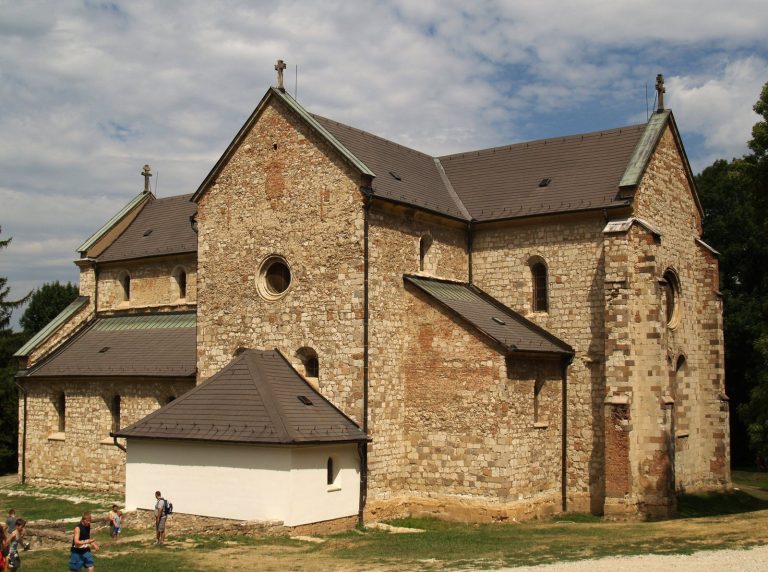
Gothic Protestant Church of Avas: A Medieval Reformed Church in Miskolc, Hungary


Site at a Glance
- Rating
- 4.6
- Popularity
- Low
- Country
- Hungary
- Primary era
- Medieval
- External website
- Open
- Eras represented
- Medieval, Early Modern, Modern
- Civilizations
- Hungarian, Ottoman
- Site type
- Religious
- Remains
- Church
On this page9 sections
History
The Gothic Protestant Church of Avas is the oldest building in central Miskolc, Hungary. Construction began in the thirteenth century as a small Romanesque church dedicated to Saint Stephen, the first king of Hungary and a central figure in the country’s Christian history. Originally Roman Catholic, it became a Reformed church during the sixteenth-century Reformation and now belongs to the Tiszáninnen Reformed Church District and the Miskolc-Avas-Dél parish.
Medieval expansion and rebuilding
The early single-nave church was extended westward during the reign of Louis I of Hungary, also known as Louis the Great, a fourteenth-century king. It was later transformed into a three-nave Late Gothic hall church. A fragment of a Latin inscription found on the north wall in 1926 places this rebuilding in 1489.
The church’s medieval form was severely damaged during the Ottoman occupation of Hungary, the period when Ottoman forces controlled or campaigned across substantial parts of the kingdom. In 1544, Ottoman forces burned the building. The Gothic ribbed vaults and roof collapsed, and the original tower was destroyed. The church remained without a roof for more than twenty years. Its medieval frescoes were no longer visible afterward, and surviving fragments were covered with whitewash.
The Reformed church and separate belfry
By this time the church was already Protestant. Borbála Fánchy, the Catholic holder of the Diósgyőr estate, refused permission for timber from nearby forests and locally produced lime to be used in its reconstruction. Rebuilding for Reformed worship eventually took place between 1563 and 1569.
The original tower was not reconstructed in its former position. Instead, a separate belfry was erected beside the ruined church in 1557, on the site of the Saint Michael cemetery chapel, which had been destroyed in 1554. An inscription above the entrance names the officials associated with its construction: castle captain Zsigmond Balassa, judge Pál Gombos, and custodian Mátyás Szijgyártó. During the seventeenth and eighteenth centuries, the belfry also served as a fire-watch post. It burned in 1865, but most of its timber structure survived.
Later additions and restoration
A Baroque mortuary chapel was added to the south side of the church in 1760. In 1896, a Neo-Gothic cemetery enclosure and an organ gallery were built on the north and west sides; the gallery was designed by Ottó Sztehlo, a Hungarian architect. Dates carved above the sanctuary mark successive roof-shingle renewals in 1666, 1696, 1734, 1768, 1796, 1839, 1868, 1923, and 1980.
Archaeological work carried out during the 1941 interior renovation showed that continuous wall bodies stood between the substantial pillars. It also revealed the former entrance to the north sacristy and the adjoining tabernacle, while clarifying the arrangement of the sacristy’s foundation walls. The most recent restoration was completed in 1982. The church, belfry, and cemetery are listed as protected monuments and form a historic monument ensemble with the Papszer exhibition building of the Herman Ottó Museum.
Organs, clocks, and memorial history
József Angster built the original organ in 1895 as the 240th instrument produced by his workshop, using a donation from the widow of János Kaszás. It was modernized in 1971, but later restoration was considered impractical. A new organ was therefore installed, while the older instrument remained in the church and was handed over on 4 June 2008. Organ concerts have included the Collegium Musicum summer series, held since 1965, and events associated with the Miskolc Opera Festival since 2001.
A clock was installed on three sides of the belfry’s roof structure in 1680. The present clock and chime mechanism were made by the Szeged craftsman Ferenc Csury at the initiative and with the support of the Miskolc lawyer Lajos Győry Nagy and his brother István. Since 1 May 1941, the chimes have sounded every quarter hour, with the complete melody played on the hour. The mechanism was renovated in 1965. Its traditional Whittington tune is regarded as a characteristic sound of Miskolc and is also used by the National Theatre of Miskolc to announce the beginning of performances.
The church’s first Reformed pastor was Mátyás Dévai Bíró, a sixteenth-century Protestant reformer traditionally regarded as the first Hungarian reformer. His memory is commemorated inside the church, alongside memorials to László Palóczy and three Miskolc Protestants persecuted during the Counter-Reformation. Palóczy’s marble plaque was installed in the south aisle in 1864 by fellow parliamentary representatives. A white Carrara-marble plaque for Dévai Bíró stands on the eastern side of the pillar beside the pulpit staircase.
Remains
The church building
The surviving church is a three-nave Late Gothic hall church whose sanctuary is as wide as the nave. An ambulatory, or passage around the sanctuary, accompanies the sanctuary, which also has buttresses and windows with varied tracery, the patterned stone framework in the upper parts of Gothic windows. Earlier supports were altered into the square-plan pillars visible today, probably retaining the cores of the original pillars. Semicircular arcades pass between them. The medieval vaults were replaced by a flat wooden ceiling, and the present ceiling dates from the eighteenth century.
Thirteen Gothic windows illuminate the building. Their tracery patterns vary, although their rib profiles are identical. Five large tracery windows are set in the south nave wall, five in the sanctuary, two in the north nave wall, and one in the west facade. Rose windows occupy the north and west facades. A Renaissance royal choir stall stands on the central axis and probably came originally from the chapel of Diósgyőr Castle.
The nineteenth-century organ gallery on the west side houses the Neo-Gothic Angster organ. This two-manual concert organ has mechanical tracker action, with a largest pipe measuring 5.5 metres and a smallest measuring 6 millimetres. It contains 170 wooden pipes and 3,010 metal pipes. The newer organ occupies the eastern, sanctuary-side part of the church, so both instruments remain within the building. The church’s acoustics support organ performance and concerts.
The belfry
The separate belfry is a compact, square-plan stone structure with one main storey and a timber gallery. Its basement and ground floor have barrel vaults. Above them rises a tall roof capped by a six-sided pyramidal structure made of hewn oak. A small arcade runs below the cap, with the roof continuing above it. A timber addition on the south side contains the entrance.
Two buttresses reinforce the east side, while the north and west sides each have three. Most of the present timber framework survived the 1865 fire. The chime is produced by vibrating rods and amplified by loudspeakers, although urban noise limits the area in which it can be heard. A plaque on the belfry’s eastern wall commemorates the donation of the clock and chime mechanism.
The cemetery and memorials
The cemetery completely surrounds the church and covers more than 10,900 square metres. Footpaths divide it into sections of different sizes, and its earliest surviving gravestones date from the seventeenth and eighteenth centuries. Burials continued through the nineteenth and twentieth centuries. Those commemorated include Bertalan Szemere and his only son Attila, László Palóczy, Lajos Horváth, members of the Latabár family, the parents of the poet Mihály Tompa, Adolf Joost, József Szatmáry, István Bay and his family, and László Schabinszky.
The south aisle contains Palóczy’s ornate marble memorial plaque, decorated with the small Hungarian coat of arms, oak and laurel garlands, ivy leaves, and Palóczy’s own coat of arms. Other interior memorials include the Carrara-marble plaque for Mátyás Dévai Bíró and the plaque dedicated to three Reformed victims of the Counter-Reformation. On the slope below the church, to the north, a memorial bench commemorates Adolf Kühne, founder of the Borsod Bükk Association.