Saint Alypius Church, Kastoria: A Medieval Orthodox Church
Site at a Glance
- Popularity
- Very Low
- Country
- Greece
- Primary era
- Medieval
- Eras represented
- Medieval
- Civilizations
- Ottoman
- Site type
- Religious
- Remains
- Church
On this page16 sections
History
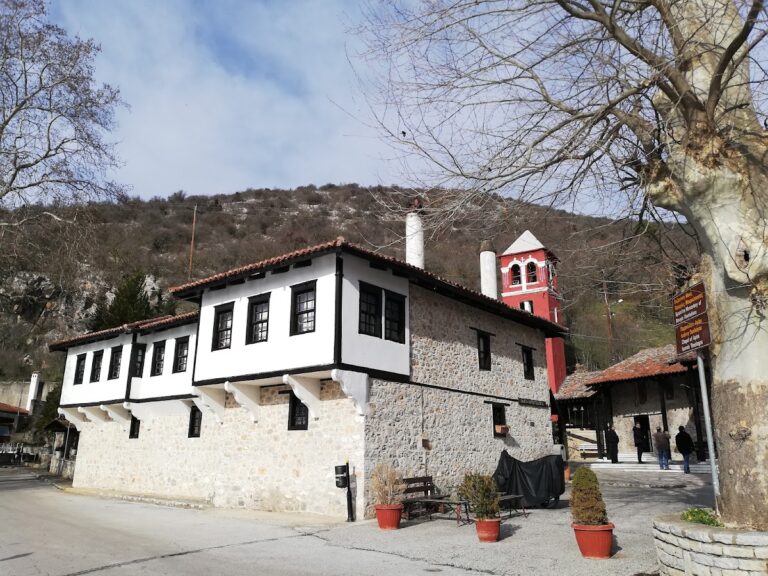
Saint Alypius Church is a medieval Orthodox church in the Tabakhane quarter of Kastoria, Greece. The church dates to 1420 and remains an active place of worship.
Foundation and dedication
An inscription records a donation to the church on 3 March 1420, following the death of the wife of Stamatios, a priest of Kastoria. She was the sister of Galaktion, an archimandrite, or senior Orthodox monastic. The church was first dedicated to the Virgin Mary and is now dedicated to Saint Alypius.
Church affiliation and conservation
The church traditionally belonged to the old Ikonomos parish and is now part of the parish of Saint Paraskevi Ikonomou. It originally fell within the Archdiocese of Ohrid, a historic Orthodox jurisdiction in the Balkans. Today it belongs to the Diocese of Kastoria under the Ecumenical Patriarchate, the Orthodox patriarchate based in Constantinople.
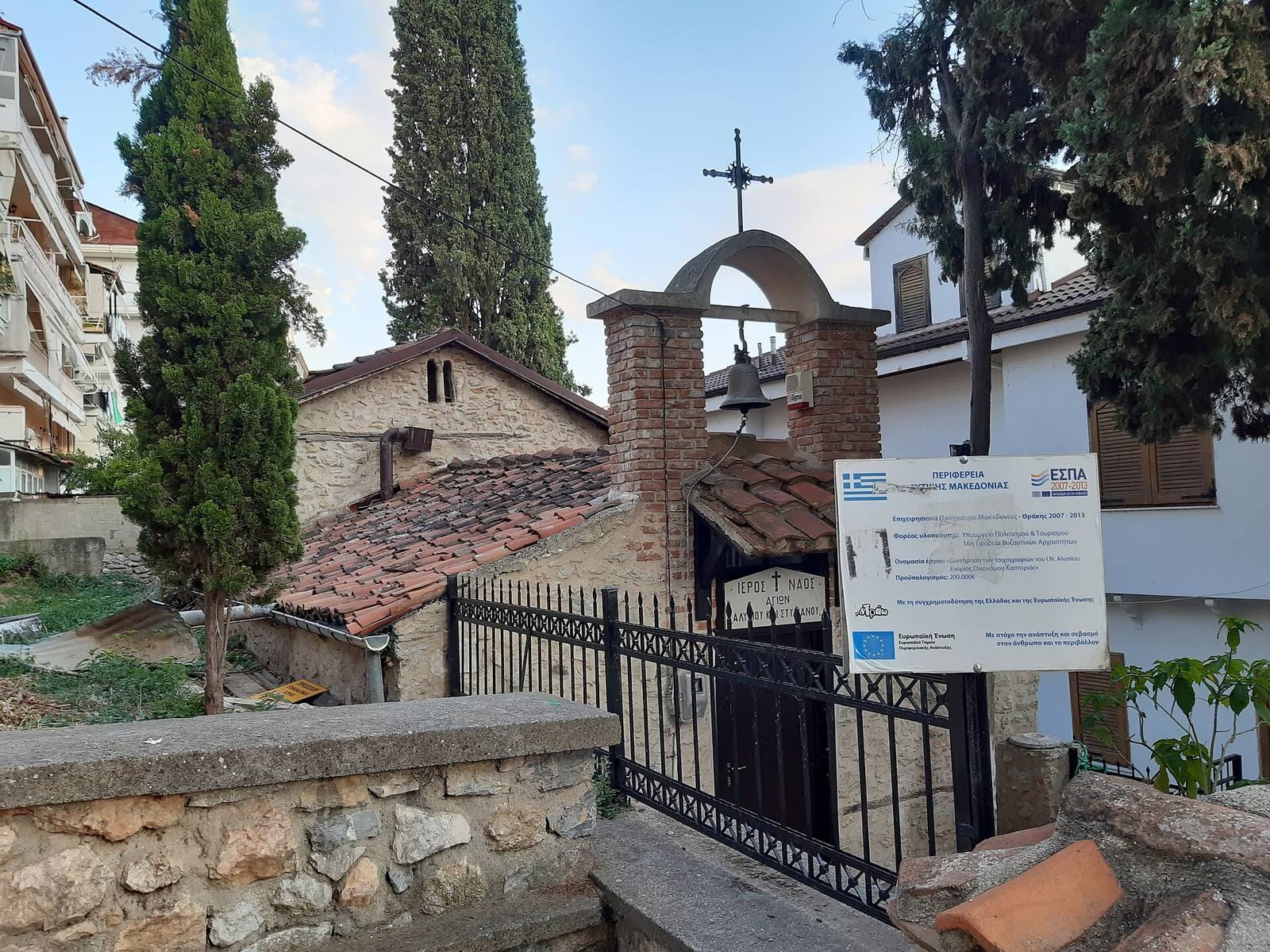
Repeated repairs altered the building. A later roof set below the original level concealed parts of the paintings high on the east and west walls; roof restoration in 2003 exposed them again. The 16th Ephorate of Byzantine Antiquities, a Greek state service responsible for antiquities, also carried out a comprehensive restoration. The church is protected as a cultural monument.
Remains
Plan and construction
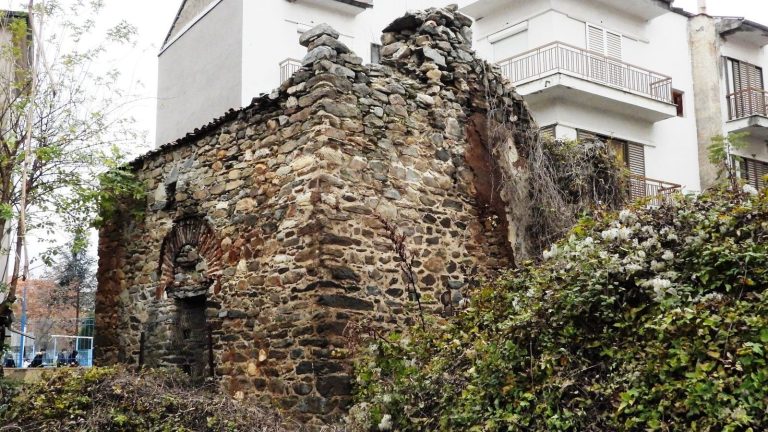
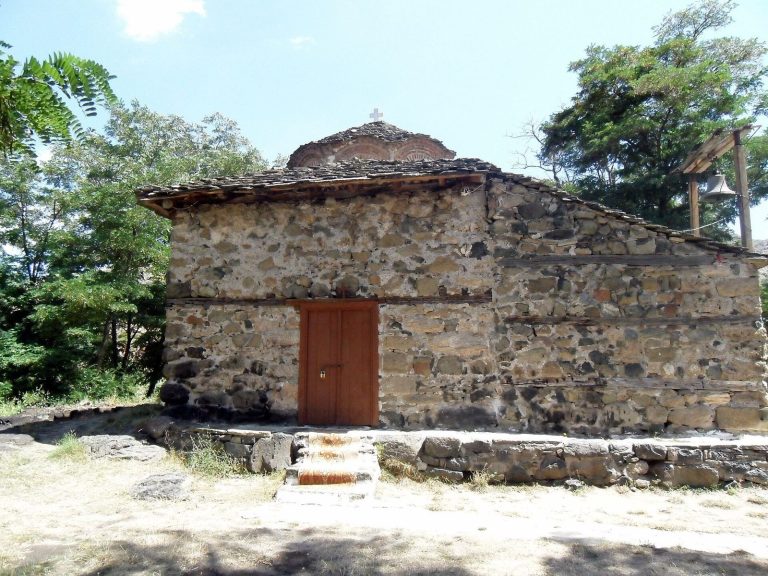
The church is a compact single-nave basilica, a longitudinal church with one main worship space. Its irregular walls are built chiefly of rubble stone and brick, with mud held within timber framing. A later entrance hall, or narthex, extends from the west end.
Nave
The nave does not form a true rectangle. Its exterior sides measure 7.70 metres on the north, 8.15 metres on the south, 5.57 metres on the east excluding the apse’s curved end, and 4.95 metres on the west. The main entrance is reached from the west through the narthex. Its doorway has a semicircular arch and a straight lintel, with a recessed niche between them. A lowered ceiling now conceals the niche. A later entrance opens in the south wall; an older, lower doorway farther west was blocked and later uncovered during conservation work on the paintings.
Two windows light the north wall. High on the outside of the west wall is a two-part, window-shaped recess with a semicircular lintel. The nave has no ceiling, leaving the timber frame of its gabled roof visible from within. Byzantine tiles cover the roof.
Sanctuary
A newer carved iconostasis, the screen separating the sanctuary from the nave, marks the altar area. Its central doors, known as the Royal Doors, were made by Athanasios Panagiotou. The sanctuary floor stands one step above the nave. A central apse contains the altar table, while a second niche serves as the prothesis, the area for preparing the Eucharistic gifts.
The central apse has a semicircular half-dome that projects outside in a three-sided form. The smaller half-dome over the prothesis lies within the wall and does not reach the ground. A small opening in the central vault brings light into the sanctuary.
Western narthex
The narthex measures 6.50 by 5.85 metres externally, and a clear construction joint separates it from the nave. It is entered from the west, while an earlier entrance on the south is blocked. A window above the western entrance lights the interior. The narthex has its own lower wooden roof, which is gabled and tiled and conceals a closed, vault-shaped recess on the east wall.
Painted decoration
Only fragments of the church’s once extensive wall paintings survive, and they are in poor condition. Paintings remain on the east, west, and south walls of the nave, with smaller painted areas on the east wall of the narthex. Their arrangement uses three horizontal zones, a pattern found in single-nave churches of the Palaiologan period, the late Byzantine era of the Palaiologos dynasty from 1261 to 1453. A decorative band survives along the lower south wall and may once have continued around the church.
Apse and sanctuary paintings
The half-dome of the central apse shows the Virgin Mary in a prayerful pose, with Christ on her breast. The image bears the title Wider than the Heavens and an inscription translated as Not Made by Human Hands. Soot once obscured the inscription, which came to light during restoration. The image is associated with the Thessalonian iconographic tradition.
Below the Virgin are four full-length bishops turned toward the centre: Athanasius, John the Theologian, Basil the Great, and Gregory the Theologian. The restored decoration also includes a canopy over the Holy Table and a chalice in the Offering of the Sacrifice scene. Together, these elements express the Eucharistic belief that bread and wine become Christ’s body and blood during the Communion rite.
Paintings at the east end
Parts of an Annunciation survive beside a blocked window on the south side of the east end. The Virgin and the Archangel Gabriel stand on opposite sides of the arch. Seated before buildings, the Virgin leans toward him. Gabriel wears a ceremonial Byzantine vestment, holds a sceptre in his left hand, and gestures as if speaking with his right. A small fragment of an image of Christ’s face on a cloth survives on the front of the apse arch between the figures.
The Ascension appears on the east gable. In the surviving lower part, the Virgin stands with raised hands, surrounded by apostles shown with energetic gestures. In a sanctuary-side chamber called the diakonikon, a damaged full-length image depicts an unidentified bishop; busts of saints in medallions occupy the area above.
South wall
Four busts of saints in medallions survive in the middle zone of the south wall. The upper zone contains scenes from the major feasts of the Orthodox calendar. The Nativity includes a bathing scene on the east gable of the south wall, and a faint surviving passage suggests that the Presentation followed it. Part of the Entry into Jerusalem remains at the west end of the south wall.
Damaged figures of unidentified saints appear lower down. On the west-facing side of the blocked south doorway is Saint Anastasia the Deliverer from Bonds, holding a small flask. On the other side, part of a crowned saint’s head survives; the jewelled crown indicates the figure’s noble status.
Virgin and Child beside the iconostasis
A niche beside the iconostasis contains a full-length image of the standing Virgin holding the infant Christ. Restoration uncovered the lower part of the painting. Their cheeks touch, conveying tenderness and anticipating Christ’s Passion. The image is titled Eleusa, meaning Merciful.
West wall
The middle zone of the west wall contains a Dormition of the Virgin, of which the right side is lost. The Virgin lies on a richly decorated bed while Christ holds her soul; angels, a seraph, and the apostles surround them. Peter burns incense at the left, and the apostles behind the bed bow in grief. Two women and a bishop appear above them. A fragment of the Transfiguration survives on the west gable, including Peter kneeling and John lying face down.
Narthex paintings and inscriptions
Small painted areas remain on the east wall of the narthex, including a fragment of the inscription associated with the church’s 1420 donation. Beneath it is an earlier painted layer with abstract ornament. Its date is uncertain, though it may belong to the same period as the other church paintings. Another fragment, above a doorway lintel, comes from a building inscription whose surviving words mean was built.
A second inscription above the doorway from the narthex into the nave was recorded by Anastasios Orlandos in 1938. It was later covered with plaster and rediscovered in very poor, fragmentary condition during conservation.
Date and style of the paintings
Euthymios Tsigaridas dates the frescoes to the last quarter of the fourteenth century on the basis of their style and imagery. Their compositions generally emphasize central figures, with narrow shoulders, relatively small heads, broad flat faces, and linear features. Painters used olive-green underpainting, light-pink highlights, and incised details to shape faces. Expressions are often calm but can convey grief or tenderness; loose drapery and buildings in the backgrounds help balance the scenes. The overall style is especially closely related to frescoes at a Kastoria church of Saint Nicholas dated to the same period. Other comparisons include Saint George on the Hill in Kastoria, the Nativity of the Virgin on Mali Grad, Christ the Life-Giver at Borje, and Saint Demetrius at Boboshtica.