Dargavs Complex: A Cemetery of Crypts in North Ossetia, Russia
Site at a Glance
- Popularity
- Very High
- Country
- Russia
- Primary era
- Medieval
- Eras represented
- Medieval, Early Modern
- Civilizations
- Unclassified
- Site type
- Burial
- Remains
- Necropolis
On this page13 sections
History
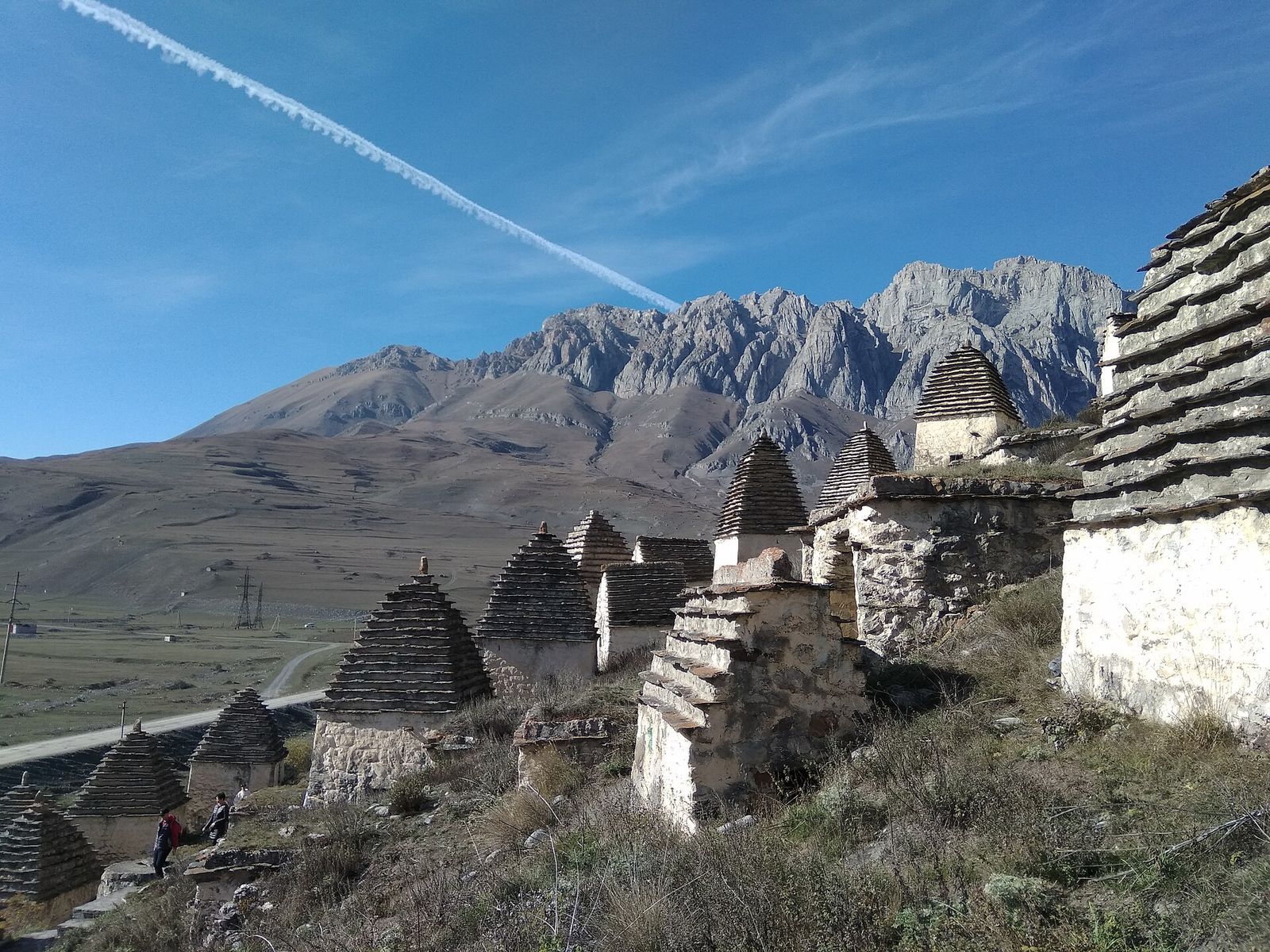
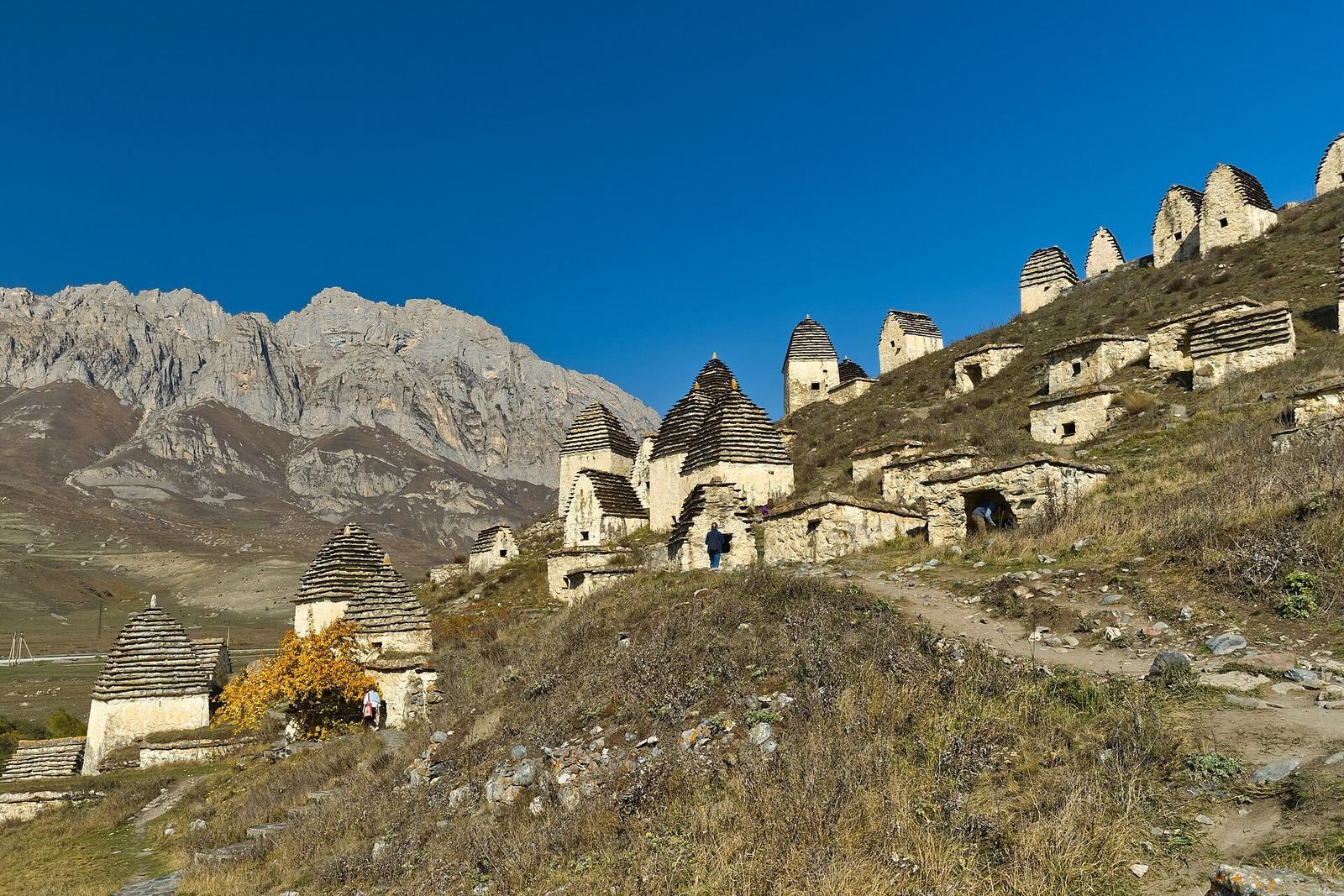
The Dargavs Complex is a cemetery of above-ground and partly underground crypts (burial chambers) near the village of Dargavs in North Ossetia, Russia. Burials began around the fourteenth century, while the crypts are broadly dated from the fourteenth to the eighteenth centuries. Its 95 crypts form the largest complex of this kind in the North Caucasus.
Origins and burial customs
The circumstances behind the cemetery’s foundation remain uncertain. One theory connects its beginnings with the Alans, an Iranian-speaking people of the North Caucasus, who withdrew into one of five gorges after Mongol campaigns conquered Kievan Rus’, the medieval East Slavic polity.
Explanations for above-ground burial include scarce farmland in the mountains, rocky ground that made underground chambers difficult to dig, respect for ancestors, social distinctions, and possible religious restrictions on burial in the earth. Some interpretations also compare the custom with Sarmatian practices. The Sarmatians were ancient Iranian-speaking peoples, and above-ground burial has been tentatively linked to beliefs about respecting the land.
Epidemic and end of use
Around the turn of the eighteenth and nineteenth centuries, the cemetery may have served as a place of isolation during an epidemic of plague or cholera. Families reportedly moved there to protect their neighbors from infection, brought food to the sick, and left after recovering. The final burials date to the mid-nineteenth century, when mountain residents began moving to the plains and coffin burial became established. Crypt use ended around this time.
Research and local traditions
Praskovja Uvarova made the first scholarly description of the complex. Leonid Semjonov researched and excavated there in the 1920s, Henry Field investigated it in 1934, and Vitalij Tmenov carried out further work in the second half of the twentieth century. Easy access to the tombs led to looting, leaving some objects in mixed, disordered groups that complicate efforts to study social distinctions and dating.
A local legend tells of a beautiful young woman accused of witchcraft and killed by men who wanted her. The story links her death to a plague and says the earth pushed buried bodies back to the surface, prompting people to build tombs above ground. Another local superstition warns that anyone who enters the cemetery will not leave alive.
Remains
Crypt architecture and layout
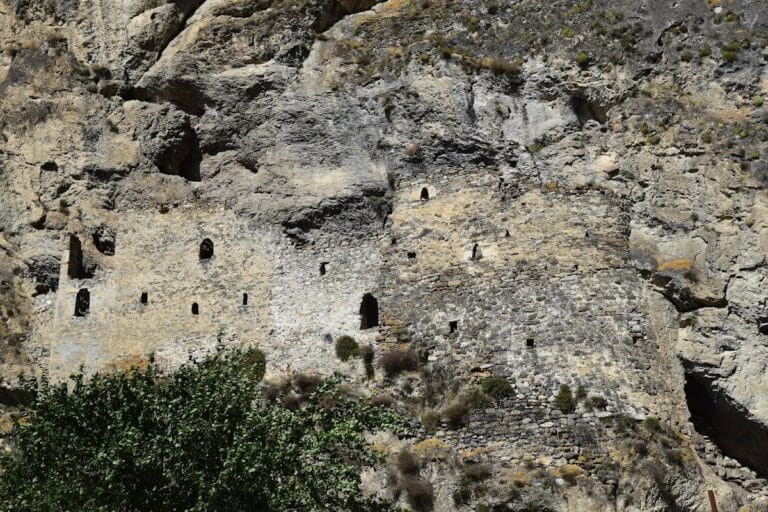
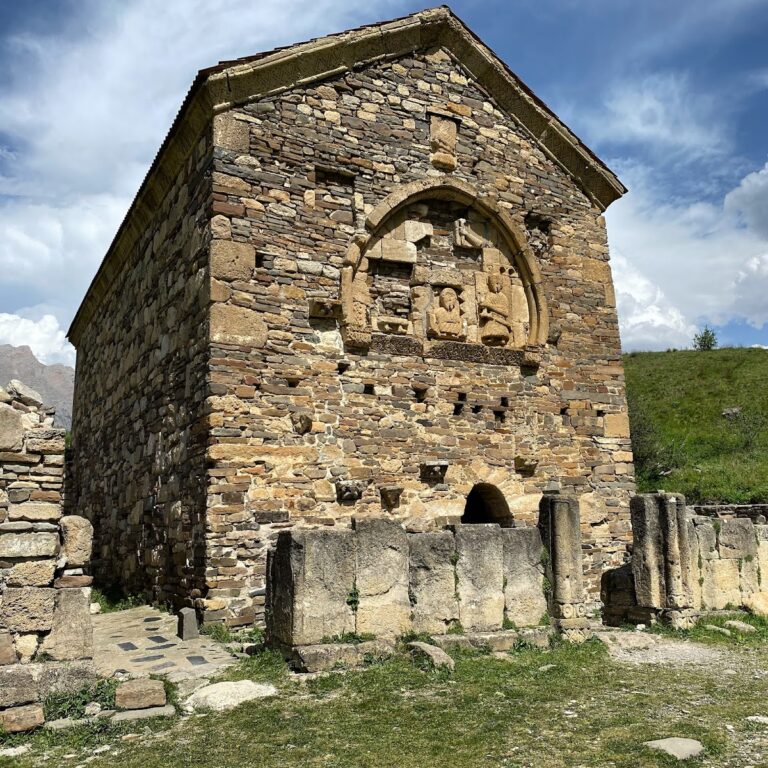
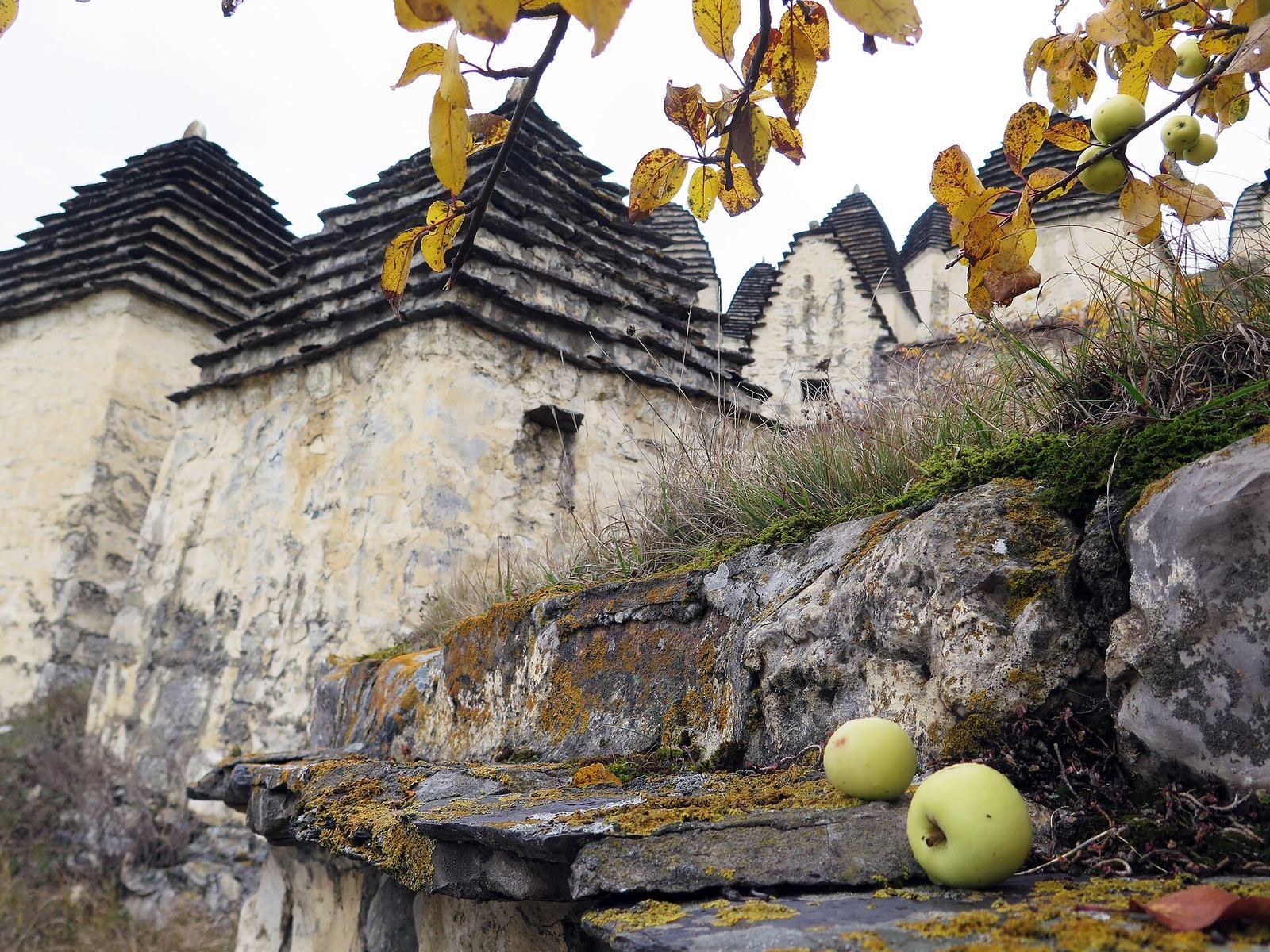
The crypts have no regular overall plan. New structures were added beside earlier ones as needed, with passages between them, and their facades face different directions. Most entrances lie on the east, south, or west sides, where they receive sunlight. Openings were closed with wooden doors or fitted stones to keep out moisture and animals. Masonry around some entrances retains traces of an inward bolt fastening, though its operation is unclear. The buildings use large, roughly worked stones set in lime mortar; their exterior walls are generally plastered and measure about 0.5 to 0.75 metres thick.
Semi-subterranean crypts
Partly underground crypts have chambers up to 8 metres long, usually with flat roofs. Wooden platforms for burials slope slightly toward the entrance, and some chambers have two levels.
Tower-shaped crypts
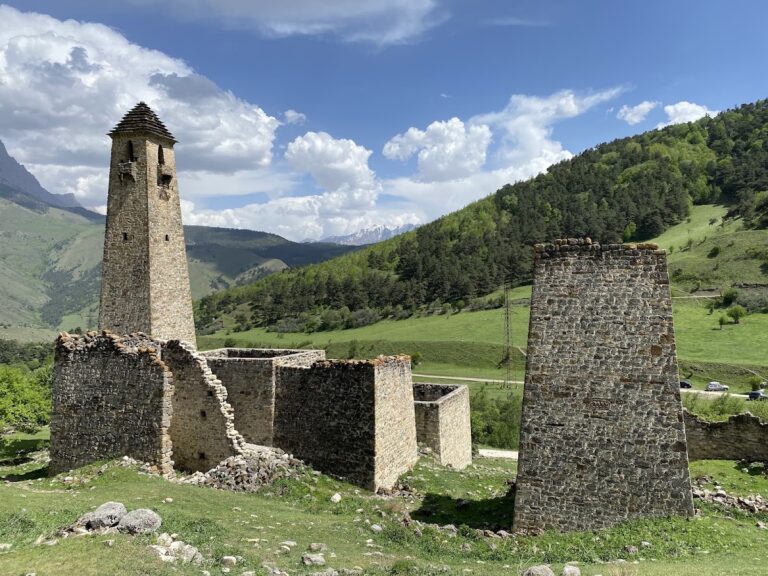
The above-ground crypts rise in tiers, most often three storeys, with examples ranging from two to four. Their wooden floors rest on supports built into the masonry. Some have openings at several heights, generally one on each facade except the north side. Roofs are gabled or hipped, with projecting slate ledges and a truncated-cone upper element.
Burial forms and human remains
Open and coffin burials
Open burials were the most common form: bodies lay on wooden platforms or above earlier remains, and men and women were buried together. Boat-shaped coffins were made from a thick log split lengthwise and hollowed with an axe. The body was placed in one half, covered with the other, and the pieces joined with iron brackets. Such coffins are also known among the Svans and Ingush in the late medieval period. Later wooden coffins used boards joined with tenon joints and assembled without nails.
Stone-box burials
Two partly underground crypts, numbered 56 and 73, contained stone-box burials, an unusual form within the chambers. Stone-box burials also lay outside the crypts nearby.
Oar burial
An oar accompanied one boat-shaped coffin burial. Since there are no navigable rivers nearby, the oar may have represented a belief that the dead crossed a river on the way to the afterlife.
Finds and preservation
Excavations have yielded more than 1,600 objects, including pottery from Georgia and Dagestan, Russian-made glass bottles dated to 1816 to 1825, turned wooden dishes and cups, clothing, footwear, jewelry, weapons, and textiles from the East. Metal finds include knives, razors, fire-strikers, lead bullets, copper thimbles, and hook-shaped plates. A wooden child’s sled measures 37 by 26 centimetres; its board is 1.3 centimetres thick and its runners are 2 centimetres thick. Dry, well-ventilated conditions inside the crypts have helped preserve objects, particularly compared with finds from underground burials. Some bodies retained flesh on the bones. Around 10,000 people are interred in the complex, with as many as 100 burials in a single tomb.