Obelisk of Axum: An Aksumite Funerary Stele
Site at a Glance
- Popularity
- Very High
- Country
- Ethiopia
- Primary era
- Classical
- Eras represented
- Classical, Modern
- Civilizations
- Aksumite, Ethiopian
- Site type
- Burial
- Remains
- Necropolis
On this page18 sections
History
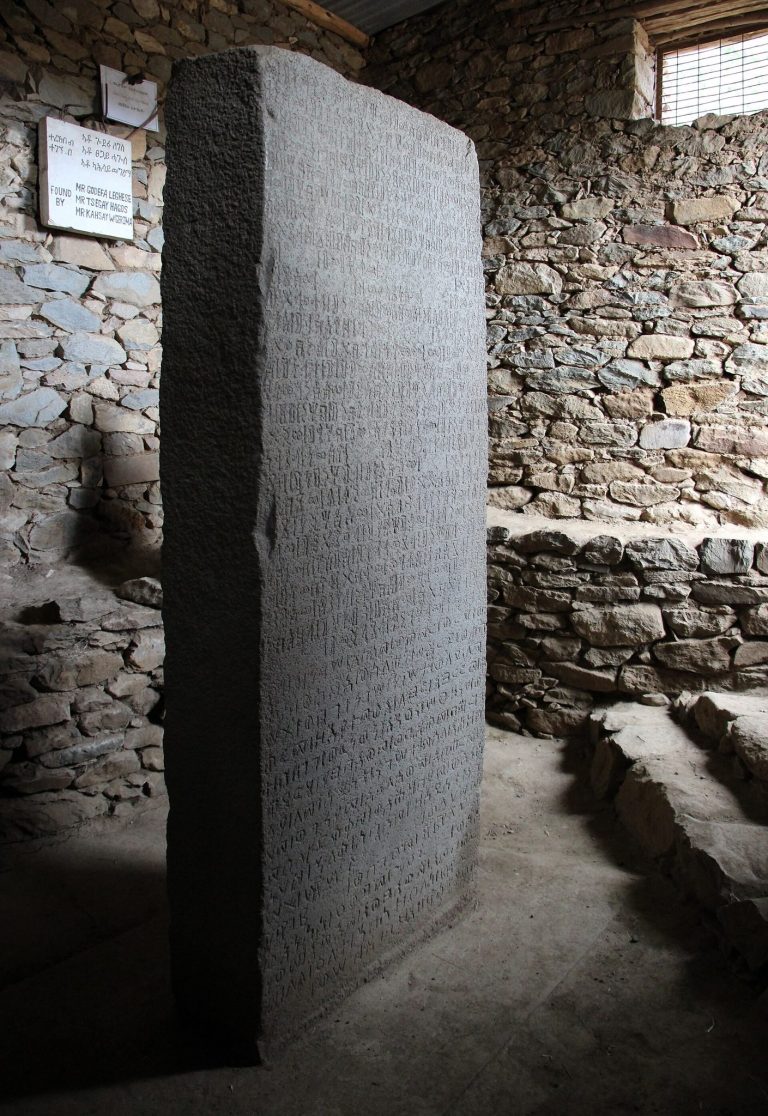
The Obelisk of Axum, an Aksumite funerary stele at May-Hedja in Ethiopia, is known archaeologically as Stele 2. Raised in the fourth century by the Kingdom of Aksum, an ancient African kingdom centred on Axum, it belonged to a group of stone monuments associated with underground tombs. Its removal to Italy in 1937 and return to Ethiopia in 2005 made it a focus of modern debate over cultural property and the legacy of Italian rule.
Aksumite burial monuments
The May-Hedja stelae were created during a period when Aksum was a powerful regional state. Their main phase is generally placed around the beginning of the fourth century, while radiocarbon dating places the carving and raising of stelae in the fourth century. They primarily marked underground tombs, some of which contained several chambers and stone coffins. Large monuments may have marked the graves of rulers or other leaders, but the people buried there cannot be identified with certainty. Tombs may also have served families or clans, and the stelae carry no inscriptions naming the dead.
In the fourth century, King Ezana adopted Christianity under the influence of Frumentius, an early missionary and bishop associated with Aksum’s conversion. The religious change is linked to the decline or end of erecting large stelae. One proposed explanation holds that the collapse of the Great Stele was interpreted as a sign against the older religion and in favour of Christian building, but this remains conjectural.
Collapse and early accounts
The reasons why several stelae fell are uncertain. Weak foundations and shifting ground, earthquakes, deliberate toppling, and military action have all been proposed; earthquakes and ground subsidence are considered particularly plausible. Ethiopian tradition attributes some toppling to Queen Gudit, a figure associated with Aksum’s decline, in the tenth century. Another tradition says that Imam Ahmad ibn Ibrahim ordered cannon fire against the monuments in 1526. Damage during the Ethiopian–Adal War, fought from 1529 to 1543, has also been suggested. Cannon fire is disputed as an explanation for the collapse of the largest stelae, though projectile damage to smaller monuments remains possible.
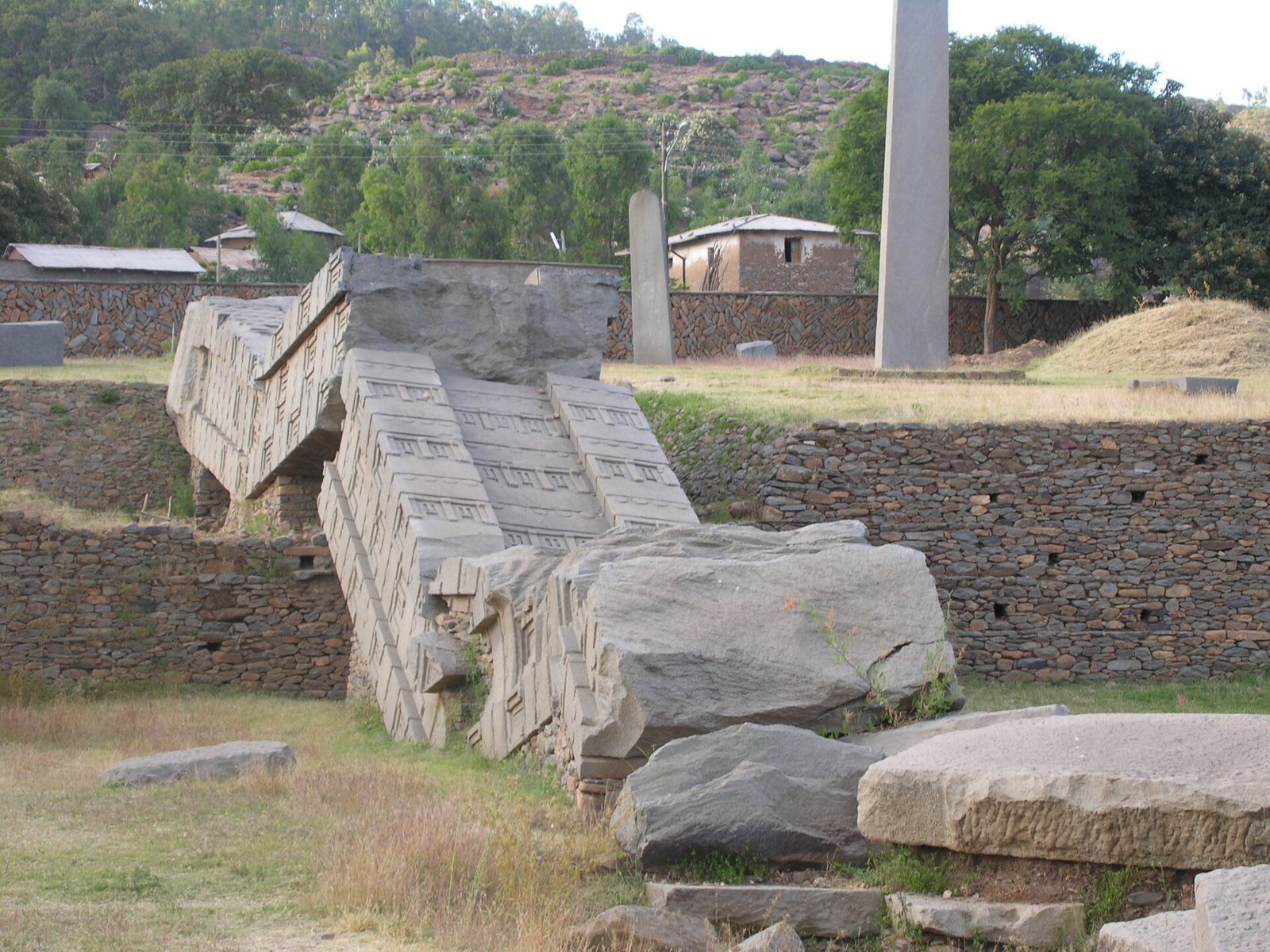
The Great Stele probably toppled while builders were trying to raise it, or not long afterward, because its foundation was inadequate. Another interpretation suggests that support beneath it may have been deliberately removed. The fallen monument broke apart and destroyed the Nefas Mawcha tomb.
The first known written mention of the stelae appears in the 1520 travel account of Francisco Alvarez, a Portuguese chaplain travelling with an embassy sent by King Manuel I to the Ethiopian ruler Lebna Dengel. Alvarez’s account placed the monuments in a longer record of contact between Ethiopia and European visitors.
Excavation and study
Scientific investigation began in 1906 with the German Aksum Expedition led by Enno Littmann. Archaeologist and architectural draughtsman Daniel Krencker carried out much of the excavation and prepared drawings. The team numbered 78 stelae; later finds and additional fields were incorporated into that numbering system.
A French mission worked at the site from 1954 to 1957. University of Cambridge teams returned under Neville Chittick in 1972–74, Munro-Hay in 1989, and David W. Phillipson in 1993–97. Excavations in 1974 uncovered a mausoleum and a nearby tomb close to the first three large stelae. Both had multiple chambers and yielded several stone coffins. Later investigations also revealed the burial ground beneath Stele 1.
Excavations ahead of Stele 2’s return examined its fallen position and foundation. A trench, probably dug clandestinely by people seeking tomb treasures, may have weakened the support, although the date of the digging is unknown. An Aksumite coin issued around AD 600 was found at the foundation, but it does not establish when the trench was made.
Removal to Italy
After Italy conquered Ethiopia, Benito Mussolini ordered Stele 2 taken to Italy in 1937 as a trophy. It travelled by truck to Massawa and by ship to Naples and Rome. There it was restored and erected at Porta Capena, near the Circus Maximus and in front of the Ministry for Italian Africa, later the headquarters of the Food and Agriculture Organization. Its unveiling on 28 October 1937 coincided with the fifteenth anniversary of the March on Rome, the 1922 Fascist action that helped bring Mussolini to power. The regime presented the monument as an emblem of its proclaimed empire and promoted a claimed connection between ancient Rome and Italy’s conquest of Ethiopia.
During the Second World War, two German 88 mm shells struck the stele, causing limited damage. Italy agreed in 1947 to return looted works to Ethiopia, and a 1956 bilateral agreement again pledged the stele’s return as soon as possible. The commitment faced resistance, including technical objections and proposals that Ethiopia give up its claim in exchange for a gesture of friendship or Italian funding for a church. Some opponents appealed to the memory of Italian war dead, while neo-Fascist militants planned to destroy the monument in 1956. The claim that Emperor Haile Selassie had agreed to give the stele to Rome remains disputed. Another controversial proposal would have allowed Italy to keep it in return for building Saint Paul’s Hospital in Addis Ababa and cancelling Ethiopian debts.
Return to Axum
Haile Selassie received assurances during a 1970 visit to Rome that the stele would be returned, but it remained in Italy. After his overthrow in 1974, Ethiopia’s new military ruler, Mengistu Haile Mariam, also requested its return. In 1997, Italian president Oscar Luigi Scalfaro renewed the commitment during a visit to Ethiopia and apologized for the removal. Practical transport problems and the 1998 war between Ethiopia and Eritrea further delayed the operation.
Dismantling began in Rome in November 2003 and was completed in 2004. Shipping and aircraft limitations, the condition of roads and bridges, and restricted access to Massawa complicated transport. The three sections were flown to Ethiopia in April 2005 aboard Antonov An-124 aircraft; Axum’s runway was upgraded to accommodate their arrival. A UNESCO-selected team led by structural specialist Giorgio Croci re-erected the monument at May-Hedja in 2008, near King Ezana’s Stele. It was formally inaugurated in September.
The Axum site joined the UNESCO World Heritage List in 1980. In 2006, the Zamani Project made three-dimensional laser scans of parts of the stelae field. The monuments remain associated with Ethiopia’s ancient past and with religious celebrations, including the Festival of Saint Mary of Zion, a celebration honouring the Virgin Mary in Ethiopian Orthodox tradition.
Remains
May-Hedja combines a group of carved stone monuments with a burial ground. Axum has five stelae fields: the western Gudit field, the burial ground at Beta Giyorgis, the southern burial ground near the Tomb of Baden, the northern field, and the main field, where the large multi-storey monuments stand. About 300 stelae are present across the site, eight of them decorated.
Construction and design
The major monuments were cut from stone quarried at Gobedra, about four kilometres west of Axum. The stone has been identified as granite and several volcanic rocks, including phonolite, nephelinite, and basalt. Workers probably split blocks with metal wedges, some marks of which remain on simpler stelae. They transported rough stone to Axum on wooden supports and ramps along a route chosen for its gentle slope rather than its directness. Carvers worked on the stelae while they lay flat, including on their undersides, and tilted them as needed. To raise a monument, builders rolled it on wooden supports to a prepared pit, set a foundation slab inside, and probably used ropes to tip the stone upright. Two more slabs braced its sides, with smaller stones packed into the spaces. Decorated base slabs were then placed around it, serving ritual purposes and adding support.
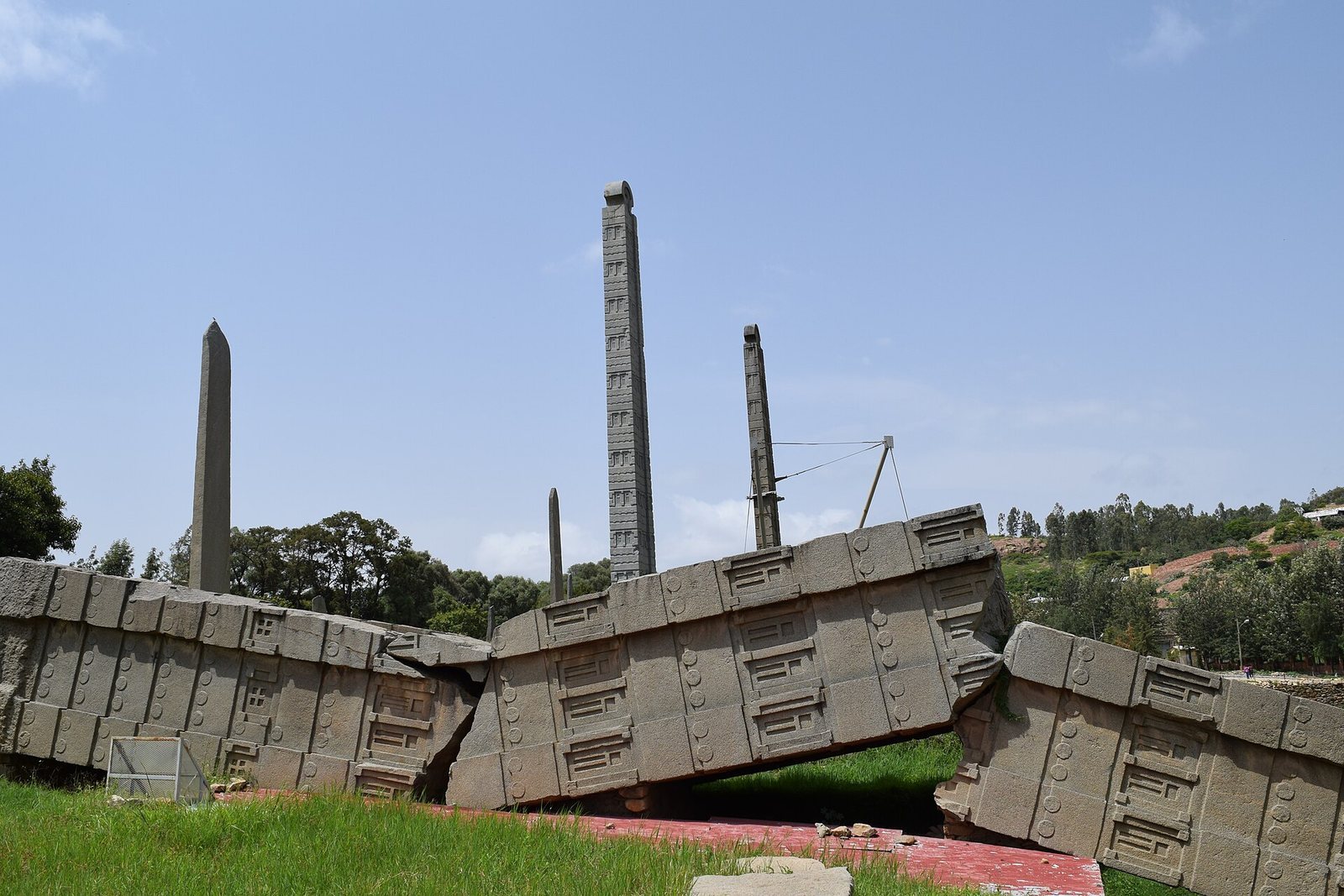
Although commonly called obelisks, these Aksumite monuments are more accurately described as stelae, upright stone slabs or pillars used as markers. A classical obelisk has a square plan, tapers on all four sides, and ends in a pyramid-shaped top. Aksumite examples generally have rectangular plans, taper unevenly, and may end in rounded or otherwise varied forms. The large decorated monuments resemble multi-storey buildings, with carved false windows, false doors, and projecting stone beam-ends often called monkey heads. They were intended to face southeast. Recesses at their tops were designed for plaques, and some rounded upper sections may have been covered or enclosed with metal.
Architectural development and ritual features
Stele 34 shows an early stage in the move toward more elaborate monuments. Its surface retains traces of carved ornament, rudimentary storeys, and projecting beam-ends. Across the site, simpler roughly carved examples stand alongside the more complex building-like forms. Offering basins and channels on some bases point to offerings made for the dead. One plaque associated with the stelae bears a human face; the designs of other plaques that may once have crowned the monuments are unknown.
The building-like facades may have represented houses for the dead, with false doors acting as symbolic entrances to an afterlife. This interpretation is supported by the removal, after Stele 1 fell, of the handle from the false door that faced upward. The meaning of the monuments and the identities of those buried beneath them remain uncertain.
Principal monuments
Stele 1, the Great Stele
The Great Stele lies in six broken pieces and measures about 33 metres in length, with an estimated weight of 520 tonnes. Its thirteen storeys carry elaborate carving on all four sides, including false doors at the front and rear with carved knockers. Recessed niches along its long sides give the cross-section a form more complex than a simple rectangle. About one-twelfth of its total length was intended to lie below ground in the foundation. The two carved doors are alike; weathering indicates that the handle was removed from the upward-facing one in antiquity. The monument’s fall damaged the Nefas Mawcha funerary structure beside it.
Nefas Mawcha tomb
The Nefas Mawcha funerary monument includes a massive stone slab about 17.5 metres long, 6.5 metres wide, and 1.3 metres thick, with an estimated weight of 300–400 tonnes. It is thought to have served as a tomb roof beneath a burial mound that has since disappeared. Stone walls below the slab form a passage around the tomb, and a second ring of stones is visible on its north and south sides. The complex layout is difficult to interpret. It may have been the tomb of an important person, with ritual movement around it.
Stele 2, the returned monument
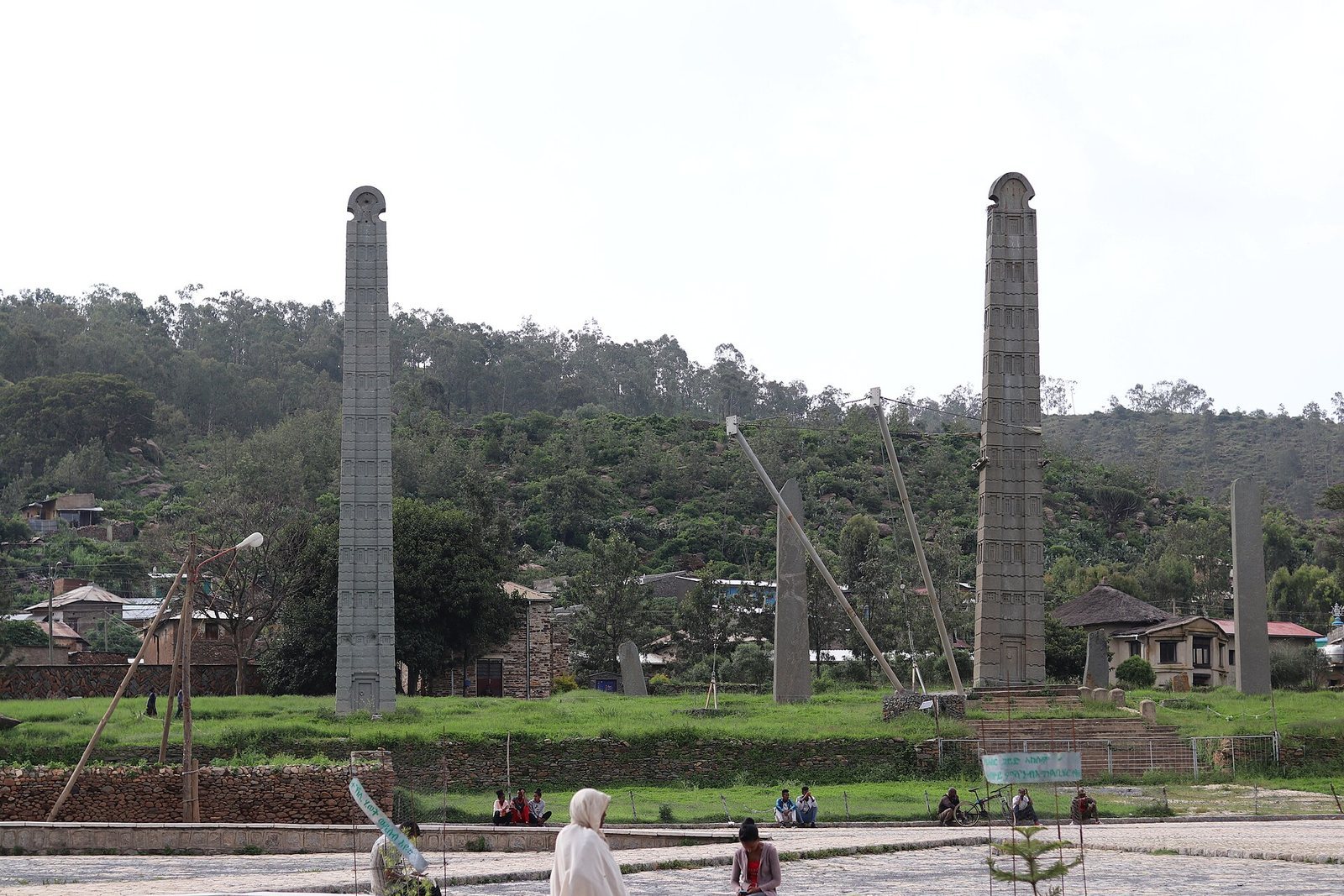
Stele 2 is about 24.6 metres long and weighs an estimated 170 tonnes. Its eleven storeys are decorated on all four sides, and its cross-section includes recessed niches. Four courses of stone form its carved false doors, whose lintels have tooth-like patterns and whose panels bear circular handles. Two rows of projecting beam-ends appear between the false windows, rather than the single row common on the large stelae. Excavation showed that it stood on a masonry foundation about 7.3 metres long, 6 metres wide, and 4.5 metres thick, built on partly levelled bedrock. A rectangular slab lay flat on the foundation, with two projections gripping the stele’s base; the base rested on this support rather than being buried in the ground.
Shell impacts in Rome made chips about 20 centimetres across and 8–10 centimetres deep, but caused only slight damage. Lightning struck the upper end in 2002 and caused more serious harm. In Rome, steel bars joined sections of the reassembled monument. For its reconstruction at Axum, conservators instead used eight aramid-fibre bars, four at each of the two joins. The reinforcement was designed to withstand earthquakes without using steel that might attract lightning or rust.
Stele 3
Stele 3, sometimes associated with King Ezana, is distinct from the separate Ezana’s Stele. It is the only large multi-storey stele to have remained upright continuously. Standing 20.6 metres high and weighing an estimated 160 tonnes, it has ten storeys and recessed niches in its cross-section. Three sides are fully decorated, while the rear is carved only at the top. Its single false door has a ring and lock, and a tooth-like pattern runs across its lintel. The base plate has carved vine patterns and offering basins. Near the top, the narrowing shaft has only one central false window in its uppermost row, followed by a rounded crown. Cables brace the stele. It stands in line with the original positions of Stelae 1 and 2 and may have belonged to a monumental frontage visible from the city.
Stele 4
Stele 4 lies fallen in front of a round church. It measures 18.2 metres and weighs about 56 tonnes. Its six decorated storeys have a rectangular cross-section, without the side niches found on Stelae 1–3. Its crowning element, or finial, now stands in Ezana Park. The 1906 expedition mistakenly treated it as a separate lance-shaped stele; recognizing it as part of Stele 4 corrected the monument’s reconstructed length. The finial has two spears carved on the front, a shield on the back, and side recesses for plaques. The decorated base consists of a raised square stone with an offering basin and a channel that may have carried sacrificial blood, set on a lower slab with three more basins and smaller round depressions around its edge.
Stele 5
Stele 5, about 15.8 metres long and estimated at 75 tonnes, lies broken in a stream between Beta Giyorgis and May Qoho. Its original position is uncertain, and erosion has shifted monuments in this area; its base slab is also displaced. Five or six decorated tiers survive. The lower two-thirds of its cross-section has niches, while the upper part is rectangular, perhaps because projecting sides broke away. The reduced number of beam-ends near the top may reflect a break during carving. Other irregularities include a beam-end visible on the base, where it would have been concealed when upright, and front and rear projections set at different heights. These features suggest that the finished stele was smaller than planned; it may originally have been intended to reach about 23 metres before damage during carving.
Stele 6
Stele 6 lies in two pieces on its rear base slab and measures 15.3 metres, with an estimated weight of 43 tonnes. Its front base slab was found in 1974. The monument has four storeys, a rectangular cross-section, an unworked back, and a base wider than its shaft. The number of wall courses between false windows varies: there are two above the false door, then four, followed by two after each later window. Two recesses at the top were intended to hold plaques.
Other fallen stelae
A roughly carved stele about 5.7 metres long appears to imitate the larger monuments. Another unusual example, about 9.8–10 metres long, lies near the northern-field boundary, over Stele 36 and about 200 metres north of the principal group. Its slightly convex cross-section ends in a pointed arch, and its base is wider than its shaft. One face shows a column with a spiral ornament on its capital and a base, supporting a small house with a roof and door; a smaller house appears on the reverse. The design’s meaning and date are unknown, though some interpret it as an image of the Ark of the Covenant.