Monastery of Panagia Mavriotissa: A Byzantine Orthodox Monastery in Greece


Site at a Glance
- Rating
- 4.8
- Popularity
- Medium
- Country
- Greece
- Primary era
- Medieval
- Eras represented
- Medieval, Early Modern
- Civilizations
- Byzantine, Ottoman
- Site type
- Religious
- Remains
- Monastery
On this page6 sections
History
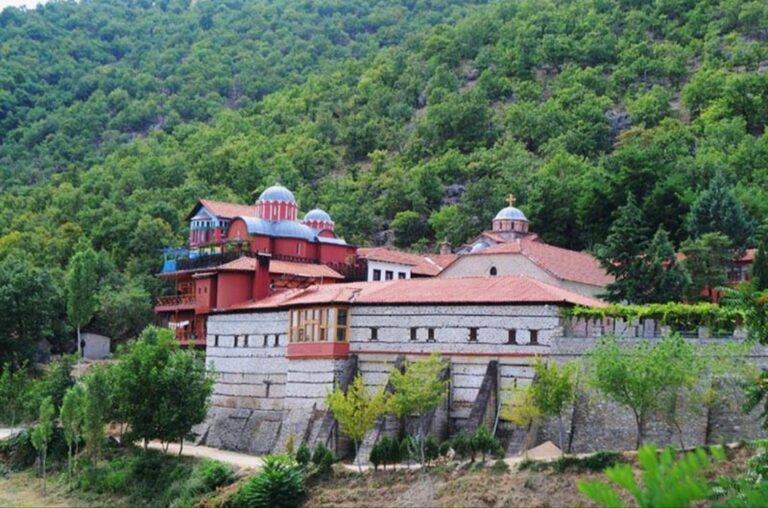
The Monastery of Panagia Mavriotissa is an Orthodox monastery in Greece, located at the end of the Kastoria Peninsula near Kastoria. Dedicated to the Dormition of the Virgin Mary, it was established as a Macedonian monastery during the period of the Archbishopric of Ohrid, a major medieval Orthodox jurisdiction in the central Balkans. Its principal church belongs to the Byzantine period and is specifically dated to 1082, during the reign of Emperor Alexios I Komnenos, who ruled the Byzantine Empire from 1081 to 1118.
Foundation and Byzantine origins
The monastery’s exact foundation date remains uncertain, but its principal church is associated with the reign of Alexios I Komnenos. A foundation tradition connects the site with the defeat of the Normans in 1083. The Normans were western European warriors whose military expansion reached the eastern Mediterranean during the eleventh and twelfth centuries. According to this tradition, forces associated with Alexios and the Byzantine commander George Palaiologos defeated them at this location. The traditional battle date is distinct from the specific date of 1082 assigned to the construction of the church.
The monastery was originally known as Sredoostrovski. At the beginning of the seventeenth century, it became known as Krpenichki, or “Virgin of Krpenitsa,” after the nearby village of Krpeni. Between the middle and the end of that century, it acquired the name Panagia Mavriotissa, referring to the village of Mavrovo across Lake Orestiada.
Ottoman-period destruction and later use
During Ottoman rule, the monastery suffered destruction and was subsequently rebuilt. It was later abandoned for a period before returning to use in 1998. The main church and the Chapel of Saint John the Theologian were designated cultural monuments in 1924. The monastery continues its religious calendar with an annual celebration on 15 August, the feast associated with the Dormition of the Virgin Mary.
Remains
The monastery occupies the tip of the Kastoria Peninsula, which projects into Lake Orestiada about 3 to 4 kilometres east or southeast of Kastoria. Mavrovo lies across the lake, a geographic relationship reflected in the monastery’s present name. Within the courtyard stands the Mavrovo plane tree, recognized as a natural monument. The principal surviving buildings are the single-nave katholikon, the monastery’s main church, and the Chapel of Saint John the Theologian, which is attached to its south side.
The katholikon
The katholikon is a single-nave basilica with a wooden roof, a spacious narthex at the west end, and a semicircular apse at the east end. Its carved wooden entrance doors are dated to the tenth century. The earliest surviving interior paintings occupy part of the east wall and date from the first half of the twelfth century. Additional paintings on the east wall and across the entire west wall belong to the late twelfth century. They include the Dormition of the Virgin, the Christian commemoration of her death and taking into heavenly glory, and the Crucifixion.
The narthex contains a late-twelfth-century Last Judgment extending across its east and south walls. This Christian scene represents the final judgment of humanity. A Baptism scene beneath it was painted somewhat later. The murals are attributed to artists from a workshop in Constantinople, the centre of the Byzantine Empire. Exterior paintings on the katholikon depict emperors, the Tree of Jesse, and Saints Demetrius and George. These works date to about 1260. Many paintings on the north and south walls were destroyed during restoration work.
Chapel of Saint John the Theologian
The Chapel of Saint John the Theologian was built into the south side of the katholikon and painted in 1552. A surviving inscription records the date of this work. The chapel is a small single-nave church with a wooden roof and a western entrance. Its apse does not project beyond the east wall, while its north wall is shared with the south wall of the katholikon. Its single-pitched roof passes beneath the slope of the main church roof.
The chapel’s paintings include the Virgin Mary in the apsidal conch, Saint Sisoes, and the Healing of the Blind. These scenes belong to the 1552 painting campaign and remain closely tied to the chapel’s architectural form and religious purpose.
Nearby sites