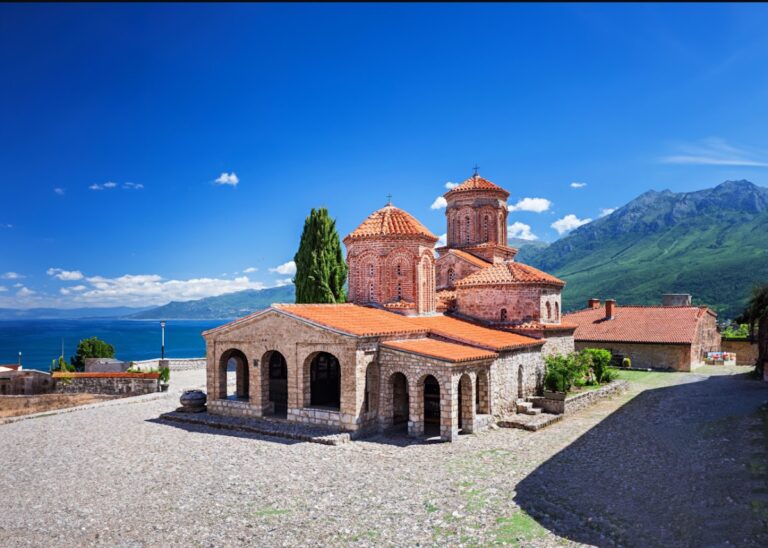
Saint Mary Eleoussa Church, Psarades: A Medieval Orthodox Cave Church in Greece


Site at a Glance
- Rating
- 4.9
- Popularity
- Very Low
- Country
- Greece
- Primary era
- Medieval
- Eras represented
- Medieval
- Civilizations
- Ottoman
- Site type
- Religious
- Remains
- Monastery
On this page6 sections
History
Saint Mary Eleoussa Church, Psarades, is a medieval Orthodox cave church and hermitage in Greece, near the village of Psarades on the southern shore of Lake Prespa. It is generally dated to 1373 and served as an ascetic religious retreat, a small hermitage centered on a church. The site is regarded as the best-preserved skete in the area, with wall paintings and other evidence of its religious use.
Foundation and ecclesiastical setting
The church originally belonged to the Archbishopric of Ohrid, a historic Orthodox ecclesiastical jurisdiction in the central Balkans. It is now part of the Florina, Prespa and Eordaia Diocese of the Ecumenical Patriarchate of Constantinople, the senior patriarchal institution of Eastern Orthodoxy, under the administration of the Church of Greece.
The date 1373 is considered more credible than the chronology suggested by the church’s inscriptions. Two inscriptions name the painter as Joannicius and the donors as Sava, Jacob, and Varlaam. They connect the church with the rule of Volkašin in 1409 or 1410, although Volkašin, a fourteenth-century Serbian king, died in 1371 at the Battle of Maritsa. The region was under Ottoman rule after his death, so the reference may concern one of his successors.
Paintings and later history
The wall paintings are dated to 1409 or 1410, while an icon is dated to 1452. Together, the surviving decoration provides a strong example of post-Byzantine art in Macedonia. Local residents call the church Saint Peter. It was declared a cultural monument in 1962 and remains an active church.
Remains
Cave church and hermitage
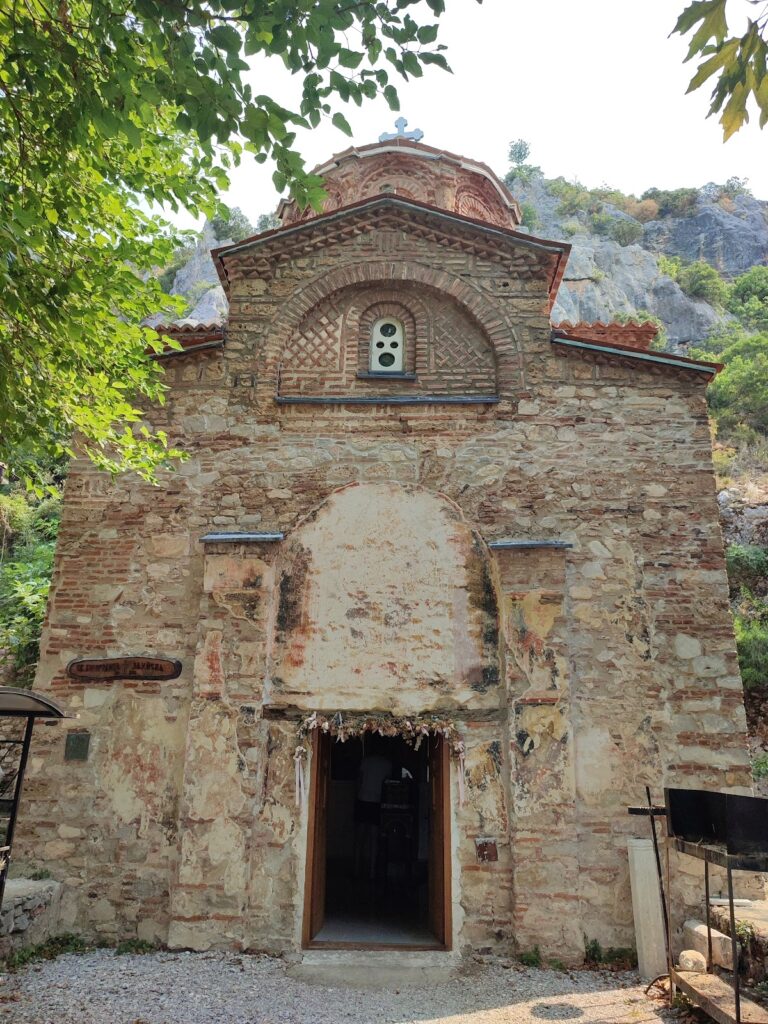
The church occupies a relatively large cave on the southern shore of Lake Prespa, close to the border with Albania. It is a small, single-nave building with a semicircular vault and a hexagonal apse at the eastern end. Stone bonded with white mortar forms the structure. Red lines painted across the mortar on the exterior imitate ceramic ornament and motifs associated with older Komnenian traditions, an artistic and architectural convention linked to the Byzantine Komnenian dynasty and its patterned brick decoration.
Fragmentary cells survive at the entrance and around the perimeter of the level area in front of the cave. A defensive wall remains at the site, together with a vaulted structure forming part of the staircase leading to the hermitage. The rock-cut churches of Saint Mary Platytera and Saint Mary Hodegetria lie southwest of Saint Mary Eleoussa on Albanian territory.
Frescoes and inscriptions
The interior is entirely covered with frescoes arranged in two zones. The lower zone includes standing figures of Saint Demetrius, Saint George, Romanos the Melodist, Simeon the Stylite, Saint Stephen, and prophets. Romanos was a prominent Byzantine Christian hymn writer, while Simeon was an ascetic traditionally associated with prolonged residence on a pillar. The upper zone contains scenes of the Twelve Great Feasts, the principal annual feasts of the Eastern Christian liturgical calendar, together with episodes from the Passion of Christ, the Ascension, and the Transfiguration. The upper figures are more stylized and expressive, while those below follow more conventional Byzantine iconography, a difference that may indicate the work of two painters.
In the sanctuary apse, the Platytera shows the Virgin Mary with the Christ Child. Above the western entrance, a semicircular niche contains Mary Eleousa, meaning “the Merciful,” affectionately inclining toward the Christ Child. An inscription above the south-wall window gives the painter’s name, while another above the entrance to the main interior space identifies the donors.