Saints Cosmas and Damian Monastery, Melissotopos: An Orthodox Monastic Foundation in Greece


Site at a Glance
- Rating
- 4.9
- Popularity
- Very Low
- Country
- Greece
- Primary era
- Modern
- Eras represented
- Medieval, Modern
- Civilizations
- Byzantine, Ottoman
- Site type
- Religious
- Remains
- Monastery
On this page11 sections
History
Saints Cosmas and Damian Monastery, Melissotopos, is an Orthodox monastery in Greece near the village of Melissotopos, formerly known as Olista. It is described as having been founded or reconstituted in 1457, when its dedication changed from Saint Panteleimon to Saints Cosmas and Damian, early Christian physician saints traditionally associated with healing. The monastery belongs to the Metropolis of Kastoria within the Church of Greece.
Byzantine origins and reconstitution
A predecessor monastery on the site is said to have been founded around 1080 during the reign of Alexios I Komnenos, the Byzantine emperor of the Komnenian dynasty who ruled from 1081 to 1118. The later reconstitution in 1457 established the dedication that the monastery retains today.
The monk Nektarios practiced asceticism at the monastery after 1460. A church in the southern wing was later dedicated to him, preserving his association with the community.
Eighteenth-century destruction and rebuilding
The monastery flourished during the eighteenth century, but raids by Turco-Albanian forces destroyed it in 1734. The monk Gerasimos, who came from Siphnos, reconstructed the monastery in 1754. A marble inscription in the courtyard records that Kosmas Aitolos, an eighteenth-century Greek Orthodox monk and preacher who travelled through Ottoman-ruled Greek lands, stayed there toward the end of 1774.
Changes in the nineteenth and twentieth centuries
A new church was erected on the foundations of the older one in 1858. Around 1900, the monastery housed between 10 and 12 monks and owned the Rudnik farm between Kumanichevo and Zagorichani, along with other properties and considerable numbers of large and small livestock. Most of these holdings were later confiscated by the Greek state.
After the suppression of the 1903 Ilinden uprising, about 4,000 people from Zagorichani and nearby villages that had been burned took refuge at the monastery. The abbot made the monastery’s grain, flour, and maize fields available to them, while an additional oven was built to ensure a continuous supply of bread.
The monastery’s library of unique manuscripts and books was destroyed by fire during the Greek Civil War. The institution resumed operation in 2001 and is regarded as one of the largest collections of theological books and printed archival material in Western Macedonia. Nine inhabitants were recorded at the monastery in both 1961 and 2011. It remains an active Orthodox monastery, dedicated to Saints Cosmas and Damian, with its feast celebrated on 1 November.
Remains
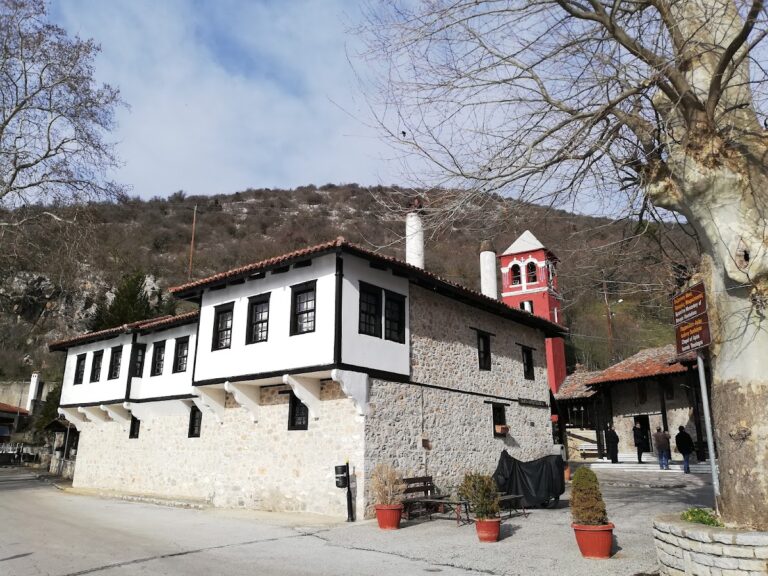
The monastery stands approximately 2 kilometres west-northwest of Melissotopos and about 24 kilometres northeast of Kastoria. Its principal surviving church occupies the foundations of the earlier church, while the southern wing contains a later church dedicated to Nektarios.
Church and religious furnishings
Three-aisled basilica
The church built in 1858 is a three-aisled basilica, meaning that a central nave is flanked by two side aisles. It has a wooden roof and is decorated with stone and marble relief representations. A carved wooden iconostasis, the screen separating the sanctuary from the main body of an Eastern Christian church, remains part of its interior.
Surviving icons
Parts of the older church’s icon collection have survived. The preserved works include the Angelic Council, the Virgin Brephokratousa, Saint John the Baptist, Christ as Great Hierarch, Saint Spyridon, and the Archangel Gabriel. Dates associated with the icons include 1763 for Christ as Great Hierarch, 1764 for the Angelic Council, 1794 for Saint Spyridon, 10 September 1875 for the Archangel Gabriel, and 1880 for another icon.
Southern wing and sacred spring
Church of Nektarios
The southern wing contains a church dedicated to the ascetic Nektarios. Its exterior is described as terracotta-colored, distinguishing it within the monastery complex.
Life-Giving Fountain
A chapel and holy spring known as the Life-Giving Fountain once formed part of the monastery. The chapel has disappeared, but its inscription was dated 1800.
Nearby sites