Saki Takatsuka Kofun: A Late Fourth-Century Japanese Burial Mound


Site at a Glance
- Rating
- 4
- Popularity
- Very Low
- Country
- Japan
- Primary era
- Classical
- External website
- Open
- Eras represented
- Classical
- Civilizations
- Yamato
- Site type
- Burial
- Remains
- Burial Mound
On this page7 sections
History
A Tomb within the Saki Hill Group
Saki Takatsuka Kofun is a late fourth-century Japanese burial mound in Nara, Japan, built during the early phase of the Kofun period. The Kofun period, lasting roughly from the third to the seventh centuries, was an era when regional elites and emerging political authorities constructed monumental tombs. Saki Takatsuka Kofun belongs to the western group of the Saki Shield-line Kofun Group, a cluster of large burial mounds on Saki Hill.
It stands south of Saki Ishizukayama Kofun and Saki Ryozan Kofun, and forms the western group with those tombs and Gosashiyama Kofun. Its medium scale and east-west alignment differ from the principal tombs in the group. These distinctions have led to the interpretation that Saki Takatsuka Kofun was subordinate to one of the group’s major mounds.
Imperial Identification and Earlier Traditions
The person buried in the mound is unknown. The Imperial Household Agency designates it as Takano Mausoleum, identified with the tomb of Empress Shōtoku. She was the same ruler who had earlier reigned as Empress Kōken, traditionally counted as the 46th sovereign, before later returning to the throne as Shōtoku, the 48th sovereign.
The Shoku Nihongi states that Empress Shōtoku died on August 4, 770, at the Western Palace residence. A bureau for constructing her mausoleum was appointed that day, and 6,300 laborers from the Kinai and neighboring provinces built a mausoleum at the former residence of Prince Suzuka, the second son of Prince Takechi. Prince Takechi was a son of Emperor Tenmu, while Prince Suzuka belonged to the imperial family. The empress was buried on August 17 in the Takano mausoleum in Saki district, Soegami District, Yamato Province.
The Engishiki lists Takano Mausoleum as a distant mausoleum in Soegami District, Yamato Province. It assigns the mausoleum an area measuring five chō from east to west and three chō from north to south, maintained by five guardian households.
Changing Interpretations of the Tomb
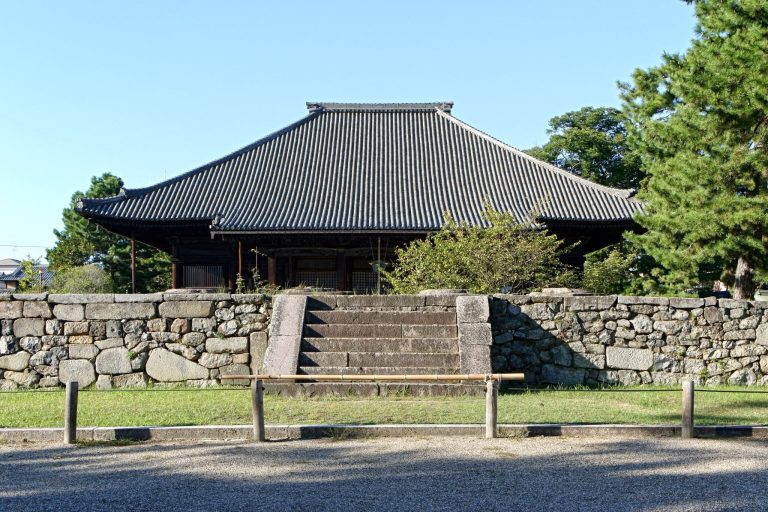
A property register from Saidaiji Temple indicates that Empress Shōtoku’s actual mausoleum was probably west of the temple precinct, rather than at Saki Takatsuka Kofun. After knowledge of that location was lost, a plan made before 1307, known as the Old Site Map of Saidaiji, came to be read as placing the mausoleum east of the temple. This interpretation encouraged the identification of Saki Takatsuka Kofun with the imperial tomb.
During the Edo period, another tradition identified Gosashiyama Kofun, farther north, as Empress Shōtoku’s mausoleum. The mausoleum repairs of 1863, carried out during the Bunkyū era, returned to the interpretation based on the Saidaiji site map. The designation was retained by the Meiji-period Imperial Household Ministry and later by the Imperial Household Agency. It has continued to the present, although the hill south of the Nara Driving School, west of Saidaiji, has also been proposed as the empress’s actual burial place.
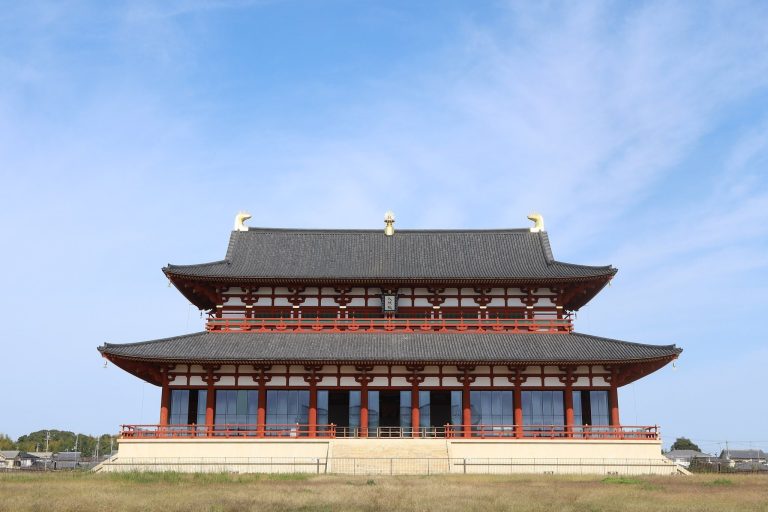
When Heijō-kyō was established in 710 as the imperial capital in present-day Nara, the area around the kofun lay in the Northern Edge, Second Ward of the Right Capital. The tomb’s imperial status has also restricted archaeological work, and no full investigation has taken place since the Meiji period.
Remains
Mound and Moat
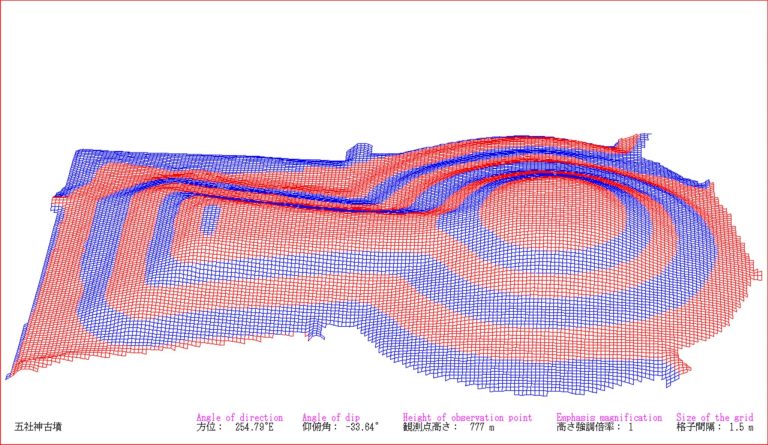
Saki Takatsuka Kofun is a keyhole-shaped mound, a form combining a rounded rear burial mound with a projecting rectangular front section. It measures approximately 127 meters in length and occupies the southern foot of Saki Hill, where the mound was formed by cutting across the end of a ridge.
The rectangular front section faces west. Its principal axis runs east to west, unlike the north-south alignment of the other tombs in the western group. The mound rises in three stepped tiers and is enclosed by a narrow, discontinuous moat that follows its keyhole shape.
Haniwa Evidence
Haniwa, ceramic figures or cylinders placed on or around burial mounds, are said to have been found on Saki Takatsuka Kofun, although the details and attribution remain uncertain. Numerous large cylindrical haniwa were recovered during river-improvement work on the Akishino River west of the mound. Some interpretations regard these pieces as material that originally belonged to Saki Takatsuka Kofun.