Sagami-ji Temple: A Koyasan Shingon Buddhist Temple in Japan


Site at a Glance
- Rating
- 3.9
- Popularity
- Low
- Country
- Japan
- Primary era
- Early Modern
- External website
- Open
- Eras represented
- Early Modern, Modern
- Civilizations
- Tokugawa
- Site type
- Religious
- Remains
- Monastery
On this page13 sections
History
Sagami-ji Temple is a Koyasan Shingon Buddhist temple in Kasai, Hyogo Prefecture, Japan, traditionally founded in 745 during the Nara period. Its principal image is Jūichimen Kannon, the eleven-faced form of Kannon, the bodhisattva of compassion. The temple was established as an imperial prayer temple and became the associated temple of neighboring Sagami Shrine, now called Sumiyoshi Shrine.
Traditional foundation and imperial patronage
Temple tradition attributes Sagami-ji’s foundation to the Buddhist priest Gyōki and Emperor Shōmu. Gyōki, a prominent Nara-period priest associated with temple foundations and charitable religious works, is said to have received an oracle from Sagami Myōjin instructing him to build a temple at the site. He reported the message to Emperor Shōmu, an eighth-century sovereign known for supporting state-sponsored Buddhism, and the emperor ordered the construction and gave the temple its name.
Sagami-ji retained a special relationship with the imperial court after its foundation. Imperial envoys visited from the late Heian period, and the temple preserved memorial tablets for successive emperors and Tokugawa shoguns in its Goma Hall. Its connection with Sagami Shrine also continued, linking the Buddhist temple with the neighboring shrine complex.
Medieval destruction and rebuilding
A late-Kamakura-period provincial description places Sagami-ji among the Six Great Temples of Harima. The same description records the recitation of the Daihannya, or Great Perfection of Wisdom, Sutras at Sagami Shrine. These references show the temple and shrine functioning within the religious life of the medieval province.
The Heiji Rebellion of 1159, a conflict between rival forces at the imperial court, brought destruction to Sagami-ji. Fire completely destroyed the temple, which was rebuilt by imperial order after Emperor Nijō granted it a seal. Emperor Nijō ruled Japan from 1158 to 1165.
The complex burned again during warfare in the Tenshō era, including conflicts associated with the Miki campaign around 1578. This second destruction formed part of the wider history of civil warfare before the political stability of the Edo period.
Edo-period protection and religious continuity
During the Edo period, Ikeda Terumasa, the daimyō who ruled Himeji and oversaw the development of Himeji Castle, designated Sagami-ji as a protective temple of the castle and supported its recovery. After the Ikeda family was transferred elsewhere, Honda Tadamasa, another early Edo-period daimyō who governed the Himeji domain, also provided assistance.
The complex was subsequently rebuilt during the Kan’ei era under the direction of the Buddhist monk Jissōin Ryūe, acting on the orders of the Tokugawa shogunate. Tokugawa Iemitsu, the third shogun of the shogunate that governed Japan during the Edo period, designated Sagami-ji as a red-seal temple. This status meant that the temple held an official charter confirming shogunal recognition and associated privileges. Successive shoguns granted official documents and a fief of 60 koku, a historical measure of rice income, helping the temple prosper after long-term protection by the imperial court, the shogunate, and feudal lords.
Sagami-ji remains part of several pilgrimage traditions. It is the twenty-ninth temple on the New Saigoku pilgrimage route, the sixteenth on the Harima Saigoku route, and the thirty-third on the Kasai Saigoku route. Its annual Inzei ceremony lasts one week beginning on September 10. The rite is said to have originated in 1011 and to derive from Ennin, a ninth-century Buddhist priest of the Tendai tradition who helped transmit esoteric teachings and rituals to Japan. The ceremony is described as being conducted only at Sagami-ji.
The Tahōtō is designated an Important Cultural Property of Japan. The bell tower and bell are tangible cultural properties designated by Hyogo Prefecture, while the Niō Gate, Main Hall, Founder’s Hall, and other components have municipal cultural-property status.
Remains
Compound layout and approach
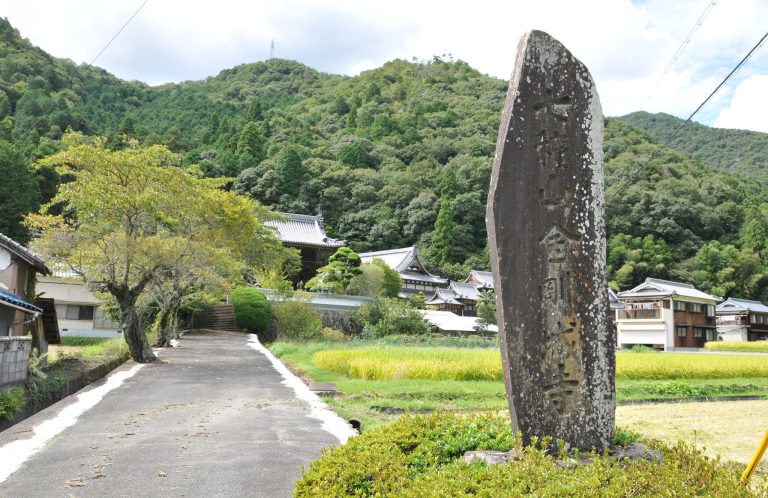
Sagami-ji occupies a spacious compound in the urban area of Hōjō-chō, beside Sumiyoshi Shrine. A small pond lies between the two religious complexes, and a stone bridge connects them. The temple compound is entered from the south through a two-story Niō Gate, also called a Rōmon, and the present structure dates from 1825.
Niō Gate
The southern entrance takes the form of a Rōmon, a two-story gate associated with paired guardian figures known as Niō. Its construction gives the approach a clearly defined entrance before the path continues northward through the compound.
Processional path and intermediate buildings
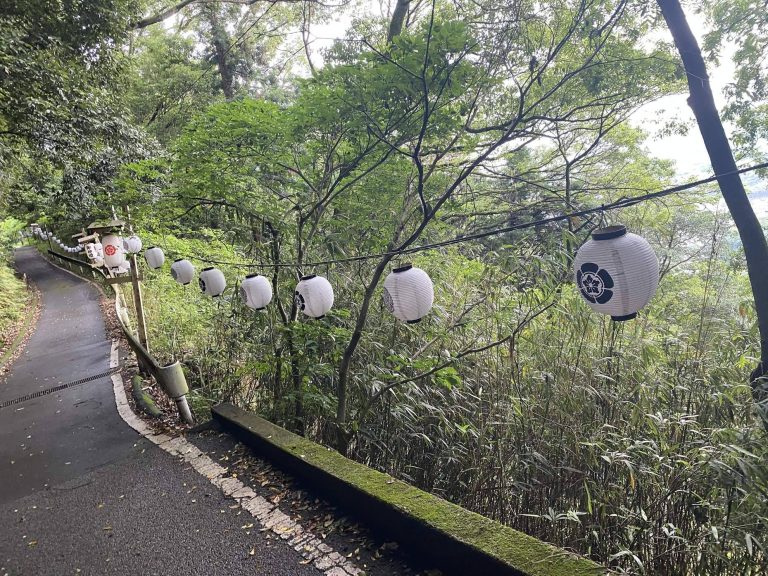
A northward stone path leads from the gate toward the Main Hall. Twenty-one bronze lanterns line each side of the path. Buildings along the approach include a Jizō Hall, the Tahōtō pagoda, a Kannon Hall, and the Jōgyōdō. The Jōgyōdō functions as an Amida Hall and is also called the Inzeidō. The Bokefuji Kannon, a devotional form associated with protection against forgetfulness and cognitive decline, stands behind it.
Main precinct buildings
Tahōtō pagoda
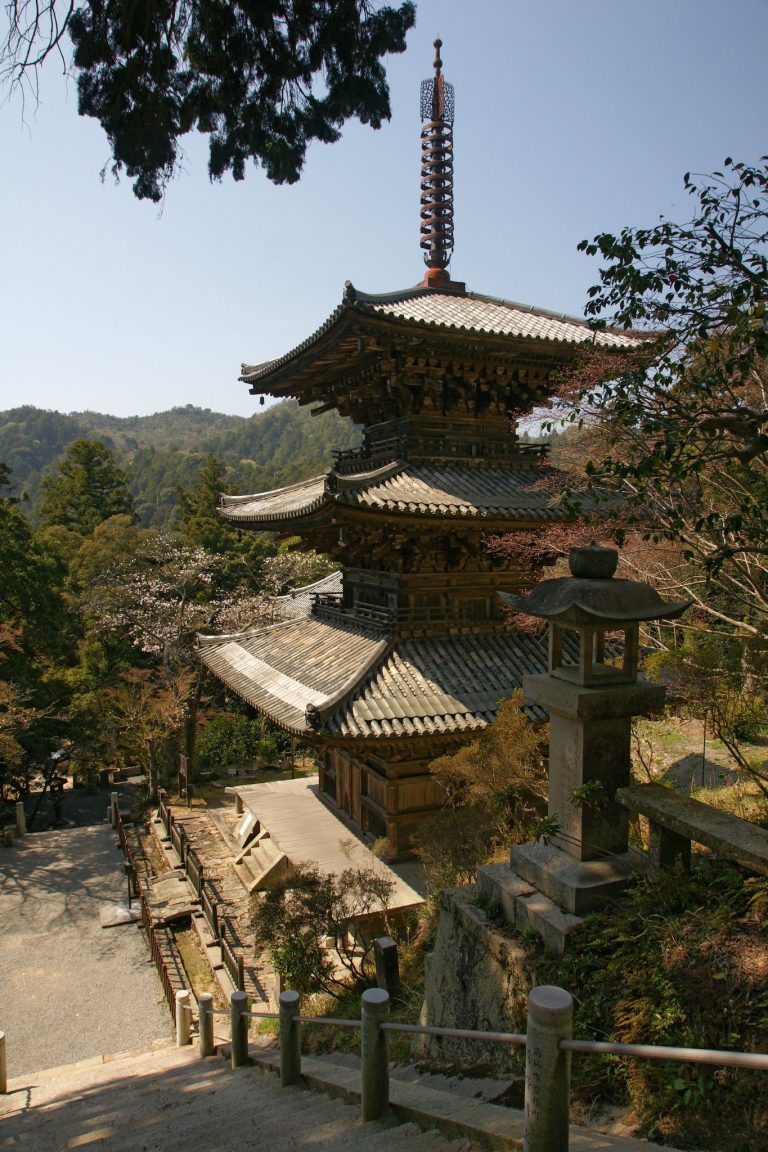
The Tahōtō dates from 1662 and is an Important Cultural Property of Japan. This pagoda form has a square lower story and a rounded upper section. Its position along the northward approach places it among the principal buildings encountered before the Main Hall.
Main Hall and bell tower
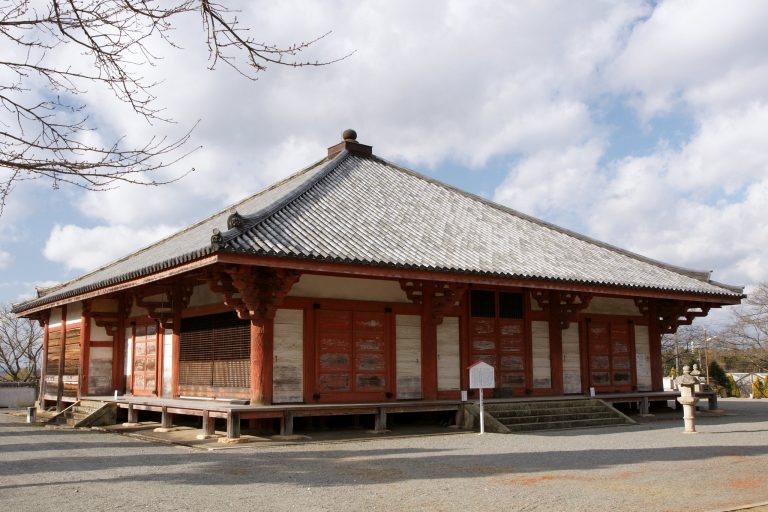
The Main Hall stands at the end of the processional path. Beside it, on a raised platform, is the Bell Tower. The inscription on the bell dates it to 1364, while the tower itself is considered to date from the same period as the Tahōtō.
Western and rear buildings
On the western side of the Main Hall is the Benzaiten sanctuary, situated in a pond. Behind the Main Hall stand the Founder’s Hall and a group of buildings enclosed by earthen walls. These include the abbot’s and monks’ quarters, the Goma Hall, and a private hall for Buddhist images.
Principal image and sculpture
The temple’s principal image is an eleven-faced Kannon carved from a single block of torreya wood. It is a hidden image opened for viewing only once every 61 years. Standing beside it are images of Bishamonten and Jikokuten. These two guardian figures were made using joined-block construction and date from the late Heian period.