Sabugal Castle: A Portuguese Frontier Fortress



Site at a Glance
- Rating
- 4.6
- Popularity
- Medium
- Country
- Portugal
- Primary era
- Medieval
- External website
- Open
- Eras represented
- Medieval, Early Modern, Modern
- Civilizations
- Kingdom of León, Portuguese
- Site type
- Military
- Remains
- Castle
On this page12 sections
History
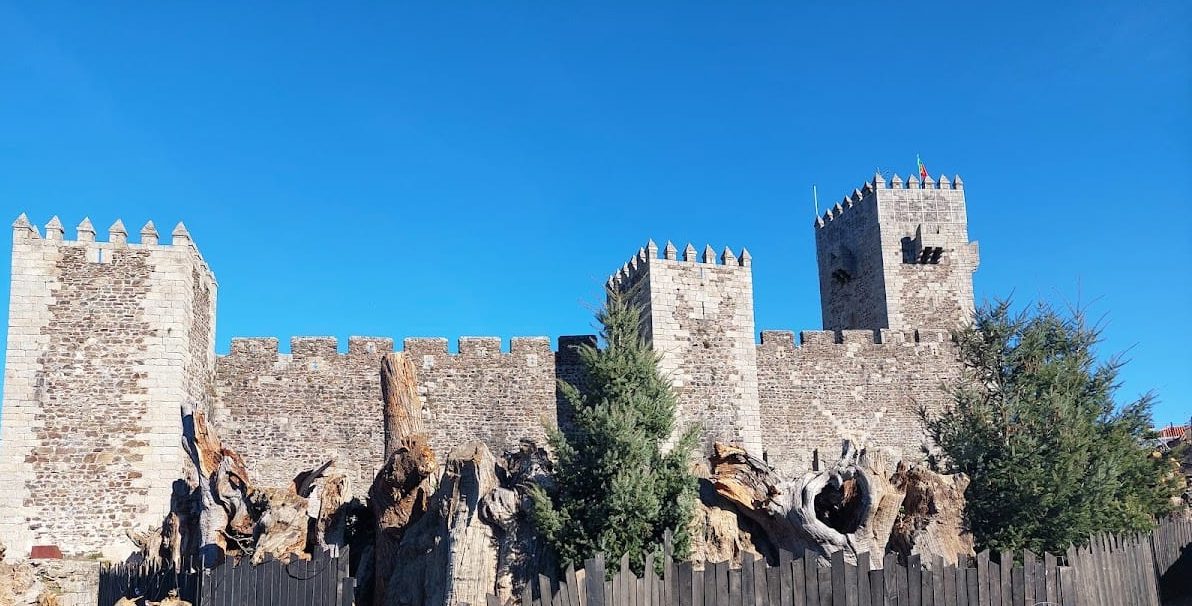
Sabugal Castle is a medieval Portuguese fortress in Portugal, standing above Sabugal on the right bank of the Côa. Its position controlled a river crossing, and its major rebuilding under Denis I was completed in 1303, incorporating Gothic features in the keep. The castle formed part of Portugal’s eastern frontier defenses and was later adapted during the Portuguese Restoration War.
Early occupation and the Reconquista
The elevation occupied by the castle was inhabited in prehistoric times and contained a hillfort, a fortified settlement built on elevated ground. During the Roman conquest of the Iberian Peninsula, a road crossed the Côa at this location. The Romans are thought to have maintained a small garrison to watch and defend the crossing. Germanic peoples and Muslim forces later occupied or used the area, although no substantial remains from those phases are known.
During the Reconquista, the long Christian conquest of territories in the Iberian Peninsula ruled by Muslim powers, Sabugal was probably first taken by Afonso Henriques, the first king of Portugal, in 1160. The town soon passed to the Kingdom of León. In 1190, Alfonso IX of León created the municipality of Sabugal, and the town was founded around 1224, when work began on a defensive redoubt.
Portuguese frontier consolidation
Sabugal formed part of Ribacôa, a frontier territory conquered from León by Denis I of Portugal. The town received a Portuguese charter in 1296, and Portugal’s possession was confirmed by the Treaty of Alcañices in 1297. This agreement established Portuguese control over several frontier territories, including Ribacôa.
Denis I strengthened the eastern frontier by ordering or supporting the rebuilding of several castles, including Sabugal. Houses inside the walls were cleared, the defenses were reinforced with two large towers, and a high keep was erected. Rui de Pina, a Portuguese chronicler and royal official, recorded that the works were completed in 1303 under Friar Pedro of Alcobaça Monastery. Denis I is also credited with establishing a refuge for fugitives in the area to attract settlers. Documents show that this privilege remained in force at the end of the fifteenth century.
Royal reforms and later military use
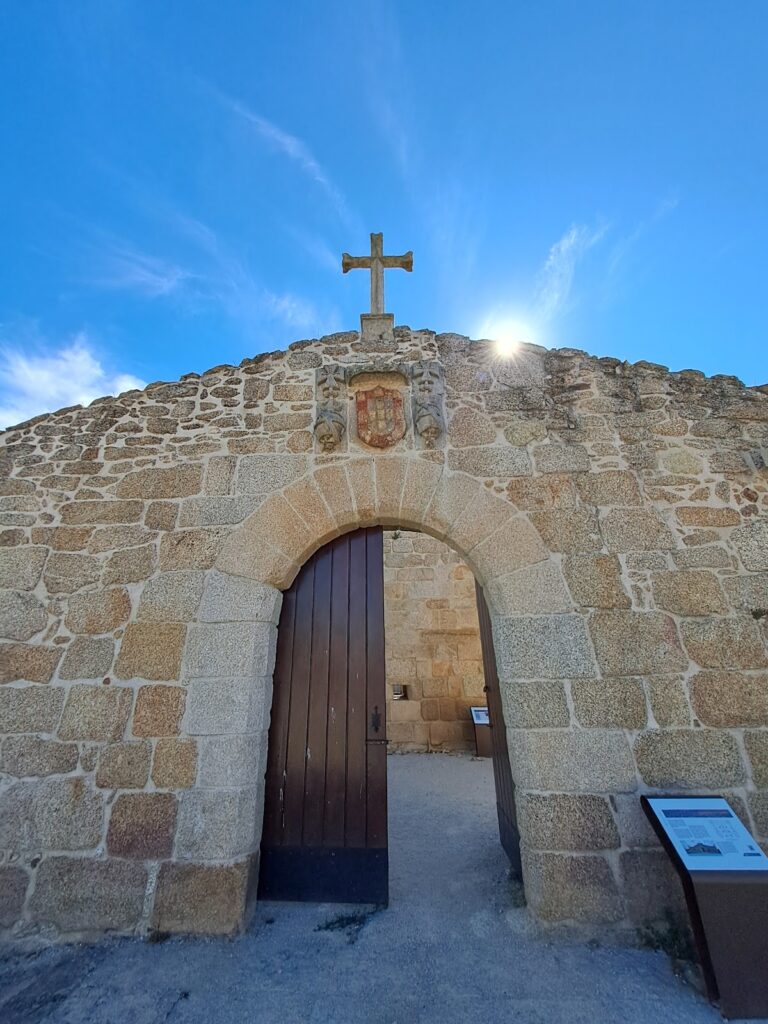
During the reign of Manuel I, the castle was depicted by Duarte de Armas in the Book of Fortresses around 1509. Improvement works were completed in 1515, as an inscription over the principal gate records, and Manuel I granted Sabugal a new charter on 1 June of that year.
The castle was modernized during the Portuguese Restoration War, the seventeenth-century conflict in which Portugal reasserted its independence from the Spanish monarchy. The Clock Tower was built after this period. In the seventeenth century, the poet and knight Brás Garcia de Mascarenhas was imprisoned in the castle. He was known for his adventures and for the epic poem Viriato Trágico.
During the Peninsular War, the wider conflict between Napoleon’s forces and the powers opposing French domination of the Iberian Peninsula, English and Portuguese troops occupied the castle in April 1811. From there they fought Napoleon’s retreating forces under General André Masséna. The castle was later abandoned, and its parade ground served as the town cemetery from 1846 until about 1927. During those decades, local inhabitants removed stones from the walls for reuse in their buildings.
Decline, restoration, and tradition
The Church of Nossa Senhora do Castelo was demolished in 1911. In the 1940s, the Directorate-General for National Buildings and Monuments, the Portuguese state body responsible for conserving and restoring historic public buildings and monuments, halted the castle’s deterioration through a major campaign of consolidation and reconstruction.
Restoration in 1993 and 1994 sought to recover the castle’s original appearance. Cracks found in the walls in 1999 were followed by the partial collapse of elements of one barbican tower and several merlons. A project launched in 2001 restored and consolidated the walls and towers and added an open-air amphitheater. The work took place between 2003 and 2005. Sabugal Castle is protected as a Portuguese National Monument.
Local tradition identifies the castle square as the setting of the “miracle of the roses,” associated with Queen Isabel and King Denis.
Remains
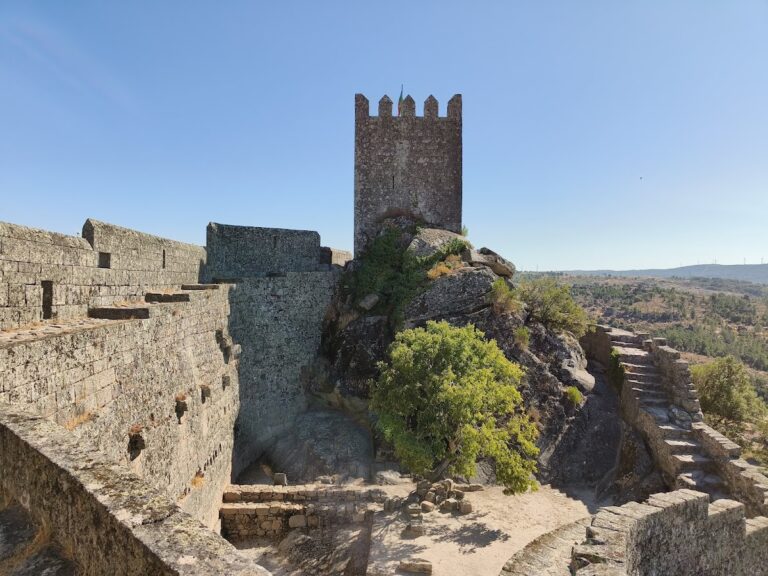
The castle occupies the highest point of a small plateau in the Serra da Malcata, above the settlement and beside the Côa. Its quadrangular enclosure is built from granite ashlar and schist masonry. A broad wall-walk, a passage along the top of a defensive wall, runs behind merlons pierced by cruciform loopholes. Four internal stairways provide access to this defensive passage.
Walls and towers
Corner and southwest towers
Three substantial towers reinforce the corners of the enclosure, while a fourth stands at the center of the southwest wall. Their upper defenses are finished with pyramidal merlons. Between the keep and the eastern corner tower, a battlemented balcony overlooks the principal entrance to the parade ground.
Pentagonal keep
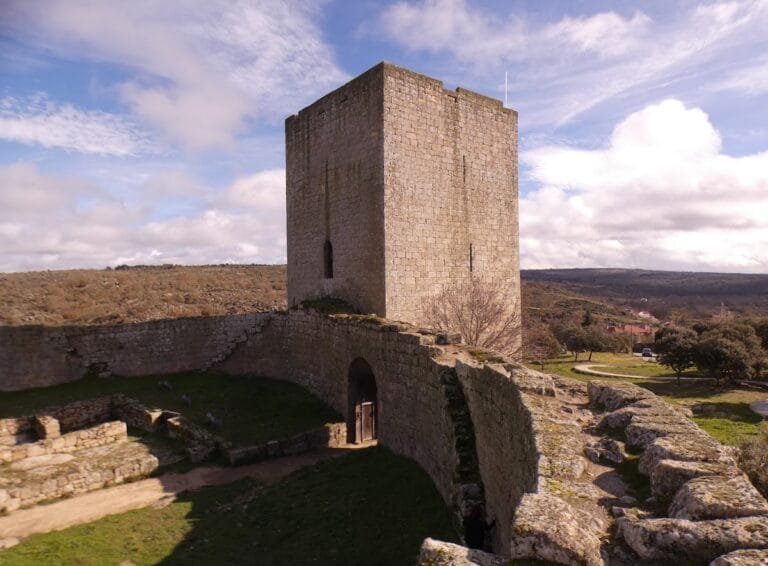
The keep, the principal fortified tower, has an unusual pentagonal plan and defends the main gate. This form gave the castle the name “Castle of the Five Corners.” Its Gothic interior is arranged over three levels with vaulted ceilings. Decorated bosses on the vaults carry shields bearing the Portuguese national escutcheons. Doors in the upper chamber open onto corbelled balconies fitted with machicolations, projecting openings through which defenders could attack people below.
Outer defenses
Barbican
Outside the main enclosure is a barbican, an outer defensive work that protects an entrance or strengthens a fortress. Its walls have massive merlons with cruciform loopholes. Two small circular turrets support the barbican, and a small pointed-arch portal opens beside one of them.
Town defenses
The town enceinte, or surrounding defensive wall, followed an approximately oval plan. Only short sections survive. The Town Gate stood near the Clock Tower, linking the fortified settlement with the castle’s later defensive landscape.
Nearby sites