Castle Linn: A Medieval Water Castle and Museum Centre in Krefeld


Site at a Glance
- Rating
- 4.6
- Popularity
- Medium
- Country
- Germany
- Primary era
- Medieval
- External website
- Open
- Eras represented
- Medieval, Early Modern
- Civilizations
- Holy Roman Empire
- Site type
- Military
- Remains
- Castle
On this page17 sections
History
Castle Linn is a restored lowland water castle in Krefeld, Germany, whose principal medieval development began in the twelfth century under the noblemen Otto and Gerlachus of Linn. Built on an earlier fortified mound, it grew into a territorial defensive installation, an administrative seat of Electoral Cologne, and later a private estate. Today, the castle, hunting lodge, archaeological museum, and Geismühle form the Museum Centre Castle Linn.
The motte and medieval castle
The earliest known defensive feature at the site was a motte established around the year 1000. A motte was an artificial defensive mound, usually surrounded by a ditch and topped by a timber stronghold. At Linn, the mound carried a wooden watchtower protected by a palisade, a fence made from upright wooden stakes.
In the twelfth century, Otto and Gerlachus of Linn added a residential and defensive tower. Built from tuff, a light volcanic stone formed from consolidated ash, and pebbles, it measured approximately 8.5 by 14.5 metres. The site’s ownership and feudal relationships changed in 1188, when Otto sold the allodial estate of Linn to Philipp I, Archbishop of Cologne, for 100 marks while retaining the castle as a fief. An allod was land held in full ownership, whereas a fief was granted by a superior lord in return for service.
Otto then joined the Third Crusade, the late-twelfth-century western European expedition against Saladin after the capture of Jerusalem. After returning, he expanded Castle Linn, drawing on Byzantine fortification traditions. The ring wall, a continuous enclosing fortification, was built in several stages. Three sections constructed between 1195 and 1200 formed exactly half of a planned symmetrical hexagon. A fourth section, completed around 1202, was made smaller than first intended, requiring adjustments to the remaining sides. The fifth and sixth sections followed around 1230 and 1250.
Otto died around 1219, and his son Gerhard of Linn completed the enclosure. At the end of the thirteenth century, the walls were raised by a further 3 metres. These successive works established the main medieval form of the castle and strengthened its ability to serve both residential and defensive purposes.
Territorial fortress and Electoral Cologne seat
At the beginning of the fourteenth century, Castle Linn was enlarged into a territorial defensive installation and became associated with the County of Cleves. Its military role was also connected with local administration. Heinrich of Strünkede served there as the official of Mechthild of Guelders, widow of Johann I of Cleves, from 1368 to 1378.
Raiding from the castle included attacks against Krefeld in the County of Moers. These attacks ended when combined forces from Cologne and Cleves stormed Castle Linn. Cologne’s feudal overlordship was confirmed by treaty in 1392, after which the castle became the administrative seat of the Electoral Cologne office of Linn. Electoral Cologne was the ecclesiastical territory governed by the archbishops and electors of Cologne.
The castle then functioned as a double castle. A residential and defensive main castle occupied the central enclosure, while an outer ward, the part of a castle outside the main enclosure, supported agricultural activity. Both parts were protected by water-filled ditches. This arrangement joined the residence of the territorial authority with the working facilities needed to manage the surrounding estate.
Sieges and artillery fortifications
Hermann of Hesse besieged Castle Linn during the Cologne Diocesan Feud in 1477, a conflict over control of the archbishopric and its political interests. In 1478, the older moat was filled to make room for another outer defensive wall, and a new moat was excavated beyond it. Buildings erected in the outer ward in 1488 as a bakehouse and brewhouse later acquired an administrative function.
During the Thirty Years’ War, the area between the inner and outer walls was filled to create a reinforced outer ring resistant to artillery. The resulting platform also provided a position for gunpowder weapons. Castle Linn and the town of Linn were gradually integrated into a larger fortified complex of earthworks, ditches, and five bastions. A bastion is a projecting part of a defensive wall designed to provide flanking fire, especially against attackers using firearms or artillery.
An outer defensive system existed by 1581, but it later deteriorated. Around 1620, it was replaced by a much stronger five-bastion system. A siege by Hesse-Kassel lasted more than four weeks and ended with the capture of the castle. The new occupants expanded and strengthened the fortifications between 1643 and 1645.
Fire, declining military importance, and later use
During the War of the Spanish Succession, a European conflict fought from 1701 to 1714 over the succession to the Spanish monarchy, Imperial troops besieged the French garrison at Castle Linn in August 1702. Bombardment set the castle on fire. It burned again in 1704, and lightning caused another fire in 1715. Restoration was abandoned after the castle lost its strategic importance, and it was considered uninhabitable from 1728.
The keep nevertheless continued to serve as a prison. Its use produced the name “Butterturm,” derived from the German term for a bailiff or enforcer. A guard was housed in a purpose-built building at the entrance because the castle itself no longer offered suitable guardroom facilities.
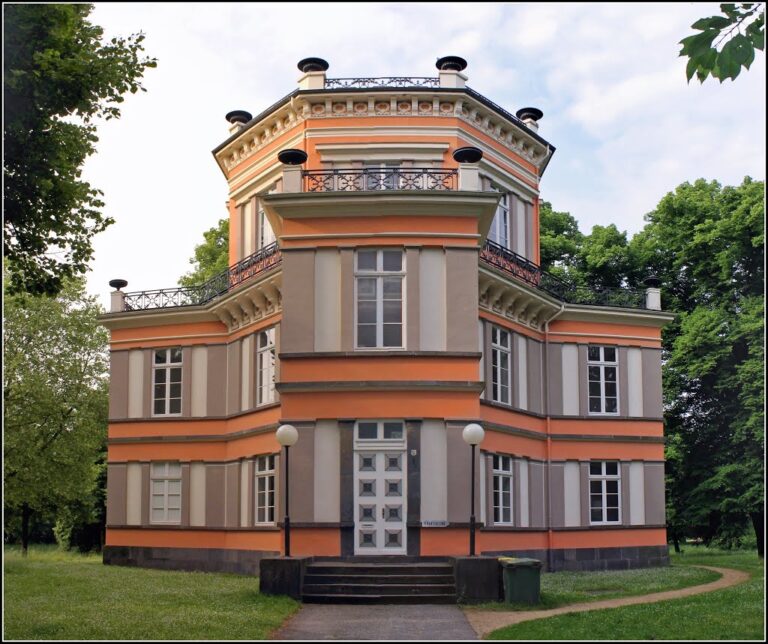
The bakehouse and brewhouse built in the outer ward in 1488 were converted in the early eighteenth century into the Kellnerei, an administrative residence and office for the management of the Electoral Cologne estate. Around 1740, Clemens August, Elector and Archbishop of Cologne, transformed the building into a hunting lodge. He visited it only rarely, but the lodge later became central to the property’s private history.
Private estate and municipal acquisition
French Revolutionary troops occupied the left bank of the Rhine in 1794. Property belonging to governments hostile to France was transferred to the French state, and Castle Linn with its lands was subsequently sold. The hunting lodge was then occupied by von Otten, the senior official of Linn.
In 1806, the Krefeld silk manufacturer Isaak de Greiff acquired the castle, hunting lodge, historic tithe barn, and surrounding estate. A tithe barn stored agricultural dues traditionally paid in kind. De Greiff used the lodge as a summer residence and as a hunting house in winter. His son Johann Philipp de Greiff inherited the property and later lived there with his family.
Marianne Rhodius, born de Greiff, grew up on the estate with her sister Emma and lived in the hunting lodge until her death in 1902. Her cousin Maria Schelleckes inherited the property. Gustav Schelleckes, a legal adviser, became co-heir and co-administrator of Marianne Rhodius’s estate and moved into the hunting lodge after the First World War.
In 1924, Gustav Schelleckes sold the castle ruins, hunting lodge, and associated properties to the City of Krefeld for 506,000 marks, although he remained in the hunting lodge until his death in 1928. Krefeld mayor Johannes Johansen strongly supported the municipal acquisition. The castle was renovated and converted into a state museum by 1926, and the hunting lodge was incorporated in 1930.
Restoration and museum centre
After the Second World War, the castle became overgrown and deteriorated through neglect. Repairs begun in the 1950s restored the floorboards and the boards forming the individual levels, while the upper storeys were initially protected by a provisional flat roof. Major roof work in the 1980s further protected the structure.
The castle and park also have a long-designed landscape setting. In the nineteenth century, Maximilian Friedrich Weyhe prepared a plan for English-style grounds around the fortifications for the brothers Cornelius and Phillip de Greiff. Presented in 1830, it placed the ruins at the romantic centre of extensive parkland, but the plan was never fully implemented. In 2004 and 2005, the park was included as an outstanding example in the Garden Art Route between the Rhine and Meuse. The grounds also host the annual Flax Market, a medieval-themed craft festival held over the Pentecost weekend.
The castle, hunting lodge, Archaeological Museum beside the castle, and Geismühle branch site now operate as a connected museum centre. The Archaeological Museum, formerly the Lower Rhine Regional Museum, presents finds from archaeological excavations in the Rhineland, extending the historical interpretation of Castle Linn beyond its own buildings.
Remains
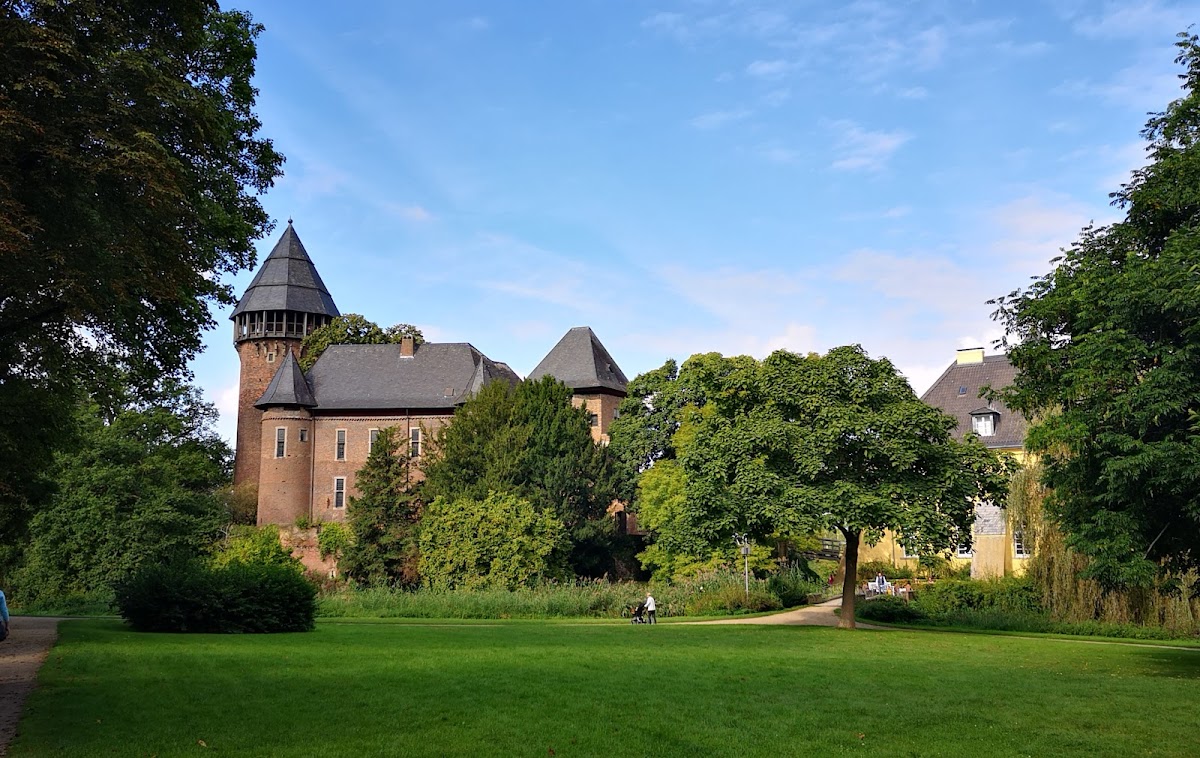
Castle Linn survives as a restored water-castle ensemble set within the largely preserved medieval fortifications of the former Electoral Cologne town of Linn. The site includes the main castle, an outer ward, water-filled ditches, earthworks, bastions, parkland, and the structures of the museum complex. Its visible form combines medieval masonry with later defensive additions, reconstructed elements, and buildings adapted for residential, administrative, and museum use.
The main castle and medieval enclosure
Keep and ring wall
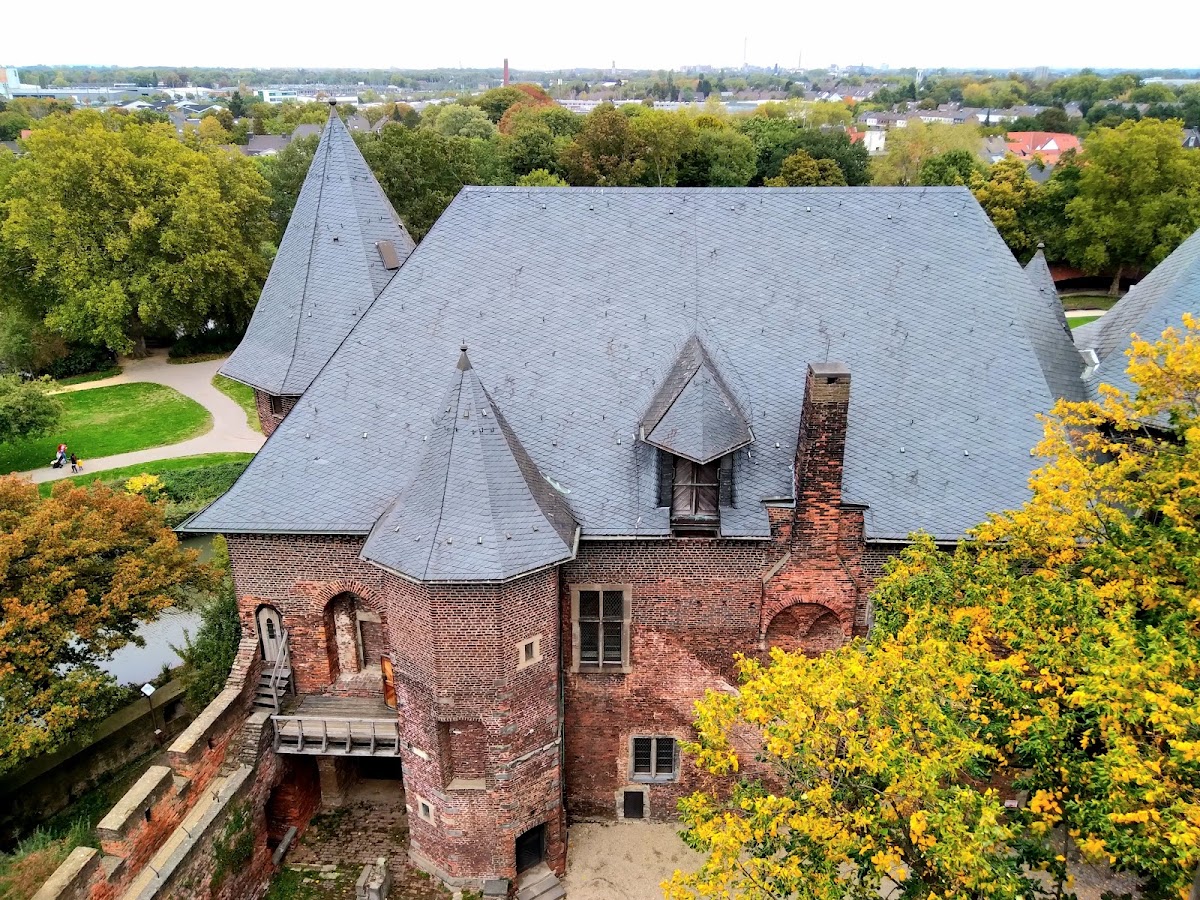
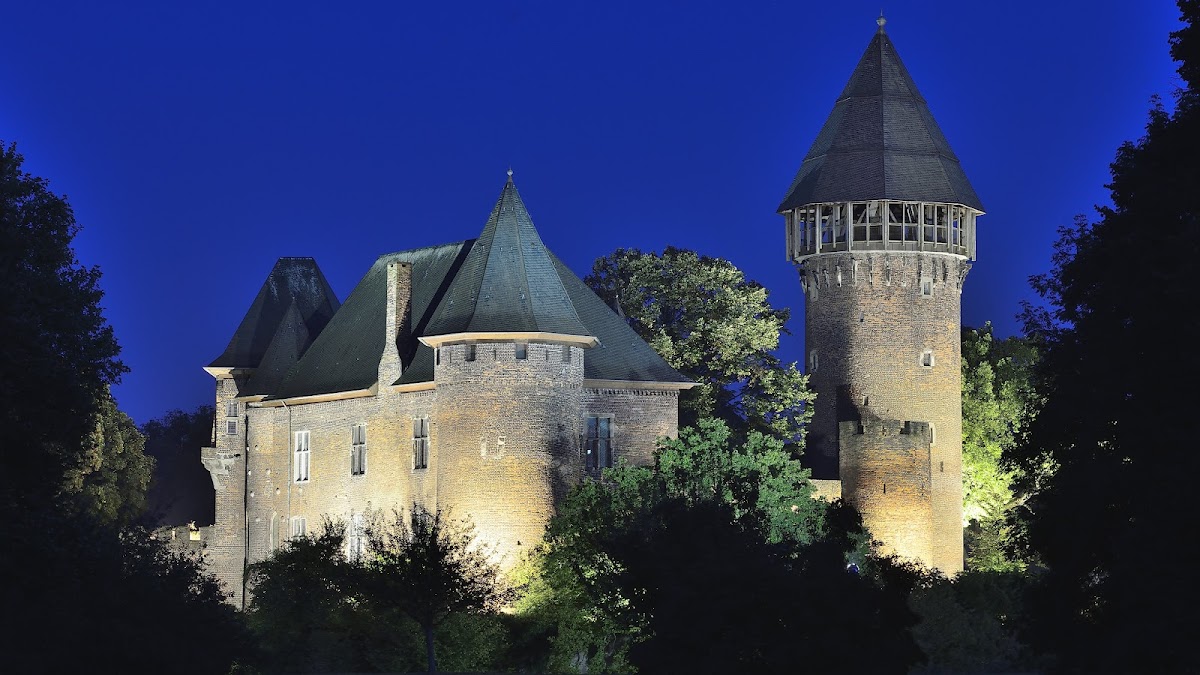
The central castle is organized around the six-sided ring wall developed between the late twelfth and mid-thirteenth centuries. Its earliest masonry addition was a strong tuff wall on the north side of the mound. Four brick-built sections were first connected to it to create a closed enclosure, and two later sections completed the six-sided plan. The surviving and reconstructed ensemble includes the keep, battlements, towers, a dungeon, a chapel, and the palas, the principal residential and representational hall of a medieval castle.
The keep served defensive, storage, refuge, and imprisonment functions rather than acting as the principal residence. Its roof was reconstructed in the 1980s with public funds and donations. The new roof combines historical reconstruction with practical requirements: the original roof was probably less steep, but the available evidence did not permit an exact reconstruction, and the roof frame was made using modern methods. The roof was raised so that the tower could serve as a viewing platform over Linn and the castle park.
Chapel tower and Gothic chapel
The Gothic chapel occupies the lower storey of the chapel tower in the gate building and dates from the fourteenth century. A large pointed arch connects it with the palas hall. Its interior consists of a rectangular bay and a five-sided, closed-ended altar space integrated into the tower. Two narrow lancet windows, characteristic of Gothic architecture, provide light. A second chapel may have occupied the upper storey of the battery tower.
Outer ward and defensive landscape
Outer ward
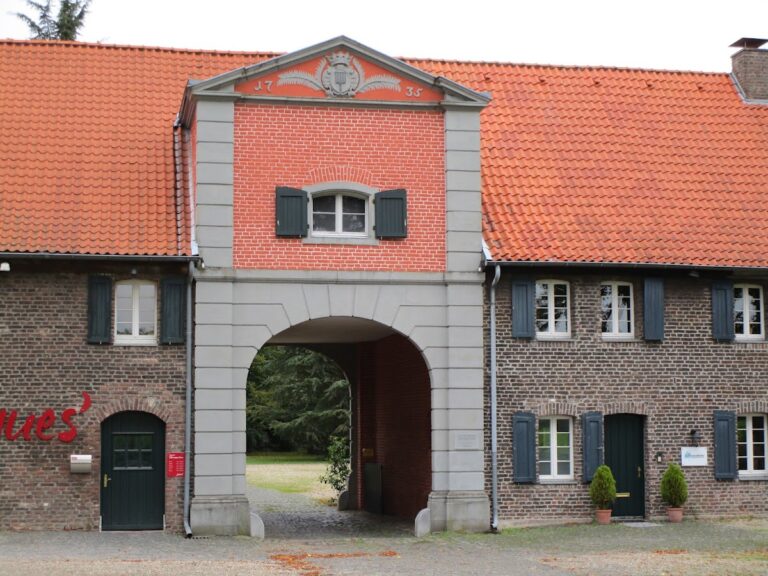
The outer ward forms the second part of the double enclosure. It was used agriculturally and contained the bakehouse and brewhouse erected in 1488. Their later conversion into the Kellnerei gave the outer ward an administrative role, while the hunting lodge created around 1740 connected the complex with the estate’s aristocratic and private history.
Ditches, walls, and bastions
Water-filled ditches surrounded both the main castle and the outer ward. The fifteenth-century outer defensive wall was built after the earlier moat had been filled, and a larger moat was then excavated outside it. The space between the inner and outer walls was subsequently filled to form an artillery platform and reinforced outer ring. Earthworks, ditches, and five bastions extended these defenses around the castle and town, and their remains now form part of the park landscape.
Hunting lodge and museum buildings
Hunting lodge
The hunting lodge in the outer ward is part of the museum complex. Its interiors contain rooms furnished in eighteenth- and nineteenth-century styles, a fully furnished Lower Rhine farmhouse kitchen, and a collection of historic musical instruments. The building therefore preserves both the later domestic use of the estate and the material setting of the families who occupied it after Castle Linn’s military decline.
Archaeological Museum and Geismühle
The Archaeological Museum beside the castle displays finds from excavations in the Rhineland. Together with Castle Linn, the hunting lodge, and Geismühle, a historic windmill operated as an external branch site, it forms the Museum Centre Castle Linn.