Kume-dera Temple: A Shingon Buddhist Temple in Kashihara, Japan


Site at a Glance
- Rating
- 3.9
- Popularity
- Low
- Country
- Japan
- Primary era
- Medieval
- External website
- Open
- Eras represented
- Medieval
- Civilizations
- Yamato
- Site type
- Religious
- Remains
- Temple
On this page10 sections
History
Kume-dera Temple is a Japanese Buddhist temple in Kashihara, Japan, founded during the late seventh-century Hakuho period. It belongs to the Omuro branch of Shingon Buddhism, an esoteric form of Japanese Buddhism, and venerates Yakushi Nyorai, the Buddha associated with healing and medicine. The temple is traditionally regarded as the birthplace of Shingon Buddhism because of its association with Kukai, the ninth-century monk who founded the Shingon school.
Foundation and early traditions
The temple’s foundation remains uncertain. One tradition credits Prince Kume, traditionally identified as the younger brother of Prince Shotoku, an early Japanese prince associated with the promotion of Buddhism and centralized government. The Record of Kume-dera supports this account. Other traditions, preserved in the Fuso Ryakki and the Shichidaiji Junrei Shiki, attribute the foundation to Kume Sennin, a legendary ascetic associated with supernatural powers. A foundation date of 594 is also given, although it is unconfirmed.
The story of Kume Sennin says that he lost his ability to fly after looking at a woman washing clothes. Prayer restored his powers, which he then used to transport timber for Emperor Shomu’s new capital. The emperor is said to have granted him thirty cho of tax-exempt fields, with which the temple was supposedly built. Another interpretation connects Kume-dera with the Kume, a hereditary group responsible for military duties under the Yamato polity, and proposes that the temple began as their clan temple.
Archaeological evidence places the foundation in the late seventh century. Roof tiles from the precinct were made from the same molds as tiles found at the Fujiwara Palace and at Kofuku-ji. This evidence has supported an influential interpretation identifying Kume-dera with Umayasaka-dera, regarded as the predecessor of Kofuku-ji.
Kukai and religious associations
Kukai is said to have received a spiritual revelation of the Mahavairocana Sutra, one of the principal scriptures of Shingon Buddhism, in Kume-dera’s eastern pagoda. After returning from study in China in 807, he propagated Shingon esoteric Buddhism at the temple. His inscription and preface for Masuda Pond refer to the temple by the name “Kume Shosha,” providing a further connection between Kukai and Kume-dera.
Kume-dera stands south of Mount Unebi, one of the Three Mountains of Yamato, and near Kashihara Jingu. Kume Mikata Shrine, now adjacent to the temple, formerly served as its tutelary shrine, meaning a shrine believed to protect a particular temple or institution. Kume-dera also belongs to several pilgrimage circuits, including the Western Japan Forty-nine Yakushi Sacred Sites, the Eighteen Sacred Pagoda Temples Pilgrimage, the Sacred Sites of Prince Shotoku, and the Northern Yamato Eighty-eight Sacred Sites. It is additionally associated with Jurojin in the Yamato Seven Fortune Deities and Eight Treasures pilgrimage.
Archaeological interpretation and modern recognition
The ruins at Okuyama in neighboring Asuka Village were once considered Kume-dera’s inner sanctuary. Excavation instead identified them as the remains of the seventh-century Oharida-dera, and they are now regarded as unrelated to Kume-dera. In 1917, an imperial princess made a formal visit to the temple while visiting Kashihara Jingu. Kume-dera’s tahōtō, a pagoda with a square lower section and cylindrical upper section, is designated an Important Cultural Property.
Remains
Kume-dera’s surviving remains include an eastern pagoda site, a large foundation stone, excavated roof tiles, and a standing tahōtō. Together, these features preserve evidence of the temple’s early construction and its later architectural form.
Pagoda remains
Eastern pagoda foundation
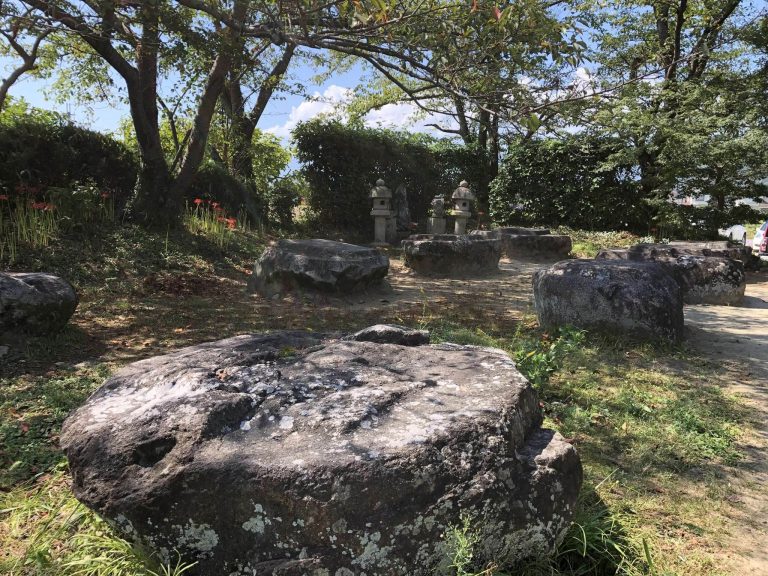
The temple precinct contains a large foundation stone from the eastern pagoda. This structure is central to the tradition that Kukai received his revelation of the Mahavairocana Sutra at Kume-dera. The surviving stone preserves the physical location of an early pagoda within the temple complex.
Tahōtō
The surviving pagoda is a tahōtō, a Japanese Buddhist form composed of a lower square section and an upper cylindrical section. Its form differs from the earlier eastern pagoda represented by the foundation stone. The tahōtō is preserved as an Important Cultural Property.
Roof tiles and foundation evidence
Excavated roof tiles
Roof tiles excavated from the precinct provide evidence for dating Kume-dera’s foundation to the late seventh century, during the Hakuho period. Their molds were also used for tiles found at the Fujiwara Palace and Kofuku-ji. The shared production evidence supports the interpretation linking Kume-dera with Umayasaka-dera, the predecessor of Kofuku-ji.