Kaibara Hachiman Shrine: A Historic Shinto Shrine in Tamba, Japan


Site at a Glance
- Rating
- 4.2
- Popularity
- Low
- Country
- Japan
- Primary era
- Early Modern
- External website
- Open
- Eras represented
- Medieval, Early Modern
- Civilizations
- Ashikaga shogunate, Tokugawa, Toyotomi regime
- Site type
- Religious
- Remains
- Sanctuary
On this page15 sections
History
Kaibara Hachiman Shrine is a Shinto shrine in Tamba, Hyogo Prefecture, Japan, founded in 1024 during the Heian period through the invitation of a divided sacred spirit from Iwashimizu Hachimangu in Kyoto. Its origins are traditionally traced to the reign of Emperor Jomei, a seventh-century Japanese sovereign, when Gozu Tenno, a Buddhist-influenced protector associated with epidemics and other harmful forces, was enshrined on the mountain summit now occupied by the three-story pagoda.
Origins and foundation
Three sacred springs appeared near the mountain in 1024. This auspicious event led Emperor Go-Ichijo, an eleventh-century emperor, to order the enshrinement of a divided spirit from Iwashimizu Hachimangu. A divided spirit was a sacred presence ritually invited from an established shrine to establish or sanctify another shrine. The new institution became known as the Kaibara Auxiliary Shrine of Tanba and formed the basis of the present shrine.
The principal deities are Hondawake, identified with Emperor Ojin and worshipped within the Hachiman tradition, Okinagatarashihime, identified with Empress Jingu, and three deities of the Munakata group: Takirihime, Takitsuhime, and Ichikishimahime.
Warfare and rebuilding
Kaibara Hachiman Shrine was drawn into a conflict in 1345, when Ogino, Governor of Aki, fought the Ashikaga forces. The original buildings burned during the battle and were later rebuilt. A three-story pagoda was erected in 1468, adding a Buddhist religious structure to the shrine precinct.
In 1579, the shrine buildings and pagoda were again destroyed by fire during Akechi Mitsuhide’s campaign in Tanba, conducted on the orders of Oda Nobunaga. In 1582, Hashiba Hideyoshi, the warlord later known as Toyotomi Hideyoshi, ordered Horio Yoshiharu, lord of Kuroi Castle, to rebuild the shrine. The present main sanctuary and worship hall were completed in August 1585.
Religious transformation and modern protection
The present three-story pagoda was rebuilt in 1815 after earlier cycles of destruction and reconstruction. The work was led by the sculptor Nakai Gonji. The shrine also retained a Buddhist connection through its former jinguji, a Buddhist temple attached to a Shinto shrine.
In 1868, the Meiji-era policy of separating Shinto and Buddhism made the former Buddhist institution independent. Buddhist images, scriptures, and related objects were transferred there, preserving those materials during the accompanying movement to suppress Buddhism. The pagoda and bell tower were nearly dismantled, but the pagoda was preserved as the Hachiman Library and the bell tower as the Time Bell.
The shrine was ranked as a district shrine in 1873 and elevated to prefectural-shrine status in 1900. Its main sanctuary and worship hall received successive forms of legal protection, becoming specially protected buildings under the 1913 Ancient Shrines and Temples Preservation Law, former National Treasures under the 1929 National Treasure Preservation Law, and Important Cultural Properties under the 1950 Cultural Properties Protection Law. A government-supported dismantling and repair project took place from January 1975 to September 1976. The worship hall was partly dismantled, while the main sanctuary was completely dismantled during the work.
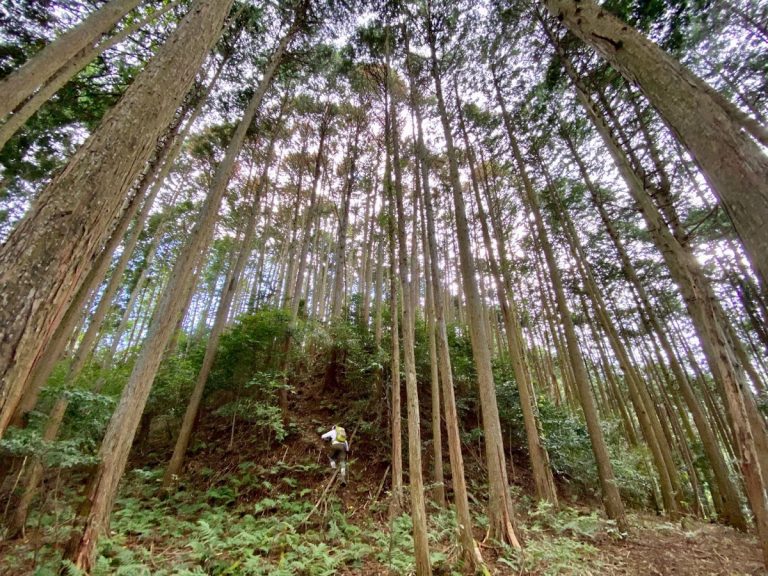
Kaibara Hachimanyama’s 73-hectare forest, densely covered with sudajii evergreen chinquapin trees, was designated a Hyogo environmental green-space conservation area and selected for the Hyogo 100 Forests and Hyogo 100 Scenic Landscapes. The shrine restored its official name, Kaibara Hachiman Shrine, in 2021.
Festivals and associated institutions
The annual Great Festival for Warding Off Calamity takes place on February 17 and 18. A rite held at midnight on February 17 is regarded as Japan’s oldest rite for warding off calamity and preserves elements of ancient practices associated with harmful influences and epidemics.
The shrine is associated with numerous subsidiary institutions, including Yasaka Shrine, the Ancestral Spirits Shrine, Nishinomiya Shrine, Kasuga Shrine, Kora Shrine, Sumiyoshi Shrine, the Shrine for Averting Calamity, Wakamiya Shrine, the Purification Hall, the Mountain Shrine, Sarutahiko Shrine, Shirahime Shrine, two Itsukushima shrines, Awashima Shrine, Kaibara Daijingu, the festival procession sanctuary, the Sacred Shrine, and the Five-Shrine Inari Shrine. The Five-Shrine Inari Shrine was founded in 1024 after a divided spirit was invited from Fushimi Inari in Kyoto, and it was rebuilt in 1756 by Oda Nobuhisa, the third lord of the Kaibara domain.
Associated cultural-property holdings include shrine documents. The three-story pagoda, Five-Shrine Inari Shrine, and bronze bell have prefectural cultural-property protection, while the stone guardian-dog pair and Noh masks are cultural properties of Tamba City.
Remains
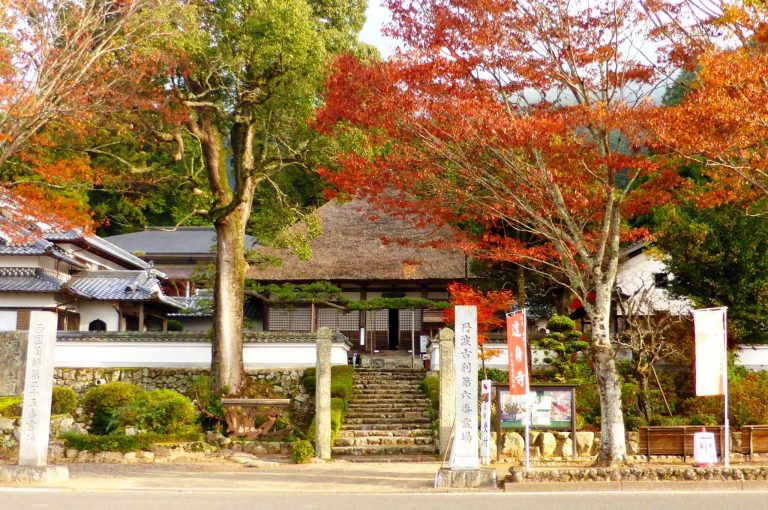
The shrine precinct lies within the forested mountain landscape of Kaibara Hachimanyama. The main sanctuary and worship hall form the principal shrine buildings, with the three-story pagoda behind them. Together they preserve a religious complex in which Shinto shrine buildings stand alongside a surviving Buddhist pagoda, a combination noted in only 18 shrine precincts nationally.
Principal shrine buildings
Main sanctuary
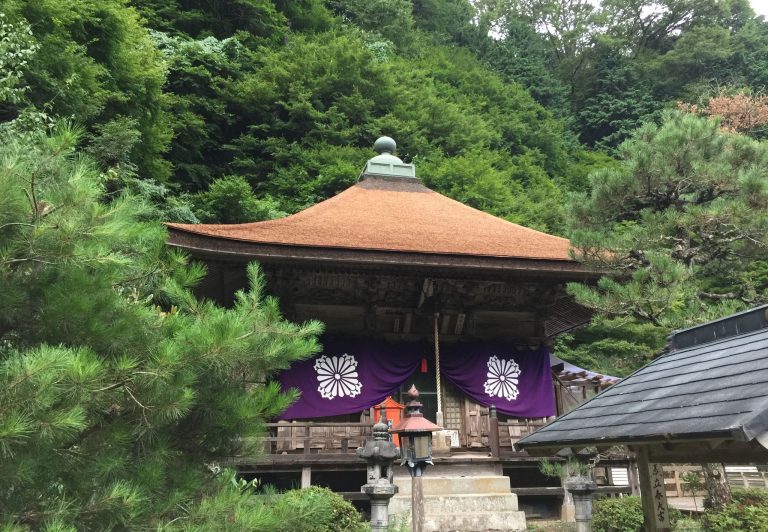
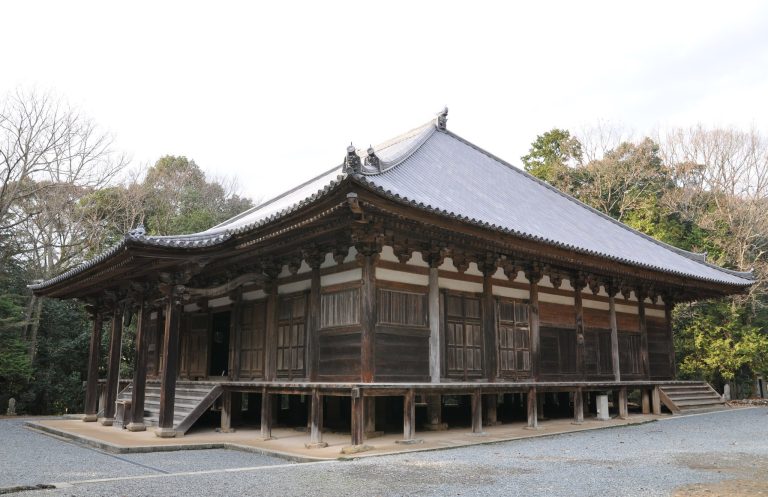
The main sanctuary is a three-bay nagare-zukuri building, a shrine form with an extended asymmetrical roof over the entrance. It has a cypress-bark roof and is regarded as an especially valuable early example of the architectural approach that developed into gongen-zukuri, in which the sanctuary and worship hall are linked through an intermediate space. The building was reconstructed in 1585 and altered repeatedly afterward. Its associated construction documents remain with the shrine.
Worship hall
Rebuilt in 1585, the worship hall has an irimoya-zukuri roof, which combines a gabled upper section with hipped lower slopes. Its front includes a karahafu, or curved decorative gable, and the roof is covered with cypress bark. The worship hall’s construction documents are preserved as part of the associated record of the principal buildings.
Pagoda and bell tower
Three-story pagoda
The three-story pagoda is a three-bay Buddhist structure standing behind the main sanctuary and worship hall. It rises approximately 23 metres and has a tiled roof with a cypress-bark roof component. The present building dates from 1815 and bears a plaque reading “Hachiman Library.” Five diaries are associated with the pagoda, providing a record connected with its history.
Bell tower
The bell tower contains a bronze bell known as the Bell for Averting Calamity and Bringing Good Fortune. The bell bears the dates 1389 and 1542 and an inscription identifying it with Takayama-dera, in present-day Hikami. It reached the shrine after Hideyoshi gathered bells from Hikami District for cannon casting. The shrine’s Buddhist clergy recognized the bell as particularly fine and successfully requested that it be donated to the shrine. The bell has prefectural cultural-property protection.
Inari shrine and subsidiary precinct
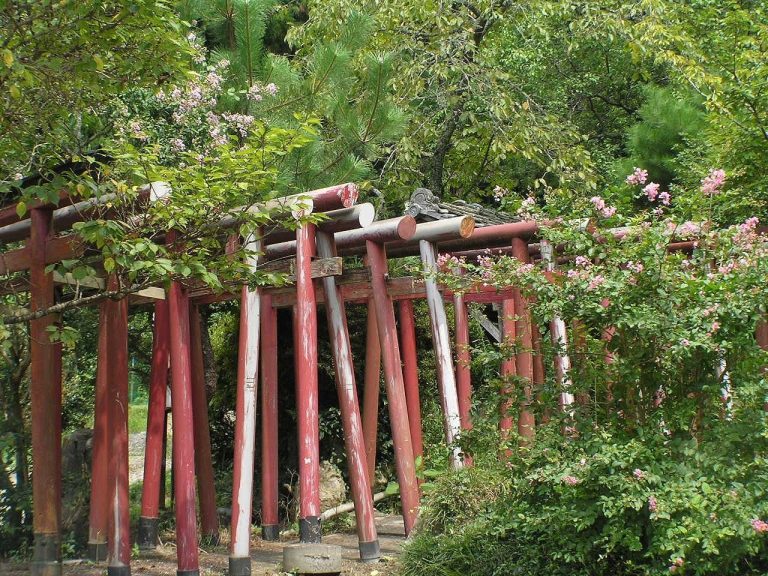
Five-Shrine Inari Shrine
The Five-Shrine Inari Shrine has a decorated worship-front porch, with a dragon carving on the porch and a phoenix in the decorative gable panel. These carvings were made by a local sculptor from the Nakai family. The shrine also includes a named gate and retains four ridgepole tablets. Its rebuilding in 1756 followed its foundation in 1024 through the invitation of a divided spirit from Fushimi Inari in Kyoto.
Other associated structures
The wider precinct includes Yasaka Shrine, the Ancestral Spirits Shrine, Nishinomiya Shrine, Kasuga Shrine, Kora Shrine, a food-offering hall, a votive-picture or kagura hall, Sumiyoshi Shrine, the Shrine for Averting Calamity, Wakamiya Shrine, the Purification Hall, the shrine office, the Mountain Shrine, Sarutahiko Shrine, Shirahime Shrine, the front Itsukushima Shrine, Awashima Shrine, Kaibara Daijingu, the festival procession sanctuary, the Sacred Shrine, and the rear Itsukushima Shrine. The forested setting is dominated by protected sudajii trees, which form the natural landscape surrounding the buildings.