Iwamoto-ji Temple: Temple 37 on Japan’s Shikoku Pilgrimage


Site at a Glance
- Rating
- 4.2
- Popularity
- Medium
- Country
- Japan
- Primary era
- Modern
- External website
- Open
- Eras represented
- Early Modern, Modern
- Civilizations
- Japanese, Tokugawa
- Site type
- Religious
- Remains
- Sanctuary
On this page12 sections
History
Iwamoto-ji Temple is a Japanese Buddhist temple in Shimanto, Japan, traditionally founded during 729–749 by the priest Gyōki under an imperial command from Emperor Shōmu. It belongs to the Chisan branch of Shingon Buddhism, a later lineage of the esoteric Buddhist school associated with Kūkai, and is temple 37 on the Shikoku 88-temple pilgrimage. Its foundation was intended to avert seven calamities and bring seven blessings.
The Niida foundation
Temple tradition places the original religious center beside the Niida River, about 2–3 kilometers northwest of the present temple, near the shrine of Niida Myōjin. Known as Niida Shichifuku or Shichifuku-ji, it was also understood as a group of seven temples representing the seven stars and the seven blessings of the Ninnō-gyō, a Mahayana Buddhist scripture concerned in part with protecting the state. This account preserves the religious meaning of the foundation while presenting its early date as temple tradition.
Between 810 and 824, Kūkai expanded Fukuenman-ji into a complex of five shrines and five temples. The shrines were associated respectively with Fudō Myōō, Kannon, Amida Nyorai, Yakushi Nyorai, and Shōgun Jizō. Fudō Myōō was understood as a fierce protector, Kannon as a figure of compassion, Amida Nyorai as a guide to rebirth in the Pure Land, Yakushi Nyorai as a healing Buddha, and Jizō Bosatsu as a protector of travelers and beings in difficult states. Kūkai is also said to have performed a secret star-offering ritual there, an esoteric rite connected with astral influences and protection.
The Five Niida Shrines and Twelve Fuku Temples
The expanded institution became known as the Five Niida Shrines and Twelve Fuku Temples. It flourished as a site of imperial prayer under the patronage of Emperor Saga. Fukuenman-ji served as the administrative temple and pilgrimage temple, with a supervising priest responsible for its religious and institutional affairs.
At the end of the medieval period, Iwamoto-ji functioned as a lodging temple in the town on the route from Fukuenman-ji toward Ashizuri. A prince named Sonkai, who later headed Ashizuri Mountain, stayed there and gave it the name Iwamoto-bō. The lodging temple then prospered. After the complex was destroyed by war fires during the Tenshō era, from 1573 to 1592, Prince Sonkai ordered his disciple Sonshin to rebuild it.
Transformation into Iwamoto-ji
As Fukuenman-ji declined, its administrative priest moved to Iwamoto-bō between 1652 and 1688. The institution was renamed Iwamoto-ji, and pilgrimage documents identified it as the administrative temple of the Five Niida Shrines. The temple was rebuilt at a site different from the original location during this period.
In the early Meiji period, the policy of separating Buddhism and Shinto transferred the five Buddhist statues associated with the Five Niida Shrines to Iwamoto-ji. The prefectural government abolished the temple in 1871, but it was revived in 1889 and has continued since then. The temple’s place on the Shikoku pilgrimage also shaped its role: the considerable distance to the preceding Shōryū-ji and following Kongōfuku-ji traditionally led many pilgrims to stay overnight at Iwamoto-ji.
Several traditions connected with Kūkai preserve seven wonders formerly associated with the Five Niida Shrines. They include a cherry tree believed to ensure safe childbirth, a chestnut tree said to fruit three times a year after Kūkai blessed roasted chestnuts, and leeches said to have stopped sucking blood after his blessing. Other traditions describe cherry blossoms becoming cherry shells, a spiral orchid, a spiny spiral shell losing its rear opening, and a village headman’s house becoming inaccessible to thieves after Kūkai blessed it in gratitude for lodging.
Remains
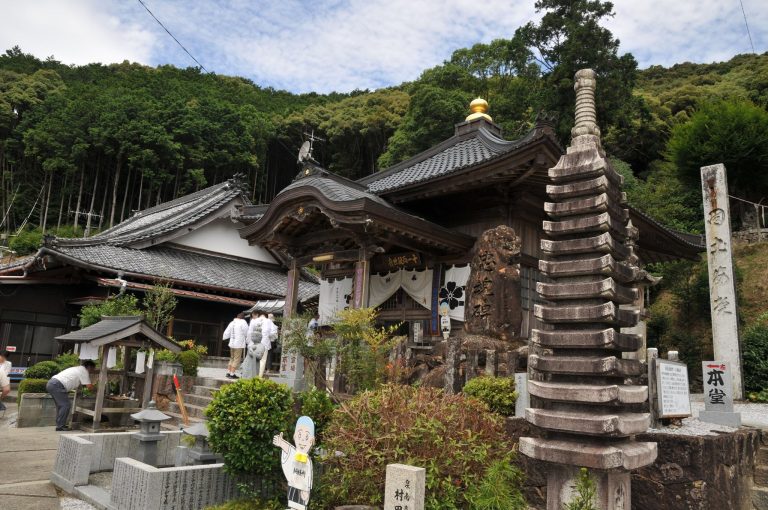
The present complex is entered through a temple gate called a Nio-mon, reached by a short flight of steps. The main hall and bell tower occupy the area to the right of the entrance, while a handwashing area and the temple office are on the left. The Seitendō is also positioned near the entrance. Lodging, a shop, and sanitary facilities stand in front of the main hall, and the Tosa Kuroshio Railway borders the rear of the grounds, passing between the temple precincts and the hillside shrine beyond it.
Main worship buildings
Main hall
Built anew in 1978, the main hall contains 575 painted ceiling panels. Artists and members of the public created scenes of flowers, birds, and the seasons, together with a smiling depiction of Marilyn Monroe. The hall’s five principal sacred images are arranged from right to left as seated Fudō Myōō, seated Shō Kannon, seated Amida Nyorai, seated Yakushi Nyorai, and Jizō Bosatsu seated in a half-lotus posture.
Five life-sized gilded front images of these deities were being produced in the period described. Newly made seated Yakushi Nyorai and Shōgun Jizō stood on the right, while seated Fudō Myōō stood on the left; the Kannon image remained unfinished at that time. The five principal Buddhist statues associated with the former shrine complex are also preserved within the temple grounds.
Daishidō and Kaisandō
The Daishidō contains an image of Kūkai, also known as Kōbō Daishi, that worshippers can view. The image is described as approximately 200 years old. To the left of the Daishidō, the Kaisandō contains the image of the Arrow-Wounded Jizō and commemorates the founding of the temple.
Seitendō and Seiryūden
The Seitendō is a small, round metal hall enshrining Kangiten, a Buddhist deity associated with prosperity and the removal of obstacles. The Seiryūden contains a crowned seated image of Amida Nyorai and was the first of the new central images to be completed.
Shrines and grounds
Suiten-gū and Mikumano Shrine
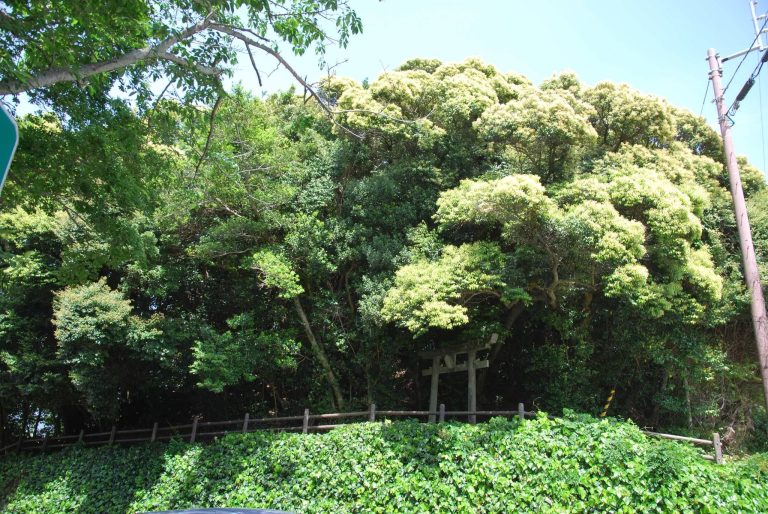
The Suiten-gū is a small shrine at the northern edge of the temple grounds. Suiten is a Buddhist water deity identified in Japanese tradition with Varuna, the deity of waters in Indian religious tradition. The Mikumano Shrine, the local guardian shrine of the temple site, stands beyond the railway line near the hillside behind the main hall.
Bell tower and memorial marker
A bell tower stands behind or near the main hall area. The grounds also contain a stone marker dedicated to Takadaya Kahei. The marker was transferred from the former Kaigetsu-an site along the Soemimizu pilgrimage route.