Ruine Bebenburg: A Medieval Aristocratic Castle in Germany


Site at a Glance
- Rating
- 4.2
- Popularity
- Very Low
- Country
- Germany
- Primary era
- Medieval
- Eras represented
- Medieval
- Civilizations
- Holy Roman Empire
- Site type
- Military
- Remains
- Castle
On this page7 sections
History
Ruine Bebenburg, also called Bemburg, is a medieval aristocratic castle in Germany, situated near Bemberg in the municipality of Rot am See, Baden-Württemberg. It was probably built around 1140 as a small castle on a projecting spur. Its first recorded association is with Wolfram I von Bebenburg, who was documented in 1140 and appears to have built the castle shortly beforehand.
The Lords of Bebenburg
Wolfram I belonged to the noble-free Lords of Weinsberg, a family considered descended from the medieval Reginbodonen, a noble lineage from which several regional aristocratic families traced their origins. He was also the husband of a daughter of Count Engelhard of Lobenhausen. In 1149, a charter issued at Würzburg by King Conrad III named Wolfram von Bebenburg among its witnesses.
The same charter placed him between Rupert von Frohburg and Wolfram von Wertheim. Rupert, who took his name from a castle near Freudenberg am Main, later became the progenitor of the Lords of Dürn and was Wolfram I’s brother from the Weinsberg line. The Counts of Wertheim were likewise regarded as a branch of the Reginbodonen.
In 1153, Wolfram I founded the monastery later known as Schöntal, a religious foundation on the Jagst River. He continued to use the Weinsberg name, while the later Bebenburg and Weinsberg lines descended from him. Both lines eventually held ministerial status. Ministeriales were service nobles who occupied an elevated social position while originally remaining legally dependent.
Later Ownership and Destruction
The status and connections of the Bebenburg and Weinsberg families were shaped partly by King Conrad III’s conquest of Weinsberg in 1140. They also help explain the family’s relationship with the imperial kitchen masters of Rothenburg, a group connected with the Lords of Nordenberg. A document dated 11 February 1314 identifies Margarethe von Bebenburg as the sister of Heinrich, the kitchen master of Nordenberg.
From 1440, the castle belonged to the noble family von Enslingen. It was probably destroyed around 1449 during the War of the Cities, a fifteenth-century conflict in the region involving towns and territorial nobles.
Remains
Spur Castle and Defenses
Setting and Enclosure
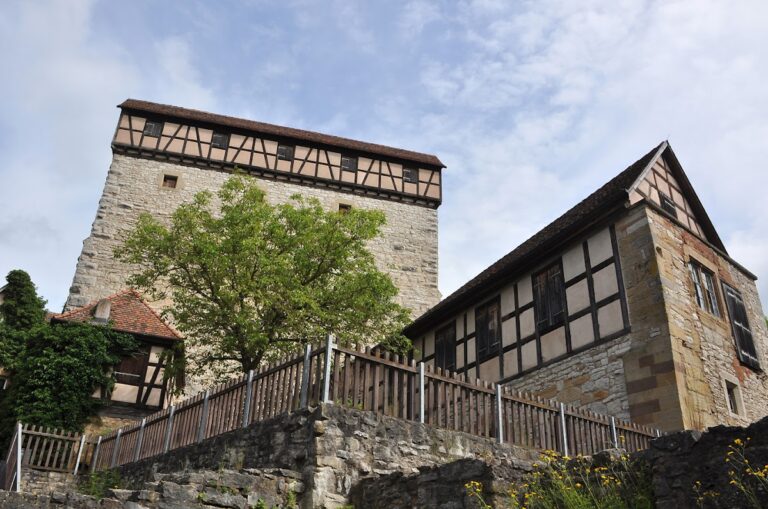
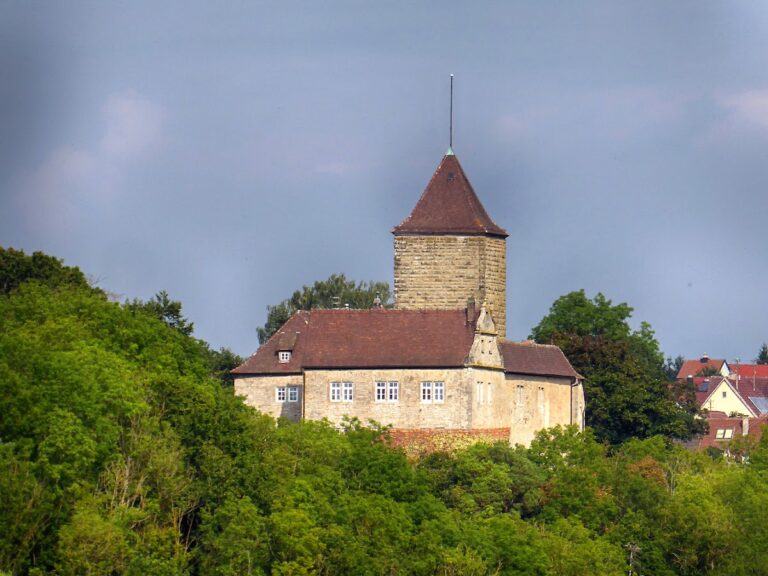
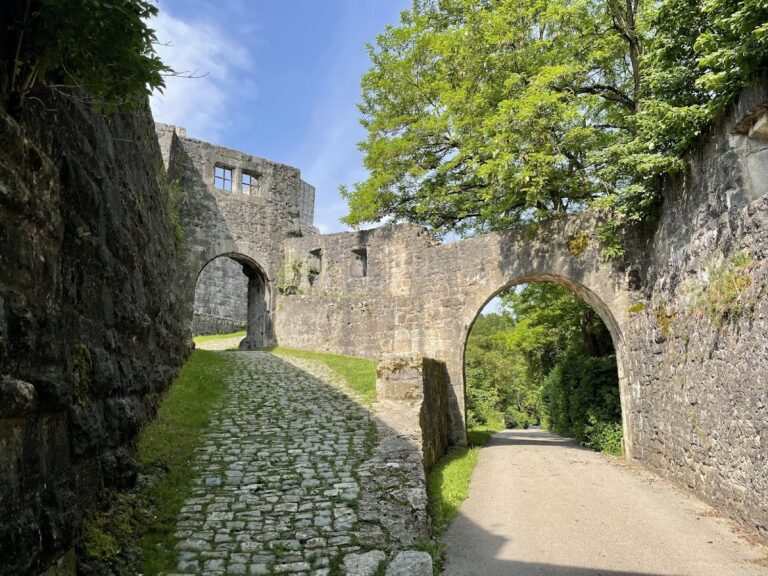
The ruin occupies a 426.6-metre-high spur above the confluence of the Blaubach and Brettach, at the western edge of Bemberg. Its position provided steep natural terrain as part of the defenses. A continuous surrounding wall and a neck ditch further protected the small tower castle.
Bergfried
The principal surviving feature is the stump of the bergfried, the main defensive tower of a medieval German castle. About 6 metres of the tower remain, and its base measures 7.5 by 7.5 metres. The tower served as a watchtower and formed the central surviving element of the castle ruin.