Amlishagen Castle: A Medieval Spur Fortress in Germany


Site at a Glance
- Rating
- 4.1
- Popularity
- Very Low
- Country
- Germany
- Primary era
- Medieval
- Eras represented
- Medieval, Early Modern
- Civilizations
- Holy Roman Empire
- Site type
- Military
- Remains
- Castle
On this page7 sections
History
Amlishagen Castle is a medieval aristocratic spur castle in Germany, standing at the southern edge of Amlishagen, now part of Gerabronn in Baden-Württemberg. Built in the thirteenth century by members of the Amlishagen family, it occupied a defensible position above the Brettach valley. The castle was first recorded in 1253 under the name Amelushagen, when the family held it as vassals of the Counts of Hohenlohe-Brauneck, a medieval Hohenlohe dynasty whose authority included the feudal relationship surrounding the fortress.
Medieval Expansion
During the fourteenth century, the Lords of Wollmershausen gradually took control of Amlishagen Castle. In the second half of that century they expanded and rebuilt the complex, creating a larger and more strongly defended residence. Archaeological investigation later identified five building phases between the first half of the thirteenth century and about 1500, revealing that the castle developed through successive stages rather than being completed in a single campaign.
Later Ownership and Conservation
Further enlargement took place around 1600, including work recorded in 1601. The castle was altered again during the nineteenth century. After the Wollmershausen family died out in the early eighteenth century, ownership passed through several hands. Johann Karl von Horlacher, the personal physician of the Prussian field marshal Gebhard Leberecht von Blücher, purchased the property in October 1821. A distant descendant of Horlacher remains its owner.
Amlishagen Castle remains privately owned and inhabited. Extensive securing, conservation, reconstruction, and archaeological investigation took place during the 1980s. These works re-created parts of the complex and clarified its sequence of construction, while part of the restored site was arranged as a museum.
Remains
Setting and Defensive Layout
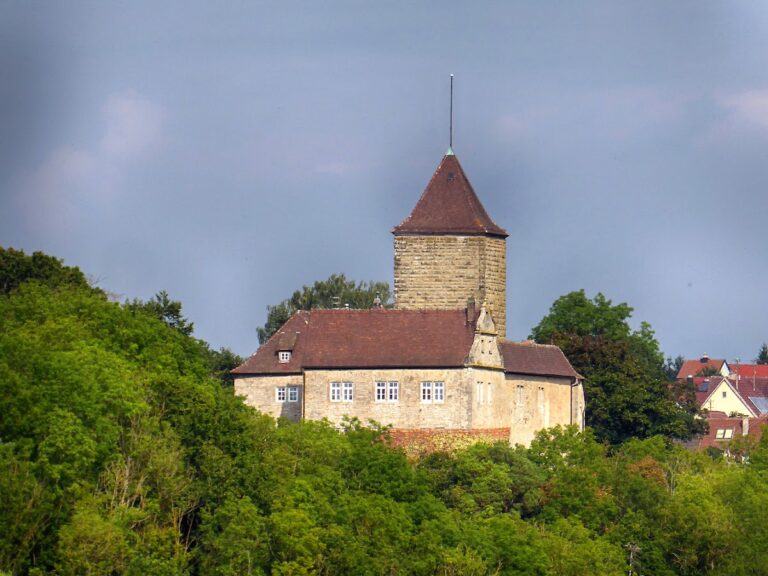
The castle occupies a southwest-projecting spur about 440 metres above sea level, on a moderately descending extension of the Hohenlohe Plain. Near its end, a hollow cuts progressively deeper into the spur. The fortress stands directly above the Hammerschmied ravine, whose intermittent stream joins the Brettach at about 375 metres above sea level. Wooded valley slopes help explain why the castle is difficult to see from below.
Amlishagen is a small fortified complex of shield-wall design. This type of fortress concentrates an exceptionally high and thick defensive wall on the landward side, where an attack was most likely. A neck ditch, cut across the spur, protected the main approach from attack and missile fire. The first building phase included a curtain wall enclosing an area corresponding to the present inner castle. During the second phase, toward the end of the thirteenth century, the massive shield wall was added.
Walls and Outer Defences
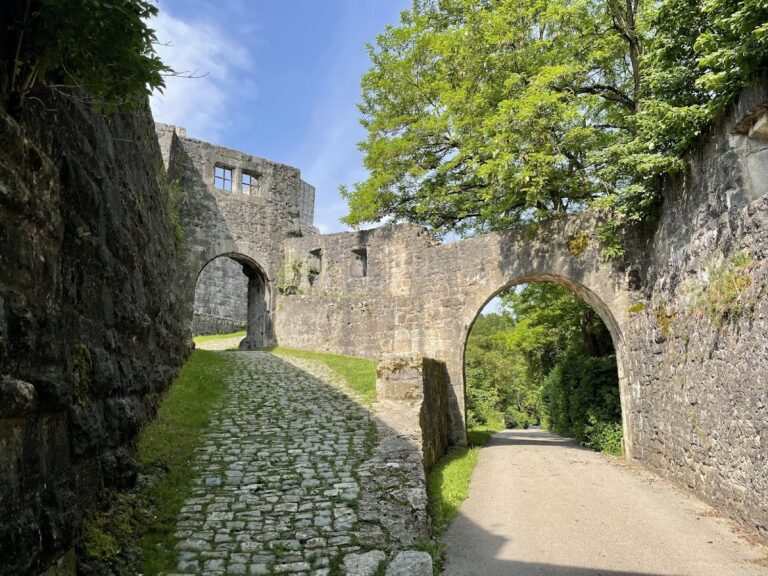
The shield wall is approximately 20 metres high, 19 metres long, and 2.5 metres thick. A defensive wall-walk, a walkway along the top of a fortification, crowned it. The present wall-walk was re-created during the conservation and renovation work of the 1980s, and a spiral staircase built within the wall provides access to it.
An outer defensive enclosure was also established during the second building phase between the main fortification and an outer wall. In later building phases, five corner towers were added to, or incorporated into, this outer wall. Together with the shield wall and neck ditch, these features formed the principal defensive arrangement of the surviving complex.
Residential and Service Buildings
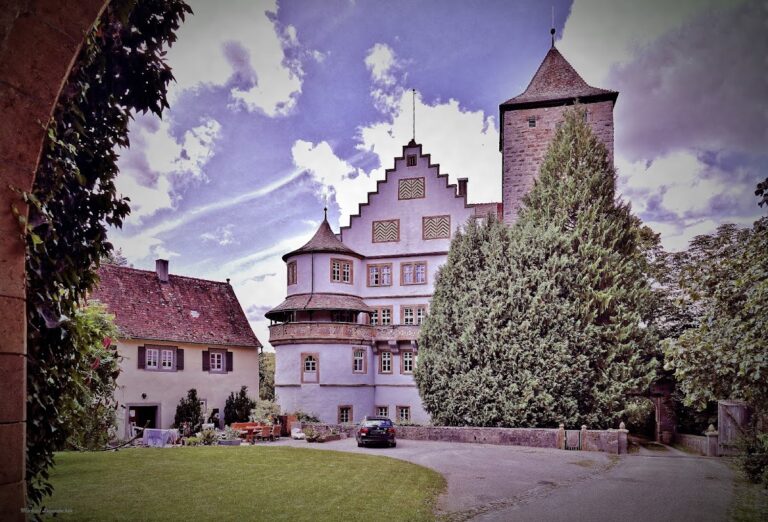
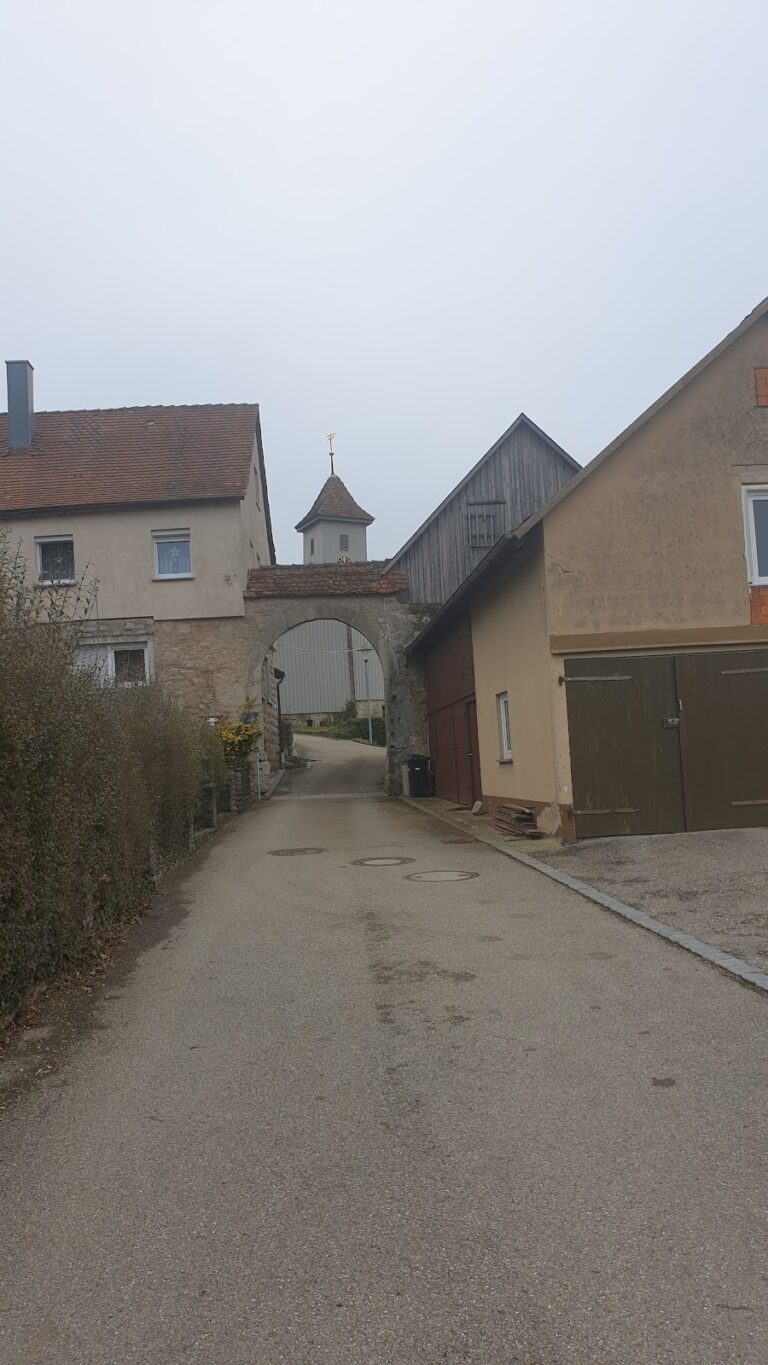
A building known as Schloss Amlishagen stands within the service yard between the village and the neck ditch. The castle complex is substantially preserved, and its buildings continue to serve as an inhabited residence.
Nearby sites