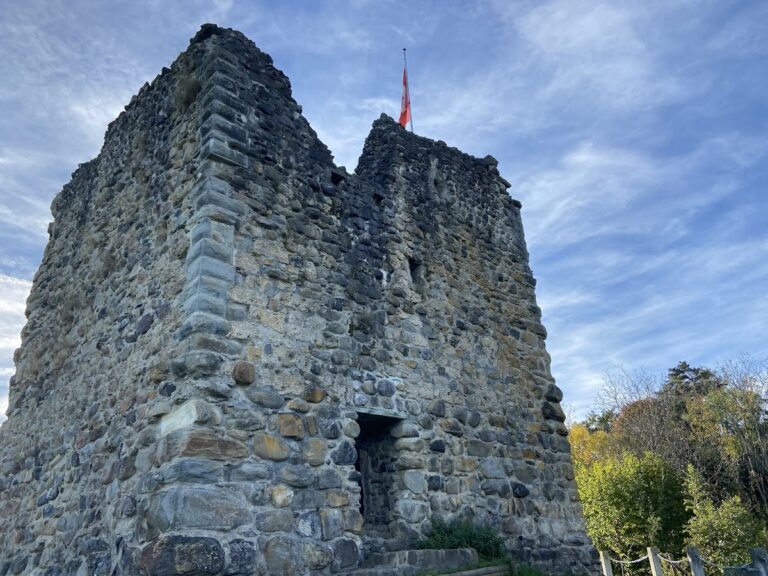
Burgruine Heitnau: A Medieval Hilltop Castle Ruin in Switzerland
Site at a Glance
- Rating
- 5
- Popularity
- Very Low
- Country
- Switzerland
- Primary era
- Medieval
- Eras represented
- Medieval
- Civilizations
- Holy Roman Empire
- Site type
- Military
- Remains
- Castle
On this page4 sections
History
Burgruine Heitnau is the ruin of a medieval hilltop castle in Switzerland, probably built in the late twelfth century. Its name probably means “the floodplain of a Heito.” The castle administered Toggenburg possessions in the upper Lauchetal.
The Lords of Heitnau
The name Heitnau first appears in a document dated 4 July 1209. The document identifies Arnold of Heitnau as a ministerial, a medieval service noble who performed administrative, military, or other official duties for a higher lord, in this case Count Diethelm II of Toggenburg. The Counts of Toggenburg were a ruling dynasty in northeastern Switzerland.
A fire damaged the castle in the mid-thirteenth century. The complex was rebuilt, but its gradual decline continued. During the same century, the Commandery of Tobel increasingly took control of the Lordship of Heitnau. A commandery was an administrative and economic center governed by the commander of a religious military order or similar ecclesiastical institution.
Transfer to Tobel and Later Reuse
In 1258, the Commandery of Tobel acquired the bailiwick over several properties at Tägerschen. In 1275, Diethelm IV of Toggenburg bequeathed the castle, its estates, and associated rights to the commandery. The castle remained inhabited until about the middle of the fourteenth century, while the Lordship and Commandery of Tobel retained it until 1798.
In 1807, stone from the fortifications was reused in the construction of the Protestant church in Braunau and later in the schoolhouse. This progressive removal left scarcely any visible wall traces on the castle hill. The remains were uncovered between 1950 and 1954 through work carried out by prisoners. Earlier undocumented excavations had heavily disturbed the archaeological layers, but the later investigation still revealed important evidence about the castle’s construction history.
Remains
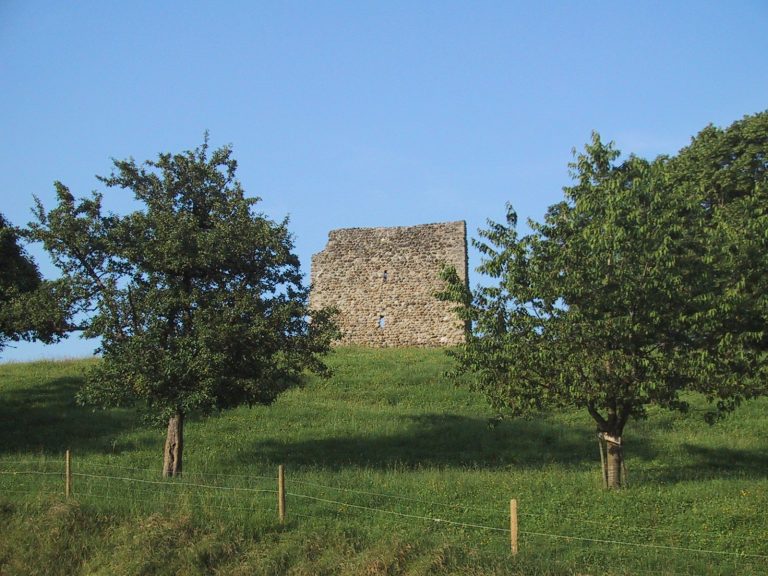
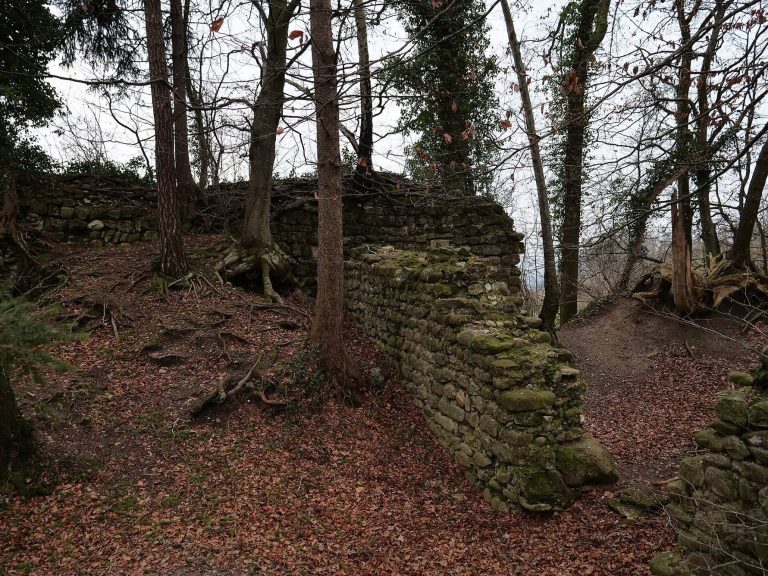
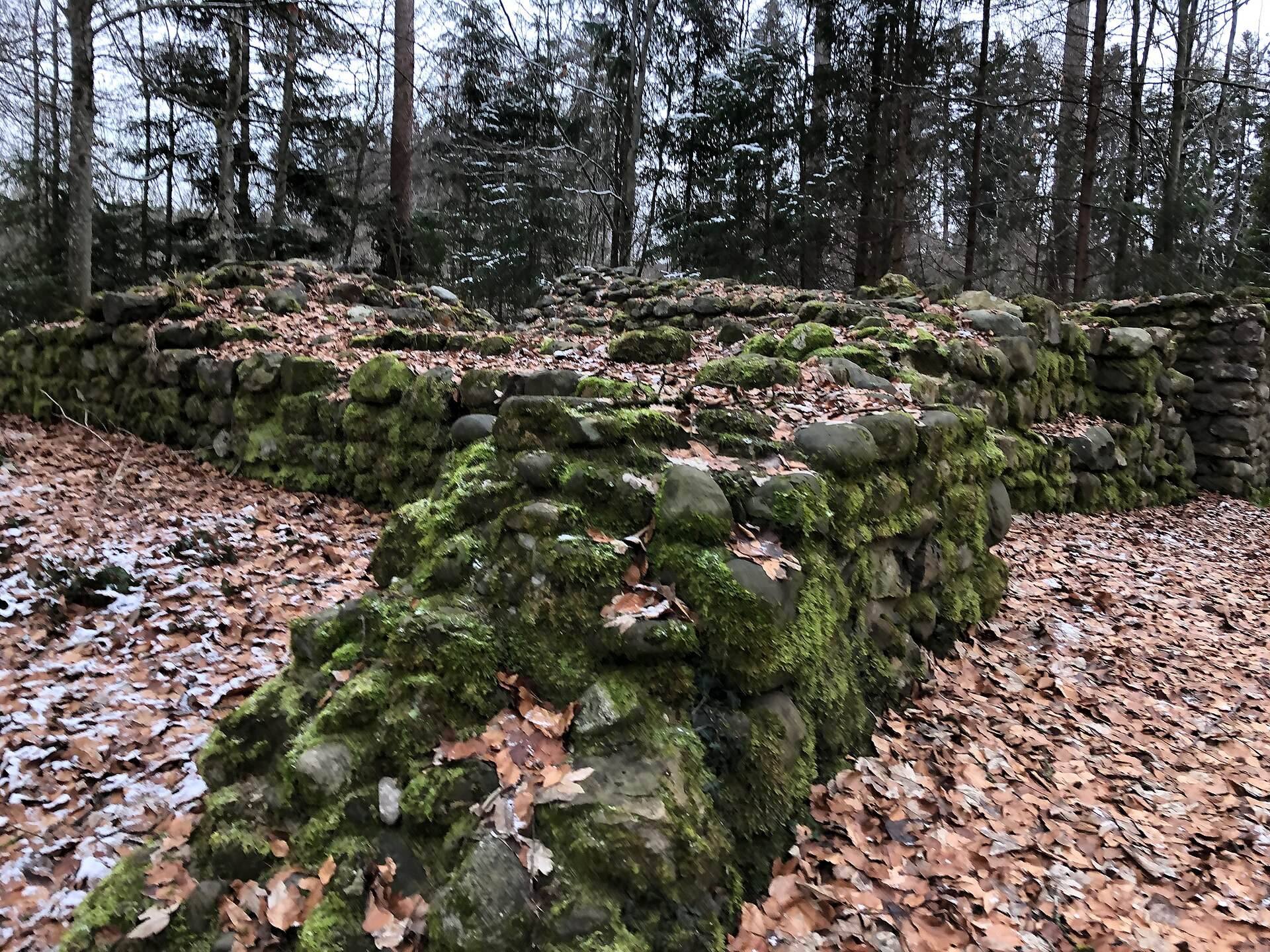
Burgruine Heitnau survives as a few wall remains from a larger defensive complex. The castle stood on a narrow tongue of land south of the Heitnau ravine and the Hartnauerbach, within the municipality of Braunau. The municipal boundary of Tobel begins a few metres to the west.
The tongue is formed between several small tributaries on the left bank of the Hartnauerbach. It measures about 62 metres across at the north and 50 metres at the south. The ground slopes gently downward from the northern edge of the Oberhausen plateau, while three sides fall steeply into a deep ravine. The eastern ravine is crossed by the Burgbach. At the northwestern foot of the castle tongue, a small channel descending through the western ravine joins the Burgbach.
The surviving masonry represents only part of the former defensive complex. Its present fragmentary condition results from the progressive removal of the castle’s stones for later construction, followed by the twentieth-century uncovering of the remaining archaeological evidence.