Vörbach Castle: A Medieval Ridge Castle in Germany


Site at a Glance
- Rating
- 3.2
- Popularity
- Very Low
- Country
- Germany
- Primary era
- Medieval
- External website
- Open
- Eras represented
- Medieval
- Civilizations
- Holy Roman Empire
- Site type
- Military
- Remains
- Castle
On this page8 sections
History
Vörbach Castle is a medieval ridge-top castle in Germany above the Waldach valley near Pfalzgrafenweiler. It was probably established in the twelfth century and is also known as Feherbach Castle. The castle was first mentioned in 1140 as property of the Counts Palatine of Tübingen, placing its early history within the medieval network of noble estates and fiefs.
Counts, fiefs, and changing ownership
In 1330, Albrecht and Diem of Steinhilben were identified as the first specifically named owners. Their father, Dietrich of Steinhilben, had probably received Vörbach as a fief, a property or right granted by a superior lord in return for service or allegiance, from the Count Palatine. Count Burkhard sold the castle to Count Palatine Ruprecht I of the Rhine in 1360. Ruprecht I belonged to the Palatinate ruling house and held the title of Count Palatine during the fourteenth century.
Count Otto I sold the complex to Counts Ludwig I and Ulrich of Württemberg in 1440. The fief was then assigned to the Lords of Emershofen until 1483, when they sold Vörbach for 1,800 gulden to the Lords of Ehingen. In 1485, Count Eberhard im Bart enfeoffed Jörg of Ehingen with the castle. Eberhard later became the first Duke of Württemberg.
From noble estate to reused stone
Rudolf of Ehingen sold Vörbach, together with other property, to Hans of Neuneck of Glatt in 1498. In 1625, Wildhans of Neuneck sold the Vörbach estate to the Duke of Württemberg for 70,000 gulden. A description from that year shows that the complex still included several service and residential buildings.
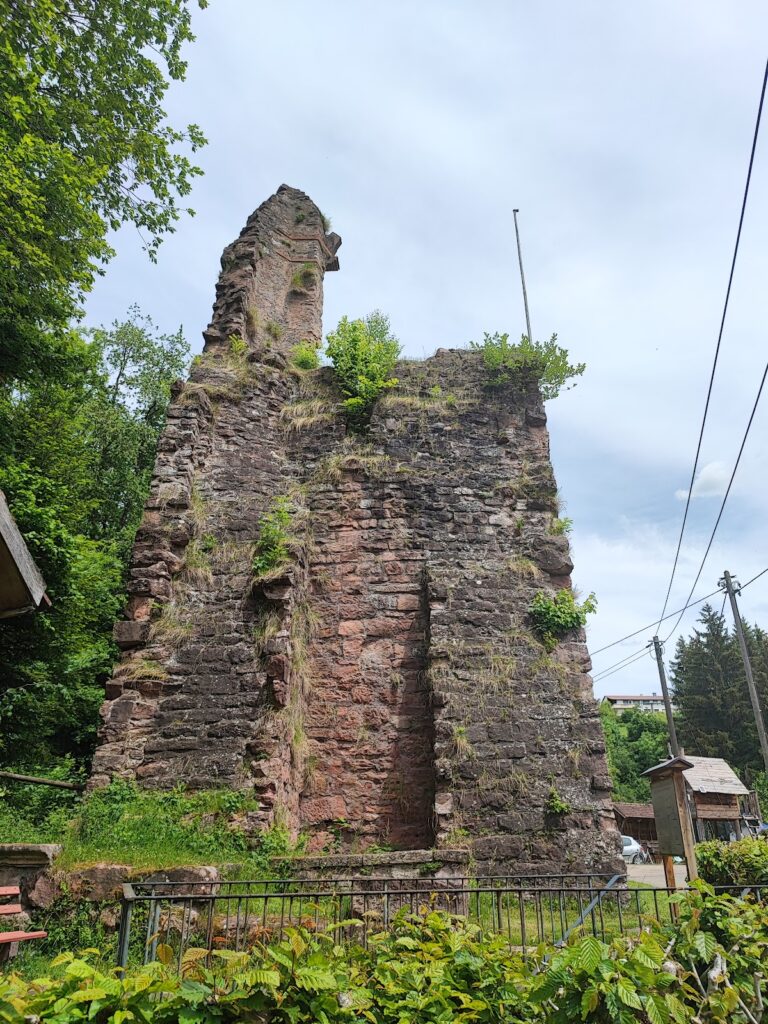
After a major fire destroyed much of Pfalzgrafenweiler on 24 April 1798, stone from Vörbach Castle was reused in rebuilding the village. In 1906, the Black Forest Association constructed the Nördlinger Hut on a surviving stump of a tower in the outer wall. Named for a founding member, the building was renovated in 1990 and serves as the clubhouse of the Pfalzgrafenweiler association.
Remains
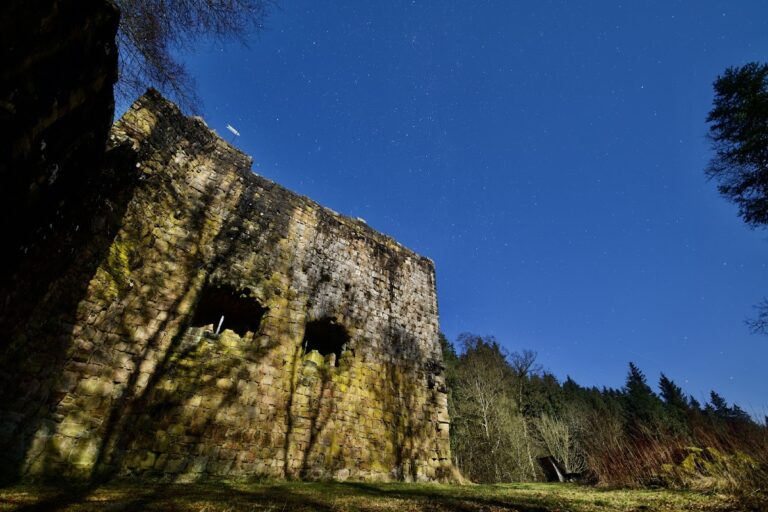
Vörbach Castle occupies a high ridge above the Waldach valley. A curved ditch cuts the castle site off from the mountain spur. The surviving masonry belongs to the keep, the shield wall, a particularly strong defensive wall protecting the most exposed side, and a flanking tower, which projected from the wall to aid sideward defence. A 1584 forestry map depicts a much larger complex with numerous ancillary buildings.
Fortifications
Keep
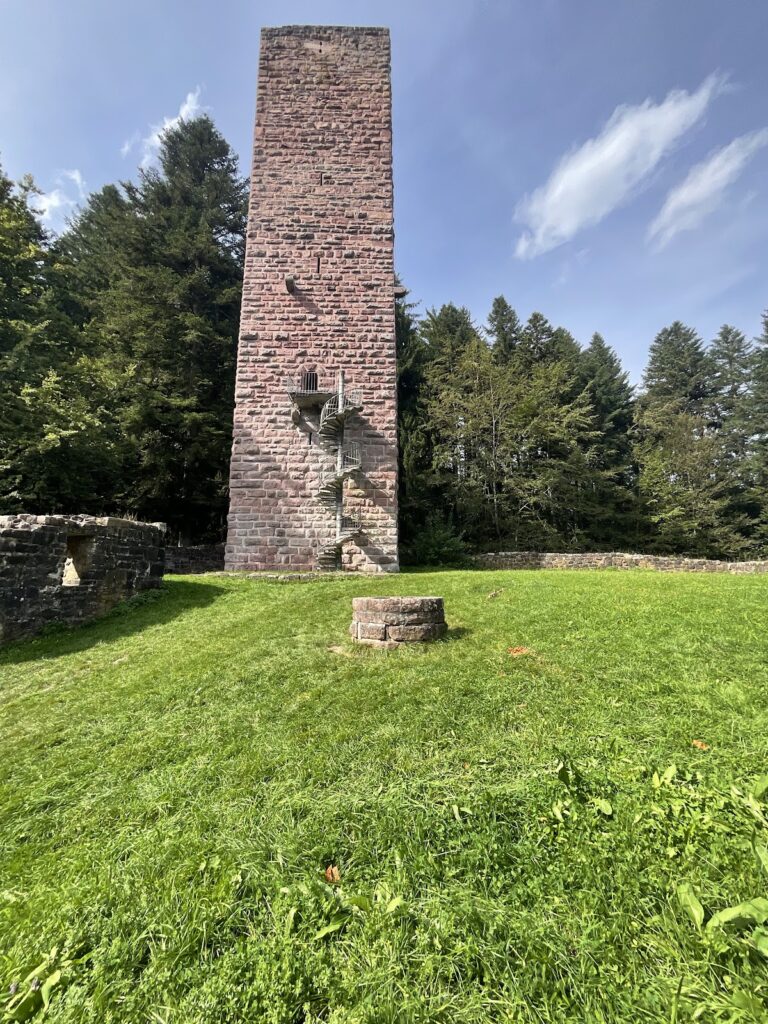
The foundation walls of the square keep lie on a hill within the castle site. Its masonry uses bossage ashlar, large carefully laid stone blocks with projecting or rough outer faces. This construction detail suggests a late Staufian date, referring to the period associated with the medieval Hohenstaufen dynasty in the twelfth and thirteenth centuries. The keep’s original height is unknown, although it has been estimated at about 30 metres.
Shield wall and flanking tower
Masonry from the shield wall and a flanking tower also survives. Together with the ditch and keep foundations, these remains define the defensive core of the ridge castle. The outer wall retains the tower stump on which the Nördlinger Hut was built in 1906.
Castle buildings and estate structures
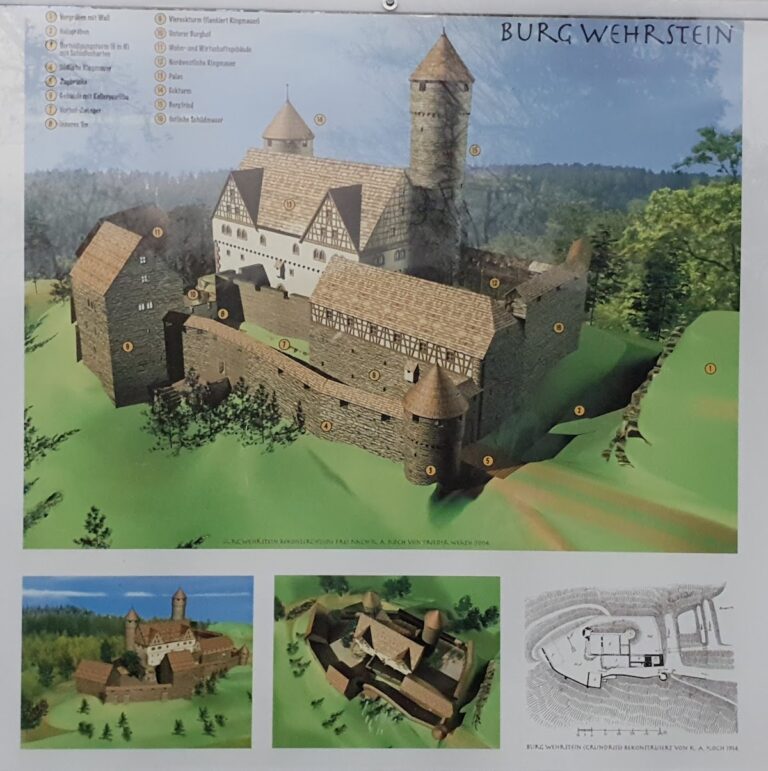
The 1625 description lists a summer house, a gatekeeper’s house, cattle and horse stables, and a well within the castle complex. Two cattle-stable buildings and a sheep barn stood outside the castle. The surviving evidence therefore represents part of a larger fortified estate whose buildings served both residential and agricultural functions.
Nearby sites