Royal Castle of Cogne: A Medieval Tower-House and Royal Hunting Lodge

Site at a Glance
- Rating
- 4.6
- Popularity
- Low
- Country
- Italy
- Primary era
- Medieval
- External website
- Open
- Eras represented
- Medieval
- Civilizations
- Holy Roman Empire
- Site type
- Domestic
- Remains
- Castle
On this page5 sections
History
The Royal Castle of Cogne is a medieval castle in Cogne, Italy, authorized in 1191 by Thomas I, Count of Savoy, Aosta, and Maurienne. Its construction was ordered for the Bishop of Aosta, who held both spiritual and temporal authority in Cogne, and it was probably completed around 1202, when the parish church was inaugurated. The castle’s first certain documentary reference dates from 1245, when a charter mentioned the “tower of the bishop’s house.”
Episcopal administration
During the Middle Ages, the bishop’s castellan administered the County of Cogne from the castle and lived in its tower. The building later accommodated a garrison. In the fifteenth century, it became a center for local political administration and hosted general hearings, extending its role beyond military defense and episcopal residence.
Restoration and royal ownership
After a long period of abandonment and deterioration, restoration began in 1844 under the parish priest Pierre-Balthazard Chamonin. The parish of Cogne had obtained the property in place of André Jourdain, Bishop of Aosta. The Siccardi Laws of 1850, nineteenth-century Italian measures that ended several legal privileges of the Catholic Church, contributed to the transfer of church property. The parish was expropriated from the castle in 1867.
The castle was auctioned in 1873 and bought by a royal representative. Victor Emmanuel II, the first king of unified Italy, converted it into a hunting lodge that provided access to the royal hunting reserve. The reserve’s territory later formed the basis of Gran Paradiso National Park, a protected Alpine area in northwestern Italy. Victor Emmanuel III, his son and successor as king of Italy, later stopped using the lodge because he was less interested in Alpine ibex. In 1915, the castle passed into private ownership.
Later uses
In the modern period, the former castle served first as a hotel and later as a summer camp operated by the Sisters of Saint Joseph. It is now privately owned and divided into apartments. The former royal residence is recognized as an Italian national monument, a status recorded on a stone plaque on the facade.
Remains
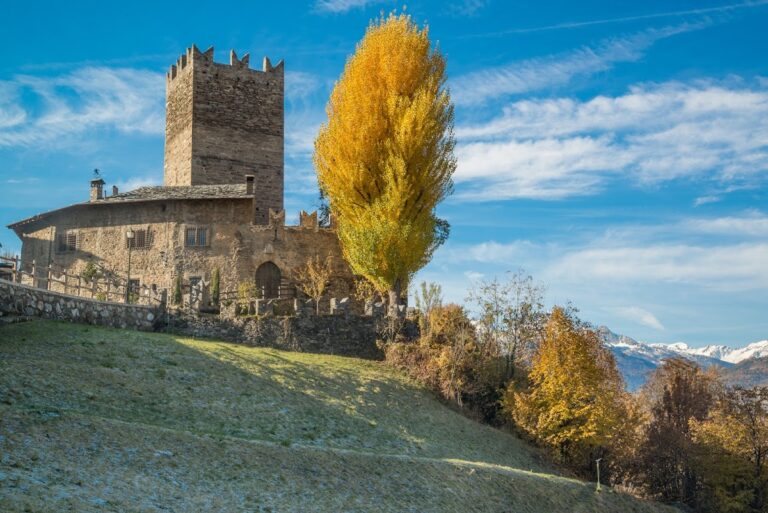
The castle stands in the center of Cogne beside the Church of Sant’Orso, at an elevation of approximately 1,524 meters. Altered several times over the centuries, it is a bulky, five-story building with a quadrangular or rectangular plan that reflects its origin as a medieval tower-house. The structure is built of rubble stone and covered with plaster. Restoration has preserved the building, which is occupied by apartments today.