Castle of Boutavent: A Medieval Fortified Site in Brittany


Site at a Glance
- Rating
- 4.2
- Popularity
- Low
- Country
- France
- Primary era
- Medieval
- External website
- Open
- Eras represented
- Medieval
- Civilizations
- Duchy of Brittany
- Site type
- Military
- Remains
- Castle
On this page8 sections
History
Origins and Early Tradition
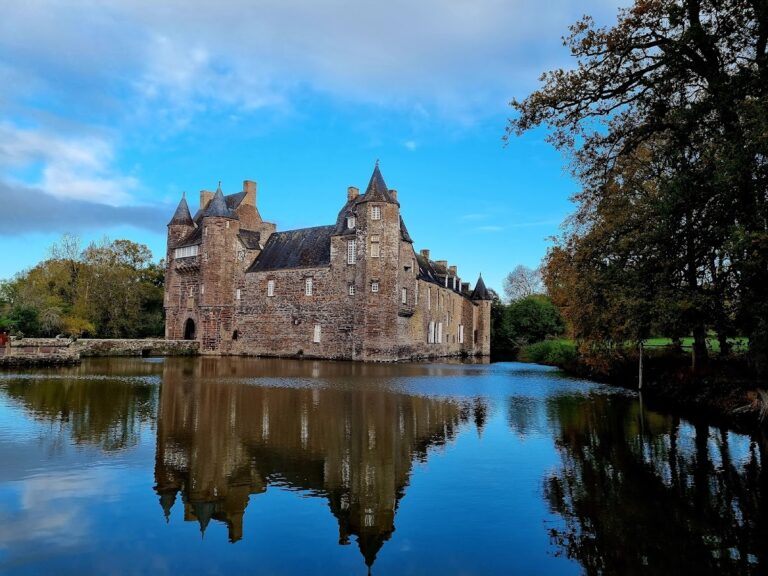
Castle of Boutavent is a medieval fortified site in France, located at Iffendic in Brittany. Its construction may have begun around the eleventh century, although the exact date remains uncertain. Local tradition places a seventh-century residence or occupation at the site and associates it with Judicaël, a ruler traditionally linked with Domnonée, a Breton kingdom in the region.
Tradition also connects Boutavent with a meeting between Judicaël and Saint Éloi, a seventh-century bishop and diplomat remembered for mediating political and territorial disputes. According to this account, Saint Éloi came to settle a border conflict between Bretons and the French. This association remains legendary rather than established history. The place-name appears as aula Boutavent in 1213 and as Boutavent in 1427.
The Montfort Possessions
During the thirteenth and fourteenth centuries, Boutavent belonged to the Lords of Montfort, a Breton noble family connected with the lordship of Montfort. The castle formed part of their possessions alongside Comper, Montfort, Montauban, and Gaël. Its position within this group reflects its place in the territorial network controlled by the Montfort family.
Destruction and Later Study
By the sixteenth century, the castle stood in ruins. The circumstances of its destruction are uncertain. It may have been dismantled during the War of the Breton Succession, a fourteenth-century dynastic conflict over the Breton succession, or during Bertrand du Guesclin’s campaign in Brittany in 1373. Later occupation also remains possible.
Nineteenth-century writers including Poignand, Vigoland, and Oresve discussed Boutavent, but the site’s complete history is difficult to reconstruct because reliable documentation is limited. Since 2006, successive consolidation campaigns have helped preserve the ruins. A preliminary archaeological investigation carried out in September and October 2015 by CERAPAR, an archaeological research centre based in the Rennes region, preceded restoration work in 2016 and revealed parts of the entrance fortifications.
Remains
Layout and Enclosure
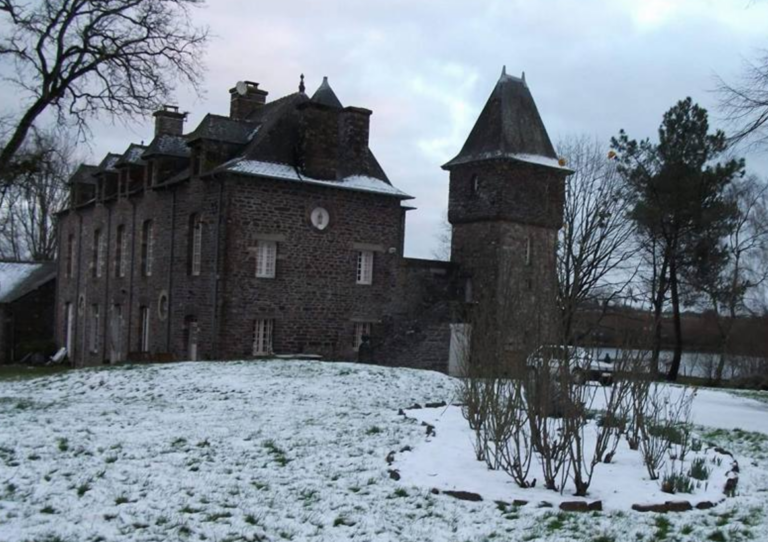
The castle occupies a natural rocky spur at Boutavent, within an area of more than two hectares surrounded by the Paimpont Forest and near the Boutavent pond. Its fortification was arranged around an upper courtyard, the more defensible inner part of the castle, and a lower courtyard, an outer enclosed area. A deep ditch separated the two spaces. Several buildings stood mainly against the curtain walls, the principal enclosing defensive walls, and their positions can be traced through changes in the ground surface.
The curtain wall and parts of the lower-courtyard enclosure remain clearly visible. Other surviving elements include foundation remains, internal dividing walls, and a loophole, a narrow opening through which defenders could observe or use weapons.
Entrance Defenses
The 2015 investigation uncovered the entrance gatehouse and a flanking tower, which projected from the defensive wall to observe and attack areas beside it. Three splayed openings and a possible postern, or small secondary entrance, were identified in the northeastern curtain wall. These features reveal the arrangement of the castle’s approach defenses.
Archaeological Material
Material recovered during consolidation and investigation includes slate, ceramics, floor paving, and glazed tiles. Together with the foundations, wall divisions, and defensive openings, these remains provide physical evidence for the castle’s buildings and internal organization.
Nearby sites