Charvensod Castle: A Medieval Episcopal Residence in Italy
Site at a Glance
- Rating
- 5
- Popularity
- Very Low
- Country
- Italy
- Primary era
- Medieval
- Eras represented
- Medieval
- Civilizations
- Holy Roman Empire
- Site type
- Domestic
- Remains
- House
On this page9 sections
History
Charvensod Castle is a medieval episcopal castle in Charvensod, Italy, in the Aosta Valley. Its exact construction date is unknown, but its surviving original corner tower dates from the fourteenth century. The castle first appears in a document of 1305 as in domo episcopali apud Chalvenzo, meaning “in the bishop’s house at Charvensod.”
Episcopal residence
Also known as the Bishop’s Castle, it served during the medieval period as a summer residence and retreat for several bishops of Aosta. The bishops owned forests, pastures, alpine meadows, and cultivated land in the surrounding area, and used the castle as a place for rest and meditation. Arduce de Pont-Saint-Martin, bishop of Aosta, stayed there in 1324, 1326, and 1327. On 6 March 1327, the day before his death, he made a testamentary provision concerning the castle. Bishop Éméric was there in 1368, while Bishop Jean-Geoffroy Gignod stayed at the residence in 1590.
Later ecclesiastical and secular use
During the plague epidemic of 1630–1631, which devastated the Aosta Valley and wider Europe, the castle housed the Council of the Commissioners, a local governing body responsible for major administrative decisions. The council met there while making important decisions during the crisis. In the eighteenth century, Bishop François-Amédée Milliet d’Arvillars, ordained between 1718 and 1720, embellished the building.
During the mid-nineteenth-century conflicts between Protestant and Catholic Swiss cantons, the bishop designated the castle as a refuge for Fillier, provost of the Congregation of the Great Saint Bernard. A provost was a senior ecclesiastical officer, while the Great Saint Bernard refers both to an Alpine pass and to its associated religious community. Fillier was probably the last ecclesiastic to live at Charvensod Castle.
Conversion into a dwelling
In 1868, the newly established Italian state expropriated ecclesiastical property. Local families then purchased the castle and adapted it for agricultural use. The structure was remodeled and plastered in 1971, completing its conversion into a dwelling. It is now privately owned, and these changes have greatly altered the surviving medieval fabric.
Remains
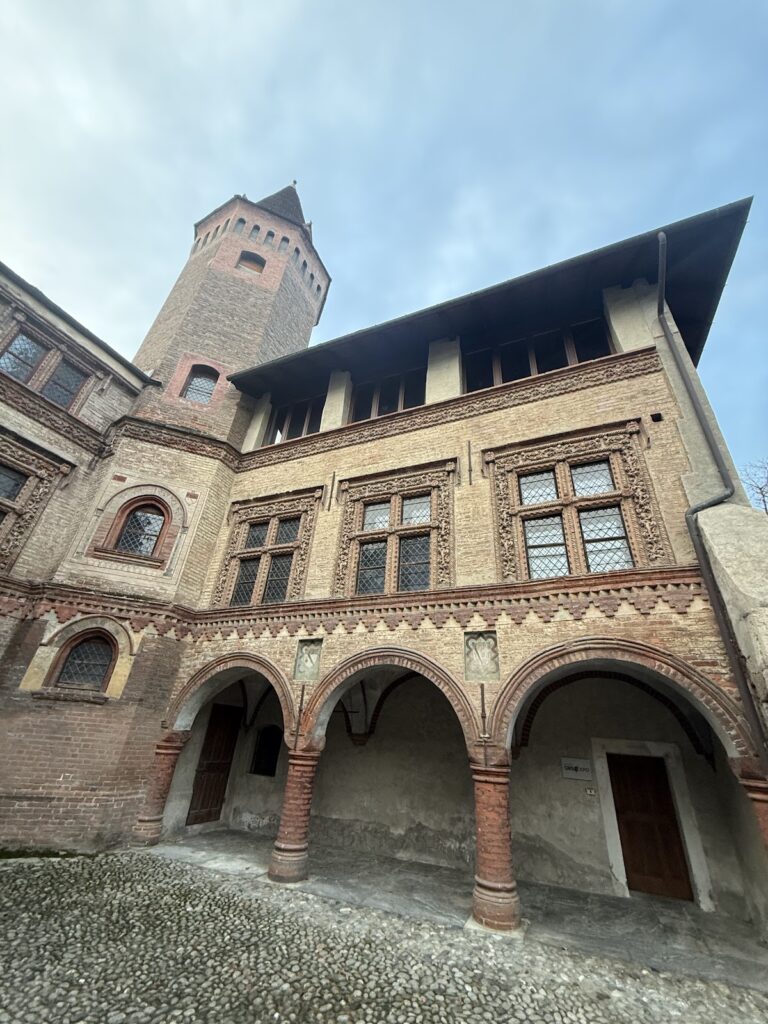
Charvensod Castle was a lowland fortification built of rubble stone. Extensive alterations have reduced the visible medieval structure to a small portion incorporated into the present residential building. A section of the former enclosing wall survives, while plastering associated with the 1971 conversion covers much of the current exterior.
Surviving medieval fabric
Northwestern corner tower
The principal original feature is the small circular corner tower in the northwest, which dates to the fourteenth century. Its survival preserves evidence of the castle’s former defensive function. Together with the remaining section of enclosing wall, it indicates the fortified character of the earlier residence, although much of the original construction has been lost or absorbed into the dwelling.
Associated military remnant
La Tornettaz
La Tornettaz is a separate medieval military remnant between Charvensod’s main settlement and Pont-Suaz. It formed part of a network of signal towers that maintained visual contact with several castles, including Charvensod Castle. Its connection with the castle therefore belongs to the wider defensive communications system of the medieval landscape, rather than to the castle’s surviving residential structure.