Royal Abbey of Montmartre: A Benedictine Nunnery in Paris
Site at a Glance
- Rating
- 4.6
- Popularity
- Medium
- Country
- France
- Primary era
- Medieval
- External website
- Open
- Eras represented
- Medieval
- Civilizations
- French
- Site type
- Religious
- Remains
- Monastery
On this page17 sections
History
The Royal Abbey of Montmartre was a Roman Catholic Benedictine nunnery in Paris, France, founded by King Louis VI in 1133–1134 at the request of his wife, Adelaide of Savoy. It replaced a Cluniac priory, a religious house belonging to the network associated with the Abbey of Cluny, and established a church and monastery on the summit of Montmartre. The foundation became an important religious and landed institution, with an estate, judicial powers, dependent properties, and a long association with the church of Saint-Pierre de Montmartre.
Foundation and royal patronage
A hamlet had grown around a chapel on Montmartre by the seventh century. The chapel’s worm-damaged beams were replaced in 835. In 1096, the monks of Saint-Martin-des-Champs received both the summit chapel and a smaller chapel midway down the hill, the latter associated with the presumed martyrdom of Saint Denis, an early Christian martyr traditionally linked with Paris.
Louis VI exchanged the Montmartre possessions of Saint-Martin-des-Champs for the church of Saint-Denis-de-la-Chartre before founding the new monastery. Benedictine nuns from the recently established Abbey of Saint-Pierre-les-Dames at Reims formed the community. Pope Innocent II confirmed its rule and possessions in October 1136. On 11 April 1147, Pope Eugenius III consecrated the church of Saint-Pierre de Montmartre in a ceremony attended by Bernard of Clairvaux, Peter the Venerable, and numerous prelates and dignitaries.
Adelaide of Savoy retired to the abbey after Louis VI died. She died there on 18 November 1154 and was buried before the high altar of Saint-Pierre. At its foundation, the monastery received Saint-Pierre church, the surrounding agricultural land, a hamlet, early Christian remains, an ancient mid-slope necropolis, and the chapel linked with the martyrdom of Saint Denis. Its gardens, vineyards, and other lands formed an estate of about 13 hectares.
The abbey as a landed and judicial lordship
The community was led by an abbess known as the “Lady of the Place” and included about 55 nuns, among them lay sisters. In 1175, Louis VII limited the community to 60 nuns because so many young women sought admission. The abbey’s annual income reached 30,000 livres, and the abbess exercised high, middle, and low justice, meaning judicial authority over serious, intermediate, and minor cases.
Until Louis XIV abolished Paris’s particular jurisdictions in 1674, the abbess maintained judicial officers, an audience hall, and a prison. After that change, her jurisdiction was restricted to the abbey’s enclosure. The community also possessed property in Paris and several surrounding lordships. Louis VI granted Bourg-la-Reine in October 1132, and the abbey retained it until the Revolution apart from its transfer to the Duke of Maine between 1710 and 1736. Its other holdings included Barbery, whose high justice the Parlement of Paris confirmed in 1272, vineyards at Bagneux and Sèvres, and interests in Bercy.
In 1460, the nuns transferred their rights in Bercy-sur-Seine and the Grange aux Merciers to Jean Bureau, treasurer of France. The proceeds helped rebuild a church bell tower. The abbey also held the Fort-aux-Dames fief in Paris, including four houses and a prison, together with houses, marketplaces, rents, and other urban properties. The parish of Montmartre extended far beyond the hill, reaching toward Saint-Lazare and Notre-Dame-de-Lorette to the south, Faubourg-Poissonnière and Clignancourt to the east, Carpeaux and Blanche to the west, and Custine, Francoeur, and Marcadet to the north. From 1669, it also included the lordship of Clignancourt.
Religious prominence and seventeenth-century reform
On 15 August 1534, Ignatius of Loyola and his companions Pierre Favre, Francis Xavier, Alfonso Salmerón, Diego Laínez, Nicolás Bobadilla, and Simão Rodrigues took vows of poverty and chastity in the Martyrs’ Chapel. They also promised to travel to Jerusalem and to serve Christians and non-Christians through preaching, confession, and the Eucharist without payment. They adopted the name Society of Jesus in 1537, and Pope Paul III approved the order in 1540.
A major fire in 1559 led to the rebuilding of most of the upper abbey. During the siege of Paris in 1590, King Henry IV established his headquarters there. The community then experienced serious disciplinary decline, reflected in a derogatory contemporary nickname and in the possibly intimate relationship between Henry IV and Abbess Claude de Beauvilliers. Claude’s sister, Marie de Beauvilliers, became abbess in 1598 and restored order.
In 1611, work at the Martyrs’ Chapel revealed a staircase leading to a vaulted crypt with engraved inscriptions. The place was identified as the site of Saint Denis’s martyrdom and became an important pilgrimage destination. In 1622, Marie de Beauvilliers used donations associated with the pilgrimage to turn the chapel into a priory, a religious house governed by a prioress rather than an abbess, initially housing ten nuns. The abbey also sent nuns to help direct the new Notre-Dame-de-la-Victoire monastery at Saint-Malo in 1621.
The abbey was regarded as dedicated to the Virgin Mary. Abbess Françoise-Renée de Lorraine introduced a feast of the Sacred Heart of the Virgin, celebrated on 8 February and described by Jean Eudes, a seventeenth-century French priest and religious writer, in 1681. A legal dispute involving the abbess and several nuns with the archbishop of Paris took place in 1629–1630.
Relocation and revolutionary dissolution
In 1686, the entire community moved from the summit to new buildings around the former priory at the foot of the hill. The upper abbey’s cloister was demolished, and its deteriorating buildings were used to store grain and fodder. The nuns continued to worship in the choir and first three bays of Saint-Pierre, known as the Chœur des Dames, while the remainder of the church served the parish.
The abbey closed in 1790. Its upper and lower buildings, connecting gallery, gardens, quarries, and agricultural lands were sold in ten lots in May 1794. The lower abbey was demolished to allow the excavation of a gypsum quarry. After the quarry was filled, streets and houses were laid out, including the Place des Abbesses, Rue Antoinette, now Rue Yvonne-Le-Tac, and part of Rue des Martyrs. The connecting gallery was also destroyed.
Saint-Pierre de Montmartre had remained a parish church and was excluded from the 1794 sale, making it the principal surviving architectural remnant of the abbey. The final abbess, Marie-Louise de Montmorency-Laval, had led the community from 1760. Expelled with the other nuns on 19 August 1792, she was condemned during the Reign of Terror, the period of revolutionary repression in France from 1793 to 1794, for alleged contacts with conspirators across the Rhine. She was guillotined on 26 July 1794.
The abbey’s former identity remains present in the names of the Place des Abbesses, its Metro station, and several nearby streets, which commemorate the 46 abbesses. Its 1623 bell was acquired by the Société du Vieux Montmartre in 2007 and placed in the choir of Saint-Pierre de Montmartre. A surviving vineyard is another remnant associated with the former complex.
Remains
The upper abbey and Saint-Pierre
Upper abbey enclosure
The upper abbey stood east, south, and southwest of Saint-Pierre de Montmartre and occupied about 13 hectares. Its enclosure covered areas now associated with Square Nadar, the reservoir, Rue Azaïs, and the southern part of Rue Saint-Éleuthère, formerly Rue de l’Abreuvoir. The community sold part of this land in 1635, and the Place du Tertre and part of Rue du Mont-Cenis were later formed there.
Conventual buildings
The entrance to the upper abbey lay on the forecourt of Saint-Pierre. After the fire of 1559, the conventual buildings surrounded a cloister. Its northern side ran beside the church as far as the choir, while the chapter house occupied the east side perpendicular to the church. The refectory stood on the south side, and dormitories and cells filled the upper floor. A ground-floor door joined the cloister to the church choir, and an upper-floor door connected the dormitories with galleries in the nave reserved for the nuns. A courtyard perpendicular to the church contained servants’ lodgings, stables, and other service buildings.
Saint-Pierre de Montmartre
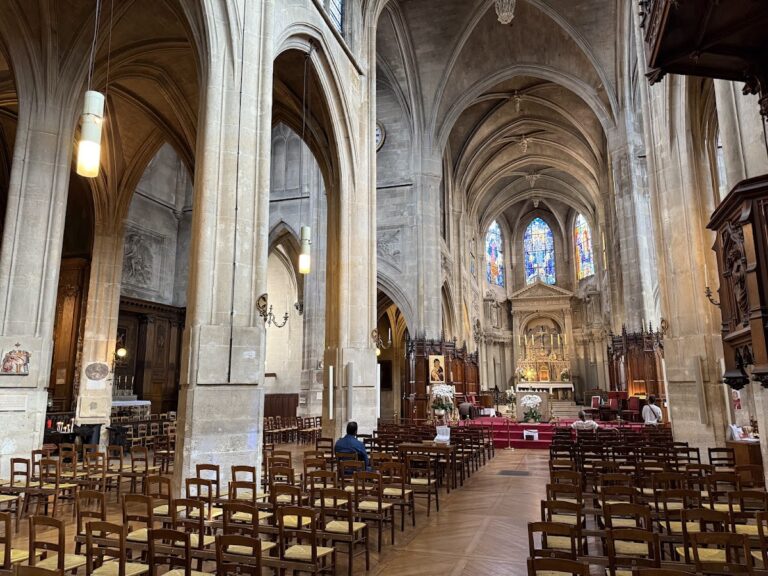
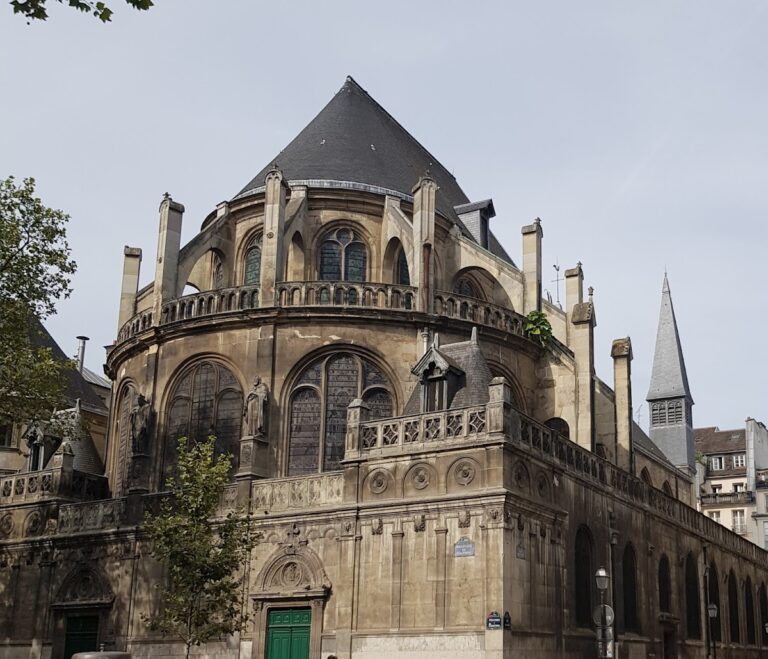
After the relocation of 1686, the nuns retained the choir and first three nave bays of Saint-Pierre, the area called the Chœur des Dames. The church also preserved an apse and two smaller apses at its eastern end, which were used for ceremonies and for the burial of abbesses. Saint-Pierre de Montmartre survived the revolutionary sale because it continued to function as a parish church and remains the principal architectural survivor of the abbey.
Martyrs’ Chapel and lower abbey
Martyrs’ Chapel
The Martyrs’ Chapel was rebuilt in 1134 and stood approximately where Rue des Martyrs meets Rue Yvonne-Le-Tac. Beneath it lay a vaulted burial chamber reached by a staircase of 60 steps. The chamber later became inaccessible after a collapse. In 1611, the discovery of the staircase, crypt, and engraved inscriptions led to the identification of the place with Saint Denis’s martyrdom. The chapel’s pilgrimage role prompted its conversion into a priory in 1622.
Lower abbey
The lower abbey was built around the former priory near the present Place des Abbesses. Its entrance lay east of the modern square, with another approach from Rue des Martyrs and a path beside the monastery wall. The abbey church stood near the junction of Rue Yvonne-Le-Tac and Rue des Martyrs. Conventual buildings lay north of it near Rue des Martyrs and Rue La Vieuville, while gardens extended eastward toward the present Marché Saint-Pierre.
The lower abbey included a domed chapel where relics, including a fragment attributed to Christ’s robe and bones attributed to several saints, were displayed for veneration. Its cloister extended toward the summit of the hill. A covered gallery about 400 metres long connected the lower priory with the upper abbey, following approximately the line of present-day Rue Drevet. The gallery remained after the 1686 move but was destroyed during the demolition of 1794.
Judicial, funerary, and surviving material features
Prison and audience hall
The abbey prison stood in Rue de la Heaumerie and the adjoining cul-de-sac known as For-aux-Dames. The complex also contained the nuns’ audience hall. These spaces reflected the abbess’s former judicial authority over the abbey’s lordship and its dependent properties.
Burial areas
Abbesses and nuns were buried in both the upper and lower abbeys. Burial places included areas beneath the choir pavement, the church, the garden, and the crypt beneath the apse. Earlier burials were sometimes disturbed to make room, with bones moved to the church loft or beneath the roofs of the side aisles. Adelaide of Savoy, Mahaut du Fresnoy, Antoinette Auger, Catherine de La Rochefoucauld de Cousage, Marguerite de Mincy, and Marie de Beauvilliers are among those associated with burials in the upper abbey and Saint-Pierre.
Bell and vineyard
Marie de Beauvilliers commissioned the abbey’s 1623 bell, which hung above the lower abbey’s Martyrs’ Chapel. It was lost when the chapel was demolished and the site was quarried, then recovered after the chapel was recreated in 1880. The bell is now in the choir of Saint-Pierre de Montmartre. The former complex also survives materially through a vineyard and through the surviving parish church, which preserves the clearest architectural connection with the Royal Abbey of Montmartre.
Nearby sites