Royal Abbey of Chelles: A Frankish Monastery for Women
Site at a Glance
- Popularity
- High
- Country
- France
- Primary era
- Medieval
- Eras represented
- Medieval, Early Modern
- Civilizations
- French, Merovingian
- Site type
- Religious
- Remains
- Fortified Monastery
On this page19 sections
History
The Royal Abbey of Chelles was a Catholic royal monastery for women founded in the mid-seventh century at Chelles, France, under the Frankish queen Balthild. It developed from a Merovingian royal estate into a religious community closely connected with Frankish rulers and their families.
Royal villa and foundation
Before the abbey existed, the site held a royal villa of the Merovingians, an early medieval Frankish dynasty. In the early sixth century, Queen Clotilde established an oratory, or small chapel for prayer, dedicated to Saint George. King Chilperic I and his wife Fredegund often stayed at the villa. Chilperic was killed there while hunting in 584.
In the mid-seventh century, Balthild, wife of King Clovis II, enlarged Clotilde’s oratory and founded a church dedicated to the Holy Cross. She entrusted the organization of the new community to Genesius, bishop of Lyon. At his request, Théodechilde, abbess of Notre-Dame de Jouarre, sent nuns to Chelles to introduce the Columbanian rule, a monastic code associated with the Irish monk Columbanus. Balthild named Bertilla the first abbess. The community later adopted the Benedictine rule, a monastic code associated with Benedict of Nursia, at an unknown date.
Balthild retired to Chelles around 664 and died there in 680 or 681. The abbey drew daughters of Frankish and foreign noble families, and its nuns helped establish religious houses as far away as England. Mildthryth, also known as Mildred, Mildburh, also called Milburga, and Mildgyth, also called Mildgytha, were associated with monasticism influenced by Chelles. Hereswith, a Northumbrian princess, was among the foreign royal women connected with the community. By the end of the seventh century, a men’s community had joined the nuns, creating a double monastery, with separate communities of women and men.
Chelles also became a place where members of the royal family were confined. In 715, Theuderic IV was held at the abbey after the death of his father, King Dagobert III. Six years later, Charles Martel removed him and placed him on the Frankish throne. In 753, Swanachilde of Bavaria, Charles Martel’s second wife, was confined at Chelles after his death and the defeat of her son Grifo’s revolt against his half-brothers Carloman and Pippin.
Carolingian abbey and royal politics
In the late eighth and early ninth centuries, Charlemagne’s sister Gisela governed Chelles. With her brother’s approval, she enlarged the abbey and developed it as a center for copying, preserving, and restoring manuscripts. Rulers and aristocrats also met there. Gisela sent Alcuin, an English scholar and cleric at Charlemagne’s court, news of the king’s coronation and requested biblical commentary for the community. She may have written the Annales Mettenses priores, which recount Charlemagne’s visit to Chelles in 804.
During the reign of Louis the Pious, a cult of Saint Balthild took shape, with observances on January 30 and March 17. In 855, Charles the Bald gave his wife Ermentrude the title of commendatory abbess, a position that conveyed the title and associated benefits without necessarily involving day-to-day direction of the monastery. The title later passed to their daughter Rothild. Rothild eventually lived at Chelles, possibly to escape recurring Norse raids, and may have carried out the abbess’s duties in practice.
Around 922, Charles the Simple tried to transfer the abbey from Rothild to his favorite, Hagano. The attempt provoked a revolt among the nobility that led to Charles’s deposition in 923, probably under the leadership of Rothild’s son-in-law Hugh the Great. In 1008, King Robert II held a council at Chelles attended by bishops from Sens, Tours, Orléans, Troyes, Châlons, and Tarbes. A papal decree issued during Innocent III’s pontificate, from 1198 to 1216, placed the abbey in a direct relationship with the Holy See, the pope’s central governing authority, while Chelles retained ties to the French royal family.
Wars and famine brought serious financial strain in the twelfth century. Donations and the dowries of noble novices helped the community recover. In 1185, Abbess Marie I of Duny presided, with Maurice de Sully, bishop of Paris, present, over the ceremonial transfer of Saint Bertilla’s remains from a crypt beneath the priory church to the new church, where they were placed beside Saint Balthild’s relics.
Medieval rebuilding and conflict
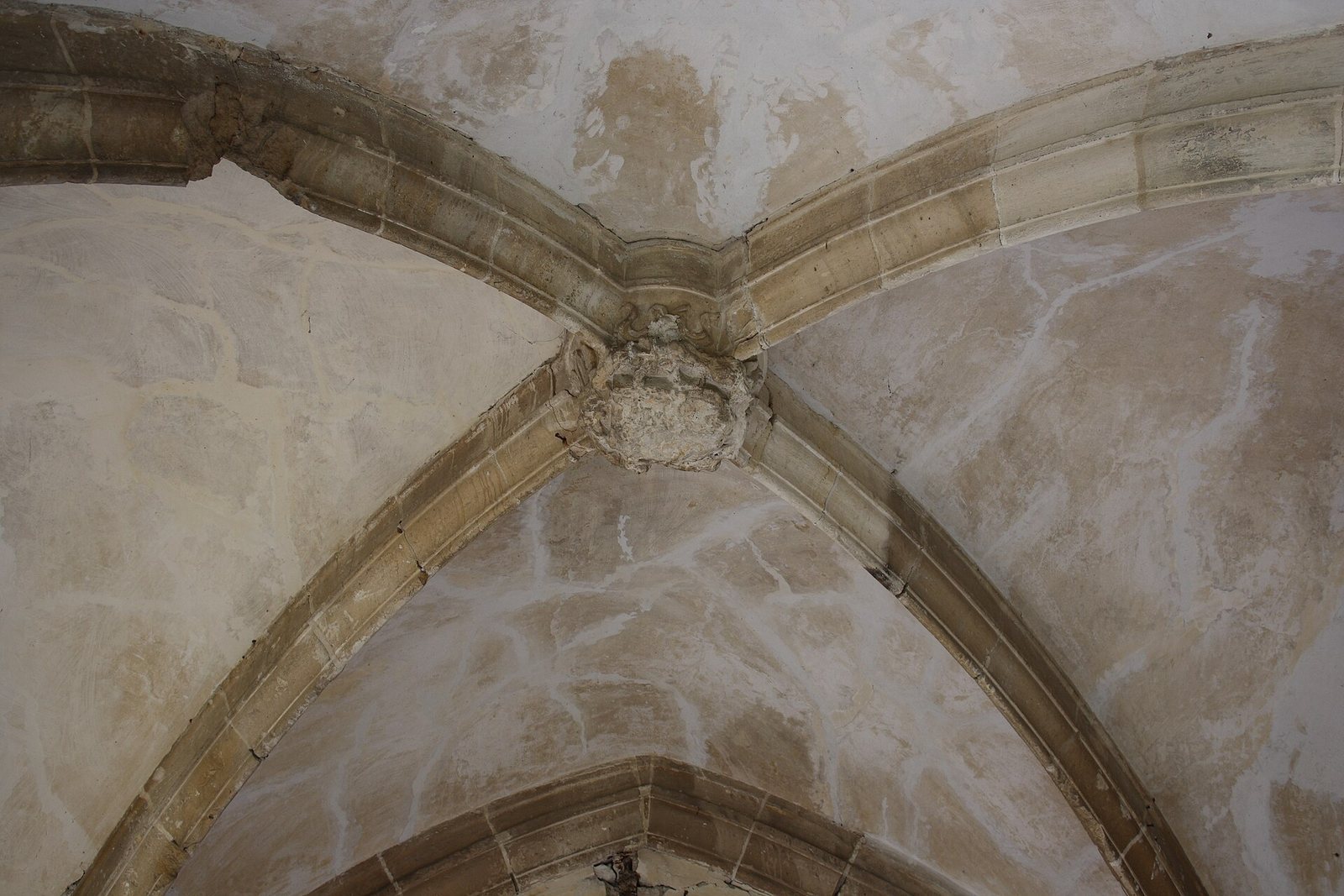
A fire in 1226 destroyed much of the abbey and temporarily scattered its community. Major French abbeys and the bishop of Paris organized a nationwide collection, which included a pilgrimage carrying the founder’s relics. The money supported the rebuilding of the church in the Gothic style, a medieval form commonly associated with pointed arches and ribbed vaults, along with new accommodation and service buildings. Gifts and privileges helped the abbey prosper again. In 1228, Matthew II of Montmorency, Constable of France, granted it additional support.
Under Abbess Matilda V of Nanteuil, whose tenure lasted from 1250 to 1274, Saint George’s parish church was entirely rebuilt. Its canons and other clergy thereafter depended wholly on the abbey. The Hundred Years’ War, the prolonged conflict between England and France, and the Black Death, a devastating plague pandemic that reached Europe in the fourteenth century, brought further hardship. In 1350, the community still had 80 nuns who had made their vows. Five years later, the abbey was assessed a levy of 1,600 livres tournois, a form of French currency, to finance the resumption of war. Royal commissioners collected it from the abbey’s lands and tenants, sharply reducing its income. Abbess Adeline II of Pacy obtained a sixteen-year schedule of annual payments of 100 livres from the Dauphin Charles, heir to the French throne, and later secured full tax exemption.
During the Jacquerie, a major French peasant revolt, the nuns fled to Paris in 1358 with relics and valuables. When the Dauphin camped at Chelles on June 22 to suppress the uprising, the abbey had been plundered, including by English forces. The community returned after the Treaty of Brétigny to buildings left in ruins. In 1369, raids by the Great Companies, mercenary bands who plundered when they lacked military employment, drove the nuns to Paris again, under the protection of Charles V. They returned after the bands found work in the Castilian war between Pedro I and Henry of Trastámara. The abbey was rebuilt, Saint Balthild’s tomb restored, and Queen Joanna of Bourbon visited.
During the early-fifteenth-century civil conflict between the Armagnac and Burgundian factions, the nuns repeatedly took refuge in Paris. They fled in 1405 as John of Burgundy’s forces advanced and again in 1411 when Armagnac forces and associated raiders threatened the area. After returning, Abbess Agnes II of Neuville sought help from Queen Isabeau of Bavaria, then at Melun with Louis of Orléans. The queen secured assistance for rebuilding and permission to fortify Chelles with walls, gates, and a moat. Agnes also established a yearly distribution of bread and wine to the poor on the day after Saint Balthild’s feast. The practice continued from 1402 until the abbey’s suppression in 1790.
Troop movements and plundering affected Chelles during the sieges of Paris by Charles VII’s forces in 1427, 1429, when Joan of Arc was present, and 1435. Late-fifteenth-century efforts to restore observance of the Benedictine rule culminated in a reform initiated in 1499–1500 by Bishop Jean-Simon de Champigny. Nuns from Fontevrault and other houses of the same order joined the community. From 1500, abbesses were elected for three-year terms, with re-election possible. Between 1500 and 1518, nuns from Chelles helped reform thirteen other abbeys. In 1517, Marie Cornu went to Faremoutiers with eleven nuns to introduce the Chelles rule. Jenne Joli led nuns sent to reform Notre-Dame de Jouarre and became its abbess by royal appointment. Chelles also assisted reforms at Malnoue, Gif, and Origny. In 1504, Bishop Étienne de Poncher approved the abbey’s definitive rule.
Royal appointments and early modern crises
Bishop Étienne de Poncher reconsecrated the abbey church between 1510 and 1512, after repeated alterations, enlargements, and repairs following its thirteenth-century rebuilding. Royal appointment gradually displaced election as the method for choosing abbesses. Renée of Bourbon was appointed in 1543, and by 1559 the king had formally ended the three-year election system under the 1516 Concordat of Bologna, an agreement between the French crown and the papacy that gave the king a role in church appointments.
On September 9, 1544, during the final phase of the war between France and the Empire, the nuns fled to Paris. They returned after the Treaty of Crépy, signed days later. They again sought refuge during the French Wars of Religion in 1562 and in 1589–1590. Troops damaged the infirmary, parlor, refectory, and church roof; King Henry IV assisted with repairs. During the plague of 1596, the abbey provided care and medical assistance by the standards of the time.
The Thirty Years’ War and the later Fronde, a series of rebellions in France during the mid-seventeenth century, brought further flights to Paris. The nuns found protection under Marshal Charles de La Porte, the abbess’s brother. In July 1651, Henrietta Maria, the exiled widow of Charles I of England, visited Chelles and attended the solemn profession, or formal taking of religious vows, of Marguerite de Cossé-Brissac, who later became abbess. Ambitious expansion and renovation work had recently begun.
The abbey reached its greatest prosperity in the seventeenth and eighteenth centuries, aided by the aristocratic connections of its abbesses and nuns. Abbess Louise Adélaïde d’Orléans, daughter of Philippe II, Duke of Orléans, led a comprehensive renovation of the church and service buildings during her tenure from 1719 to 1734. She was partly influenced by Jansenism, a Catholic theological movement. In 1719, composer Jean-Baptiste Morin became the abbey’s music master. Another music master, Pierre Ezéchiel Levasseur de Roche, was buried in the church in 1762.
Revolution and dissolution
The abbey’s long-serving abbess, Anne de Clermont, died in 1789. On July 5, Madeleine-Élisabeth-Delphine de Sabran received a royal appointment as abbess. Local residents rallied to protect the abbey, and National Guard units were organized. A decree of November 2, 1789, required the sale of church and monastic property; a law of February 13, 1790, suppressed religious orders. An inventory made on February 25 listed 4,673 arpents of land, using a historic French measure whose size varied by locality, and annual income exceeding 140,000 livres, against debts of 238,000 livres. The community consisted of 33 nuns, including the abbess, and 23 lay sisters, who generally undertook practical or household duties.
The abbey’s property was sold on January 7, 1791. Most of it was bought by Boutarel, who soon resold it to porcelain manufacturer Henri Nast. The nuns endured severe poverty while waiting for their legally assigned pensions, and the municipality assumed charitable duties the abbey had carried out for centuries. On August 18, 1792, the Legislative Assembly abolished religious communities except those devoted to public instruction and considered to have served the nation. The Chelles community dissolved, and Madeleine de Sabran ordered the nuns to leave on October 1. Some stayed nearby to teach; others returned to their families.
A municipal inspection on October 20, 1792, found extensive looting and damage to the abbey’s movable property and sacred objects. Relics of Saints Bertilla and Balthild were among the surviving items. The buildings were abandoned, fell into ruin, and were later demolished. The complex was sold as national property in 1796. In the twentieth century, the remains of the cloister and the floors of the former abbey church were classified as historic monuments in 1974; the churches of Holy Cross and Saint George received the same protection in 1984.
Remains
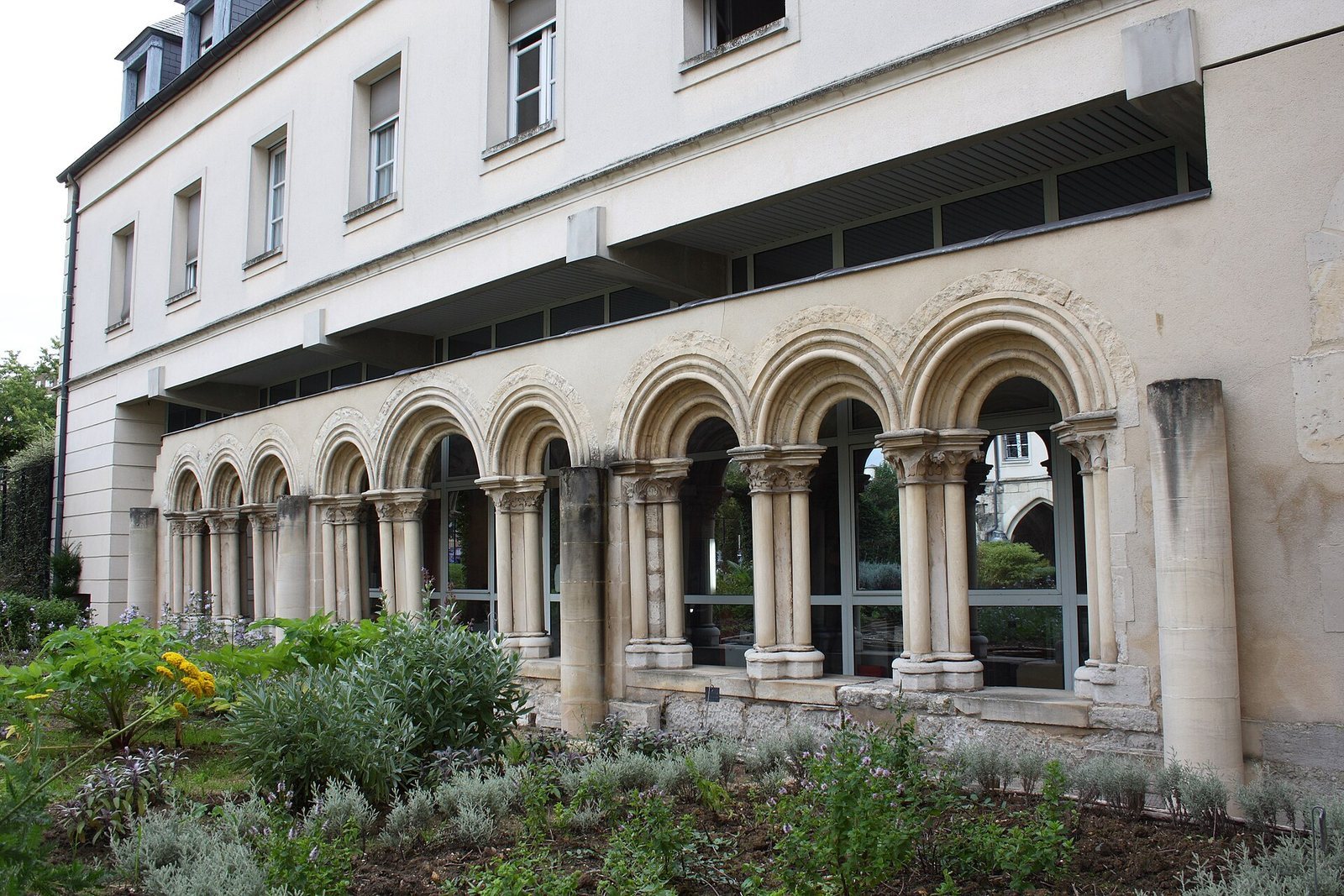
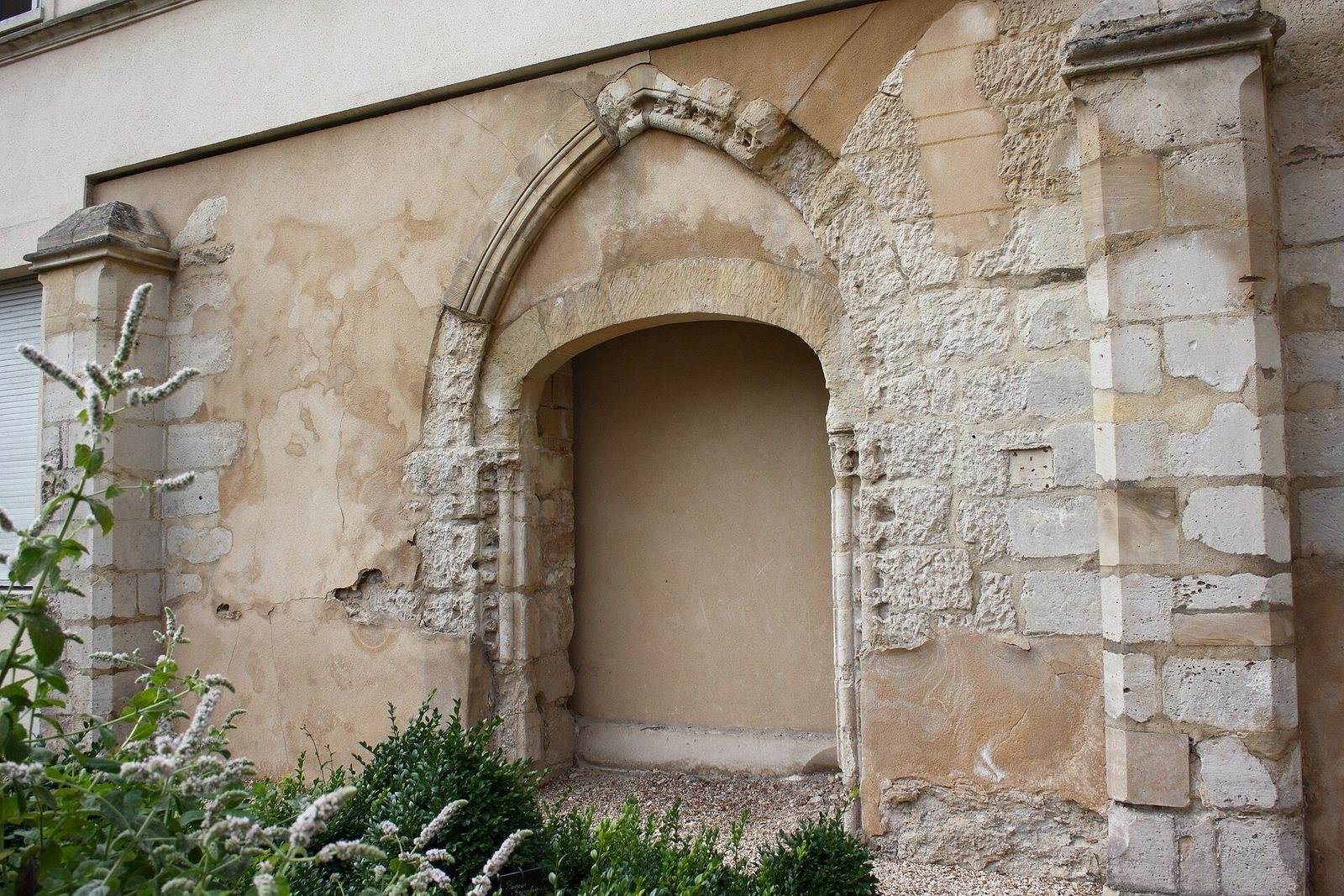
The abbey developed across the former royal villa site, and its surviving elements now occupy several parts of Chelles. The churches of Holy Cross and Saint George have been adapted as a cultural center. Remains of the cloister, a covered walkway around an open courtyard, are incorporated into the town hall, while the former abbey gardens correspond approximately to today’s Émile Fouchard Memorial Park.
Churches and abbey layout
The church complex changed as the abbey grew, with churches serving the religious community and the people who worked for it. A plan drawn in 1688 shows the form of the abbey church rebuilt in the medieval period.
The Holy Cross church
Balthild founded the first church of the Holy Cross, and the church later rebuilt on the site dates to the thirteenth century. It was remodeled in the sixteenth century. The 1688 plan shows a Latin-cross layout, in which a long central nave is crossed by a shorter transept, and a group of apsidal chapels arranged around the rounded end of the church.
Saint George’s church
Saint George’s church occupies the site of the sixth-century sanctuary. Built in the eleventh and twelfth centuries, it was entirely rebuilt under Matilda V of Nanteuil in the thirteenth century. It served as the parish church associated with the abbey.
The church of Our Lady and the earlier sanctuary
During Gisela’s abbacy, a new church dedicated to Our Lady was built. The earlier church was then divided: part served as a Holy Cross chapel for the priory’s religious community, while another part became Saint George’s parish church for the abbey’s service staff.
Cloister and gardens
Surviving cloister remains have been incorporated into Chelles town hall. The former gardens’ approximate extent is reflected in Émile Fouchard Memorial Park.
Burials, sculpture, and sacred objects
Saint Balthild’s burial and Saint Bertilla’s relics
Saint Balthild was first buried in a mausoleum behind the eastern apse of the Holy Cross church. In 833, her remains were transferred to a newly built chapel behind the altar. In 1185, Saint Bertilla’s remains were moved from the crypt beneath the priory church to the new church and placed beside Balthild’s relics. Balthild’s tomb was restored after the abbey was rebuilt in the later fourteenth century.
Sculptural fragments
Twentieth-century excavations recovered fragments of sculpture from the abbey. They date to the twelfth century, with some pieces assigned to 1110–1120 and others to around 1140. The fragments are held at the Alfred-Bonno Museum.
Relics and vestments
The abbey held a large collection of relics, and Balthild’s possessions were treated as relics there. They included a chasuble, a sleeveless outer vestment worn by a priest during Mass, embroidered with a pectoral cross and an image of a necklace. The vestment is displayed at the Alfred-Bonno Museum.
Manuscript production and collection
Scribes and production
Chelles’s scriptorium, a place where manuscripts were copied and prepared, was active by the ninth century. At least nine nuns worked as scribes. Jane Stevenson estimated that about fourteen nuns worked in a workshop under a master scribe. The manuscripts are associated with a distinctive script, and several bear the names of women who copied them, including Girbalda, Gislidis, Agleberta, Adruhic, Altildis, Eusebia, and Vera. The nuns also composed royal memorial writings and lives of saints.
Texts associated with Chelles
Manuscripts attributed to the Chelles workshop include parts of Augustine’s Commentary on the Psalms, now held in Cologne Cathedral Library, as well as Eusebius’s Ecclesiastical History, a fragment of Isidore of Seville’s Etymologies, other works by Isidore, Gregory the Great’s Dialogues, and a fragment of his Homilia in evangelium. The abbey also owned or had access to the Frankish royal annals known as the Annales regni Francorum and to the Continuationes Fredegarii, a continuation of a Frankish chronicle associated with Fredegar.