Fort de Vaujours: A Paris Defense Fort and Atomic-Energy Research Site
Site at a Glance
- Popularity
- Medium
- Country
- France
- Primary era
- Modern
- Eras represented
- Modern
- Civilizations
- French
- Site type
- Military
- Remains
- Fort
On this page12 sections
History
Fort de Vaujours is a military fortification spanning Courtry and Vaujours in France. Approved in 1874, it was built by the French military, with construction beginning in 1876 and completion in the early 1880s. The fort formed part of the Séré de Rivières system, a French defensive program developed after France’s defeat and partial occupation in 1870 to protect Paris.
Military service and wartime use
The French military used the fort until 1939, including for army training during the First World War. On 19 December 1939, the government of Édouard Daladier, then France’s prime minister, turned it into an internment camp for people with criminal convictions and others liable for military service who had no fixed home.
German forces occupied the fort in June 1940 and used it to store munitions. During their withdrawal in 1944, they destroyed the depot and barracks, while the batteries remained intact. In 1947, the Sevran powder works took over the site and conducted explosives experiments until 1955.
Atomic-energy research and uranium
On 3 June 1955, the French Atomic Energy Commission (CEA), France’s national body for atomic-energy research and development, established its Centre d’Études de Vaujours at the fort. The center used the fort and about 45 hectares of surrounding land until it closed in late 1997. Its work contributed to the development of France’s first atomic bomb, including its detonator.
The CEA used shock tubes and other equipment in pyrotechnic experiments examining high-pressure shock waves in uranium. Tests used a total of 600 kilograms of natural uranium. About 150 kilograms spread around the fort, with some reaching a kilometer from the site of the experiments. The area consequently became marked by both natural and depleted uranium.
Cleanup and redevelopment proposals
The CEA dismantled facilities and undertook cleanup from 1996 to 1998, then carried out further work in 2001 and 2002. Most of the dispersed uranium was recovered in 2002, although the CEA could not rule out remaining traces. After pressure from local and environmental groups, the CEA allowed CRIIRAD, an independent radioactivity research and public-information organization, to investigate. Its alert that year drew on exploratory measurements, not a complete radioactivity survey. The French research laboratory SUBATECH later carried out limited surface cleanup around areas identified as radiologically marked.
A site assessment took place in spring 2000, and a monitoring commission was formed in January 2001. After a further review in 2004, a prefectural decree issued on 22 September 2005 limited the site to commercial, industrial-service, and similar uses, while leaving possible gypsum extraction for later consideration. In 2011, CRIIRAD and environmental groups called for an independent assessment before any authorization to exploit the site.
Placoplatre, a subsidiary of Saint-Gobain, acquired part of the site from the state in 2010, including surviving fortifications; other contaminated land remained publicly owned. In 2012, the Marne and Chantereine intermunicipal authority acquired the entrance-area support zone and offices. Three years later, it offered to sell Placoplatre its 16 hectares, saying it lacked the resources to demolish buildings, address residual contamination, and secure the land.
Placoplatre proposed an open-pit gypsum quarry that would eventually require demolition of the fort, apart from the south battery. Demolition of 25 buildings began in 2014 but stopped because of radioactive contamination; it resumed in mid-2015 with approval from France’s Nuclear Safety Authority (ASN). Local elected officials objected that they had not received the work protocol and that Placoplatre could monitor its own work.
In 2014, measurements at one localized area found radiation levels 10 to 20 times the natural background; a measurement in one casemate reached 3 microsieverts per hour. ASN cautioned that these isolated readings did not represent the entire site and called for measures to protect workers. Objects with weak uranium markings were found in August 2017 as earth was removed from above casemates outside the central fort. In 2018, the CEA described uranium-marked finds from 2014 as human-origin uranium with low isotope content.
By July 2022, gypsum extraction had not begun. A proposed plan divided the work into two stages, with 30 years of extraction on former municipal land followed by 18 years on the former fort grounds. The environmental authority said the impact assessment did not clearly address possible radioactive contamination or how potential sources would be identified and treated. Opposition grew, and a petition calling for the truth about Fort de Vaujours collected more than 130,000 signatures.
Remains
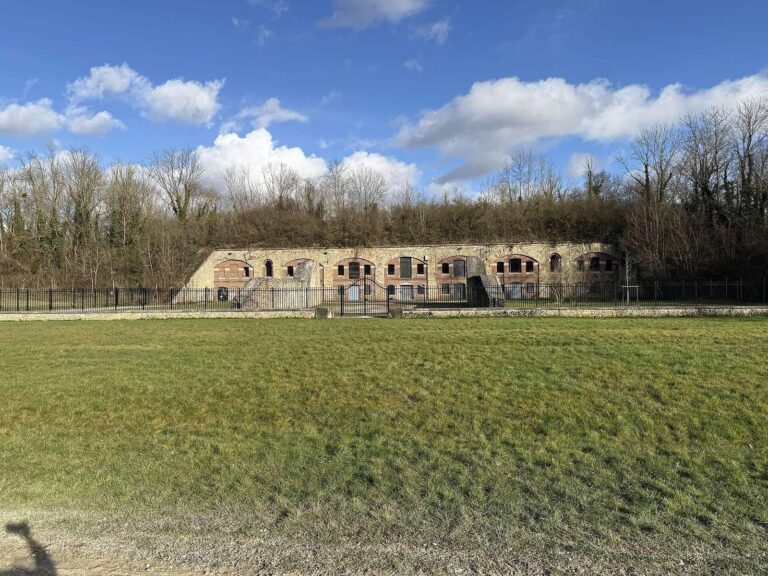
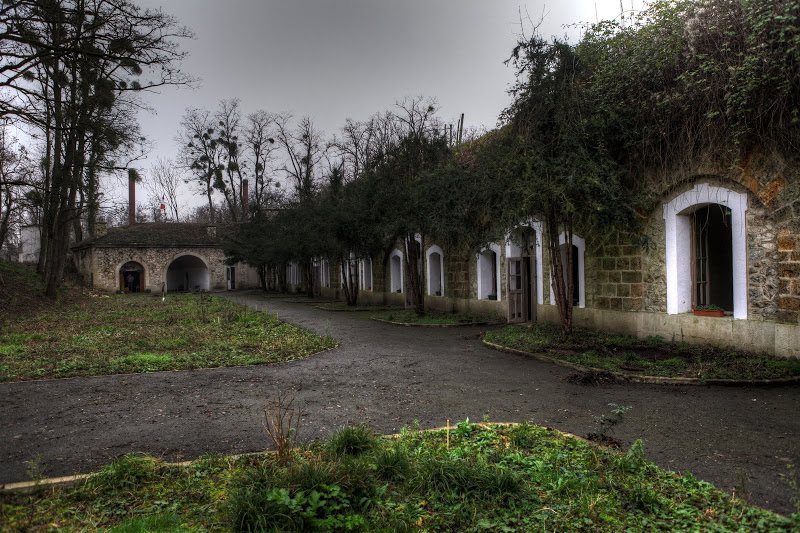
The fort is a large, many-sided structure built of masonry and concrete. Two annex gun batteries, one to the north and one to the south, were connected to the central fort by a covered way, a sheltered passage. A ditch enclosed the central work’s perimeter.
Central fort
Perimeter and entrance
At the entrance, a caponier, a protected defensive structure serving the entrance and ditch, interrupted the perimeter ditch. The fort’s original armament comprised 48 artillery pieces.
Artillery turrets
The fort’s armament included a machine-gun turret and a Mougin turret, an armored artillery turret, designed for two 155-millimeter guns. Both turrets formed part of the 1911 modernization. The Mougin turret remains in place, but its guns have been removed.
Annex batteries
Northern battery
The northern battery had six machine-gun positions in casemates, fortified chambers used to protect personnel or weapons. It was badly damaged during subsequent use by the Sevran powder works, the French state-owned explosives and propellants company SNPE, and the CEA. Demolition work was under way.
Southern battery
The southern battery had six gun positions and remained in very good condition, although it includes modern sections. An association maintains it and has sought to turn it into a museum.
Research buildings
During the CEA’s occupation, more than 300 office and laboratory buildings were constructed across the site. Their construction substantially altered the fort and its surroundings.