Rocca Nuova: The Medieval Fortress of Serravalle Pistoiese

Site at a Glance
- Rating
- 4.5
- Popularity
- Low
- Country
- Italy
- Primary era
- Medieval
- Eras represented
- Medieval
- Civilizations
- Republic of Lucca
- Site type
- Military
- Remains
- Castle
On this page11 sections
History
Rocca Nuova, also known as the Rocca di Castruccio, is a medieval fortress in Serravalle Pistoiese, Italy, built from around 1302 to strengthen Lucchese control of this strategic settlement. It formed the newer fortified section beside the older Rocca Vecchia and became closely associated with Castruccio Castracani, an early-fourteenth-century military commander and political leader whose campaigns made Serravalle an important base.
The Siege of Serravalle
Serravalle was strategically important to Pistoia, while Lucca and Florence regarded it as a threat to their territories. In the wars between these powers, Lucca and Florence acted together against Pistoia. Before the allied siege, Pistoia reinforced the castle with more than 300 of its best soldiers, additional mercenaries from Bologna, about 500 archers, and enough food and weapons to withstand an attack and launch operations into Lucchese territory.
The allied army placed itself under Moroello Malaspina, lord of Lucca and commander of the combined forces. Lucchese troops occupied positions near Poggio dello Spedaletto and the Castellina, while the Florentines surrounded the castle with a wooden palisade designed to prevent sorties. The siege continued for about three months. Florentine forces bombarded the fortification by day and night with trebuchets, medieval engines that hurled heavy stones, and other stone-throwing machines. As the siege continued, supplies inside the castle dwindled.
The defenders reportedly sent a messenger secretly to Pistoia, apparently using passages beneath the castle, to request help. A Pistoian relief force attempted to break the siege, but the effort failed. After seeing the approaching troops, about 400 armed men from Serravalle made a sortie to destroy the enemy palisade and assist the attack. The larger Florentine force defeated them, and the survivors withdrew with many dead.
When the Pistoian troops at the Castellina learned of the defeat, they retreated to Pistoia, leaving the castle exposed. The defenders then negotiated with Moroello Malaspina and surrendered. The Pistoian and Serravallese soldiers were taken prisoner and transported in chains to Lucca. The civilian population swore submission to the Lucchese, while the mercenaries were released on condition that they return to their own territories. Serravalle was placed under Lucchese jurisdiction.
Construction and Castruccio’s Fortress
The Lucchese began Rocca Nuova around 1302 to reinforce Serravalle and control its population. They feared that the inhabitants would revolt and restore Pistoian rule after the main army had departed. Uguccione della Faggiola, a powerful Tuscan military and political leader of the period, continued the work. The fortress was completed by Castruccio Castracani after Serravalle returned to Pistoian control.
During renewed warfare with Pistoia, Castruccio recognized Serravalle’s value as a base for expansion against Pistoia and later Florence. The fortress was reinforced and supplied with a large, well-trained garrison. From this phase it became known as the Rocca di Castruccio. Rocca Nuova is now restored, belongs to the municipality of Serravalle Pistoiese, and has Italian national-heritage status.
Remains
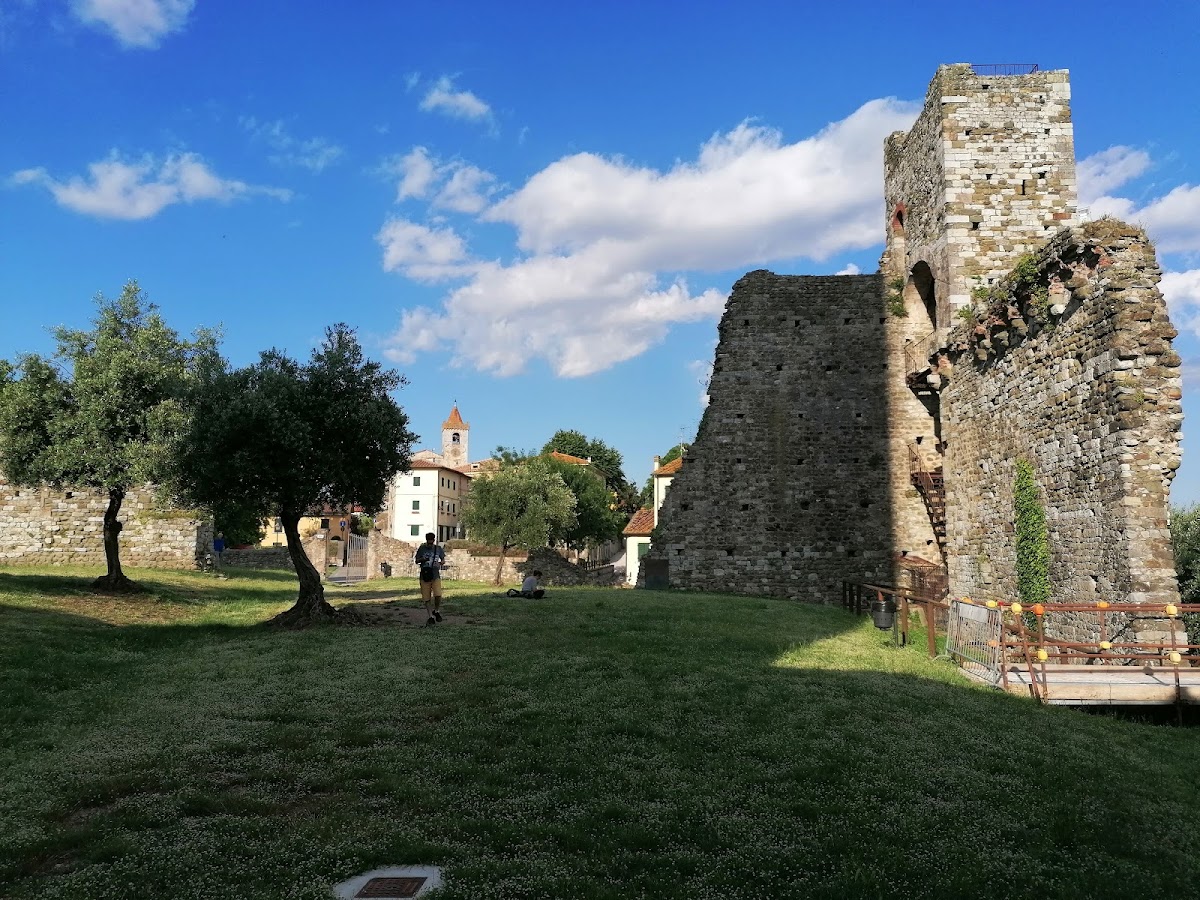
Rocca Nuova survives as a separate fortified enclosure beside the older Rocca Vecchia. A thick dividing wall kept the two fortresses apart, with their only connection provided by a single door. The new enclosure was built with powerful limestone walls, using stone quarried in Lucchese territories. Its defensive system included protected wall-walks, observation turrets, and several tall guard towers.
The Fortified Enclosure
Southwestern Tower
Substantial sections of the massive enclosure remain, including a rectangular tower at the southwestern corner. Together with the surviving walls, it preserves the substantial defensive character of the newer fortress and forms part of the restored remains visible within the complex.
Northwestern Turret and Principal Gate
A characteristic projecting turret marks the northwestern corner. Another surviving curtain wall retains a clearly identifiable wall-walk, a protected walkway running along or behind a defensive wall. The wall extends toward a hexagonal tower overlooking the side of the castle facing Valdinievole, and the principal town gate opens through this tower.
Cistern and Courtyard Well
A large rainwater cistern was excavated inside Rocca Nuova to supply the garrison during sieges. It extended beneath the tallest tower, linking the fortress’s water storage to its defensive structure. A well remains visible in the courtyard.
The Older Fortified Area
Torre del Barbarossa
The older fortified area includes the square-plan Torre del Barbarossa, also identified as the Longobard Tower. It stands within an area that has recently been restored and represents one of the surviving elements of Rocca Vecchia.
Bell Tower of Saint Stephen’s Church
Another older tower was converted into the bell tower of the Church of Saint Stephen. Most of the older enclosure has been lost, but this reuse preserves a physical connection between the earlier fortress and the later religious building.