Rosenburg: A Medieval Hill Castle in Switzerland
Site at a Glance
- Popularity
- Medium
- Country
- Switzerland
- Primary era
- Medieval
- Eras represented
- Medieval
- Civilizations
- Holy Roman Empire
- Site type
- Military
- Remains
- Castle
On this page6 sections
History
Rosenburg is a ruined hill castle on the wooded Ramsenstock in Switzerland, west of Herisau and about 1 km south of Ramsen. Built in the 12th century by the noble Rorschach family, it served as a seat of the Knights of Rorschach. The family’s castle was one of two associated with the Rorschachs near Herisau; Rosenberg stood to the north, about 2.3 km away.
The Rorschach family castle
The Rorschachs are recorded from 1176 as knights serving the Abbot of St Gall. The abbey was a major monastic institution, and its abbot also exercised regional authority. The family owned several castles, while its branches used a rosebush in their coats of arms. A descendant, Egilolve von Rosinburc, was connected with Rosenburg in 1270. The castle was mentioned in 1275 in connection with the destruction of Urstein Castle.
A 14th-century chronicle by Johannes von Winterthur recounts an episode involving two brothers named Rudolf, who no longer lived at Rosenburg and had left a farmer to manage it. Two knights and their servants came to drive the farmer out and seize the castle. The farmer surprised them, killed both knights inside, and then killed their servants in the stables.
In 1350, the two Rudolfs agreed with their cousin Eglolf von Rosenberg not to attack or damage Rosenberg Castle. In return, Eglolf promised to leave them the Rosenberg estates in Herisau after his death. The brothers sold those estates to the Abbey of St Gall in 1396 but kept Rosenburg.
Destruction and changes in ownership
During the Appenzell Wars in 1403, Appenzell rebels rose against the authority of the Abbot of St Gall, and Rosenburg was burned. By 1466, the ruined castle belonged to the abbey, which retained it until 1803.
In 1803, amid the political changes following the Helvetic Republic, a short-lived Swiss state founded in 1798, and the Act of Mediation, which reorganized Switzerland’s political system, the ruins passed to the newly formed Canton of St Gallen. The canton sold them to Herisau on 2 February 1809 for 440 florins, a historical currency unit. Excavation, stabilization, and repairs took place in 1936–1937. Rosenburg is recognized as a Swiss cultural property of national significance.
Remains
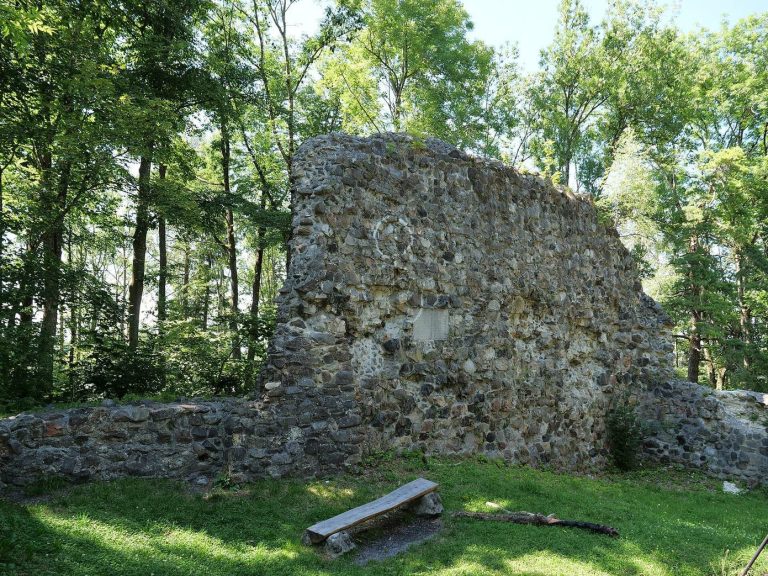
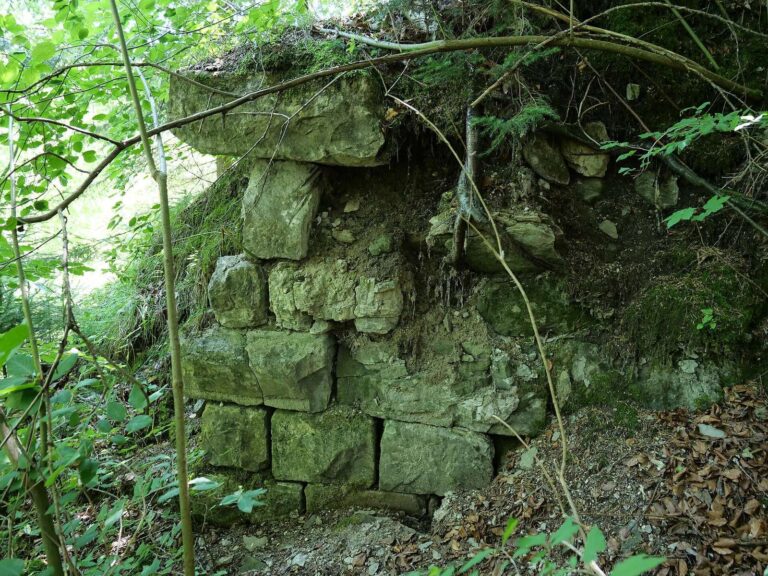
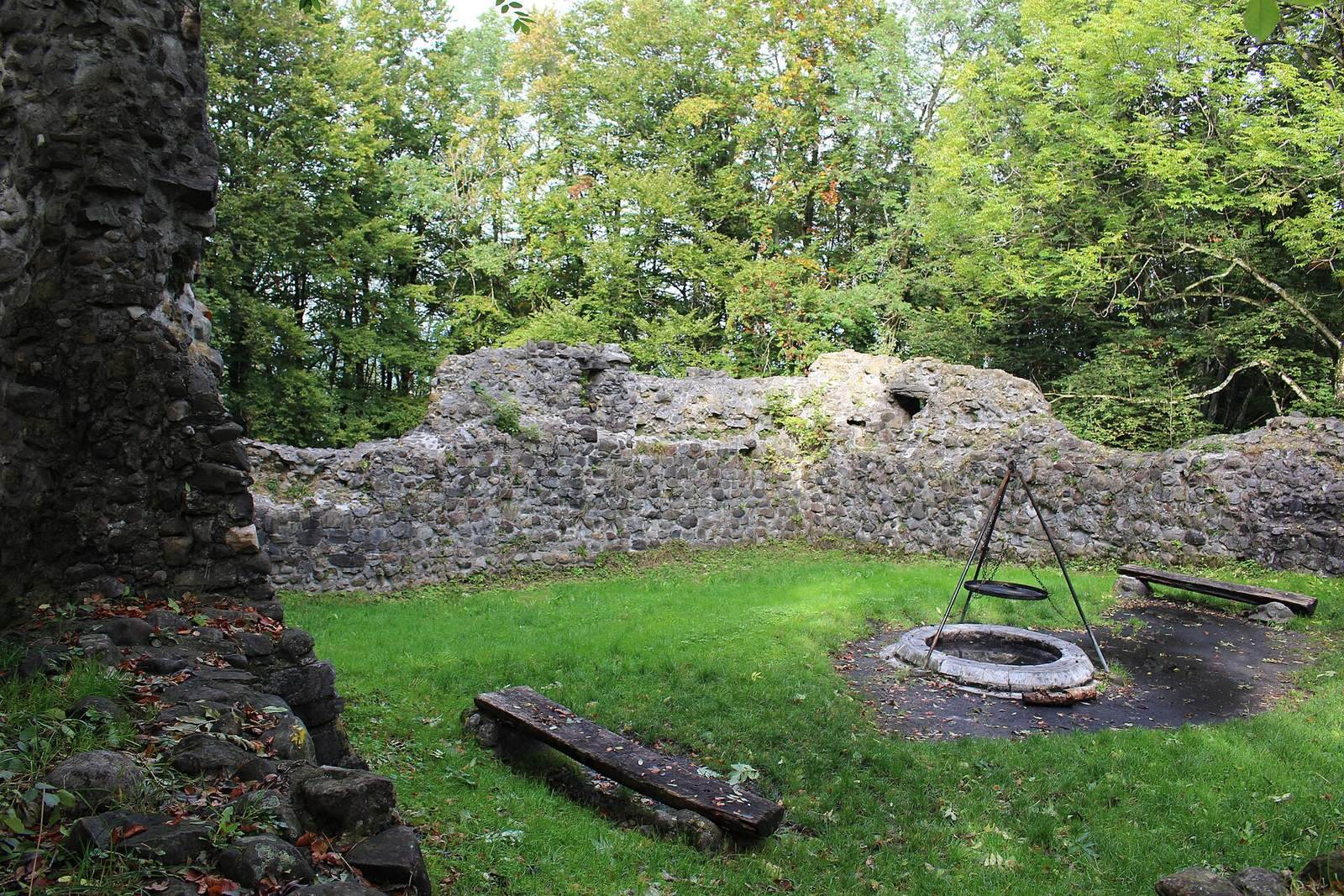
The ruins occupy the wooded Ramsenstock at an elevation of 926 m. The hilltop complex includes a residential tower, residential buildings, and an enclosing wall, with a deep ditch around the site. Sections of masonry survive, and the castle’s position on the Ramsenstock gave rise to its alternative name, Ramsenburg.
Residential tower
The tower dates to the 13th century and has a roughly square plan, measuring about 9–10 m on each side. Its walls are 2.2–2.9 m thick, and its entrance is approximately 4.4 m above ground. In the inner courtyard, an entrance lies on the left; a wooden staircase on the right leads to the tower opening, which is closed by a grille.
Western main-castle ruins
The larger main-castle remains lie west of the tower and date to the late 13th or early 14th century. Rosenburg was smaller than nearby Rosenberg.