Urstein Castle Ruins: A Medieval Stronghold of St. Gallen Abbey
Site at a Glance
- Rating
- 3
- Popularity
- Very Low
- Country
- Switzerland
- Primary era
- Medieval
- External website
- Open
- Eras represented
- Medieval
- Civilizations
- Holy Roman Empire
- Site type
- Military
- Remains
- Castle
On this page10 sections
History
Foundation and abbey lordship
Urstein Castle Ruins lie near Herisau, Switzerland, on the site of a medieval stronghold commissioned in 1080 by Abbot Ulrich II von Eppenstein. Its earliest form, called Rachinstein or Rachenstein, was intended to defend the lands of St. Gallen Abbey, a Benedictine monastery and a major territorial power in eastern Switzerland. Ulrich supported the king during the Investiture Controversy, a medieval struggle over who could appoint church officials, particularly between secular rulers and the papacy.
Urstein stood within the abbey’s former lordship and was first associated with an ecclesiastical prince before becoming linked to the nobility. It was rebuilt at the beginning of the 13th century and was the oldest and largest of the three castles in present-day Herisau, alongside Rosenberg and Rosenburg. The castle was an especially large and important stronghold in the region.
The Urstein family and the castle’s destruction
The Urstein family is known through two names in the abbey’s second register of the dead: Bertha de Urstein and Rudolfus de Urstein, described as a layman. They are the only known members of the family, which may have been related to the Rorschach family. In 1225, Rudolf von Rorschach endowed an annual memorial for his mother, Bertha de Urstein.
In 1275, Ulrich von Ramschwag destroyed the castle while it was held by Rudolf von Rorschach. The conflict concerned lands granted by two rival abbots. Ulrich came from a castle about 11 kilometres to the north. A chronicle compiled by Kuchimeister around 1335 mentions Urstein in connection with its destruction.
Fires, decline, and archaeological investigation
The castle’s building history included repeated fire damage and repairs. After an early fire and masonry failure, the structure was repaired; another fire led to further restoration, while a later blaze left the walls to decay, with some masonry going down with the rock.
Emergency excavations began in October 1971 and continued through 1978, within archaeological investigations that ran from 1971 to 1985. Herisau added the ruins to its municipal inventory of protected properties in 1955. They are also classified as a Class B Swiss cultural property of regional significance.
Remains
Setting and defensive layout
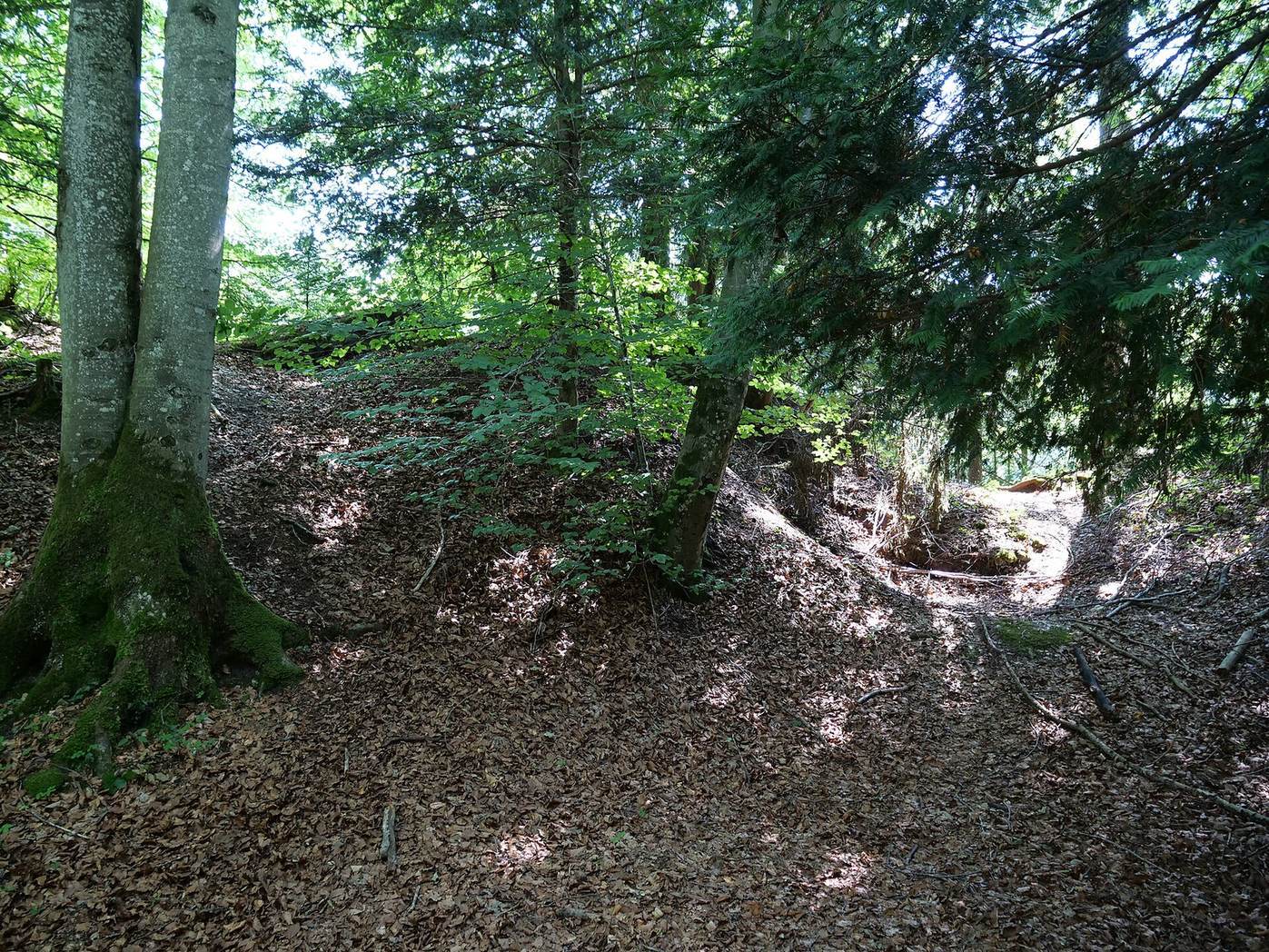
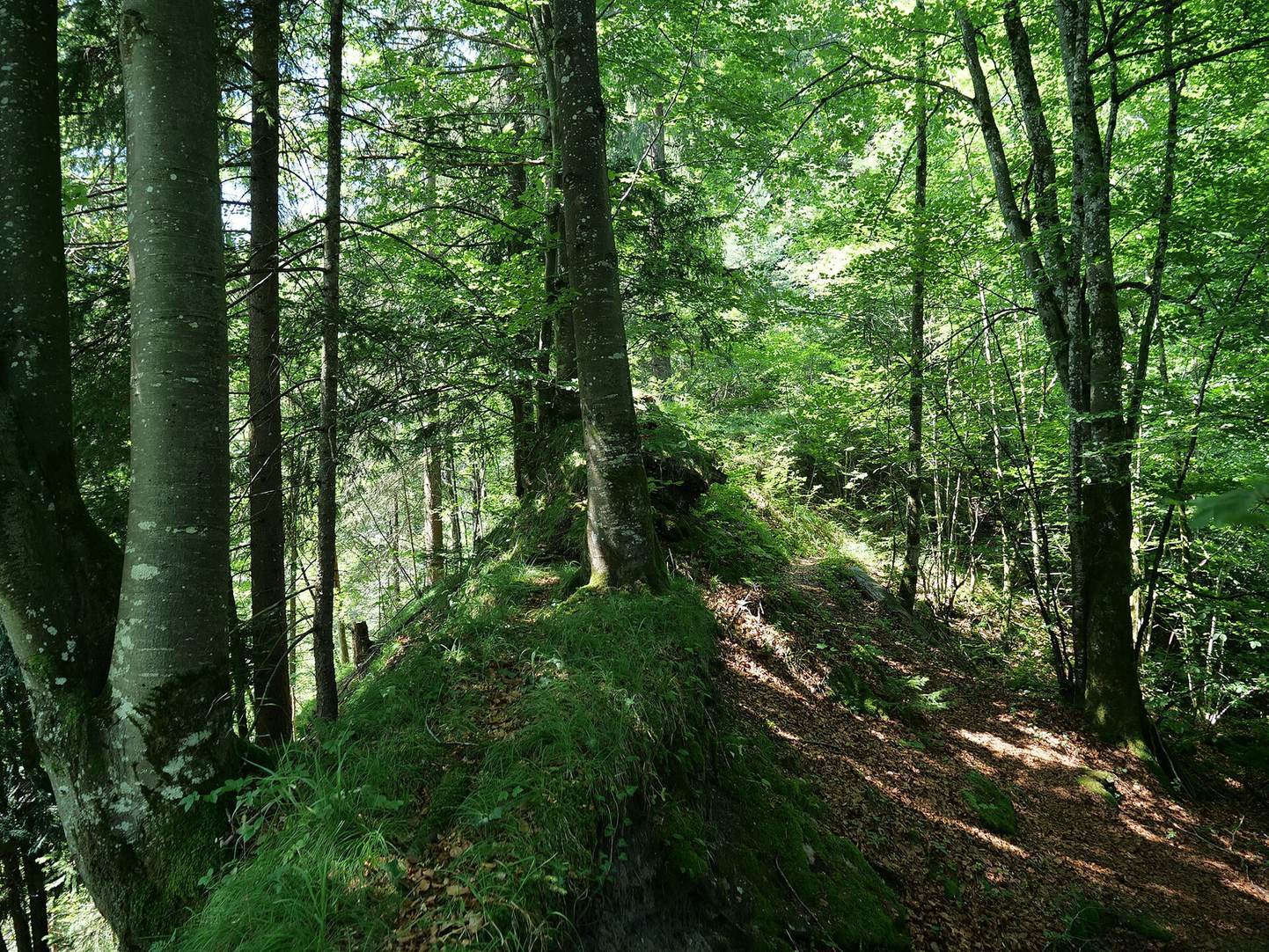
The ruins occupy a steep, wooded ridge projection of Molasse, a sedimentary rock formation associated with the Alpine foreland, at about 690 metres above sea level. The Urnäsch runs through a deep ravine to the east, at about 630 metres, while the Stösselbach ravine lies to the northwest. A defensive ditch, or neck ditch, crossed the southern, landward approach from the higher ridge. Its traces remained clearly visible in 2024. The castle probably occupied the whole spur beyond the ditch; in 1971, the site measured about 60 metres in length.
Castle fabric and archaeological evidence
Walls and building phases
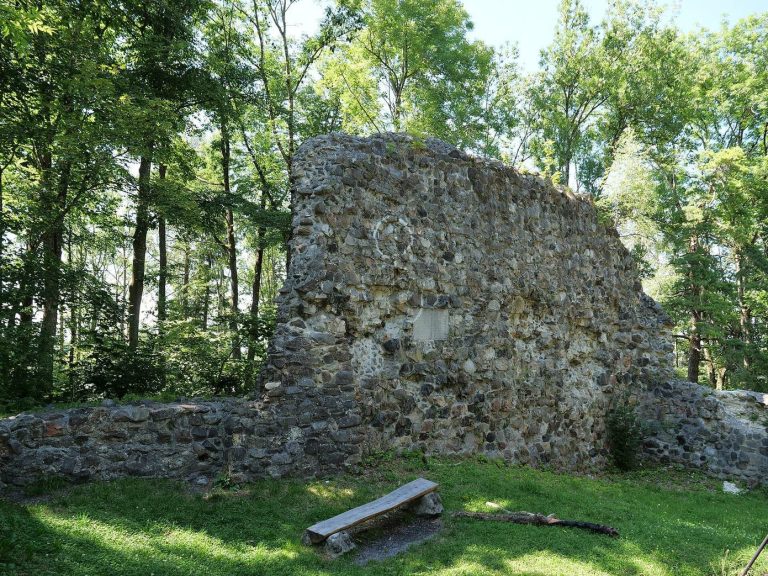
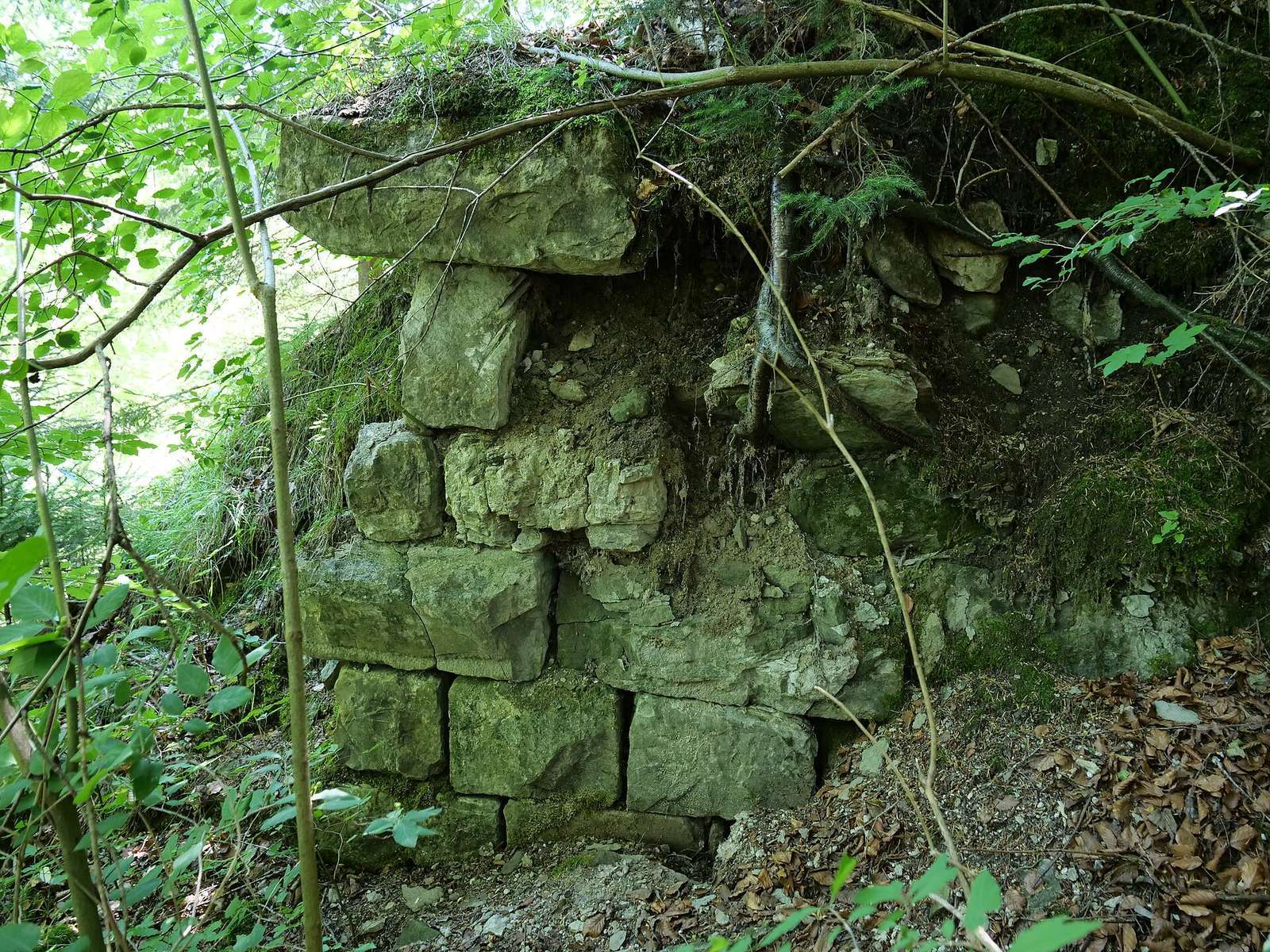
Excavations revealed sandstone walls belonging to three buildings, including two corners formed by walls about 2.2 to 2.3 metres thick. The masonry is roughly dressed sandstone. On the southwest side, a wall of larger, carefully dressed blocks adjoined the other masonry and belongs to a later building phase. Repairs also incorporated cup-tile stoves, ceramic heaters made with cup-shaped tiles. By the 1971 excavations, most of the keep, the castle’s principal tower, and the bedrock beneath it had collapsed.
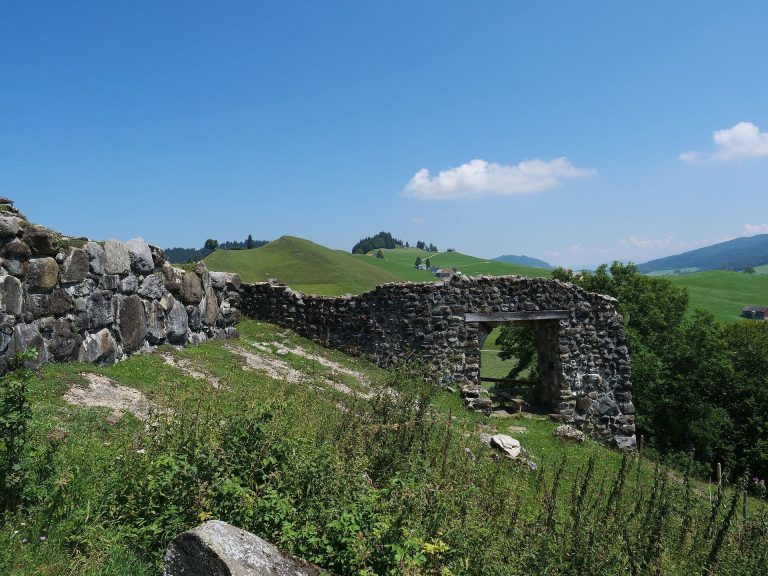
The narrow spur is highly vulnerable to erosion. By 1955, most of the castle remains had already slipped into the ravines on either side, and erosion of the ridge and weathering of the masonry continued afterward. In 2024, only isolated wall fragments remained, and further loss was expected.
Excavated finds
Excavations recovered Mesolithic tools and animal bones from pigs, sheep, and goats, as well as less frequent remains of wild game. Photographs and sketches of the castle, together with excavation finds, are exhibited at Museum Herisau.
Historical depiction
Johann Ulrich Fitzi painted the ruins in pen and watercolour in 1818. The image is preserved in Johann Caspar Zellweger’s book of banners and coats of arms at the Cantonal Library in Trogen.