Roman Aqueduct of Andelos: Water Supply System of a Roman City in Spain
Site at a Glance
- Rating
- 4.6
- Popularity
- Very Low
- Country
- Spain
- Primary era
- Classical
- Eras represented
- Classical
- Civilizations
- Roman
- Site type
- Infrastructure
- Remains
- Aqueduct
On this page10 sections
History
The Roman Aqueduct of Andelos is a Roman water-supply complex in Spain, serving the ancient city of Andelo near Muruzábal de Andión in Mendigorría, Navarra. The system was developed during the first and second centuries AD, when the city expanded and reached a period of prosperity under Roman rule. Andelo, the preferred modern form of the ancient name, belonged to the Vascones, an ancient people whose territory included parts of the western Pyrenees and the upper and middle Ebro region. Classical authors placed it among the stipendary cities of the Vascones within the conventus of Caesaraugusta, a Roman administrative district centered on modern Zaragoza.
From Iron Age settlement to Roman city
A small settlement associated with the Iron Age occupied the area during the fourth and third centuries BC. Its inhabitants were later moved from this earlier settlement to the larger urban center of Andelo. This change took place as Roman expansion began to affect the region from the early second century BC, during the period when Roman control was extending through central Navarra.
By the first century BC, houses with Roman-style room arrangements and decorated opus signinum floors had been constructed. This flooring used mortar mixed with crushed ceramic to create a durable paved surface. Andelo then grew during the first and second centuries AD, when its urban area and water infrastructure were expanded. In AD 74, Emperor Vespasian issued an edict granting communities in Hispania the status of civitas, a formally recognized civic community within the Roman administrative system. Andelo’s territory extended along the middle course of the Arga River.
Water management and later history
The city developed a complex water-supply system during the first and second centuries AD. The aqueduct was built in the first century AD and repaired in the second. Archaeological remains of metalworking have encouraged an interpretation that the water system also served industrial activity. Some streets were paved or improved during the third century, indicating continued urban use after the main period of expansion.
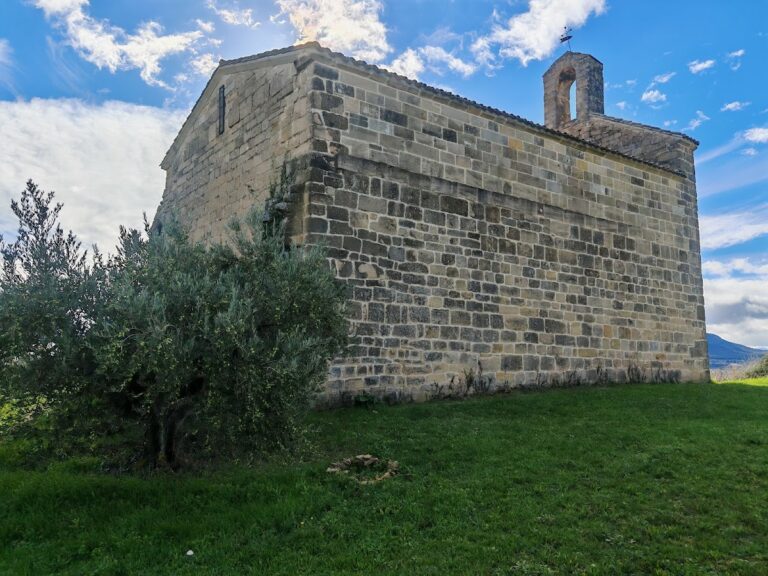
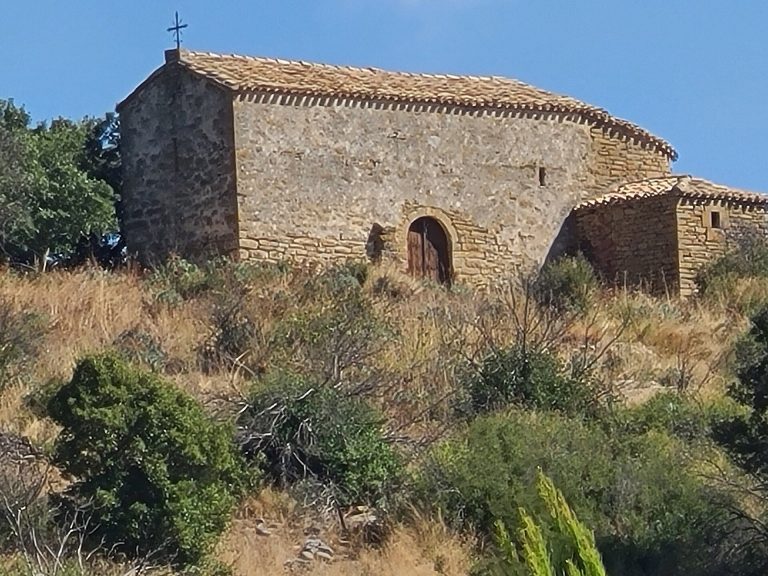
Andelo survived into the medieval period. An eleventh-century church dependent on Santa Maria of Pamplona was built at the settlement, which was abandoned around the middle of the fourteenth century, probably in connection with the plague of 1348.
Rediscovery and archaeological investigation
The ruins were identified in the seventeenth century by the Jesuit José Moret y Mendi. Saturnino Rivera Manescau began excavations in 1940, and Blas Taracena Aguirre continued the work in 1943 and 1944. Taracena prepared plans of the discoveries, but the excavated area was later reburied and returned to cereal cultivation. Objects from these campaigns were preserved in the Museum of Navarra.
Systematic archaeological work directed by María Ángeles Mezquíriz Irujo continued from the 1980s until 2000 and exposed numerous remains. A site museum was established in 1999 and 2000 on the initiative of the Government of Navarra’s Directorate-General for Culture, following a project by the architect José Luis Franchez Apezetxea. Andelo was designated a Spanish Site of Cultural Interest in 1995, protecting the archaeological site as part of Spain’s heritage system.
In 2025, archaeological work at the city revealed the skeletons of four perinatal individuals. The burials date from the late second or early first century BC, around the period of the city’s foundation and the Roman conquest of central Navarra. Their context has been related to the replacement of earlier settlement patterns by Roman civitates. The discovery has also been considered alongside the predominance of cremation at the time and the practice of burying infants inside houses.
Remains
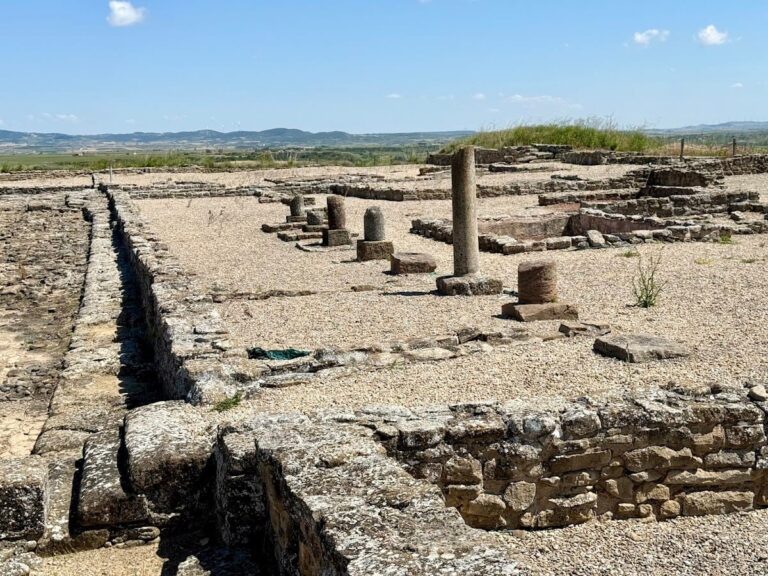
Andelo occupied approximately 18 hectares on a plateau. The ground fell sharply along the north-eastern side and descended more gradually towards the west in two terraces. Fortifications served both defensive and retaining purposes, with two external defensive towers positioned to the north-west and south-east. The excavated urban plan includes two decumani, east-west roads, and three cardines, north-south roads. One of the cardines was porticoed, and the roads formed rectangular urban blocks.
Urban districts and houses
The upper terrace contained the residential district together with large houses, public buildings, baths, and shops. The south-western quarter formed an artisanal area with warehouses and a fullery, a workshop for washing and finishing textiles. Houses used Roman-style room arrangements, and their decorated opus signinum floors included examples made in the first century BC. At least one preserved floor carries an inscription in the Iberian alphabet.
Water-supply structures
Reservoirs and cistern
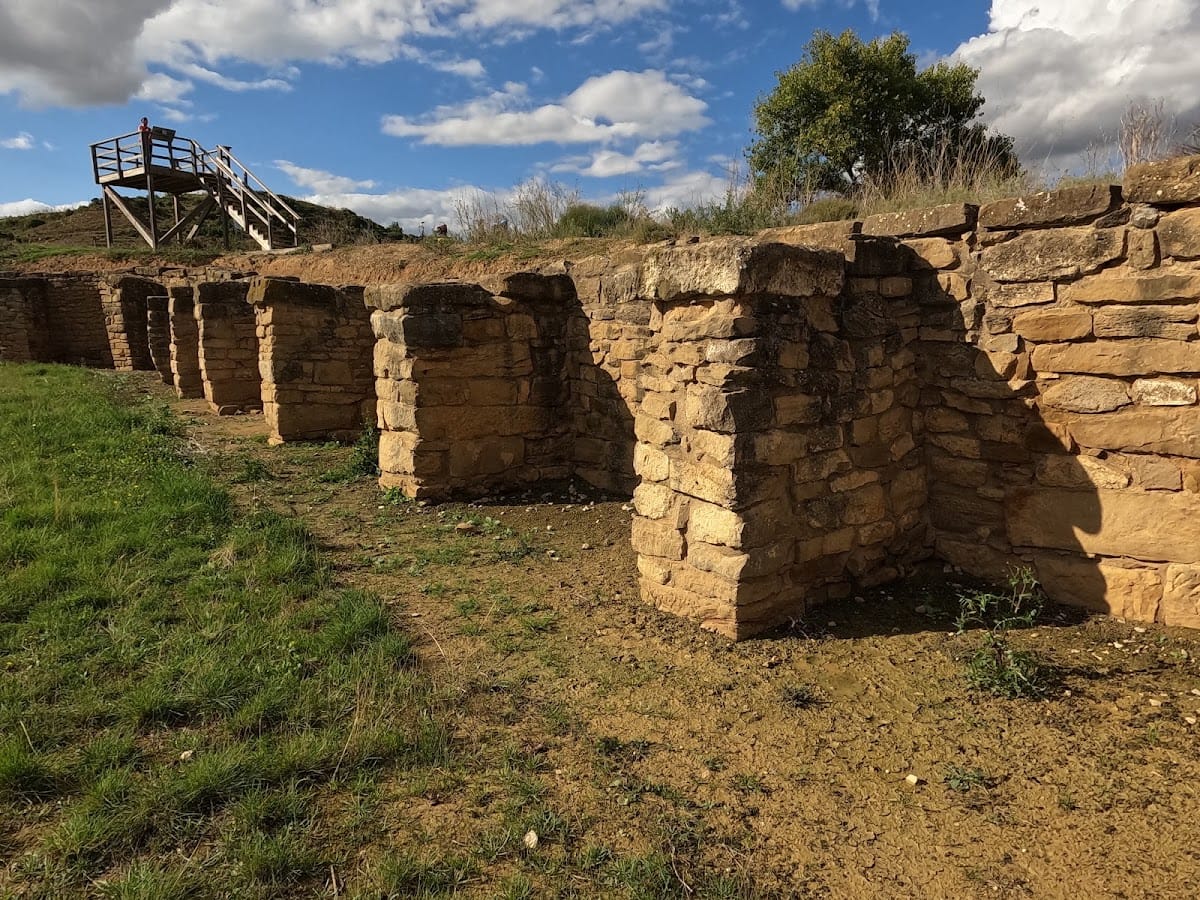
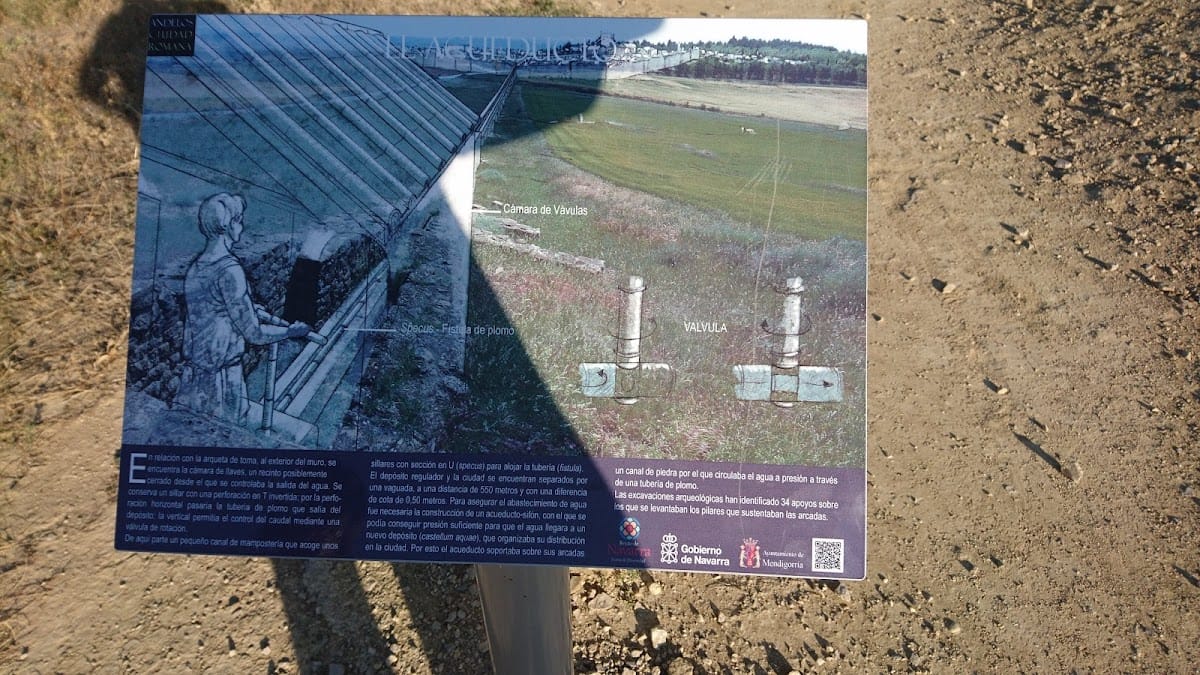
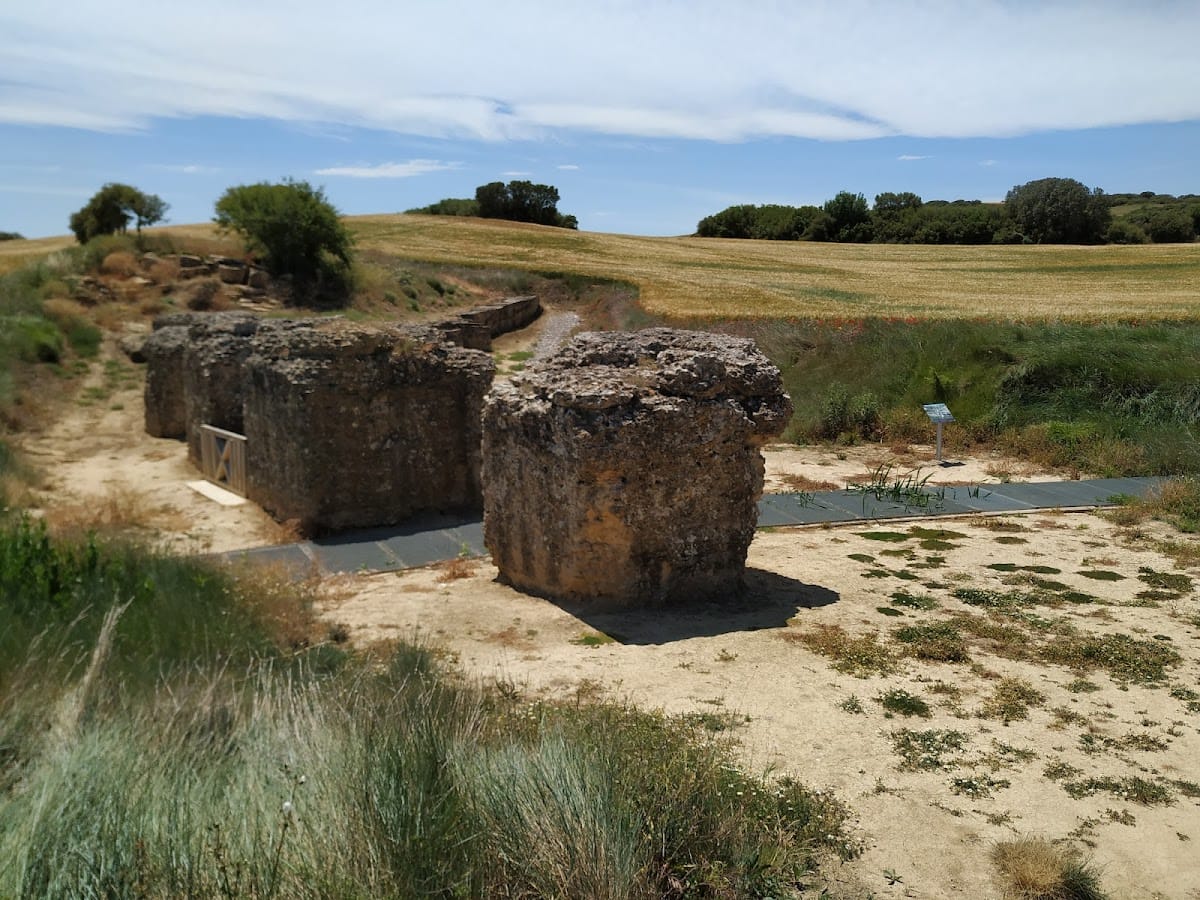
The water-supply complex is one of the principal surviving groups of remains. It included the two Iturránduz dams, one discovered in 1980 and the other in 1983, as well as a channel, an aqueduct siphon, and a castellum aquae, a Roman distribution tank or water-distribution building. Water was captured at Puente del Diablo, where retaining works survive, and carried to a cistern cut into the ground. The cistern measures approximately 85 by 37 metres and had a capacity of about 7,000 cubic metres.
Conduit and distribution tank
The conduit combined a stone channel with lead pipes. Before reaching the city, the water passed through a siphon system that used differences in elevation and water pressure to carry it through a lowered section of the route.
The castellum aquae had a rectangular podium supporting a distribution tank that was originally covered by a vault. Its thick walls were built from blocks and coated inside with three layers of waterproof plaster. A series of openings on the eastern side probably formed part of a public fountain. Together, the dams, cistern, conduit, siphon, and distribution tank show the stages through which water was collected, conveyed, and distributed within Andelo.
Objects and inscriptions
A mosaic known as the Triumph of Bacchus is associated with Andelo and is held in the Museum of Navarra. A bronze plaque dedicated to Apollo was also found at the site. An inscription discovered in 1993 preserves the phrase “Likine abuloŕaune ekien bilbiliaŕs.” Its language remains disputed, with interpretations identifying it either as an early form of Basque or as Iberian.
The four perinatal burials uncovered in 2025 consist of human skeletal remains dating from the late second or early first century BC. Their position in the history of the settlement connects the physical evidence at Andelo with the transition from the earlier settlement to the Roman urban center.