Gorriza: A Depopulated Medieval Settlement and Hermitage in Navarre
Site at a Glance
- Rating
- 4.7
- Popularity
- Very Low
- Country
- Spain
- Primary era
- Medieval
- Eras represented
- Medieval, Early Modern
- Civilizations
- Kingdom of Navarre
- Site type
- Religious
- Remains
- Church
On this page9 sections
History
Gorriza is a depopulated settlement in Spain, within the municipality of Guirguillano in Navarre. It is documented from 1268, when it belonged to the valley of Arguiñariz and had a church served by a cleric. The settlement may have originated as a defensive site because of its position on a rocky spur above the Arga gorge, although this interpretation remains a hypothesis.
Medieval Lordship
Gorriza does not appear in the 1366 assessment. In 1412, Charles III, king of Navarre, restored its lordship to Carlos de Arellano. His grandfather, Juan Ramírez de Arellano, had previously held the estate. A lordship was a territorial estate controlled by a lord, and its restoration placed Gorriza again within the authority of the Arellano family.
By 1534 Gorriza was recorded as depopulated and belonged to Constanza de Belascoáin. From that period it formed part of the lordship of Belascoáin, while its parish church continued to be served by an abbot in 1802. Before 1857, Gorriza belonged to the municipality of Arguiñariz and Gorriza. Its lands then passed to Guirguillano.
Castle and Abandonment
An old castle stood at Gorriza until at least the early twentieth century. In the eighteenth century it was occupied by Sr. Azkona, a patrimonial official responsible for administering or defending the ruler’s hereditary property. The castle was already threatened with ruin but retained traces of battlements and narrow arrow openings. No part of it survives.
During the nineteenth century, Gorriza was a small hamlet or farmstead. In 1934 it had six buildings and twelve inhabitants, while another contemporary account listed three householders and fifteen people. Population records from 1858 to 1950 range between four and fifteen inhabitants. The settlement was completely abandoned in 1960.
Archaeology and Religious Continuity
An archaeological survey of the medieval settlement area recovered barquiform hand-mill remains, boat-shaped stones used to grind grain or other materials, together with pottery. The pottery cannot be assigned securely to a particular culture, although its paste resembles material from the Late Bronze Age or Early Iron Age.
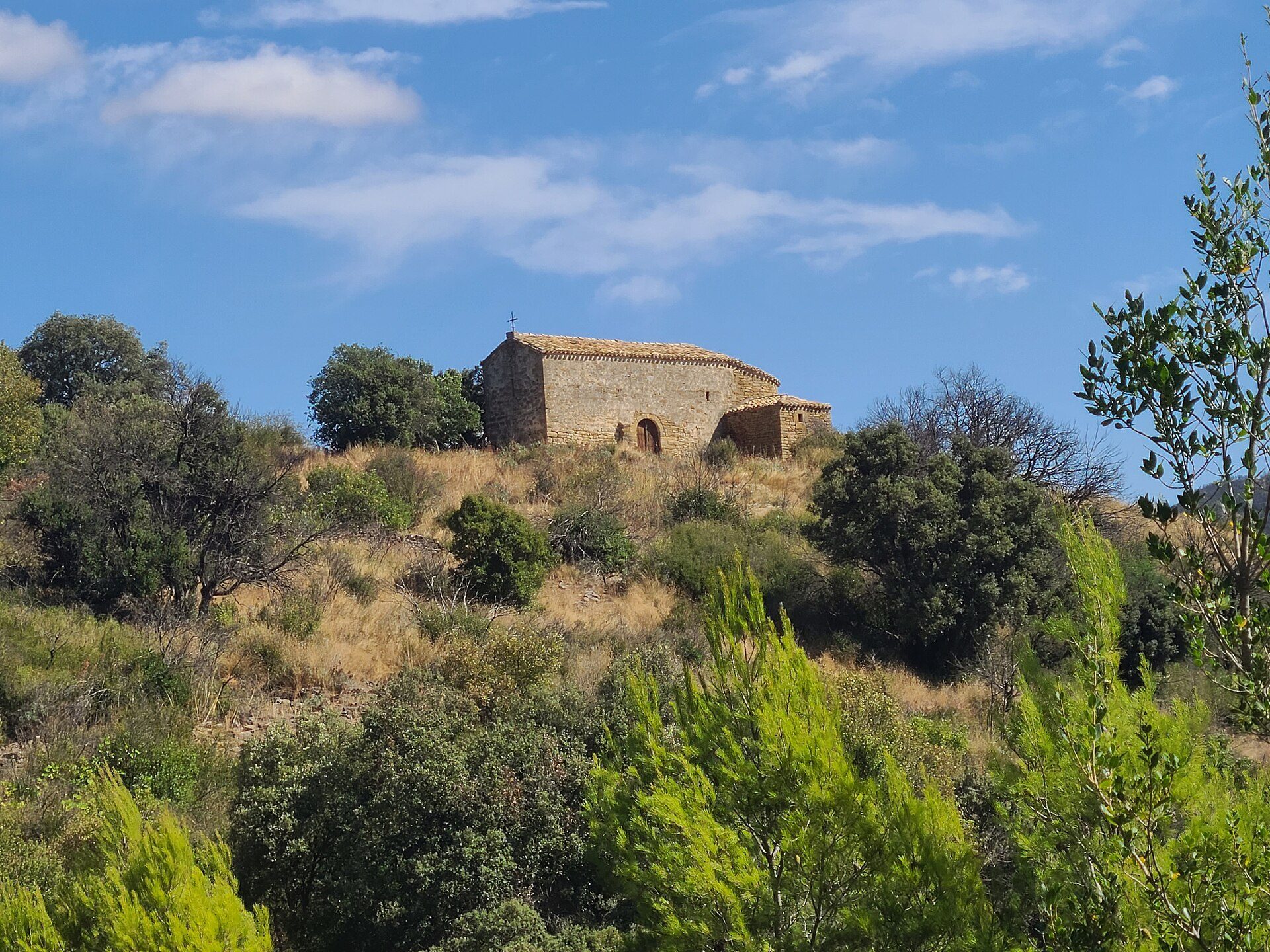
Forest repopulation led to the demolition of the final houses, apart from the hermitage. Ground disturbance displaced archaeological remains. The territory now forms part of Navarra’s Forest Heritage. Gorriza’s former parish church survives as the Hermitage of Our Lady of Gorriza, which remains the destination of traditional pilgrimages from nearby communities. Residents of Arguiñariz and Echarren attend at Pentecost, while Belascoáin attends on Saint Peter’s day.
The image of Our Lady of Gorriza is normally kept in a private house in Artazu and brought to the hermitage for the pilgrimage. Bishop Lorenzo Igual de Soria of Pamplona took an interest in the image and ordered a frontal and a crown for it. He also ordered the removal of the cap from the image and from the Child.
Remains
Settlement Landscape
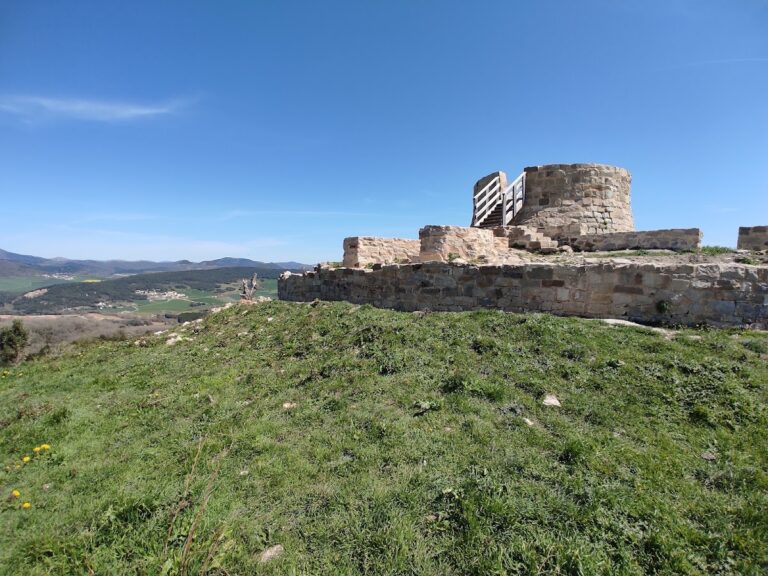
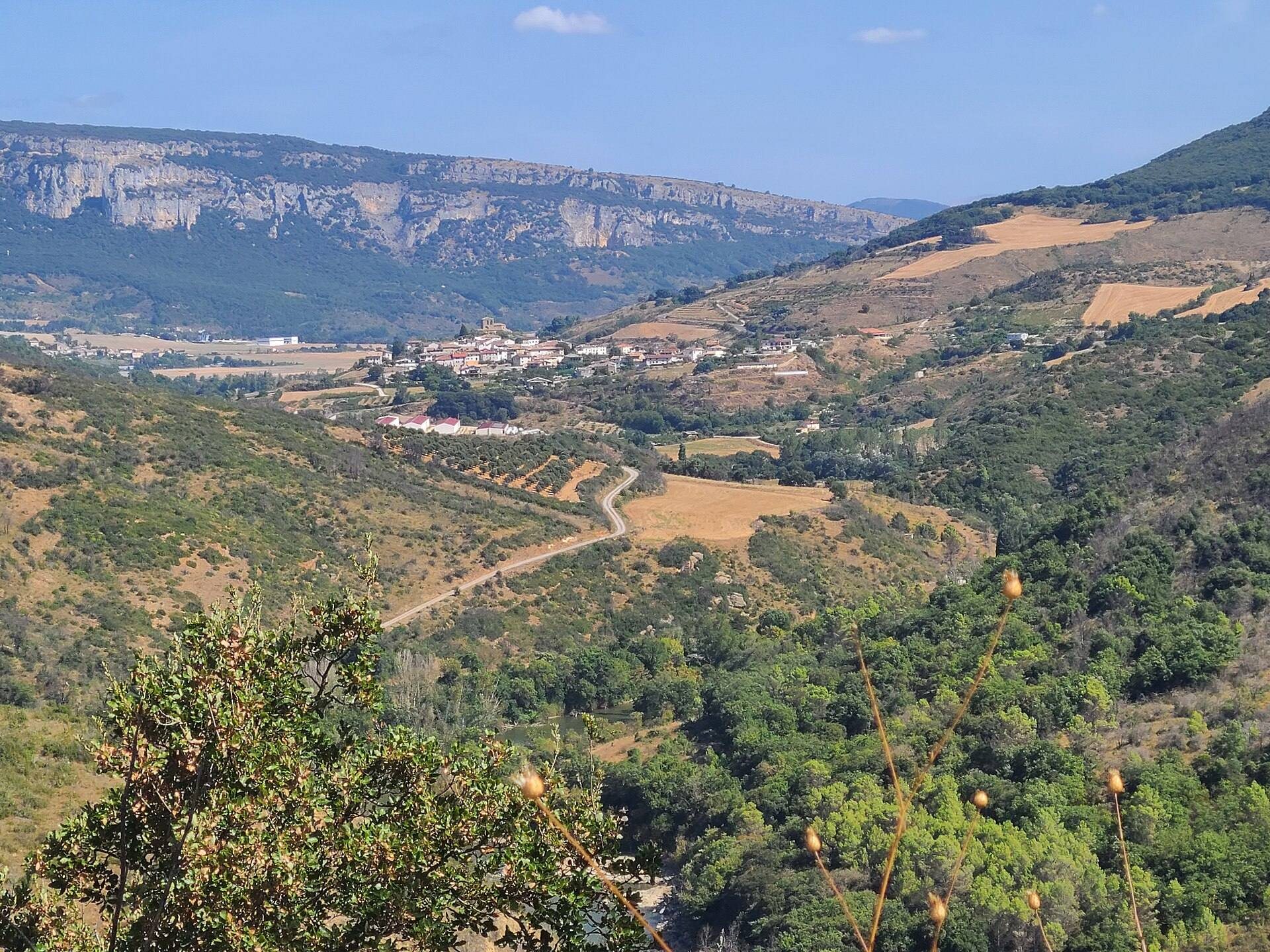
Gorriza lies on the left slope of a spur descending from Esparaz toward the Arga, between two streams. The former settlement occupied a rocky spur at approximately 489 metres, while the territory’s highest point, the peak identified as Gorriza, reaches 584.71 metres. The territory covers 112 hectares. Oaks grow mainly in the north and east, cultivated land historically occupied parts of the south and west, and modern forestry has introduced Austrian pine and oak. The road from Belascoáin to Puente la Reina borders the territory near the river on the east.
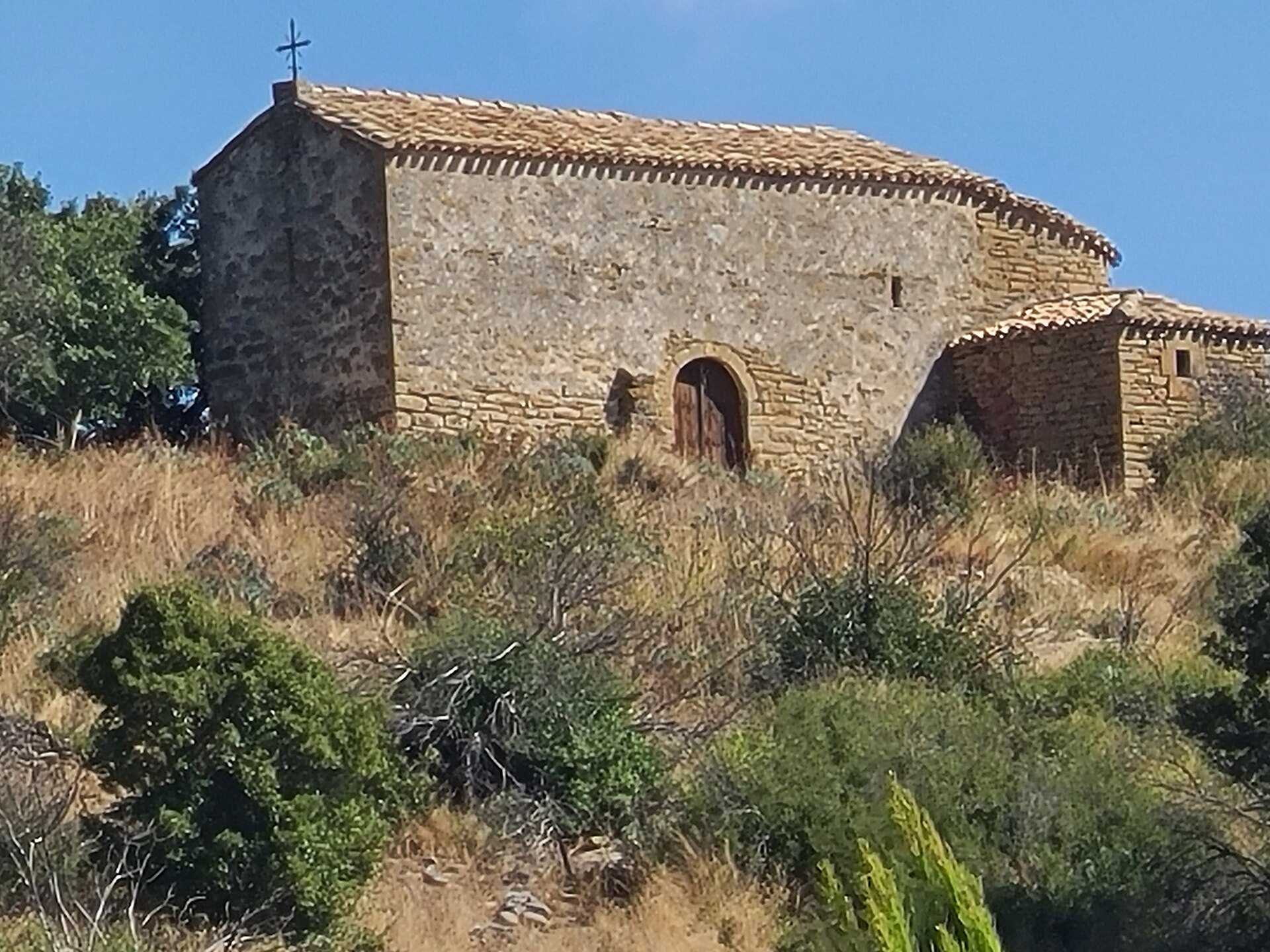
The settlement site was protected by steep natural escarpments on three sides and an artificial slope on the fourth. Its position gave it an outlook over the Arga gorge between Belascoáin and Puente la Reina. Later forestry work disturbed the ground and displaced archaeological material. The Hermitage of Our Lady of Gorriza is the only surviving structure of the former settlement, standing at the end of a ridge extending from the Esparaz range toward the Arga.
Romanesque Hermitage
Building
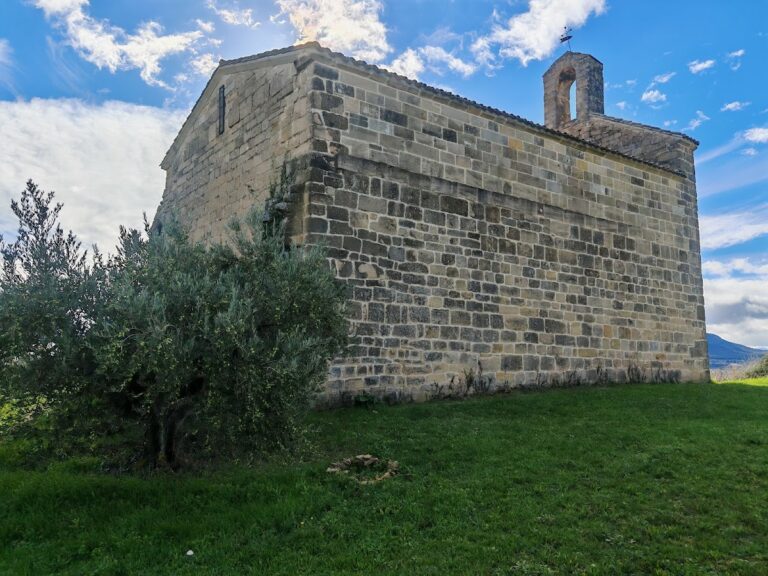
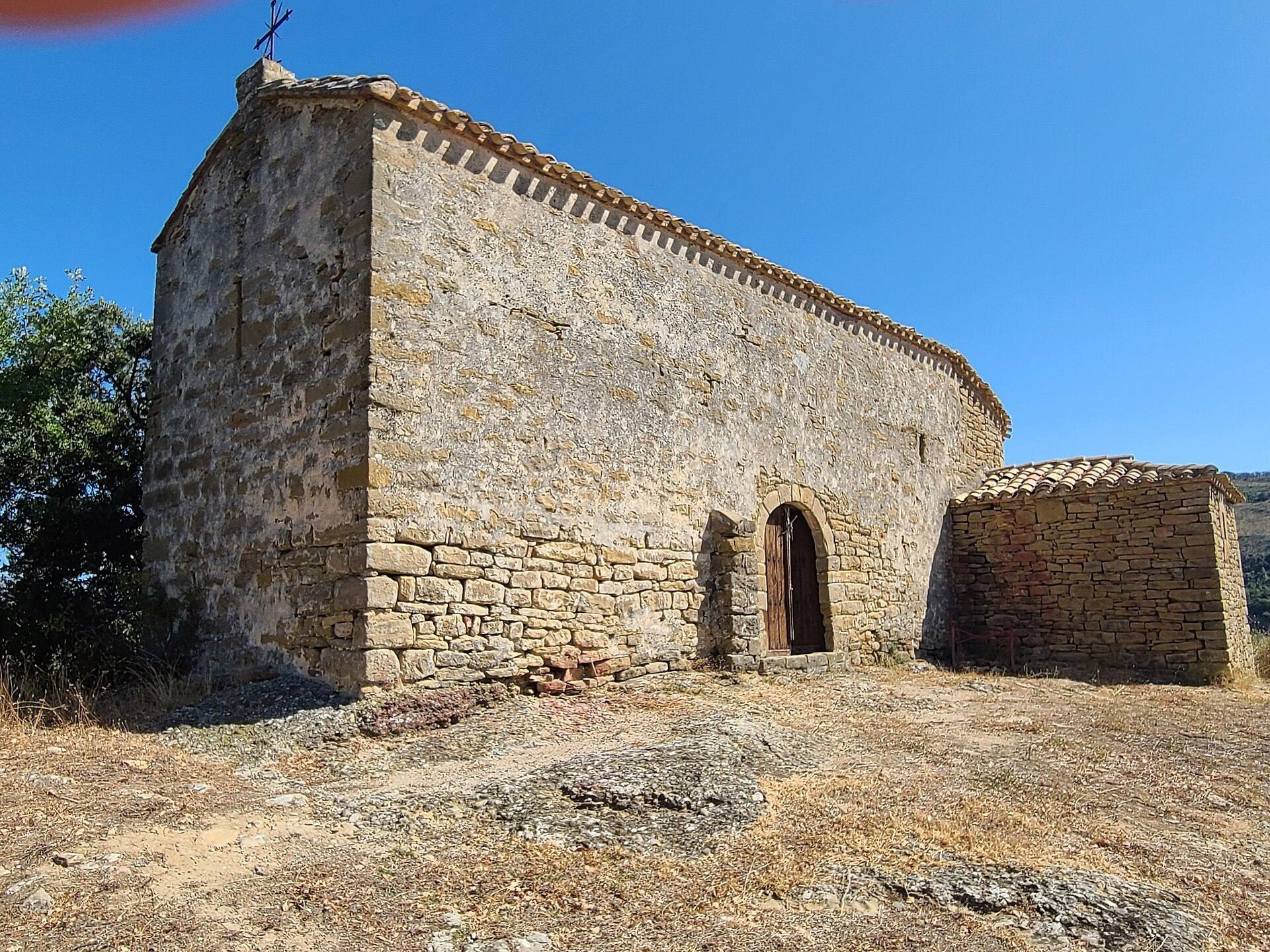
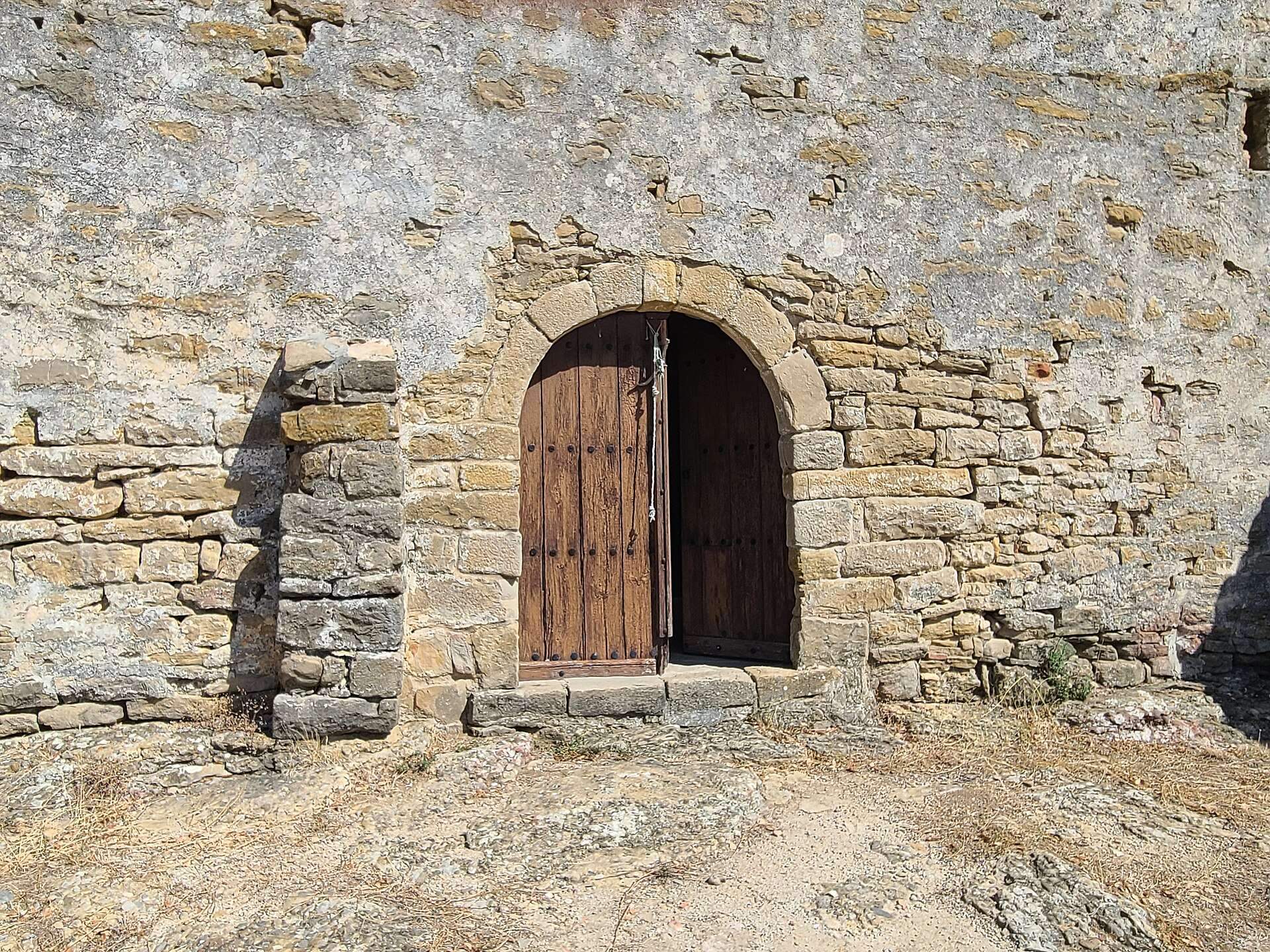
The hermitage is a rural Romanesque church with robust masonry, simple forms, a single nave, and a semicircular apse, the rounded end of the building. A rectangular sacristy is attached to the right-hand side of the apse when facing the altar. The relatively long, narrow nave has a sixteenth-century timber framework supporting a gabled roof. The walls are built of exposed irregular rubble masonry, with some areas rendered.
A stone block set above the gable forms a bell gable and supports a metal cross. A loophole, or narrow wall opening, pierces the gable, while small rectangular openings in the right-hand wall provide light to the nave. These features survive as part of the building’s present rural form.
Interior and Image
The presbytery, the area around the main altar, has a Baroque groin vault formed by the intersection of two barrel vaults. The sacristy has a vault of the same type. A medieval stone altar slab remains in the presbytery. A small niche opens on the right-hand side, with an opening above it that illuminates the area. A small choir gallery occupies the west end of the nave.
The titular image shows the Virgin with the Child seated on her knees. It is a plaster cast that may preserve an earlier element and follows a popular thirteenth-century type. The image has been regarded as medieval, but it is not permanently kept in the hermitage. It is transferred from Artazu for the local pilgrimage.