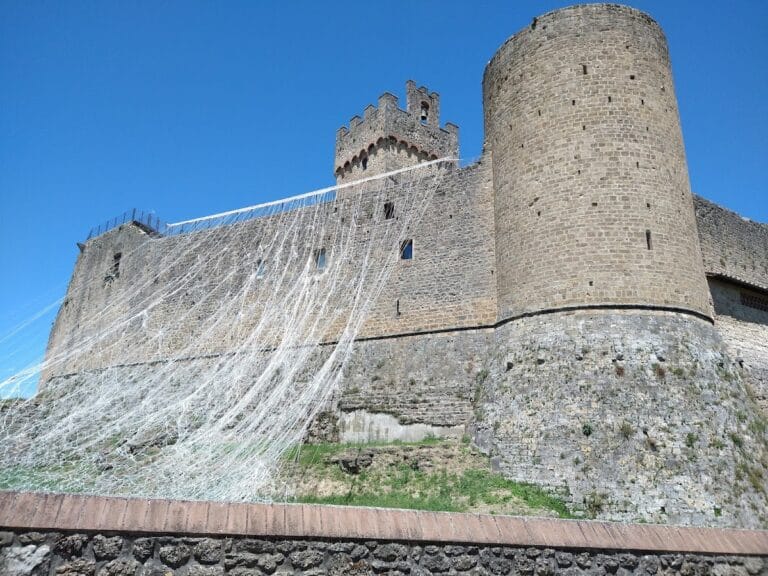
Rocca di Castellina in Chianti: Medieval Fortress and Municipal Seat in Italy


Site at a Glance
- Rating
- 4.6
- Popularity
- Medium
- Country
- Italy
- Primary era
- Medieval
- External website
- Open
- Eras represented
- Medieval
- Civilizations
- Republic of Florence
- Site type
- Military
- Remains
- Castle
On this page8 sections
History
Rocca di Castellina in Chianti is a medieval castle in Italy, with origins recorded in the eleventh century and a defensive form developed through the fifteenth century. It began as a fortified settlement of the Counts Guidi, a powerful Tuscan noble family, and was dependent on the nearby Castle of Trebbio in the area now associated with Radda in Chianti. At that time, the settlement was known as “Castellina de’ Trebbiesi.” Its position near the border between Florence and Siena later made it an important Florentine stronghold.
From Guidi Settlement to Florentine Stronghold
In 1193, the lords of Trebbio reached an agreement with Florence to maintain a garrison at Castellina. As the settlement gained importance, it joined the League of Chianti in the mid-thirteenth century. This Florentine territorial and administrative organization was divided into districts, and Castellina eventually became the administrative capital of one of the three districts, alongside Radda and Gaiole.
The frontier location brought repeated military conflict. Castellina served for many years as an advanced Florentine position and was attacked in 1397 by troops led by Gian Galeazzo Visconti, the ruler of Milan and an ally of Siena. The castle was destroyed during the assault. Florence recovered possession in 1400 and ordered the defenses to be enlarged and strengthened, consulting the Florentine architect and engineer Filippo Brunelleschi during the reconstruction.
Fifteenth-Century Sieges and Later Administration
The rebuilt defenses endured a 44-day siege in 1452 by John II of Lorraine, Duke of Calabria, but the attackers did not conquer the stronghold. The fortifications were strengthened again with the collaboration of Giuliano da Sangallo, a Renaissance architect and military engineer associated with fortification design.
In 1478, an Aragonese army attacked Castellina, sacked the settlement, and partly destroyed it. Florentine control was restored in 1483 and continued until the unification of Italy. In 1774, Peter Leopold of Lorraine, the grand duke of Tuscany, abolished the League of Chianti as part of his administrative reforms. The territory of the new Community of Castellina was then made broadly equivalent to the former district.
The Rocca now serves as the seat of the municipal government. Since 21 April 2006, it has also housed the Archaeological Museum of the Sienese Chianti, which presents the ancient landscapes and history of the wider Chianti territory, including Castellina, Castelnuovo Berardenga, Gaiole in Chianti, and Radda in Chianti. The fortress is recognized as Italian national heritage.
Remains
The surviving fortress forms part of the old walled settlement. Its medieval military complex developed from the eleventh through the fifteenth century, while the later defensive enclosure expanded into a larger and more massive irregular hexagon. Square-based towers were incorporated into the walls, and the main stronghold occupied the highest point of the settlement.
Walled Settlement
Town Walls
Long sections of the town walls remain around the historic settlement. The later enclosure is distinguished by its irregular hexagonal plan, substantial construction, and numerous square-based towers, which formed part of the expanded defensive system.
Historic Gates
The fortifications originally had two entrances, the Fiorentina Gate and the Senese Gate. Neither historic gate survives. The Fiorentina Gate was destroyed during the First World War and later replaced by an opening reconstructed in a historical style.
Central Keep
The keep, known as a cassero, was the fortified central stronghold of the settlement. It is a massive crenellated structure, meaning that its parapet alternates raised sections with defensive openings. Positioned at the highest point of Castellina, the keep survives in excellent condition and consists of two square buildings enclosed by high walls.