Castle of Volpaia: A Medieval Fortress and Winery in Tuscany



Site at a Glance
- Rating
- 4.7
- Popularity
- Low
- Country
- Italy
- Primary era
- Medieval
- External website
- Open
- Eras represented
- Medieval, Early Modern
- Civilizations
- Grand Duchy of Tuscany, Republic of Florence
- Site type
- Military
- Remains
- Castle
On this page13 sections
History
The castle of Volpaia is an early medieval fortification in Italy near Radda in Chianti, with its earliest surviving written evidence dating to 21 April 1172. It stood on a strategically important ridge in Chianti and was repeatedly drawn into the conflicts between Florence and Siena before losing its military function and becoming a residential and agricultural complex.
Medieval origins and Florentine administration
Volpaia occupies a ridge running from Badia di Montemuro toward Radda in Chianti. The ridge forms the watershed between two small valleys whose streams flow into the Pesa, giving the settlement a position between the upper Pesa and upper Arno valleys. Together with the nearby parish district of Santa Maria Novella, Volpaia belonged to the Florentine judicaria, a medieval territorial jurisdiction, from at least the eleventh century.
On 21 April 1172, the brothers Franculus and Galfredus of Cintoia mortgaged property that included the estate and castle of Volpaia. They received 28 silver pounds from Spinello da Montegrossoli, with the consent of their father and of Liquiritia, Franculus’s wife. By the second half of the twelfth century, Volpaia was certainly within territory dependent on Florence, as the frontier between the Republic of Siena and the Republic of Florence began to take shape.
In 1250, Florence assigned Volpaia to the Lega del Chianti and the Terzo di Radda. These were Florentine territorial and administrative divisions created during a reorganization of Florentine lands. Ecclesiastically, the settlement belonged to the Diocese of Fiesole, while its church dedicated to Saint Lawrence was attached to the parish district of Santa Maria Novella.
Roads, religion, and the Florentine-Sienese frontier
A road from Santa Maria Novella passed through Volpaia and connected the upper Pesa valley with the upper Arno valley. It descended toward the floor of the Pesa valley, passed near Albola, and continued toward the ridges separating Chianti from the upper Valdarno. Its importance in the fifteenth century led to the construction of a lodging house for pilgrims at Volpaia.
The settlement’s position at a critical point in Chianti repeatedly exposed it to warfare. Volpaia was affected by the raids of the mercenary commander Alberico da Barbiano during the war between Florence and the Visconti of Milan, the ruling dynasty involved in Milan’s conflict with Florence. The Aragonese invasions of 1452 and 1478 caused particularly severe damage. On several occasions, the castle took part in defending Florentine positions in the Terzo of Radda.
The war of 1478
The most fully recorded episode came during the Aragonese invasion of 1478. On 24 December 1477, Siena and Ferdinand of Aragon, king of Sicily, formed an alliance against Florence. Pope Sixtus IV later joined and approved the alliance. In July 1478, the allied forces attacked the Florentine state in the Staggia valley, captured the castle of Rencine, and in August seized several small but important fortresses in Chianti, including Volpaia.
The agreement assigned fortresses and territories captured within 15 miles of Siena to the Sienese. Volpaia rebelled before the end of August, expelled the Sienese garrison, and captured the Sienese commissioner Cipriano, who was taken to Florence. The allied army returned under Federigo, son of the king of Naples, defeated the defenders, and recaptured Volpaia on 2 September 1478.
Florentine forces retook the fortress and most of the other Chianti castles on 7 October. The war then moved beyond Chianti. A truce was negotiated in Rome in 1479, and a final peace settlement followed in March 1480. The fighting left a lasting mark on Volpaia’s buildings and defensive works.
From fortress to settlement
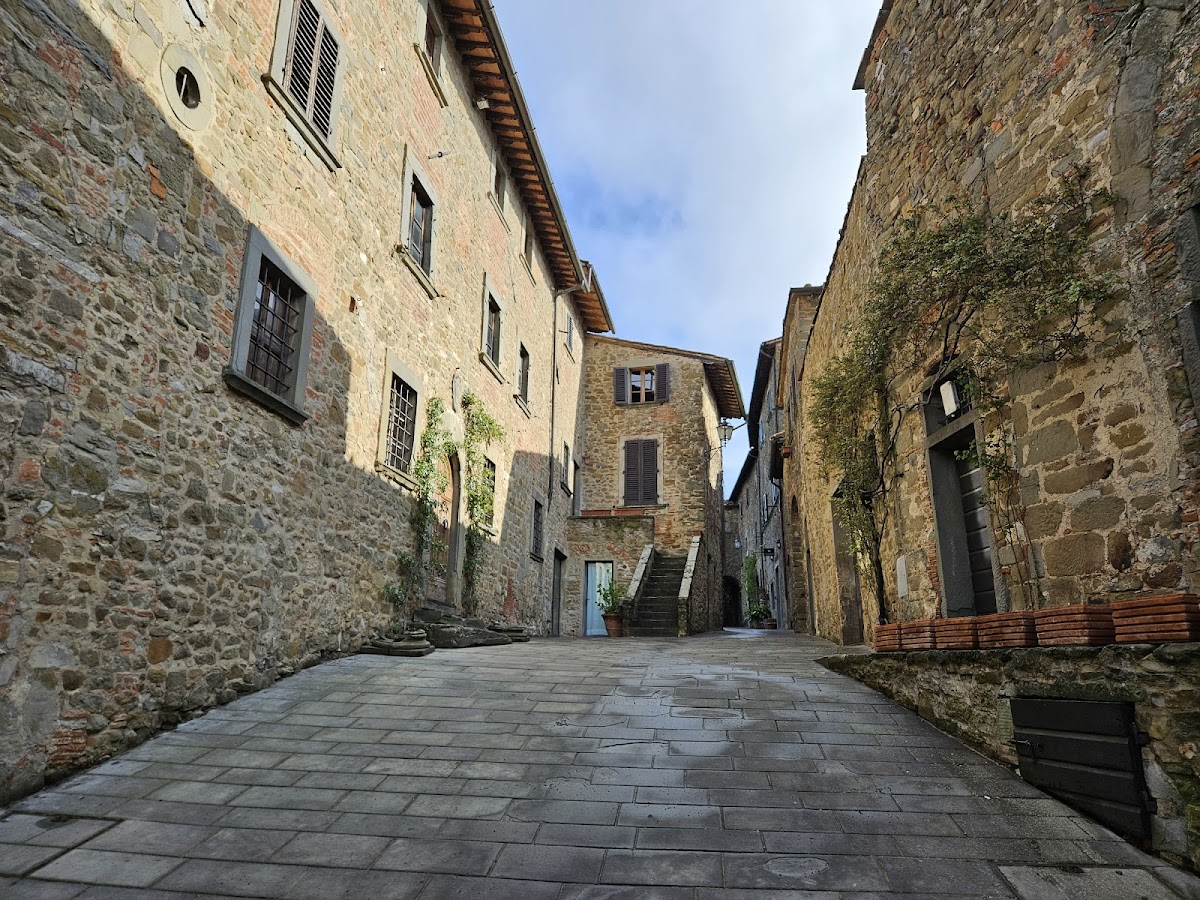
After Siena’s decline and the fall of the Sienese Republic in 1555, Chianti entered a long period of peace. Volpaia gradually ceased to function as a military stronghold. Parts of the walls disappeared, and residential buildings were constructed inside the former fortress. Late Renaissance portals leading to these dwellings preserve evidence of the change from defended castle to inhabited settlement.
Religious building continued near the castle during the Counter-Reformation, the Catholic renewal that followed the sixteenth-century Reformation. The simple Ceppeto Chapel and the Chapel of Madonna del Fossato survive from the seventeenth century. Madonna del Fossato contains a fresco of the Madonna and Child dating from the second half of the fifteenth century. The image had previously been housed in a tabernacle belonging to the chapel.
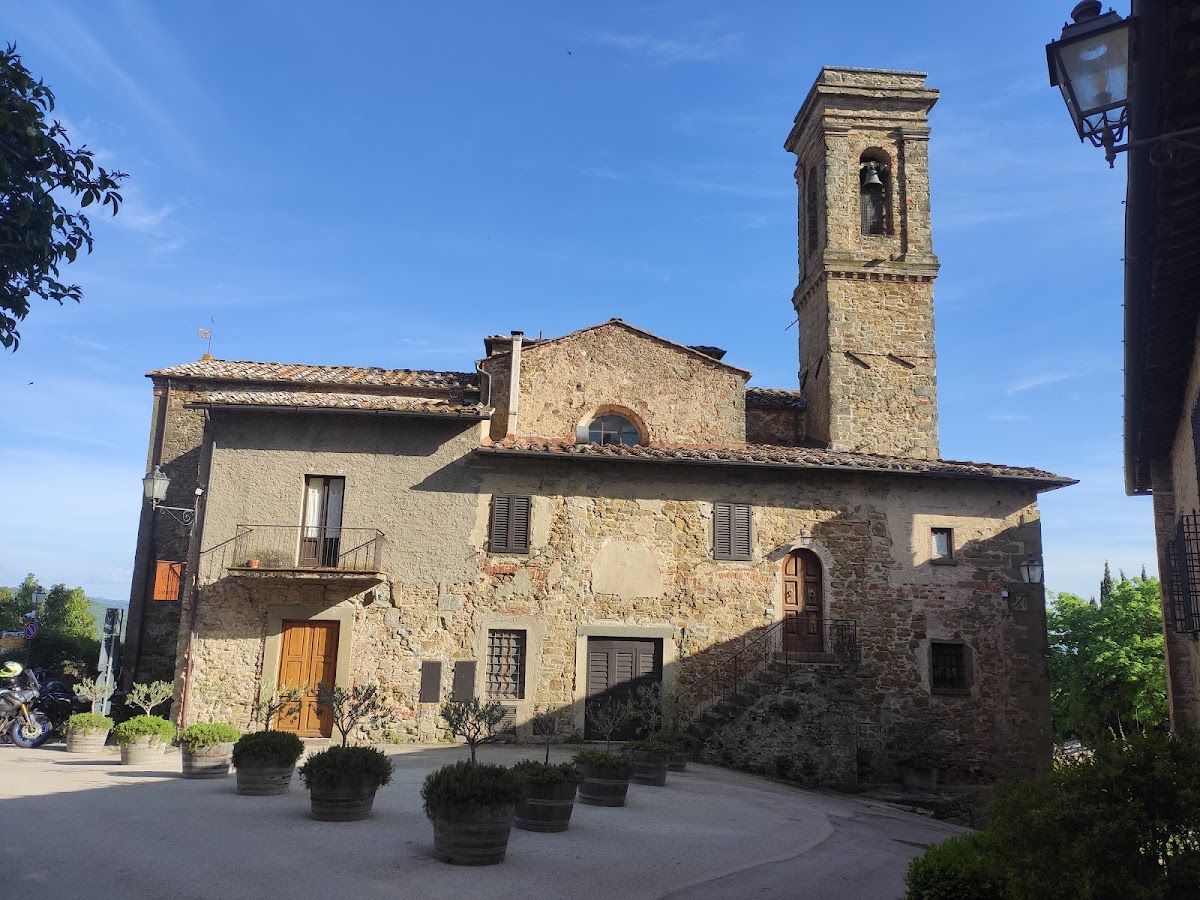
The castle’s tower church, commonly called La Commenda, was associated with a commenda, an endowed holding that provided rights over specified property or revenues. In 1443, Ser Piero della Volpaia granted this holding to Fra Bartolomeo Canigiani of the Hospitallers, the religious-military order also known as the Knights of Saint John. The church was secularized in 1932.
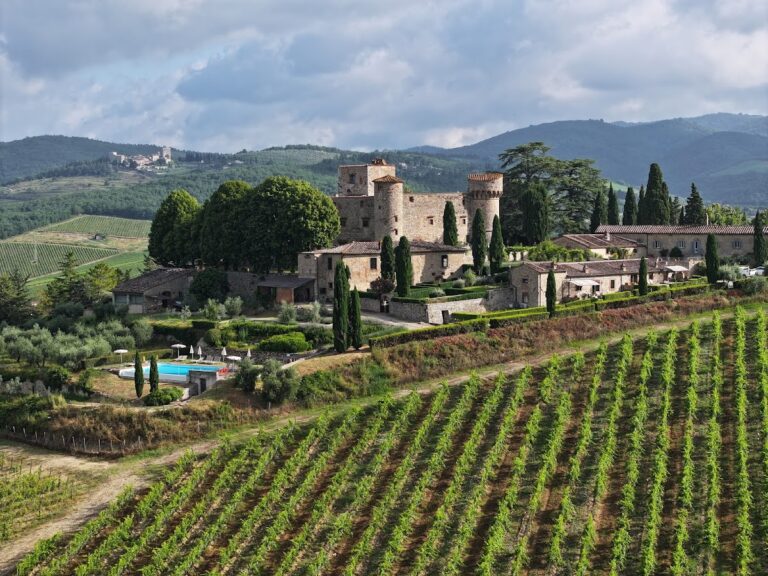
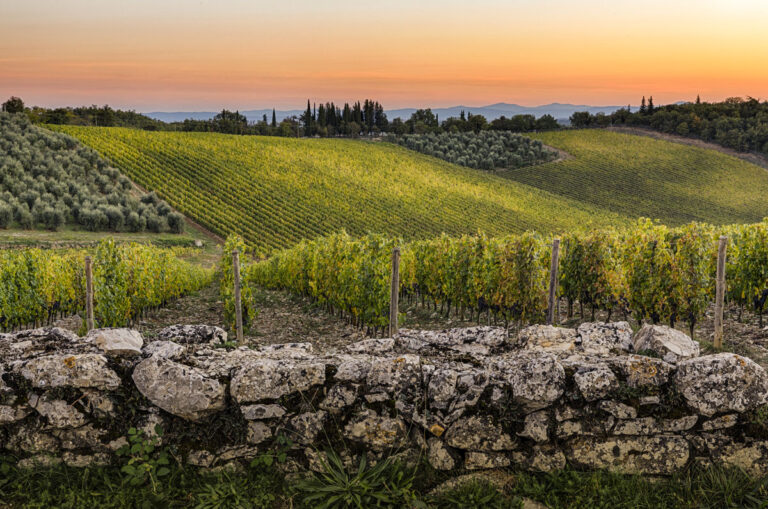
Today, the castle is used as a winery with accommodation facilities. The estate also includes vineyards, an olive grove, and an oil mill. The castle of Volpaia is designated Italian national heritage.
Remains
Fortress circuit and internal layout
The fortress was enclosed by an approximately elliptical wall circuit containing several defensive towers. Its largest tower stood beside the entrance on a rectangular plan and served as the main tower. Portions of the circuit, the main tower, and one smaller tower survive among the later residential buildings.
A road once divided the interior lengthwise into two halves. It began at the wall circuit, where a gate must formerly have stood. The entire southwestern side was later altered, and the gate disappeared from the surviving structure, although it remains shown in drawings included in an eighteenth-century register of privileges.
North tower
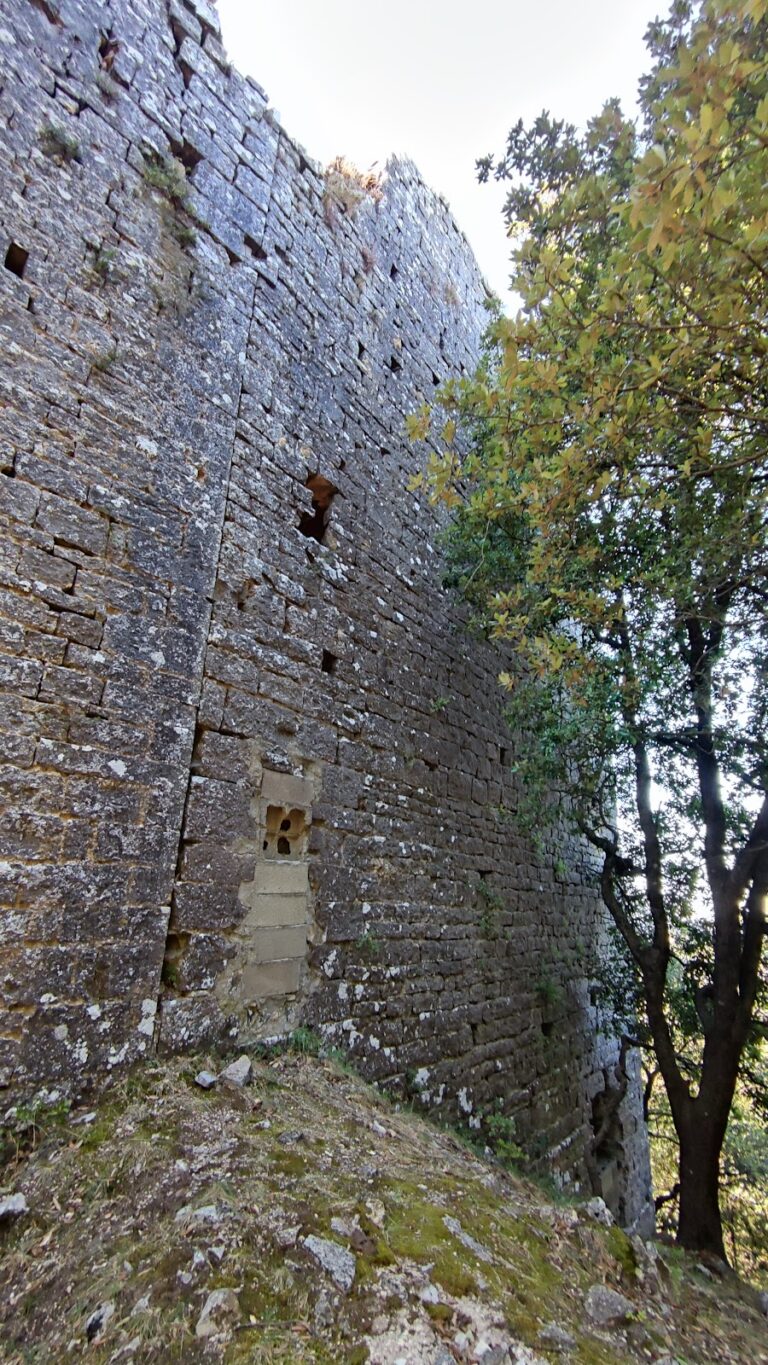
A small round tower projects from the northern side of the fortress. Its stones are more finely and differently worked than the rougher masonry of the older walls. The tower was probably added after the destruction caused by the Aragonese attack of 1478, when round towers were increasingly employed because their form better resisted attack.
Medieval masonry and residential buildings
Substantial medieval remains are incorporated into the present residential buildings. The oldest masonry is identified by its regular facing and probably dates from the first half of the thirteenth century. It was built with sandstone quarried nearby, giving the complex a darker appearance than the lighter limestone commonly used in Chianti fortifications.
The surviving fabric does not preserve a single uniform architectural phase. The castle has few architecturally prominent elements and little decorative sculpture, making an exact date for every surviving part impossible. Late Renaissance portals in the residential buildings belong to the period when domestic construction replaced portions of the former defensive arrangement.
Churches and chapels
Former church of Saint Lawrence
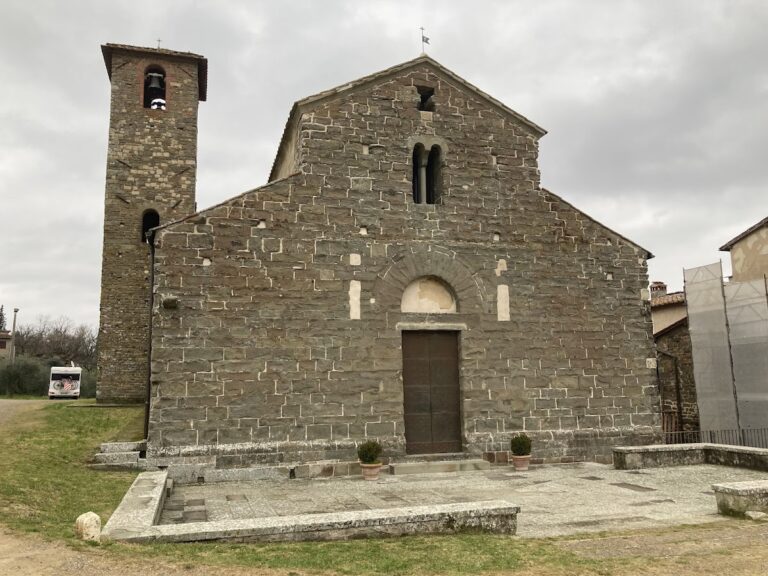
The former church of Volpaia stood within the fortress walls. Its facade is identified by a blocked circular oculus, a round window or opening, and a pointed-arch molding above a very simple portal. The church has an almost rectangular plan, a single nave, and an exposed timber roof framework visible from inside.
Its date remains uncertain. It may be a fourteenth-century building, or it may have been erected in the second half of the fifteenth century after the Aragonese raids, over the remains of a smaller earlier church. Its right side coincides with part of the fortress wall. That side has irregular masonry rather than the sandstone facing of the oldest castle work, and it incorporates finely worked limestone projections, possibly reused elements from the earlier church, alternating with fragments of sandstone. One surviving castle tower served as the church’s bell tower.
Chapel of Madonna del Fossato
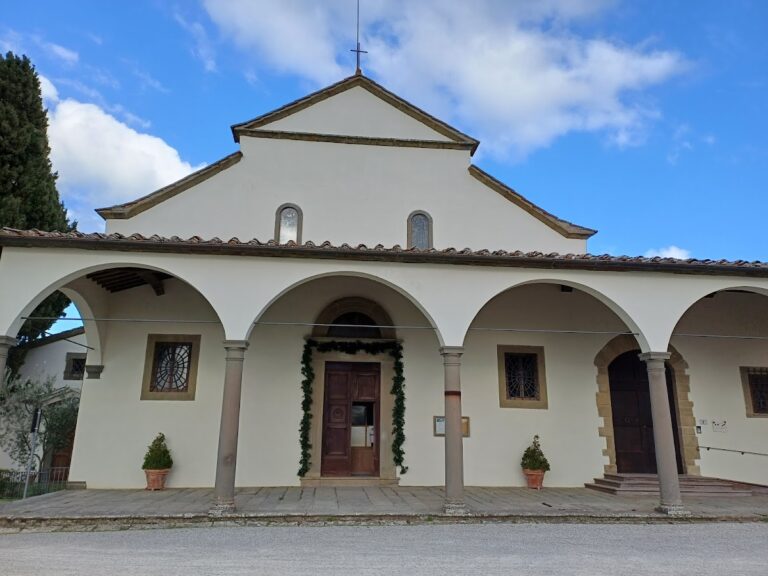
The Chapel of Madonna del Fossato has a small rectangular plan and a portico supported by pillars of gray stone. A short, steep stairway leads to the chapel. Inside, a fresco depicts the Madonna and Child. The chapel is one of the seventeenth-century religious buildings that survive near the former fortress.
La Commenda
La Commenda is a tower church dedicated to Saint Eufrosino, traditionally regarded as the apostle and patron saint of Chianti. Its plan and construction belong to the fifteenth century, and the building was erected between 1443 and 1460. Its architecture points toward Michelozzo Michelozzi, while its execution more closely recalls the style of Giuliano da Maiano, both leading figures in fifteenth-century Italian Renaissance architecture and sculpture.
Until its secularization in 1932, the church housed a major altarpiece made in 1480 by Cosimo Rosselli, a Florentine Renaissance painter. The work has a carved and painted architectural frame and is now held by the National Center for Renaissance Studies.