Rocca del Leone: Medieval Fortress on Lake Trasimeno


Site at a Glance
- Rating
- 4.7
- Popularity
- Very Low
- Country
- Italy
- Primary era
- Medieval
- External website
- Open
- Eras represented
- Medieval, Early Modern
- Civilizations
- Holy Roman Empire
- Site type
- Military
- Remains
- Castle
On this page12 sections
History
Rocca del Leone is a medieval fortress in Castiglione del Lago, Italy, on Lake Trasimeno. Its construction began during the first decades of the thirteenth century under Frederick II of Swabia, a Holy Roman Emperor of the Hohenstaufen dynasty, as part of a military deployment built over an older structure. The fortress was repeatedly rebuilt and enlarged, becoming a major defensive complex beside the lake.
Medieval foundations and rebuilding
The earlier structure included a parish church dedicated to Saints Philip and James. Only a few ruins of that church survive. Frederick II almost certainly commissioned the architect Elia da Cortona to rebuild the fortress, and further restructuring took place in 1325 under Lorenzo Maitani, an Italian architect and sculptor active in the late thirteenth and early fourteenth centuries.
Perugian and Corgna transformations
In 1503, the lords of Perugia, Giampaolo Baglioni and Malatesta IV, improved and enlarged the complex. They also established their summer residence there, adding a residential role to the fortress’s military purpose.
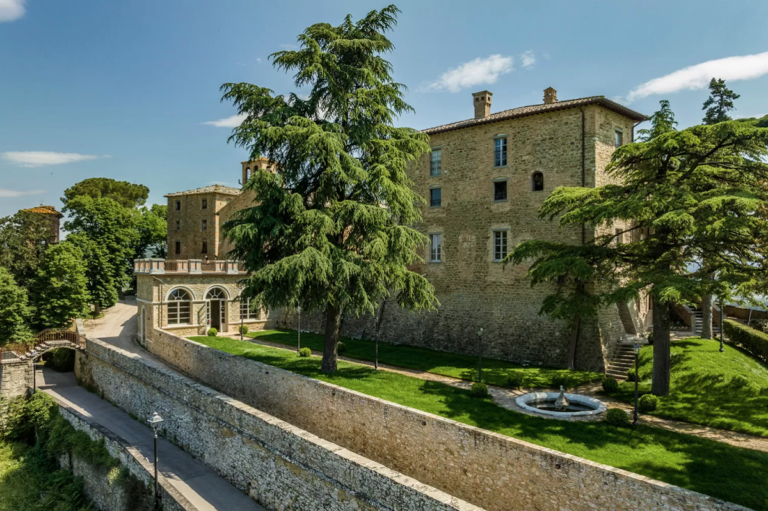
Major changes followed under Ascanio della Corgna, marquess of Castiglione del Lago and an expert in military architecture. In 1563 he commissioned the ducal palace and continued to strengthen the fortress. The works lasted until 1571. Some earlier towers were replaced by cylindrical bastions, and an Italian-style garden was created inside the enclosure. These improvements gave the fortress a reputation in Europe for being impregnable.
Ascanio I’s successors, Diomede, Ascanio II, and Fulvio Alessandro, focused mainly on embellishing the palace and gave less attention to the defensive works. The fortress nevertheless remained militarily important. In 1642, during the Barberini War, a conflict fought from 1641 to 1644 over the occupation of the Farnese Duchy of Castro, the army of Odoardo I, Duke of Parma, attacked it unsuccessfully while attempting to secure passage through the Corgna fief. Fulvio II was absent, and the soldiers eventually entered the town by other means.
Papal jurisdiction and municipal ownership
After the duchy of Castiglione passed to the Papal States following the death of the childless Duke Fulvio II in 1647, the fortress came under papal jurisdiction. The Papal States were territories governed directly by the pope before the creation of the modern Italian state. In 1860, Rocca del Leone passed to the local municipality. It is now well preserved and restored.
Remains
Fortifications and lakeside defenses
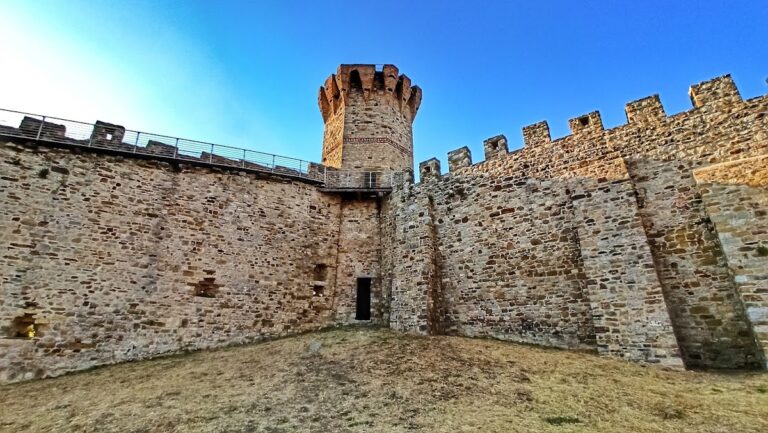
Rocca del Leone has an irregular pentagonal plan and is constructed from dressed stone blocks and brick. Its fabric reflects successive building campaigns extending from the first decades of the thirteenth century to 1571. The fortress forms the outermost extension of a bastion enclosing a small peninsula on Lake Trasimeno, placing the defensive complex directly within the lakeside landscape.
Triangular keep
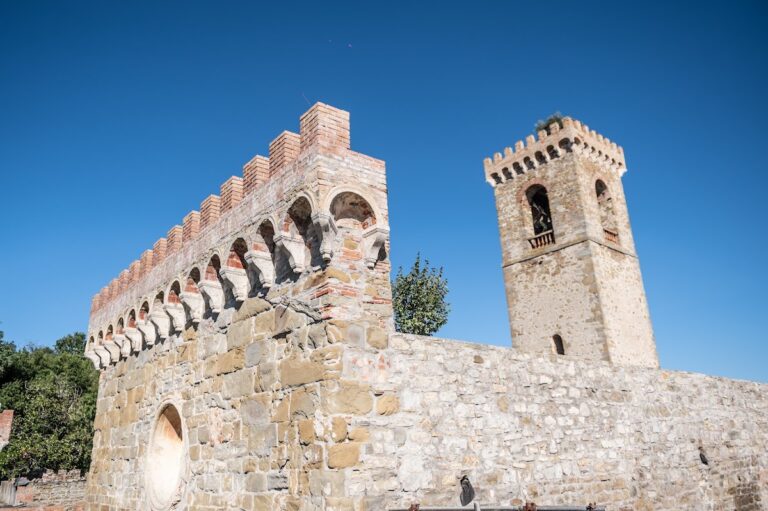
A triangular keep, or principal fortified tower, rises 39 metres above the fortress. It supervised Lake Trasimeno and the surrounding lands and served as the final defensive element of the fortification. Its commanding position and height made it the central vertical feature of the complex.
Walls, towers, and bastions
Crenellated walls are reinforced by four corner towers. Later alterations replaced some original towers with cylindrical bastions, giving parts of the medieval enclosure a form adapted to changing defensive requirements. The walls and towers remain part of the preserved fortress structure.
Palace, passage, and enclosed garden
Covered passageway
The ducal palace is linked to the fortress by a covered passageway. Narrow loopholes, openings through which weapons could be used while keeping defenders protected, face toward the lake. The passage is entered through a door in the throne room, connecting the residential palace with the fortified enclosure.
Italian-style garden
An Italian-style garden occupies part of the fortified enclosure. Ascanio della Corgna created it during the works that continued until 1571, adding a formal landscaped space within the military complex.
Parish church ruins
A small number of ruins survives from the earlier parish church dedicated to Saints Philip and James. These remains belong to the structure that preceded the medieval fortress and preserve evidence of an earlier religious phase within the site.
Nearby sites