Rocca di Isola Polvese: A Medieval Island Fortress in Italy


Site at a Glance
- Rating
- 4.3
- Popularity
- Low
- Country
- Italy
- Primary era
- Medieval
- Eras represented
- Medieval
- Civilizations
- Papal States
- Site type
- Military
- Remains
- Fort
On this page10 sections
History
Rocca di Isola Polvese, also known as Castello di Isola Polvese, is a medieval defensive fortress on Isola Polvese in Lake Trasimeno, Italy. Its oldest surviving section, the keep, dates from the eleventh century, while later walls, towers, and cannon defenses formed a fortified complex intended to protect a nearby settlement and the monks of San Secondo. The Rocca was not an aristocratic residence, but a refuge and military stronghold for the island community.
Medieval origins
The keep was established in the eleventh century, and the taller sections of the surrounding walls were added during the twelfth century. Several churches were built on Isola Polvese in the medieval period, including San Secondo, the island’s largest church. Although San Secondo now survives as ruins, the fortress continued to serve as a place of protection for its monks as well as for the inhabitants of the settlement.
The fifteenth-century fortress
The later fortress took shape from 1429, when construction began on a more extensive defensive enclosure. Work was completed two years later. A treasurer recorded 168 florins and 8 lire for expenses already incurred and still needed for the building project. The remaining walls and corner towers belong to this phase, and the Rocca first appears in surviving records from the fifteenth century.
During the Renaissance, the defensive system was reorganized for cannon. Openings arranged on two levels in the towers show the adaptation of the fortifications to firearms, although the cannon were never used. The arrangement preserved the fortress’s defensive purpose while changing the way its towers could be employed.
Garrison, decline, and restoration
The fortress experienced its only military event in 1643, during the Castro War, a seventeenth-century conflict between the Papal States and the Farnese family over the Duchy of Castro. A large garrison occupied the Rocca under Captain Martino Nini, a military commander of the period.
The fortress began to decline in 1625, when Pope Urban VIII ordered the monks of San Secondo to transfer to the monastery of Sant’Antonio a Porta Sole in Perugia. The move was prompted by malaria and the damp climate of the island. Extensive restoration took place across Isola Polvese between 2000 and 2020, including work on the fortress. Excavations on its terraces also revealed the foundations of former soldiers’ dwellings, adding physical evidence of the garrison’s presence.
Remains
Fortress layout
The Rocca occupies an irregular pentagonal plan, approximately triangular in appearance, with five polygonal corner towers. Its longer southern side measures about 85 metres and originally reached toward the lake. From the two southern corner towers, the walls rise along the island’s natural slope toward the northern summit, where the keep stands. The enclosed ground differs in elevation by about 10 metres from north to south and is divided into three terraces by two retaining walls.
Principal structures
The keep
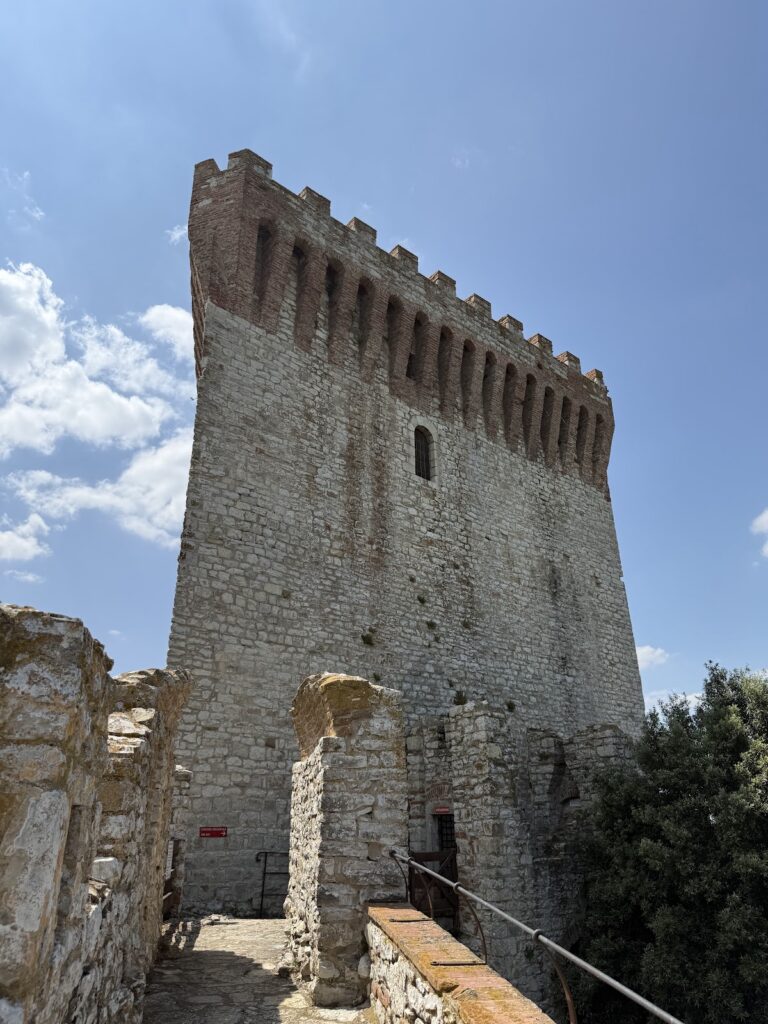
The keep faces the summit of Isola Polvese and rises above the rest of the fortress to a height of approximately 15 metres. It has an octagonal plan and is built from dressed stone. Its upper section retains well-preserved terracotta corbels. Rectangular openings in the keep functioned as machicolations, defensive openings through which stones or boiling pitch could be dropped onto attackers below.
Walls and towers
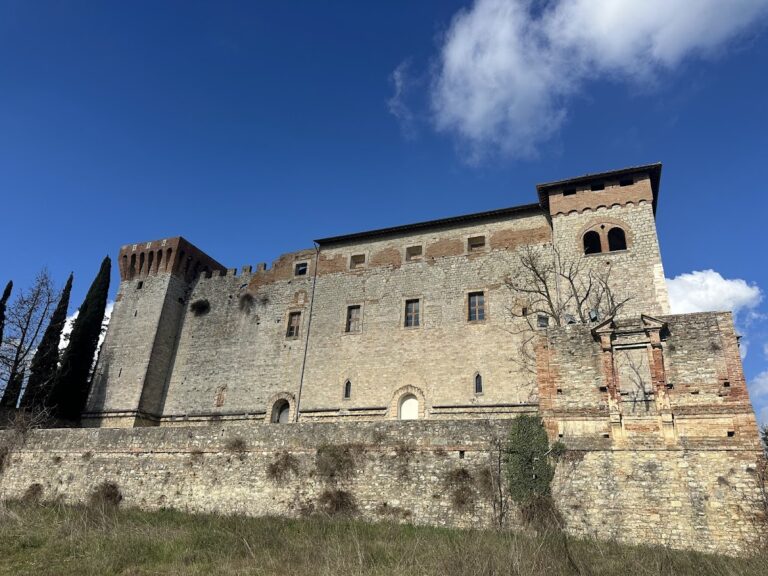
The walls and towers rise approximately 9 to 10 metres. The five corner towers are joined by a continuous crenellated walkway running along the perimeter. A sixth tower was later inserted at the centre of the southern wall to strengthen the entrance. The fortress combines limestone, sandstone, marl, brick, rubble stone, and fieldstone, reflecting the varied materials used in its construction.
Terraces and associated churches
Excavation of the three terraces exposed masonry foundations belonging to former soldiers’ quarters. Decorated ceramic fragments dating from the fourteenth to the sixteenth centuries were also recovered, providing evidence of activity within the complex before and around the fifteenth-century rebuilding. Behind the keep stands the small church of San Giuliano, while the larger medieval church of San Secondo survives elsewhere on the island as ruins. Together, these remains preserve the relationship between the fortress and the religious community it helped protect.
Nearby sites