Fort van Zwijndrecht: An Ammunition Facility in Antwerp’s Defence Line


Site at a Glance
- Rating
- 3.3
- Popularity
- Very Low
- Country
- Belgium
- Primary era
- Modern
- External website
- Open
- Eras represented
- Modern
- Civilizations
- Belgian
- Site type
- Military
- Remains
- Fort
On this page7 sections
History
Fort van Zwijndrecht is a Belgian fortress west of Antwerp, built between 1870 and 1880 as part of the Antwerp Defence Line. The brick fort formed part of the expanded nineteenth-century defensive system created after Antwerp was designated the National Redoubt in 1859, a fortified area intended to serve as Belgium’s final defensive position until allied assistance could arrive.
Creation of the Antwerp Defence Line
The original defensive ring around Antwerp consisted of eight forts built in 1859 under the direction of military engineer Henri Alexis Brialmont. They formed an approximately 18-kilometre arc from Wijnegem to Hoboken. After the Franco-Prussian War of 1870, the plans were enlarged because advances in weaponry required stronger and more distant defenses. The revised system included three bridgehead forts, which protected strategic crossings and areas around them, as well as an outer line supported by controlled flooding defenses.
Fort van Zwijndrecht was constructed with Fort van Eepoel on the boundary between Kruibeke and Burcht. Its associated defensive works were carried out between 1870 and 1880. A Defensive Dike between Fort van Zwijndrecht and Fort Sint-Marie was intended to protect the left bank from flooding from the Melselepolder, while Fort van Kruibeke defended the Scheldt. Two further works, Half Maan and Put van Fien, protected the roads leading to Kallo and Melsele.
Expansion and Modernization
The law of 30 March 1906 confirmed an expanded plan for Antwerp’s main defensive line. The resulting Main Resistance Position, the principal line of the Antwerp fortification system, comprised 16 forts and 10 redoubts on the Scheldt’s right bank, together with five forts and two redoubts in the Fortified Camp of the Left Bank. The left-bank complex included the existing forts at Steendorp, Kruibeke, and Zwijndrecht, as well as planned forts at Haasdonk and Doel. Doel was never built, while a 1905 plan also proposed works at Nieuwkerken, Verrebroek, and St-Antoniushiek. The Fortified Camp of the Left Bank was never actually used militarily. Fort van Zwijndrecht itself was modernized in 1912.
Military and Ammunition Uses
Until the 1970s, about 800 military personnel and civilian employees worked at Fort van Zwijndrecht. Its principal role was ammunition handling, supported by its own railway connection and a station on the Antwerp-Ghent railway line.
In 2007, the site employed 31 people. Twelve were military personnel from the Inspection Service for Gunpowder and War Explosives, while 19 civilians carried out gunpowder analyses in the laboratory. Closure was expected that year, but the fort remained in use.
On 14 March 2013, the Council of Ministers authorized Defence Minister Pieter De Crem to begin recovering ammunition from the surrounding moats. Belgian, German, British, and American armies had deposited ammunition there before and after the First and Second World Wars, making the site one of the largest wartime ammunition dumps. An investigation commissioned in 2001 by Defence Minister André Flahaut examined the contents of the moats. By 2013, the quantity was estimated at approximately 2,000 to 4,000 tonnes. The clearance was expected to take four years, with the final ammunition scheduled for removal in 2016. Because of the quantity involved, the fort was expected to remain military property, and its later reuse was uncertain.
Remains
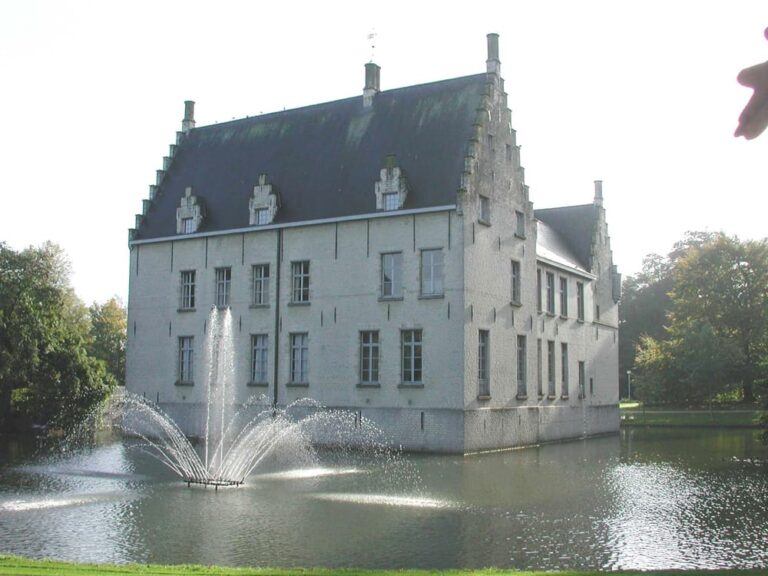
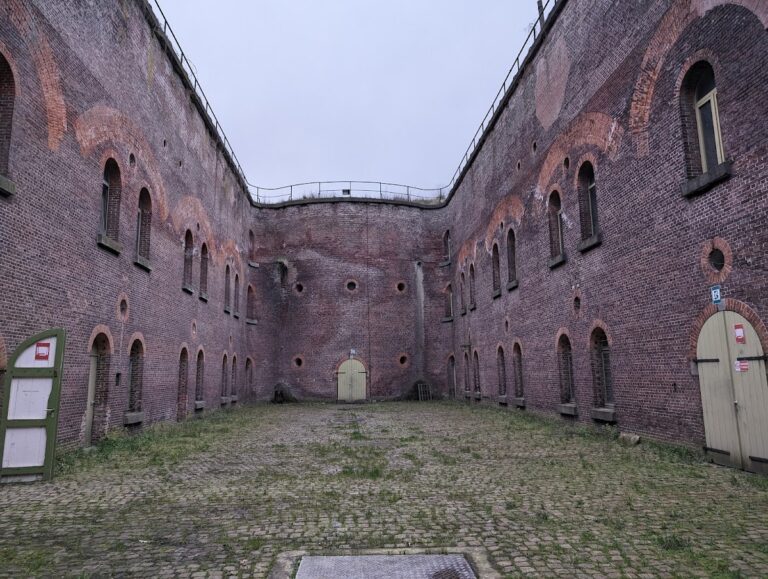
Fort van Zwijndrecht is a five-sided, star-shaped fortified island surrounded by water. Its buildings are made of brick, and the surrounding moat is largely intact. The historic buildings of the fort remain present, preserving the physical form of the defensive complex.
Fortified Island
The fort differs from forts I to VIII in Antwerp’s original ring because it has no inner fort. It also has no redoubt, a fortified defensive enclosure. Instead, a battery, an artillery position, extends across the full width of the fort at the rear. This arrangement forms part of the fort’s distinctive five-sided layout and explains its organization as a water-surrounded defensive island.
Moats and Ammunition Storage
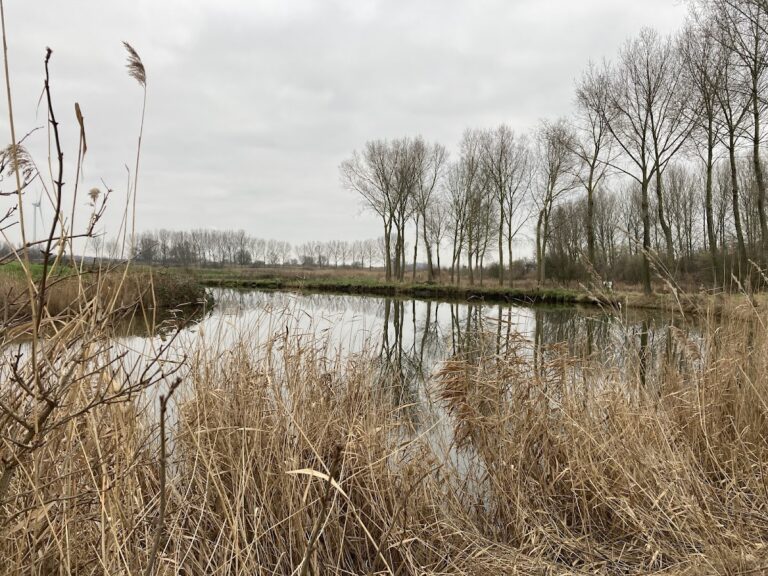
The largely intact moat formed part of the fort’s surviving defensive setting and later became a storage area for wartime ammunition. Recovery operations authorized in 2013 concerned ammunition deposited there by Belgian, German, British, and American forces before and after the two world wars. The estimated quantity of 2,000 to 4,000 tonnes made the moats an important part of the site’s later military history.